
 Worksheets
APP1 Semester 1 Concepts
Total questions: 130
Worksheet time: 56mins
______________ indicates how far an object ends from its initial position, regardless of its total distance traveled.
Displacement
Distance
Position
______________ is displacement divided by the time interval over which that displacement occurred.
Average velocity
Instantaneous velocity
Average speed
Instantaneous speed
______________ is how fast an object is moving at a specific moment in time with reference to directionality.
Average velocity
Instantaneous velocity
Average speed
Instantaneous speed
To determine how far from the detector and object is located, look at the _____________ of the position-time graph.
horizontal axis
vertical axis
area under the curve
slope
To determine how fast an object is moving, look at the _____________ of the position-time graph.
horizontal axis
vertical axis
area under the curve
slope
To determine which way an object is moving, look at the angle of the _____________ of the position-time graph.
horizontal axis
vertical axis
area under the curve
slope
A position-time slope like a front slash, /, means an object is _____________ the detector
moving away from
moving towards
not moving in reference to
A position-time slope like a back slash, \, means an object is _____________ the detector
moving away from
moving towards
not moving in reference to
The _______ of a position-time graph gives you the data for the velocity-time graph.
horizontal axis
vertical axis
area under the curve
slope
To determine how fast something is moving, look at the __________ of the velocity-time graph.
horizontal axis
vertical axis
area under the curve
slope
An object is moving away from the detector if the velocity-time graph is ________________.
above the horizontal axis
below the horizontal axis
to the left of the vertical axis
to the right of the vertical axis
An object is moving towards the detector if the velocity-time graph is ________________.
above the horizontal axis
below the horizontal axis
to the left of the vertical axis
to the right of the vertical axis
To determine how far something has traveled, look at the __________ of the velocity-time graph.
horizontal axis
vertical axis
area under the curve
slope
T/F: On a velocity-time graph, it is possible to determine how far from the detector an object is located.
True
False
Most everyday motion can be represented with __________ segments on a velocity-time graph.
straight
horizontal
vertical
curved
When an object is in free fall, which two statements are true?
The horizontal acceleration is always 10 m/s per second.
The horizontal acceleration is always 0 m/s per second.
The vertical acceleration is always 10 m/s per second.
The vertical acceleration is always 0 m/s per second.
True/False: Velocities in perpendicular directions add just like perpendicular forces.
True
False
To approach projectile motion equations, you should make _______ kinematic chart(s): _______________.
Two; vertical and horizontal
one; vertical
one; horizontal
To determine the acceleration of an object, look at the __________ of the acceleration-time graph.
horizontal axis
vertical axis
area under the curve
slope
To determine the velocity of an object, look at the __________ of the acceleration-time graph.
horizontal axis
vertical axis
area under the curve
slope
To determine the acceleration of an object, look at the __________ of the velocity-time graph.
horizontal axis
vertical axis
area under the curve
slope
In order to translate motion from the vertical to the horizontal, you need to know the _______.
displacement x or y
velocity, v
acceleration, a
time, t
Which of the following is the correct unit for displacement or distance traveled?
meters, m
meters per second, m/s
meters per second per second, m/s2
seconds per meter, s/m
Which of the following is the correct unit for velocity or speed?
meters, m
meters per second, m/s
meters per second per second, m/s2
seconds per meter, s/m
Which of the following is the correct unit for acceleration?
meters, m
meters per second, m/s
meters per second per second, m/s2
seconds per meter, s/m
Which of the following could NOT be used to measure a distance traveled?
caliper
odometer
meterstick
photogates
Which of the following could NOT be used to measure speed or velocity?
speedometer
photogates and a meter stick
a meter stick and a stopwatch
a stopwatch and photogates.
__________ is possessed by any moving object.
Translational kinetic energy
Rotational kinetic energy
Kinetic energy
Gravitational potential energy
Elastic potential energy
__________ is energy stored in a gravitational field.
Translational kinetic energy
Rotational kinetic energy
Kinetic energy
Gravitational potential energy
Elastic potential energy
The formula for translational kinetic energy is
=1/2mv2
=1/2Iω2
=mgh
=-GM1M2/d
=1/2kx2
__________ is energy stored by a spring.
Translational kinetic energy
Rotational kinetic energy
Kinetic energy
Gravitational potential energy
Elastic potential energy
The formula for gravitational potential energy is
=1/2mv2
=1/2Iω2
=mgh
=-GM1M2/d
=1/2kx2
The formula for elastic potential energy is
=1/2mv2
=1/2Iω2
=mgh
=-GM1M2/d
=1/2kx2
Internal energy of a two-object system is just another way of saying "__________."
potential energy
kinetic energy
translational energy
internal energy
Mechanical energy refers to the sum of which energies?
potential
kinetic
thermal
translational
__________ is done when a force acts on something that moves a distance parallel to that force.
work
energy
power
momentum
__________ is defined as energy used per second, or work done per second.
work
energy
power
momentum
Which two variables are equal?
work
energy
power
momentum
Work is done when a force is exerted on an object, and that object moves __________ to the direction of the net force.
parallel
perpendicular
A "conservative" force converts __________ energy to other forms of __________ energy when it does work.
potential; kinetic
potential; mechanical
kinetic; potential
kinetic; mechanical
True/False: A conservative force does not change the mechanical energy of a system.
True
False
The only types of potential energy used in AP Physics 1 are:
gravitational potential energy.
elastic potential energy.
magnetic potential energy.
electrical potential energy.
chemical potential energy.
Positive work is done by a force __________ to an object's displacement.
parallel
antiparallel
perpendicular
antiperpendicular
Negative work is done by a force __________ to an object's displacement.
parallel
antiparallel
perpendicular
antiperpendicular
True/False: Work is a vector quantity.
True
False
On a force-displacement graph, work is the...
vertical axis.
horizontal axis.
slope.
area under the curve.
An alternative way of thinking of __________ is =Fv.
power
work
momentum
energy
A _________ is a push or a pull applied by one object and experienced by another object.
force
net force
weight
force of friction
The __________ on an object is the single force that could replace all the individual forces acting on an object and produce the same effect.
force
net force
weight
force of friction
__________ is the force of a planet on an object near the planet.
force
net force
weight
force of friction
This is also called the force due to gravity.
force
net force
weight
force of friction
The __________ is the force of a surface on an object running parallel to the surface.
force
net force
weight
force of friction
__________ friction is the friction force when something is moving along the surface and acts opposite the direction of motion.
kinetic
static
oppositional
coefficient
__________ friction is the friction force between two surfaces that aren't moving relative to one another.
kinetic
static
oppositional
coefficient
The __________ is the force of a surface on an object running perpendicular to the surface.
normal force
kinetic friction
static friction
coefficient of friction
The __________ is the number that tells you how rough a surface is.
normal force
kinetic friction
static friction
coefficient of friction
__________ is the ability of an object to stay in motion. This is also Newton's first law.
inertia
acceleration
friction
force
Newton's second law states that __________ is equal to the force experienced by an object divided by its mass.
inertia
acceleration
friction
force
Newton's third law states that the force of Object A on Object B is __________ and __________ to the force of Object B on Object A.
equal in magnitude
opposite in magnitude
equal in direction
opposite in direction
For AP Physics 1, only two forces can act on an object without contact. Which are they?
gravitational
electrical
normal
frictional
When an object moves along a surface at a constant speed, the acceleration in direction perpendicular to the surface must be __________. Therefore, the net force perpendicular to the surface is also zero.
zero
greater than zero
less than zero
The frictional force is equal to __________ times __________.
coefficient of friction
normal force
static force
kinetic force
When a force acts at an angle Θ measured from the horizontal, the vertical components of that force equal __________
FsinΘ
FcosΘ
FtanΘ
When a force acts at an angle Θ measured from the horizontal, the horizontal components of that force equal __________
FsinΘ
FcosΘ
FtanΘ

On an incline of angle Θ, the parallel component of weight is equal to __________.
mgsinΘ
mgcosΘ
mgtanΘ
On an incline of angle Θ, the perpendicular component of weight is equal to __________.
mgsinΘ
mgcosΘ
mgtanΘ
One rope has ________ tension(s).
one
two
three
four
An object is in equilibrium if it is moving in a straight line at __________ speed. This includes an object remaining at rest.
constant
no
increasing
decreasing
The net force on an object in equilibrium is __________.
zero
positive
negative
not constant
Force is measured with a...
spring scale
platform scale
photogate
meterstick
The units for force are...
netwons (N)
kgm/s2
kgms-2
all of these
The net force is always in the direction of __________.
motion
displacement
velocity
acceleration
__________ tells how much material is contained in an object.
mass
weight
density
The units for mass are in __________.
kilograms, kg
grams, g
pounds, lbs
stones, st
Which of the following parts is necessary for a free body diagram?
A labeled arrow representing each force
Each arrow begins away from the object.
Each arrow points in the direction in which the force acts.
Only draw perpendicular forces.
What is hooke's law?
a metal that can burn?
extension is directly proportional to force within elastic limit
A person who can run fast?
extension is inversely proportional to force within elastic limit
What happens when a spring exceeds its elastic limit.
It will not return
explode
nothing
the k constant decreases.
Elastic deformation is when a spring is streched/compressed and it returns to it's original shape
true
false
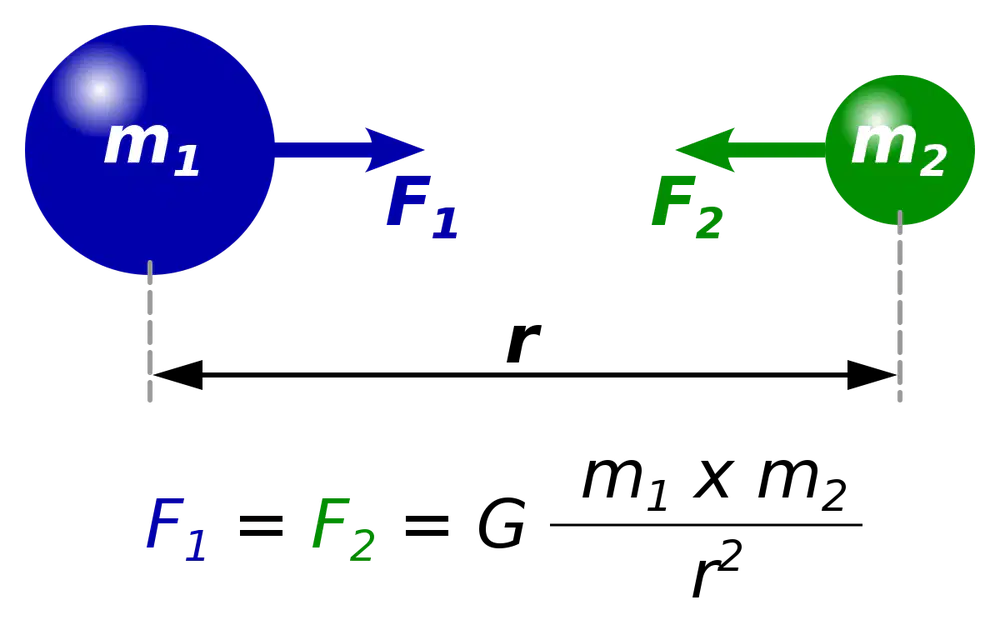
if the separation between m_1 and m_2 were tripled, what happens to the force of attraction between the two objects.
The force of attraction decreases to one-third of its original value.
The force of attraction remains unchanged.
The force of attraction triples in strength.
The force of attraction decreases to one-ninth of its original value.
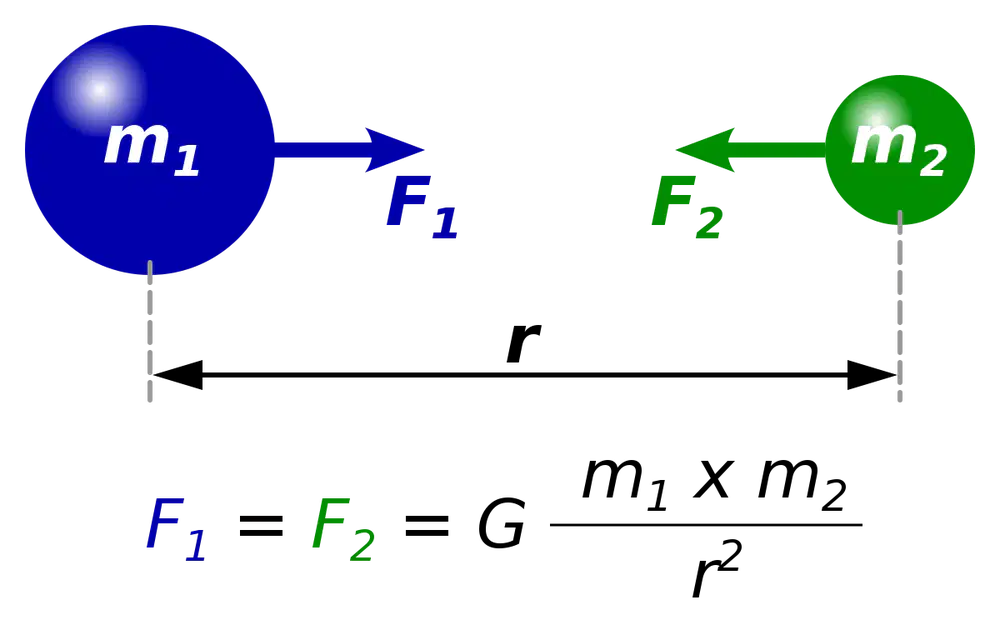
If m_2 becomes doubled, what happens to the force of attraction between m_1 and m_2?
The force of attraction between m_1 and m_2 becomes doubled.
The force of attraction becomes quadrupled.
The force of attraction remains the same.
The force of attraction becomes halved.
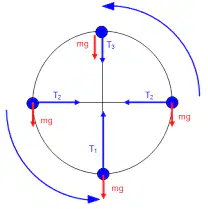
A ball swung in a vertical circle has greater tension at the bottom than at the top.
False
True
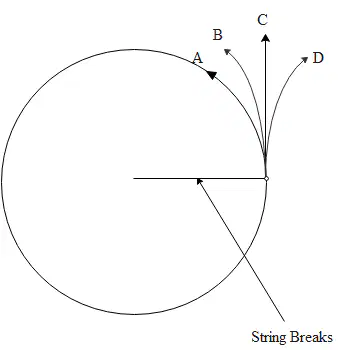
A 2kg ball is attached to a string and whirled in a circle on a tabletop. What path will the ball take after breaking?
A
B
C
D
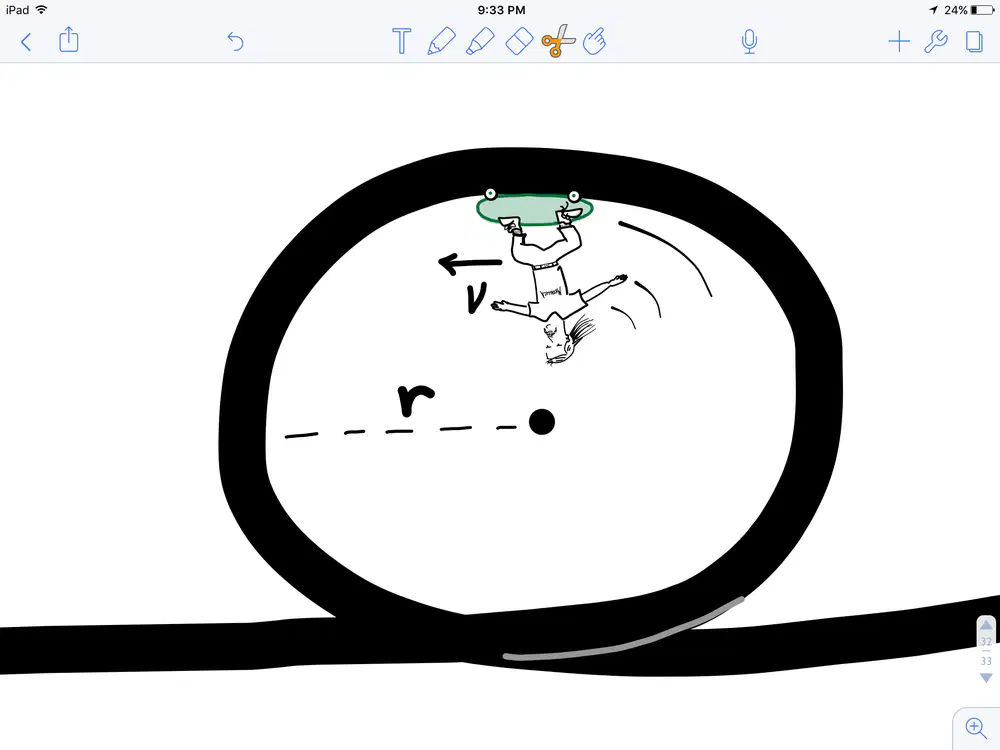
In order to accomplish the loop without falling, ___must be at least as great as gravity
frictional force
buoyant force
centripetal force
magnetic force
Kepler's Third Law states that the square of the orbital period T of a planet is proportional to:
the cube of the orbital period T
the square root of the planet's orbital radius
The cube of the planet's orbital radius
the square of the planet's orbital radius
Which of the following is true about Kepler’s Third Law?
It applies only to planets orbiting the Sun
It applies to all orbiting objects, including moons and artificial satellites
The distance between planets is irrelevant to their orbital periods.
The mass of a planet affects its orbital period directly.
If an object is traveling at constant velocity, which two forces will be equal?
weight and net
applied and frictional
net and frictional
net and applied

This diagram can be used to indicate which of the following? (TWO correct answers)
An object at rest
An object accelerating
An object decelerating
an object moving at a constant velocity (speed)
(Trick question -- there is only one correct answer)
A car is driving in a circle on a flat road. What provides the centripetal force that keeps the car moving in a circular path?
Friction between the tires and the road.
Gravity pulling the car downwards.
Engine power pushing the car outward.
Air resistance slowing the car down.
A ball is being whirled in a horizontal circle at the end of a string. What force is responsible for the centripetal force that keeps the ball moving in the circle?
Gravity acting on the ball
Friction between the ball and the surface
Air resistance against the ball
Tension in the string
A satellite is in a stable orbit around the Earth. What force provides the necessary centripetal force for the satellite's circular motion?
Magnetic force
Frictional force
Tension force
Gravitational force
A roller coaster car is moving through the bottom of a loop. What force is primarily responsible for providing the centripetal force at this point?
Gravitational force
Frictional force
Normal force
Tension force
In a centrifuge, a sample spins in a circular path. What force provides the centripetal force that keeps the sample moving in a circle?
The normal force from the walls of the container
Magnetic force and buoyancy
Gravity and inertia
Tension and friction
What happens to the K constant of a spring when 2 or more are arranged in series?
The K constant increases when springs are arranged in series.
The K constant decreases when springs are arranged in series.
What happens to the K constant when you arrange two or more springs in parallel?
The K constant increases and is equal to the sum of the individual spring constants.
The K constant remains unchanged.
The K constant decreases and is equal to the average of the individual spring constants.
The K constant becomes zero when springs are in parallel.
The rougher the surface, the faster an object will travel over the surface.
True
False
TRUE or FALSE if you push a box across a surface like Ice with no friction, it will NEVER stop
TRUE, as long as it doesn't run into something it will keep going and going and going
FALSE, it will stop very quickly

Are forces balanced or unbalanced when a marble speeds up rolling down a ramp?
Balanced
Unbalanced

The object is moving at a constant velocity.
Definitely False
Definitely True
Might be True or False
A moving object's __________ is its mass times its velocity. It is in the direction of motion.
momentum
impulse
inelastic collision
elastic collision
__________ is defined as a force multiplied by the time during which that force acts. This is also known as the change in momentum.
momentum
impulse
inelastic collision
elastic collision
A __________ is made up of several objects that can be treated as a single thing.
system
surroundings
universe
A __________ is made up of everything other than the system.
system
surroundings
universe
Momentum is conserved __________ collisions.
only in elastic
only in inelastic
in all
never during
Kinetic energy is conserved __________ collisions.
only in elastic
only in inelastic
in all
never during
True/False: The center of mass of a system of objects obeys Newton's Second Law.
True
False
True/False: The impulse-momentum theorem is only valid when objects collide.
True
False
The only time when momentum of a system is NOT conserved is when a force is exerted by an object that's __________ ,
not in the system
in the system
moving
not moving
The standard units for momentum are...
Newton-seconds, Ns.
Newtons per second, N/s
Newton meters, Nm
Newtons per meter, N/m
The direction of an object's momentum is always __________ its direction of motion
the same as
the opposite of
parallel to
perpendicular to
Given a force-time graph, impulse is...
the vertical axis.
the horizontal axis.
the slope.
the area under the curve.
True/False: Impulse and momentum have different units.
True
False
For an elastic collision of two masses, M1 and M2, with two velocities, V1 and V2, after the collision, their total momentum will be equal to:
M1V1+M2V2=M1V1'+M2V2'
M1V1+M2V2=M1V1+M2V2
M1V1+M2V2=(M1+M2)V3
M1V1+M2V2=(M1+M2)(V1+V2)
For an inelastic collision of two masses, M1 and M2, with two velocities, V1 and V2, after the collision, their total momentum will be equal to:
M1V1+M2V2=M1V1'+M2V2'
M1V1+M2V2=M1V1+M2V2
M1V1+M2V2=(M1+M2)V3
M1V1+M2V2=(M1+M2)(V1+V2)
True/False: Momentum is a vector.
True
False
A mosquito flying at 3 m/s that encounters a breeze blowing at 3 m/s in the same direction has a speed of
0
3
4
6
Katelyn runs along the aisle of a train that moves at 8 m/s. Her speed relative to the floor is 3 m/s. Her speed relative to an observer at rest on the ground is
5 m/s
11 m/s
either depending on her running direction
none of the above
Amy runs at 4 m/s along a traincar traveling at 10 m/s in the opposite direction. Jake's speed relative to the ground is
6 m/s
10 m/s
14 m/s
none
A mosquito flying at 3 m/s that encounters a breeze blowing at 3 m/s in the same direction has a speed of
0 m/s
3 m/s
4 m/s
6 m/s
The accelerations possible for a ball on an inclined plane
range from zero to g.
range from g to infinity.
have no limit.
none of the above
A freely falling object falls with constant:
velocity
speed
acceleration
distance each second
I throw a ball up and another straight down, with both the same speed. Which hits with greater speed?
The one thrown up
The one thrown down
Same
None
When a ball thrown straight upwards reaches the very top of its path, its acceleration is
zero.
5 m/s².
10 m/s².
none of the above
If you walk from position 0 to position +6 and then back to position 0, your distance is...
0
3
6
12
If the Earth were no longer influenced by the Sun's gravitational pull it would
still circle around the sun
travel in a straight line like all other moving objects
stop moving completely
move in a random direction
Pretend you are sitting in a car when the driver suddenly turns to the right, your body would
Immediately lurch to the right with the car.
Lurch to the left due to your tendency to keep going forward
Stay perfectly still
Move backward
A package falls off a car at 60 miles per hour. The horizontal speed of the package is
less than 60 mi/hr as it hits the road
about 60 mi/hr as it hits the road
more than 60 mi/hr as it hits the road
No way to know
Josh pulls with a force of 45 N on a horizontal rope tied to a pole in a parking lot. What is the net force on the rope?
The net force on the rope is 45 N
The net force on the rope is zero N
The net force on the rope is 90 N
The net force on the rope is 15 N
Josh pulls with a force of 45 N on a horizontal rope tied to a pole in a parking lot. What is the tension in the rope?
The tension in the rope is 0 N
The tension in the rope is 90 N
The tension in the rope is 45 N
The tension in the rope is 15 N
In which scenario does the equilibrium rule apply?
An object being pulled 10N to the left and 10N to the right
An object that has a constant speed of 30 m/s due north
Both of these
Neither of these
When you stand on a pair of bathroom scales the reading on each scale
adds up to your weight
weirdly, combines to a total more than your weight
shows exactly half your weight
shows exactly your weight

