wayground logo

Free Printable Worksheets

Font size

S
M
L
XL
Worksheets

Conservation of Energy and Momentum

Total questions: 129

Worksheet time: 2hrs 51mins

Name
Class
Date
1.

Energy stored because of gravity is called:

a)

Gravitational Potential Energy

b)

Kinetic Energy

c)

Mechanical Advantage

d)

Chemical Energy

2.

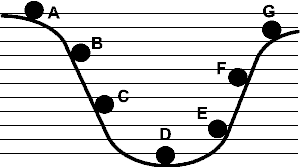
At which point does the ball has the greatest gravitational potential energy (GPE)?

a)

A

b)

G

c)

D

d)

C

e)

G

3.

Which would have the LEAST gravitational potential energy (GPE)?

a)

A ball sitting on the ground

b)

Moon viewed from the Earth

c)

An airplane flying 30,000 feet above the ground

d)

A rock sitting on top of Mt. Everest

4.

How could you increase the gravitational potential energy of an object without changing its mass and gravity?

a)

Make the object larger

b)

Lower the object towards the ground

c)

Raise the object farther off the ground

d)

Allow the object to roll on the ground

5.

How could you increase the object's gravitational potential energy (GPE) without changing its distance from the ground (height) and gravity?

a)

Decrease the object's mass

b)

Increase the object's height

c)

Increase the object's mass

d)

Decrease the object's height

6.

____________ is the ability to do work.

a)

Energy

b)

Force

c)

Friction

d)

Motion

7.

When you are holding a book, energy is stored between the book and Earth; this type of energy is called ________ potential energy.

a)

Kinetic Energy

b)

Chemical Energy

c)

Gravitational Potential Energy

d)

Electric Energy

8.

Gravitational potential energy depends on the strength of gravity, ________ and ________ of the object.

a)

height and mass

b)

friction and movement

c)

mass and movement

d)

height and friction

9.

You throw a ball into the air as shown in the diagram. At what point does the ball have the most gravitational potential energy?

a)

W

b)

X

c)

Y

d)

Z

10.

At which position does the child on the swing have the most gravitational potential energy?

a)

W

b)

X

c)

Y

d)

Z

11.

At which point on the roller coaster is the gravitational potential energy the greatest?

a)

W

b)

X

c)

Y

d)

Z

12.

What kind of energy is in a rock at the edge of a cliff?

a)

Gravitational Potential Energy

b)

Kinetic Energy

c)

Both potential and kinetic energy

d)

none of the above

13.

Which is the correct unit for expressing gravitational potential energy?

a)

Joule

b)

Newton

c)

m/s2

d)

meter

14.

Which of the following is the correct equation for calculating an object's gravitational potential energy?

a)

PE = mgh

b)

PE = mg / h

c)

PE = mg + h

d)

PE = gh

15.

What is the value of the Earth's acceleration due to gravity (g)?

a)

9.8 m/s2

b)

100 m/s2

c)

25 m/s2

d)

3.14 m/s2

16.

What is the gravitational potential energy (GPE) of a 1 kilogram book that is 1 meter above the ground?

g = 9.8 m/s2

a)

9.8 Joules

b)

1.0 Joule

c)

0.10 Joule

d)

11.8 m/s2

17.
The faster an object moves, the ________ kinetic energy it has. 
a)
more
b)
less
c)
none of the above
d)
all of the above 
18.

A cheetah can run briefly with a speed of 31.0 m/s. Suppose a cheetah with a mass of 47.0 kg runs at this speed. What is the cheetah’s kinetic energy?

a)

1457 Joules

b)

22,584 Joules

c)

15 Joules

d)

45,167Joules

19.
What would have the greatest kinetic energy?
a)
A car driving down a hill.
b)
A person running down a hill. 
c)
A ball rolling down a hill. 
20.
What is kinetic energy?
a)
energy of work
b)
energy of motion
c)
energy of gravity
d)
energy of power
21.
A 60 kg Ewok is travelling at a constant speed of 7 m/s. What is its kinetic energy in KJ?
a)
1.47 KJ
b)
210 KJ
c)
147 KJ
d)
1470 KJ
22.
What is the kinetic energy of a 1500 gram object moving at a velocity of 100 m/s
a)
112.5 J
b)
7,500,000 J
c)
75 J
d)
7,500 J
23.
What is the kinetic energy of a 25,000g object moving at a velocity of 2.5 m/s
a)
78.125 J
b)
31250 J
c)
781.25 J
d)
78,125 J
24.
How much kinetic energy does a person of mass 50kg running at 3m/s have? Provide your answer in KJ.
a)
225 KJ
b)
0.225 KJ
c)
75 KJ
d)
0.075 KJ
25.
What is the kinetic energy of a 30,000 g object moving at a velocity of 4 m/s. Provide you answer in KJ
a)
240,000 KJ
b)
240 KJ
c)
2400 KJ
d)
0.24 KJ
26.
Which is the best example that something has kinetic energy?
a)
a. a car parked on a steep hill 
b)
b. a tennis ball rolling across the court
c)
c. a picture hanging on the wall 
d)
d. a piece of coal before it's burned 
27.
The faster an object moves, the ________ kinetic energy it has. 
a)
more
b)
less
c)
none of the above
d)
all of the above 
28.
Can energy be destroyed?
a)
no
b)
yes
29.
Can energy be changed?
a)
yes
b)
no
30.
Energy can not be created or destroyed, only converted from one form to another.
a)
true
b)
false
31.
What would have the greatest kinetic energy?
a)
A car driving down a hill.
b)
A person running down a hill. 
c)
A ball rolling down a hill. 
32.
The SI unit in which kinetic energy is measured is 
a)
Newton
b)
Kilogram
c)
Joules
d)
Metres per second
33.
Calculate the kinetic energy of a moving 4 kg object travelling at a velocity of 3 m/s.
a)
18 J
b)
36 J
c)
12 J
d)
6 J
34.
How much kinetic energy does a moving 6 kg object have if it moves with a velocity of 3 m/s?
a)
27 J
b)
18 J
c)
9 J
d)
2 J
35.

The statement that "the energy within a system remains constant and cannot be created or destroyed, only transformed" best sums up _________.

a)

Something Mr. Lance likes to say.

b)

Life

c)

Law of Conservation of Energy

d)

The scientific method

e)

Newton's Third Law

36.

A cheetah can run briefly with a speed of 31.0 m/s. Suppose a cheetah with a mass of 47.0 kg runs at this speed. What is the cheetah’s kinetic energy?

a)

1457 Joules

b)

22,584 Joules

c)

15 Joules

d)

45,167Joules

37.

What is energy?

a)

something that picks up things, like a magnet.

b)

Motion of an object

c)

ability to do work

d)

magic rays of sunshine that come down when you're feeling blue.

38.

What is the kinetic energy of a 4kg shotput thrown with a velocity of 13m/s

a)

676 J

b)

52 J

c)

17J

d)

338 J

39.

What is the kinetic energy of a ball with a mass of 5kg rolling at 10m/s

a)

50 J

b)

500 J

c)

250 J

d)

25 J

40.

What is the GPE at point A

a)

14 J

b)

12 J

c)

6 J

d)

8 J

41.

What is the KE at point B?

a)

14 J

b)

12 J

c)

6 J

d)

8 J

42.

What is the Total Energy of the system?

a)

14 J

b)

12 J

c)

6 J

d)

8 J

43.

What is the KE at point D?

a)

14 J

b)

12 J

c)

6 J

d)

8 J

44.

What is the GPE at point E?

a)

14 J

b)

12 J

c)

6 J

d)

8 J

45.

What is the Total Mechanical Energy at point A?

a)

500,000 J

b)

400,000 J

c)

200,000 J

d)

50,000 J

46.

What is the Kinetic Energy at point B?

a)

500,000 J

b)

400,000 J

c)

300,000 J

d)

50,000 J

47.

What is the Kinetic Energy at point C?

a)

500,000 J

b)

400,000 J

c)

300,000 J

d)

50,000 J

48.

What is the Kinetic Energy at point D?

a)

500,000 J

b)

250,000 J

c)

300,000 J

d)

50,000 J

49.

What is the GPE at point E?

a)

500,000 J

b)

250,000 J

c)

300,000 J

d)

100,000 J

50.

What is the GPE at point F?

a)

500,000 J

b)

250,000 J

c)

300,000 J

d)

0 J

51.

What is the KE at point F?

a)

500,000 J

b)

250,000 J

c)

300,000 J

d)

0 J

52.

What is the Total Energy at the top?

a)

15,000 J

b)

3,750 J

c)

7,500 J

d)

11,250 J

53.

What is the KE 1/4th of the way down?

a)

15,000 J

b)

3,750 J

c)

7,500 J

d)

11,250 J

54.

What is the KE 1/2 of the way down?

a)

15,000 J

b)

3,750 J

c)

7,500 J

d)

11,250 J

55.

What is the KE 3/4th of the way down?

a)

15,000 J

b)

3,750 J

c)

7,500 J

d)

11,250 J

56.

What is the KE at the bottom?

a)

15,000 J

b)

3,750 J

c)

7,500 J

d)

11,250 J

57.

What is the GPE at the top?

a)

50 J

b)

25 J

c)

0 J

d)

100 J

58.

What is the KE half way down?

a)

50 J

b)

25 J

c)

0 J

d)

100 J

59.

What is the Total Energy at the bottom?

a)

50 J

b)

25 J

c)

0 J

d)

100 J

60.
A pair of trapeze performers at the circus is swinging from ropes attached to a large elevated platform. Suppose that the performers can be treated as a simple pendulum with a length of 16 m. Determine the period for one complete back and forth cycle.
a)
2 sec
b)
12 sec
c)
8 sec
d)
10 sec
61.
A pendulum is 0.75 meters long and has a period of 4.17 seconds. The Pendulum is on an unknown planet.  What is the gravity of the Unknown Planet?
a)
9.8
b)
3.4
c)
1.7
d)
Greater than 9.8
62.
If the length of a simple pendulum is doubled, its period will: 
a)
halve 
b)
increase by a factor of sqrt(2) 
c)
decrease by a factor of sqrt(2)
d)
double 
63.
What is the equation for frequency?
a)
f = t/n
b)
f = 1/T
c)
f = 2 T
64.
A mass-spring system can oscillate with simple harmonic motion because a compressed or stretched spring has which kind of energy?
a)
kinetic
b)
mechanical
c)
gravitational potential
d)
elastic potential
65.
For a system in simple harmonic motion, which of the following is the number of cycles or vibrations per unit of time?
a)
amplitude
b)
period
c)
frequency
d)
revolution
66.
What is the period on Earth of a pendulum with a length of 2.4 m?
a)
3.1 sec
b)
1.9 sec
c)
9.3 sec
d)
5.1 sec
67.

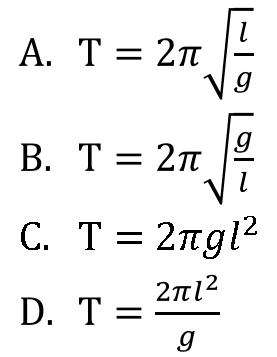
Based on your findings, which equation could best describe the pendulum’s period?

a)

A

b)

B

c)

C

d)

D

68.
A simple harmonic oscillator takes 4.8 s to undergo five complete vibrations. What is the frequency of 1cycle? 
a)
1.04 s
b)
4.8 s
c)
1/4.8 s
69.
A simple harmonic oscillator takes 4.8 s to undergo five complete vibrations. What is the period (T) of 1 cycle?
a)
4.8 s
b)
.96 s
c)
9.8 s
70.
What is the frequency of a pendulum that has a period of 10 s?
a)
10 Hz
b)
1/1000 Hz
c)
.1 Hz
71.
The period of a pendulum may be decreased by
a)
Increasing the mass of the bob
b)
moving the equilibrium point
c)
decreasing the mass of the bob
d)
shortening the length of pendulum
72.

The velocity of a spring-block system vibrating along the y-axis changes with time according to the equation: 𝑣(𝑡) = 2𝜋 cos(𝜋𝑡 + 𝜋). All quantities in the equation are expressed in S.I units. Consider that the object is initially at the equilibrium position. What is the amplitude of the motion of the object in meter?

a)

2/𝜋

b)

2

c)

2𝜋

d)

𝜋/2

73.

A block of mass 2.0 kg is attached to a spring. What is the spring constant if the block’s acceleration is 13 m/s2 when it is 0.75 m away from the equilibrium position ?

a)

35 N/m

b)

22 N/m

c)

12 N/m

d)

8 N/m

74.

The maximum velocity occurs where the ____.


a)

potential energy is a maximum


b)

kinetic energy is a minimum


c)

displacement from equilibrium is equal to

the amplitude of 0.4 𝑚

d)

displacement from equilibrium is equal to

zero

75.

An object of mass 𝑚 is attached to a horizontal spring, stretched to a displacement 𝐴 from equilibrium and released, undergoing harmonic oscillations on a frictionless surface with period 𝑇 . The experiment is then repeated with a mass of 4𝑚. What’s the new period of oscillation?

a)

2T

b)

T

c)

4T

d)

T√2

76.

When is the pendulum at maximum velocity

a)

At its lowest point

b)

At its highest point

c)

It moves at a constant velocity

d)

It is at rest

77.

When does the mass move at maximum velocity in a mass-spring system?

a)

At equilibrium

b)

At the farthest point from the equilibrium

c)

At its hightest point

d)

At its lowest point

78.

What are the two requirements for a simple harmonic oscillator?

a)

The object vibrates about the equilibrium point and the restoring force is proportional to the displacement

b)

The object moves left to right and the restoring force is proportional to the displacement

c)

The object vibrates about the equilibrium and the restoring force is greater than the displacement

d)

The object moves left to right and the restoring force is greater than the displacement

79.

When is the pendulum at 0 velocity

a)

At its lowest point

b)

At its highest point

c)

It moves at a constant velocity

d)

It is at rest

80.

When does the mass move at 0 velocity in a mass-spring system?

a)

At equilibrium

b)

At the farthest point from the equilibrium

c)

At its hightest point

d)

At its lowest point

81.

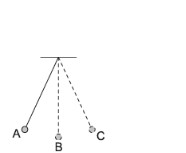
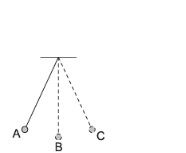
A pendulum oscillates as shown. At which of the following positions is the potential energy equal to the total energy?

a)

A

b)

B

c)

C

d)

Not enough information

82.

A pendulum oscillates as shown. At which of the following positions is the kinetic energy equal to the total energy?

a)

A

b)

B

c)

C

d)

Not enough information given.

83.
Gases have...
a)
A definite shape and volume
b)
A definite shape but no definite volume
c)
No definite shape but a definite volume
d)
No definite shape or volume
84.
What is the variable for this number 22.4 L
a)
P
b)
T
c)
n
d)
V
85.
What is the variable for this number 32oC
a)
P
b)
T
c)
n
d)
V
86.
What is the variable for this number 9.10 atm
a)
P
b)
T
c)
n
d)
V
87.
What is the variable for this number 122 K
a)
P
b)
T
c)
n
d)
V
88.
What is the variable for this number 1.5 mol
a)
P
b)
T
c)
n
d)
V
89.
PV=nRT
a)
Charles Law
b)
Boyle's Law
c)
Combined Gas Law
d)
Ideal Gas Law
90.

What does R stand for

a)

Ideal gas constant

b)

Real gas constant

c)

Temperature constant

d)

Ideal gas law

91.

Which form of matter has a definite shape and takes up space (has definite volume)?

a)

liquid

b)

solid

c)

gas

d)

clay

92.
My glass of ice water is sitting in the sun and has droplets of water on the outside of the glass. What is happening?
a)
condensation
b)
evaporation
c)
melting
d)
freezing
93.
The molecules in the picture are tightly held together with little movement. They have shape and energy.  Therefore, the picture represents _________.
a)
solid
b)
liquid
c)
gas
d)
plasma
94.
When thermal energy is added to a substance, the substance's particles move:
a)
More rapidly at an increased diestance from each other.
b)
More rapidly with less distance between each other.
c)
More slowly with a greater distance between each other.
d)
More slowly with a reduced distance between each other.
95.

Which form of matter has a definite shape and takes up space (has definite volume)?

a)

liquid

b)

solid

c)

gas

d)

clay

96.
My glass of ice water is sitting in the sun and has droplets of water on the outside of the glass. What is happening?
a)
condensation
b)
evaporation
c)
melting
d)
freezing
97.
When the temperature of matter increases the particles...
a)
speed up and move closer
b)
speed up and move farther apart
c)
slow down and move closer together
d)
slow down and move farther apart
98.
When the temperature of matter decreases the particles ...
a)
speed up and move farther apart
b)
speed up and move closer together
c)
slow down and move farther apart
d)
slow down and move closer together
99.
Definite shape and a definite volume.
a)
Gas
b)
Liquid
c)
Solid
100.
When air in a hot air balloon is heated the air inside the baloon...
a)
expands
b)
contracts
c)
evaporates
d)
condenses
101.
What does this picture represent? 
a)
solid
b)
liquid
c)
gas
d)
plasma
102.
What does this picture represent? 
a)
solid
b)
liquid 
c)
gas
d)
plasma
103.
The molecules in the picture are tightly held together with little movement. They have shape and energy.  Therefore, the picture represents _________.
a)
solid
b)
liquid
c)
gas
d)
plasma
104.
What phase change occurs between points B and C if heat is added?
a)
Freezing
b)
Melting
c)
Boiling
d)
Condensing
105.
If an object has particles that are moving very slowly, the object's temperature is probably ______.
a)
hot
b)
small
c)
cold
d)
big
106.
The liquid in a thermometer ______________ as the temperature increases.
a)
expands
b)
disappears
c)
freezes
d)
explodes
107.

In a plasma the number of positively charged particles is ______ than the number of negatively charged particles.

a)

significantly more

b)

significantly more

c)

almost equal

108.

The negative charge in a plasma is usually due to the

a)

protons

b)

neutrons

c)

electrons

109.

Plasma can be found in which of the following

a)

Auroras

b)

Lightening

c)

LED light bulbs

d)

Stars

e)

Moons

110.

A plasma can be made in a laboratory by

a)

cooling a gas to very low temperatures

b)

cooling a gas and reducing the pressure

c)

heating a gas to extremely hot temperatures

d)

heating a liquid to the point it turns into a gas

111.

In a plasma the electrons are no longer associated with a particular nucleus.

a)

True

b)

False

112.

Is Lightning a Solid, Liquid, Gas, or Plasma?

a)

Solid

b)

Liquid

c)

Gas

d)

Plasma

113.

Is the Tail Of A Comet a Solid, Liquid, Gas, or Plasma?

a)

Solid

b)

Liquid

c)

Gas

d)

Plasma

114.

Is a Fireball from a Nuclear Explosion a Solid, Liquid, Gas, or Plasma

a)

Solid

b)

Liquid

c)

Gas

d)

Plasma

115.

Which One is a Plasma?

a)

Oil

b)

Rock

c)

The Sun

d)

Leather

116.
Heat is the _______ of energy.
a)
Transfer
b)
Measure
117.

Which of the following has the greatest momentum?

a)

a scurrying cockroach

b)

a parked semi-truck

c)

more information is needed

118.
Which of the following has more momentum? 
a)
a moving SUV
b)
a moving semi-truck
c)
more information is needed
119.

Which of the following is NOT a unit of momentum?

a)

kg*m/s

b)

N*s

c)

kg*mph

d)

kg*m/s2

120.
If a net force is acting on an object, 
a)
its velocity must be constant
b)
its velocity must be changing
c)
its mass must be changing
d)
its acceleration = 0 
121.

In an elastic collision, ______ is conserved.

a)

Momentum only

b)

Kinetic Energy only

c)

Both momentum and energy

122.
In a perfectly inelastic collision, ______ is conserved. 
a)
Momentum only
b)
Kinetic Energy only
c)
Both momentum and kinetic energy
123.
Which of the following collisions is not perfectly elastic nor perfectly inelastic?
a)
a football tackle where both players fall wrapped together
b)
a cue ball hitting a billiards ball
c)
a flower pot breaking over someone's head
d)
an arrow staying in the apple after impact
124.
The recoil speed of a rifle is much less than the exit velocity of a bullet because...
a)
the rifle experiences a smaller force
b)
the rifle experiences a smaller change in momentum
c)
the rifle has a much greater mass
d)
the rifle does not obey the laws of physics
125.
A 50 kg ball rolls down the street at 5 m/s. Calculate the momentum of the ball. 
a)
55 kg*m/s
b)
100 kg*m/s
c)
250 kg*m/s
d)
500 kg*m/s
126.

Two skaters begin at rest. Skater 1 has a smaller mass than Skater 2. After they push off each other,...

a)

Skater 1 experiences a greater change in momentum

b)

Skater 2 experiences a greater change in momentum

c)

Skater 1 has a greater speed than Skater 2

d)

Skater 1 experiences a greater force

127.
What happens to the speed of the wagon as the rain collects inside of it?
a)
it decreases
b)
it remains constant
c)
it increases
128.
A block sliding on a frictionless surface runs into a second block of equal mass at rest. After the two collide, they stick together and travel with a velocity...
a)
that is twice the magnitude of the original velocity
b)
that is half the magnitude of the original velocity
c)
more information is needed
129.
Both students experience the same ____
a)
force of impact
b)
time of impact
c)
change in momentum
d)
all of the above