wayground logo

Free Printable Worksheets

Font size

S
M
L
XL
Worksheets

Static Electricity

Total questions: 135

Worksheet time: 7hrs 45mins

Name
Class
Date
1.

Which of the following is an example of a conductor?

a)

plastic

b)

copper

c)

glass

d)

rubber

2.

If the balloon has a negative charge, the hair must have what charge?

a)

negative

b)

positive

c)

neutral

3.

For an object to have a positive charge, it must ____.

a)

lose electrons

b)

gain electrons

c)

lose protons

d)

gain protons

4.

_______ is when there is a buildup of charges (more of one type of charge) on an object.

a)

static electric discharge

b)

static electricity

c)

current electricity

5.

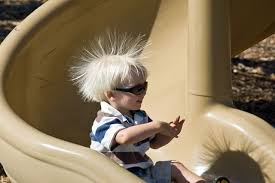
When someone's hair is charged by the person holding onto the Van de Graaf generator, you are observing ___.

a)

friction

b)

conduction

c)

induction

6.

All of the following are examples of static electric discharge EXCEPT:

a)

lightning

b)

getting shocked by a doorknob

c)

the crackle sound as you pull clothes from the dryer apart

d)

when your hair stands on end as you jump on the trampoline

7.

Select all that describe insulators.

a)

allow charges to flow easily

b)

do not allow charges to flow easily

c)

plastic

d)

metal

e)

surround a wire

8.
What types of charges attract?
a)
Positive and Positive
b)
Positive and Neutral
c)
Negative and Neutral
d)
Positive and Negative
9.
What charge does a proton have?
a)
negative (-)
b)
positive (+)
c)
neutral or no charge (0)
10.
What charge does an electron have?
a)
negative (-)
b)
positive (+)
c)
neutral or no charge (0)
11.
If a substance has a higher number of electrons than protons on its surface, what type of charge does it have?
a)
A positive charge.
b)
A negative charge.
c)
A neutral charge
d)
No charge at all
12.
Which of the following is caused by static electricity?
a)
a stove getting hot when it is turned on
b)
a magnet being attracted to a refrigerator
c)
a lightning strike during a storm
d)
a light bulb coming on when a switch is turned on
13.
An object becomes postiively charged when which of the following occurs?
a)
loses electrons
b)
gains electrons
c)
loses protons
d)
gains neutrons
14.

The difference between attraction and repulsion is that to attract is to pull something closer and repel is to push something away.

a)

True

b)

False

15.

the positively charged particle in an atom, never leaves the nucleus, determines the element

a)

proton

b)

neutron

c)

electron

16.
What types of charges attract?
a)
Positive and Positive
b)
Positive and Neutral
c)
Negative and Neutral
d)
Positive and Negative
17.
In a neutral atom, the number of electrons is equal to the number of _______.
a)
Neutrons
b)
Orbits
c)
Protons
d)
subatomic particles
18.
An object becomes charged when the atoms in the object gain or lose
a)
electrons
b)
protons
c)
neutrons
d)
all of the above
19.
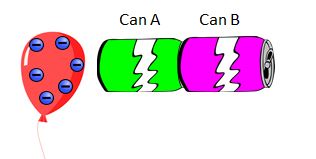
The negatively charged balloon is brought near the two cans. What happens?
a)
The negative charges in Can B move towards the balloon
b)
The negative charges in Can A move away from the balloon
c)
The positive charges in Can B move towards the balloon
d)
The positive charges in Can A move away from the balloon
20.
If the two charges represented in the figure were brought near each other, they would
a)
attract each other.
b)
repel each other.
c)
cause static discharge.
d)
have no affect on each other
21.

Will the balloons ATTRACT or REPEL each other?

a)
b)
22.

Will the balloons ATTRACT or REPEL each other?

a)
b)
23.

Static electricity can "jump" from the charged object to another object, causing . . .

a)

static cling (objects sticking together)

b)

electric discharge (and a shock!)

24.

When negative charges on a cloud cause positive charges to build up on the ground, what may happen?

a)
b)
25.

Why is the balloon attracted to the cat?

a)

The balloon and the cat's hair have opposite electric charges

b)

The cat sat in glue

c)

The balloon is in love with the cat

d)

The balloon and the cat's hair have the same electric charges

26.

When the same charges are near each other,

they repel (move away from) each other.

a)
b)
27.

A force that pushes objects away from each other

a)

electrical charge

b)

attraction

c)

force

d)

repulsion

28.

What type of charge does this balloon have?

a)

Positive

b)

Negative

c)

Neutral

29.
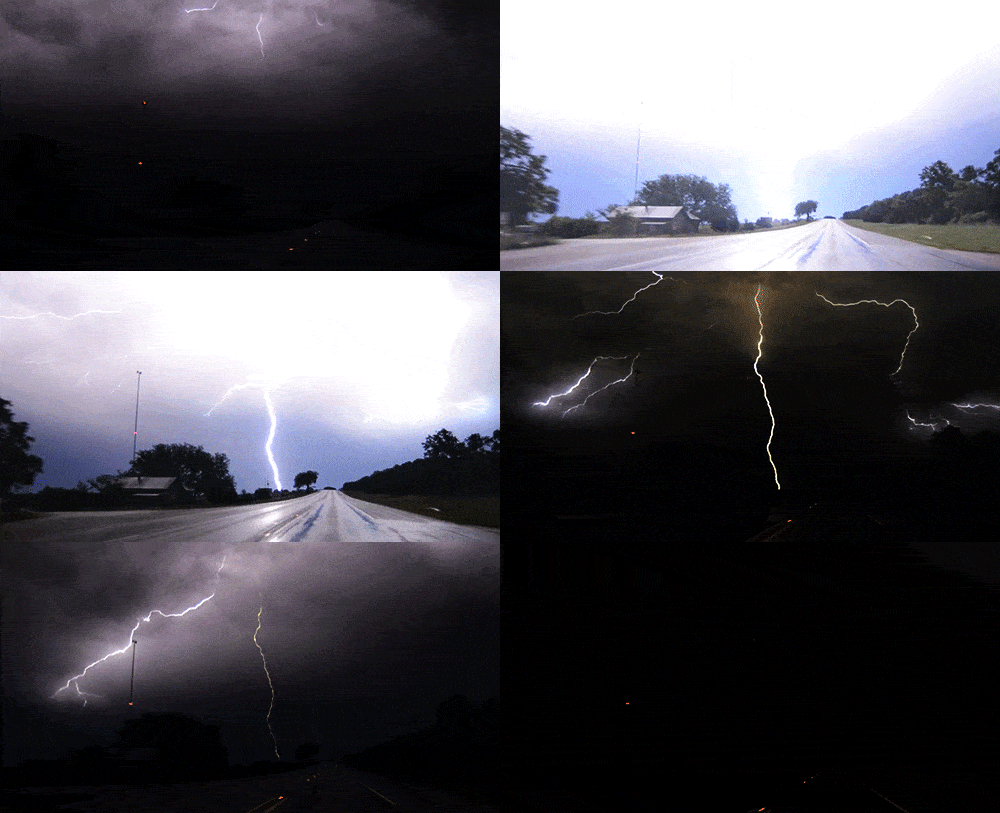
What will you likely see during an electrical discharge?
a)
A rainbow
b)
A spark
c)
Red
d)
Moisture
30.
What types of charges attract?
a)
Positive and Positive
b)
Positive and Neutral
c)
Negative and Neutral
d)
Positive and Negative
31.
What charge does a proton have?
a)
negative (-)
b)
positive (+)
c)
neutral or no charge (0)
32.
What charge does an electron have?
a)
negative (-)
b)
positive (+)
c)
neutral or no charge (0)
33.
If a substance has a higher number of electrons than protons on its surface, what type of charge does it have?
a)
A positive charge.
b)
A negative charge.
c)
A neutral charge
d)
No charge at all
34.
Which of the following is caused by static electricity?
a)
a stove getting hot when it is turned on
b)
a magnet being attracted to a refrigerator
c)
a lightning strike during a storm
d)
a light bulb coming on when a switch is turned on
35.
An object becomes postiively charged when which of the following occurs?
a)
loses electrons
b)
gains electrons
c)
loses protons
d)
gains neutrons
36.

The difference between attraction and repulsion is that to attract is to pull something closer and repel is to push something away.

a)

True

b)

False

37.

the positively charged particle in an atom, never leaves the nucleus, determines the element

a)

proton

b)

neutron

c)

electron

38.
What types of charges attract?
a)
Positive and Positive
b)
Positive and Neutral
c)
Negative and Neutral
d)
Positive and Negative
39.
In a neutral atom, the number of electrons is equal to the number of _______.
a)
Neutrons
b)
Orbits
c)
Protons
d)
subatomic particles
40.
An object becomes charged when the atoms in the object gain or lose
a)
electrons
b)
protons
c)
neutrons
d)
all of the above
41.

Ms Pippin rubbed two balloons with a piece of wool. What will happen when the balloons are brought near each other?

a)

The balloons will repel each other.

b)

The balloons will attract each other.

c)

The balloons will become positively (+) charged.

d)

The balloons will pop.

42.

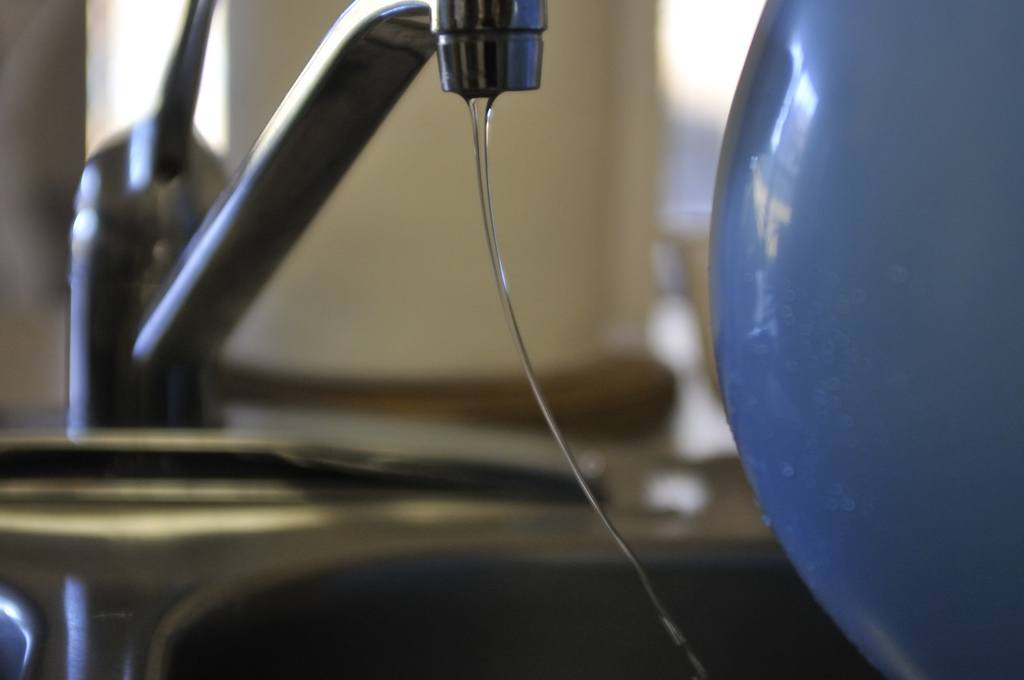
Bending water with a charged balloon is an example of what type of charging (charging an object without touching)

a)

friction

b)

induction

c)

conduction

43.

The difference between attraction and repulsion is that to attract is to pull something closer and repel is to push something away.

a)

True

b)

False

44.
If a substance has a higher number of electrons than protons on its surface, what type of charge does it have?
a)
A positive charge.
b)
A negative charge.
c)
A neutral charge
d)
No charge at all
45.
Electrical charge built up on the surface of an object is called _________________.
a)
static electricity
b)
current electricity
c)
lightning
d)
electrons
46.

the positively charged particle in an atom, never leaves the nucleus, determines the element

a)

proton

b)

neutron

c)

electron

47.

During a lab a balloon was rubbed with a wooly fabric. This is an example of which type of charging?

a)

conduction

b)

friction

c)

induction

48.

What is the major difference between static electricity and current electricity?

a)

Current electricity involves a continuous flow of elecrons; static electricity is a sudden transfer of protons

b)

Current electricity can be deadly; static electricity is almost always safe

c)

In current electricity, there's a single transfer of electrons; in static electricity, there's a steady flow of electrons

d)

Current electricity involves a flow of electrons; static electricity involves a single transfer of electrons

49.
What types of charges attract?
a)
Positive and Positive
b)
Positive and Neutral
c)
Negative and Neutral
d)
Positive and Negative
50.

What happens when you touch a metal doorknob after rubbing your shoes on the carpet?

a)

The doorknob sends a burst of electric current into your body

b)

Millions of electrons go from your finger into the doorknob

c)

The doorknob sends millions of electrons into your finger

d)

Your finger becomes negatively charged

51.
Which of the following is caused by static electricity?
a)
a stove getting hot when it is turned on
b)
a magnet being attracted to a refrigerator
c)
a lightning strike during a storm
d)
a light bulb coming on when a switch is turned on
52.

An object that is neutral contains the same number of electrons and protons.

a)

True

b)

False

53.

the negatively charged particle in an atom, moves freely, can be released, shared, or “stolen” from an atom

a)

proton

b)

neutron

c)

electron

54.

the charging of an object by the contact of a charged object to a neutral object (like touching a door knob)

a)

induction

b)

conduction

c)

friction

55.

Lightning occurs because ___.

a)

the negative charges at the bottom of clouds are attracted to the positive charges on the ground.

b)

the positive charges at the bottom of clouds are attracted to the negative charges on the ground.

c)

the positive and negative charges inside clouds are attracted to each other

d)

All of these reasons are correct.

56.
What types of charges attract?
a)
Positive and Positive
b)
Positive and Neutral
c)
Negative and Neutral
d)
Positive and Negative
57.
The buildup of charges on an object is called:
a)
positive charge
b)
static charge
c)
negative charge
d)
static discharge
58.
Electric charges that are alike _______ each other.
a)
Attract
b)
Repel
59.
Electric charges that are different _______ each other.
a)
Attract
b)
Repel
60.
Ms Jo Jo rubbed two balloons with a piece of wool. What will happen when the balloons are brought near each other?
a)
The balloons will repel each other.
b)
The balloons will attract each other.
c)
The balloons will become positively (+) charged.
d)
The balloons will pop.
61.
The difference between attract and repel is that to attract is to pull something closer and repel is to push something away.
a)
True
b)
False
62.
What charge does a proton have?
a)
negative (-)
b)
positive (+)
c)
neutral or no charge (0)
63.
What charge does an electron have?
a)
negative (-)
b)
positive (+)
c)
neutral or no charge (0)
64.
If a substance has a higher number of electrons than protons on its surface, what type of charge does it have?
a)
A positive charge.
b)
A negative charge.
c)
A neutral charge
d)
No charge at all
65.
True or False, Lighting is a form of static electricity.
a)
True
b)
False
66.
If the two charges represented in the figure were brought near each other, they would
a)
attract each other.
b)
repel each other.
c)
cause static discharge.
d)
have no affect on each other
67.
If an object has a higher number of protons than electrons on its surface, what type of charge does it have?
a)
A positive charge.
b)
A negative charge.
c)
A neutral charge
d)
No charge at all
68.
If an object has a higher number of electrons than protons on its surface, what type of charge does it have?
a)
A neutral charge.
b)
A positive charge.
c)
A negative charge
d)
No charge at all
69.
Which type of charge moves from one object to another to cause static electricity?  
a)
Atom
b)
Proton
c)
Electron
d)
Neutron
70.
A buildup of electric charge on an object.
a)
Electric field
b)
Electric force
c)
static electricity
d)
static discharge
71.
The loss of static electricity as electric charges move from one object to another.
a)
Electric field
b)
Electric force
c)
static electricity
d)
static discharge
72.
Is Wood a conductor or Insulator?
a)
Conductor
b)
Insulator
73.
What is the difference between a conductor and an insulator?
a)
An insulator allows electricity to flow through it easily and a conductor does not
b)
A conductor allows electricity to flow through it easily and an insulator does not.
c)
An insulator is magnetic and a conductor is not
d)
A conductor is magnetic and an insulator is not
74.
Static charge builds up due to the movement of�?
a)
electrons
b)
protons
c)
both electrons and protons
d)
either protons or electrons
75.
What is one type of good conductor that we learned about in class?
a)
Most plastics
b)
Most fruits
c)
Most wood products
d)
Most metals
76.
What types of charges attract?
a)
Positive and Positive
b)
Positive and Neutral
c)
Negative and Neutral
d)
Positive and Negative
77.
What charge does a proton have?
a)
negative (-)
b)
positive (+)
c)
neutral or no charge (0)
78.
What charge does an electron have?
a)
negative (-)
b)
positive (+)
c)
neutral or no charge (0)
79.
If a substance has a higher number of electrons than protons on its surface, what type of charge does it have?
a)
A positive charge.
b)
A negative charge.
c)
A neutral charge
d)
No charge at all
80.
An object becomes postiively charged when which of the following occurs?
a)
loses electrons
b)
gains electrons
c)
loses protons
d)
gains neutrons
81.
Which of the following an insulator?
a)
copper
b)
wood
c)
silver
d)
salt water
82.

Bending water with a charged balloon is an example of what type of charging (charging an object without touching)

a)

friction

b)

induction

c)

conduction

83.

the positively charged particle in an atom, never leaves the nucleus, determines the element

a)

proton

b)

neutron

c)

electron

84.

An object that is neutral contains the same number of electrons and protons.

a)

True

b)

False

85.
If the two charges represented in the figure were brought near each other, they would
a)
attract each other.
b)
repel each other.
c)
cause static discharge.
d)
have no affect on each other
86.
Static electricity is:
a)
electricity flowing in a wire
b)
the buildup of electric charges on an object
c)
when protons move between objects
87.
Two objects with LIKE static charges will
a)
attract each other
b)
even out in the end
c)
repel each other
d)
cause a spark
88.
Which is an example of static dischage?
a)
a motor
b)
lightning
c)
thunder
d)
insulators
89.
Static charges build up when
a)
protons move within an object
b)
electrons move within an object
c)
neutrons move within an object
d)
the nucleus moves within an object
90.
Which subatomic particle has a POSITIVE charge?
a)
Proton
b)
Neutron
c)
Electron
d)
Nucleus
91.
Which subatomic particle has a NEGATIVE charge?
a)
Proton
b)
Neutron
c)
Electron
d)
Nucleus
92.
Is it possible to CREATE electrons?
a)
Yes, that's what static electricity is.
b)
No, you can move them, but they are never created or distroyed.
c)
Sometimes, it depends on the voltage.
d)
Sometimes, it depends on the element.
93.
If two objects with static charge are attracted, what do you know about them?
a)
They are both positively charged.
b)
They are both negatively charged.
c)
One is positively charged and one is negatively charged, but you won't be able to tell which is which.
d)
One is positively charged and one is negatively charged, and you can tell which is which by looking at them.
94.
Rubbing a balloon on hair is an example of static charge build up created by....
a)
conduction
b)
friction
c)
induction
d)
hairduction
95.

True or False:

In static electricity, charges build up on an object, but they do not flow continuously.

a)

True

b)

False

96.
If an object has the same number of positive and negative charges, its electrical charge is...
a)
positive
b)
negative
c)
neutral or no charge
d)
opposite
97.
True or False
Like charges repel
a)
True
b)
False
98.
True or False
A positively charged object has lost electrons
a)
True
b)
False
99.
True or False
A negatively charged object has lost protons
a)
True
b)
False
100.
Materials that tightly hold on to their electrons are considered 
a)
Good conductors
b)
Good insulators
c)
Good anti-static agents
d)
Useful for storing charge
101.
Which one of these objects is a good insulator
a)
Copper wire
b)
Glass
c)
Aluminum 
d)
Gold
102.
Materials that easily loose or accept electrons are considered
a)
Good conductors
b)
Good insulators
c)
Good anti-static agents
d)
Good for storing charge
103.
Is it possible to CREATE electrons?
a)
Yes, that's what static electricity is.
b)
No, you can move them, but they are never created or distroyed.
c)
Sometimes, it depends on the voltage.
d)
Sometimes, it depends on the element.
104.

What happens when you touch a metal doorknob after rubbing your shoes on the carpet?

a)

The doorknob sends a burst of electric current into your body

b)

Millions of electrons go from your finger into the doorknob

c)

The doorknob sends millions of electrons into your finger

d)

Your finger becomes negatively charged

105.
Which of the following is caused by static electricity?
a)
a stove getting hot when it is turned on
b)
a magnet being attracted to a refrigerator
c)
a lightning strike during a storm
d)
a light bulb coming on when a switch is turned on
106.
Electrical charge built up on the surface of an object is called _________________.
a)
static electricity
b)
current electricity
c)
lightning
d)
electrons
107.

the positively charged particle in an atom, never leaves the nucleus, determines the element

a)

proton

b)

neutron

c)

electron

108.

the negatively charged particle in an atom, moves freely, can be released, shared, or “stolen” from an atom

a)

proton

b)

neutron

c)

electron

109.

The difference between attraction and repulsion is that to attract is to pull something closer and repel is to push something away.

a)

True

b)

False

110.
If a substance has a higher number of electrons than protons on its surface, what type of charge does it have?
a)
A positive charge.
b)
A negative charge.
c)
A neutral charge
d)
No charge at all
111.

An object that is neutral contains the same number of electrons and protons.

a)

True

b)

False

112.
What types of charges attract?
a)
Positive and Positive
b)
Positive and Neutral
c)
Negative and Neutral
d)
Positive and Negative
113.

What is the major difference between static electricity and current electricity?

a)

Current electricity involves a continuous flow of elecrons; static electricity is a sudden transfer of protons

b)

Current electricity can be deadly; static electricity is almost always safe

c)

In current electricity, there's a single transfer of electrons; in static electricity, there's a steady flow of electrons

d)

Current electricity involves a flow of electrons; static electricity involves a single transfer of electrons

114.

Bending water with a charged balloon is an example of what type of charging (charging an object without touching)

a)

friction

b)

induction

c)

conduction

115.

During a lab a balloon was rubbed with a wooly fabric. This is an example of which type of charging?

a)

conduction

b)

friction

c)

induction

116.

the charging of an object by the contact of a charged object to a neutral object (like touching a door knob)

a)

induction

b)

conduction

c)

friction

117.
If two charges repel each other, the two charges must be
a)
Positive and neutra
b)
Positive and negative
c)
positive and neutral
d)
negative and negative
118.
If you rub a glass rod with a piece of silk, the rod becomes positively charged. This means that
a)
friction destroyed electrons in the rod.
b)
the silk has become negatively charged.
c)
protons have moved to the rod.
d)
glass attracts more protons.
119.
If you bring a charged object near an electrically neutral surface without allowing the object to touch the surface, the charges in the surface are rearranged by
a)
friction.
b)
convection.
c)
induction.
d)
conduction.
120.
Charging by ____ occurs when electrons are transferred from one object to another by direct contact.
a)
reduction
b)
induction
c)
conduction
d)
friction
121.
The buildup of charges on an object is called:
a)
positive charge
b)
static charge
c)
negative charge
d)
static discharge
122.
Which type of charge moves from one object to another to cause static electricity?  
a)
Atom
b)
Proton
c)
Electron
d)
Neutron
123.
The loss of static electricity as electric charges move from one object to another.
a)
Electric field
b)
Electric force
c)
static electricity
d)
static discharge
124.
What method of static charging is shown in this picture
a)
Polarization
b)
Friction
c)
Induction
d)
Conduction
125.
Lightning is _____.
a)
a buildup of neutrons
b)
harmless
c)
a high-voltage electric current
d)
a large discharge of static electricity
126.
Find the magnitude of the force between two charges of 1.0 C each which are 1.0 meter apart?
a)
9E-9 N
b)
9E9 N
c)
1.1E10 N
d)
1.1E-10 N
127.

Two charged particles experience a force of 20 N while 12 cm apart. What is the strength of the force when they are 6 cm apart?

a)

40N

b)

10N

c)

5N

d)

80N

128.

Two charged particles experience a force of 90N while 10 cm apart. What is the force between them when they are 30 cm apart?

a)

30N

b)

10N

c)

45N

d)

23N

129.

Calculate the force exerted between two charged objects separated by a distance of 0.6 m. One object has a charge of -5 C and the other has a charge of +2.0 C.

a)

-1.5E-11 N

b)

2.5E11 N

c)

-2.5E11 N

d)

-7.5E-10 N

130.

As shown in the figure, the charge Q is midway between two other charges. If Q= -7.5 nC what must be the charge q1 so that charge q2 remains stationary as Q and q1 are held in place?

a)

30 nC

b)

15 nC

c)

7.5 nC

d)

60 nC

131.

The image shows two charged particles with a force of 2.4 N. What would you predict the force of interaction would be when the magnitude of charge on q2 doubles?

a)

9.6 N

b)

4.8 N

c)

1.2 N

d)

.6 N

132.

A point charge of +3.0 X 10⁻⁷ coulomb is placed 2.0 X 10⁻² meter from a second point charge of +4.0 X 10⁻⁷ coulomb. What is the magnitude of the electrostatic force on the charges?

a)

6.0 X 10⁻¹² N

b)

3.0 X 10⁻¹⁰ N

c)

5.4 X 10⁻² N

d)

2.7 N

133.
What is the magnitude of the electrostatic force that a charge of +3.0 X 10⁻⁵ coulomb exerts on a charge of +6.0 X 10⁻⁶ coulomb that is 0.30 meter away?
a)
1.8 X 10⁻³ N
b)
5.4 X 10⁻² N
c)
5.4 X 100 N
d)
1.8 X 101 N
134.
Calculate the force exerted between two charged objects separated by a distance of 0.6 m. One object has a charge of -5 C and the other has a charge of +2.0 C.
a)
-1.5E-11 N
b)
2.5E-11 N
c)
-2.5E11 N
d)
-7.5E-10 N
135.

A charge of 3 C is 27 m away from another charge. They exert a force of -2.59 x 10⁸ N on each other. What is the 2nd charge?

a)

5 C

b)

-5 C

c)

7 C

d)

-7 C