
 Worksheets
Physics, First Semester Exam Review
Total questions: 130
Worksheet time: 4hrs 45mins
Name
Class
Date
1.
Which of the following is an area of physics that studies motion and its causes
a)
thermodynamics
b)
mechanics
c)
quantum mechanics
d)
optics
2.
Listening to your favorite radio station involves which area of physics?
a)
optics
b)
thermodynamics
c)
vibrations and wave phenomena
d)
relativity
3.
A baker makes a loaf of bread. Identify the area of physics that this involves
a)
optics
b)
thermodynamics
c)
mechanics
d)
relativity
4.
according to the scientific method, why does a physicist make observations and collect data?
a)
to decide which parts of a problem are important
b)
to ask a question
c)
to make an interpretation
d)
to solve all problems
5.
In the steps of the scientific method, what is the next step after formulating and objectively testing hypotheses?
a)
interpreting results
b)
stating conclusions
c)
conducting experiments
d)
making observations and collecting data
6.
Why do physicists use models?
a)
to explain the complex features of simple phenomena
b)
to describe all aspects of a phenomenon
c)
to explain the basic features of complex phenomena
d)
to describe all of reality
7.
Which statement about models is not correct?
a)
Models describe only part of reality
b)
models help build hypotheses
c)
models help guide experimental design
d)
Models manipulate a single variable or factor in an experiment
8.
What two dimensions, in addition to mass, are commonly used by physicists to derive additional measurements?
a)
length and width
b)
area and mass
c)
length and time
d)
velocity and time
9.
The symbol mm represents a
a)
micrometer
b)
megameter
c)
millimeter
d)
manometer
10.
The SI base unit used to measure mass is the
a)
meter
b)
kilometer
c)
gram
d)
kilogram
11.
The SI base unit for time is
a)
1 day
b)
1 hour
c)
1 minute
d)
1 second
12.
A lack of precision in scientific measurements typically arises from
a)
limitations of the measuring instrument
b)
human error
c)
lack of calibration
d)
too many significant figures
13.
Five darts strike near the center of a target. The dart thrower is
a)
accurate
b)
precise
c)
both accurate and precise
d)
neither accurate nor precise
14.
The greek letter Δ indicates a(n):
a)
difference or change
b)
sum or total
c)
direct proportion
d)
inverse proportion
15.
The most appropriate SI unit for measuring the length of an automobile is the
a)
micron
b)
kilometer
c)
meter
d)
nanometer
16.
Which of the following is a scalar quantity?
a)
displacement
b)
force
c)
velocity
d)
speed
17.
The slope of a two-dimensional position-time graph gives
a)
displacement.
b)
distance.
c)
velocity.
d)
acceleration.
18.
Displacement must always be measured from
a)
the y-axis.
b)
a reference point.
c)
infinity
d)
the current position of an object.
19.
On a position-time graph, the average velocity between two points is
a)
computed by change in position divided by change in time between the two positions.
b)
computed by change in time divided by change in position between the two positions.
c)
the horizontal displacement on the graph between the two positions.
d)
the vertical displacement on the graph between the two positions.
20.
Which of the following is not a vector quantity?
a)
acceleration
b)
displacement
c)
velocity
d)
speed
21.
The speedometer on your car measures
a)
average speed.
b)
average velocity
c)
instantaneous speed.
d)
instantaneous velocity.
22.
Which one of the choices does not give you displacement, velocity, or acceleration
a)
area under a velocity-time graph
b)
slope of a velocity-time graph
c)
slope of a position-time graph
d)
area under a position-time graph
23.
Which one of the choices does not give you displacement, velocity, or acceleration
a)
area under a velocity-time graph
b)
slope of a velocity-time graph
c)
slope of a position-time graph
d)
area under a position-time graph
24.
Which change results in zero acceleration of a system?
a)
d.
a change in only the time interval in which
direction and velocity are measured
b)
a change in only the direction of velocity
c)
a change in only the magnitude of velocity
d)
a change in both the magnitude and direction of
velocity
25.
Which is a possible unit for acceleration?
a)
ft2/s2
b)
m/s
c)
ft/s2
d)
m2/s
26.
Two-dimensional acceleration is the
a)
slope of a position-time graph.
b)
the area underneath a position-time graph.
c)
the area underneath a velocity-time graph.
d)
slope of a velocity-time graph.
27.
The area beneath a velocity-time graph within a given time interval gives
a)
the system's displacement during that interval.
b)
the distance covered by the system during that
interval.
c)
the system's speed during the interval.
d)
the system's acceleration during the interval.
28.
The equations of linear motion apply only if
a)
system velocity is constant.
b)
system acceleration is constant.
c)
the total motion of a system is in one dimension
within its reference frame.
d)
system acceleration is nonzero.
29.
The equations of motion apply only if
a)
displacement is constant
b)
motion is horizontal
c)
acceleration is constant
d)
velocity is constant
30.
Motion is the change of position during an interval of time.
a)
True
b)
False
31.

If you throw a baseball straight up, what is its acceleration at the highest point?
a)
-9.8 m/s2
b)
-9.8 m/s
c)
0 m/s2
d)
0 m/s
32.

If I throw a crayon straight up at 12 m/s, how fast is its velocity when I catch it at the same height?
a)
-6 m/s
b)
-12 m/s
c)
-18 m/s
d)
-24 m/s
33.

What is the horizontal acceleration of a projectile?
a)
0 m/s2
b)
-9.8 m/s2
c)
0 m/s
d)
-9.8 m/s
34.
What is the horizontal acceleration of a projectile?
a)
0 m/s2
b)
-9.8 m/s2
c)
0 m/s
d)
-9.8 m/s
35.
The horizontal component of a projectile's velocity is independent of...
a)
it's range
b)
time
c)
the vertical component
d)
none of these
36.
Which of the following would NOT be considered a projectile?
a)
a cannonball thrown straight up
b)
a cannon ball rolling down a slope
c)
a cannonball rolling off a table
d)
a cannonball thrown in the air
37.

What is the vertical acceleration of a projectile?
a)
0 m/s2
b)
-9.8 m/s2
c)
0 m/s
d)
-9.8 m/s
38.
A ball is thrown horizontally at a height of 2.2 meters at a velocity of 65 m/s. Assume no air resistance. How far did the ball travel horizontally when it hit the ground?
a)
14.3 m
b)
30.55 m
c)
65 m
d)
43.55 m
39.
A bullet is fired horizontally at a height of 1.3 meters at a velocity of 950 m/s. Assume no air resistance. How long until the bullet reaches the ground?
a)
0.52 s
b)
0.27 s
c)
0.13 s
d)
0.36 s
40.
An object is projected horizontally from a cliff. The time it takes to hit the ground is
a)
more than if it was just dropped
b)
less than if it was just dropped
c)
the same amount of time than if it was just dropped
d)
impossible to determine
41.
What acts on a projectile in the y direction that causes an object to travel in a parabolic arc?
a)
Friction
b)
Gravity
c)
Tension
d)
No force acting.
42.

If you throw a baseball straight up, what is its velocity at the highest point?
a)
9.8 m/s2
b)
9.8 m/s
c)
0 m/s2
d)
0 m/s
43.
In the absence of air resistance, as an object travels through the air, its horizontal velocity
a)
changes continuously
b)
not enough information
c)
remains the same
44.
A projectile is an object that:
a)
is acted upon only by gravity.
b)
travels at a constant horizontal velocity
c)
accelerates at -9.8 m/s2
d)
all of the above
45.
Two stones, A and B, are thrown horizontally from the top of a cliff. Stone A has an initial speed of 15 meters per second and stone B has an initial speed of 30. meters per second. Compared to the time it takes stone A to reach the ground, the time it takes stone B to reach the ground is
a)
the same.
b)
twice as great.
c)
half as great.
d)
four times as great.
46.
A satellite of mass m and speed v orbits the Earth at a distance r from the centre of the Earth. The gravitational field strength due to the Earth at the satellite is equal to.
a)
v/r
b)
v2/r
c)
mv/r
d)
mv2/r
47.
What is a PUSH or PULL of an object?
a)
Motion
b)
Force
c)
Friction
d)
Gravity
48.
What is a force that works AGAINST MOTION?
a)
Force
b)
Motion
c)
Gravity
d)
Friction
49.
Which force produces a change in motion?
a)
unbalanced force
b)
balanced force
c)
gravitational force
d)
frictional force
50.
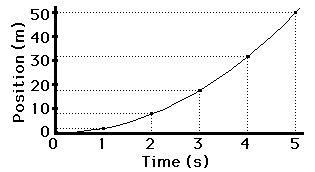
The picture of the position vs. time graph shows an object that is...
a)
accelerating/speeding up
b)
moving at a constant speed
c)
not moving
d)
accelerating/slowing down.
51.
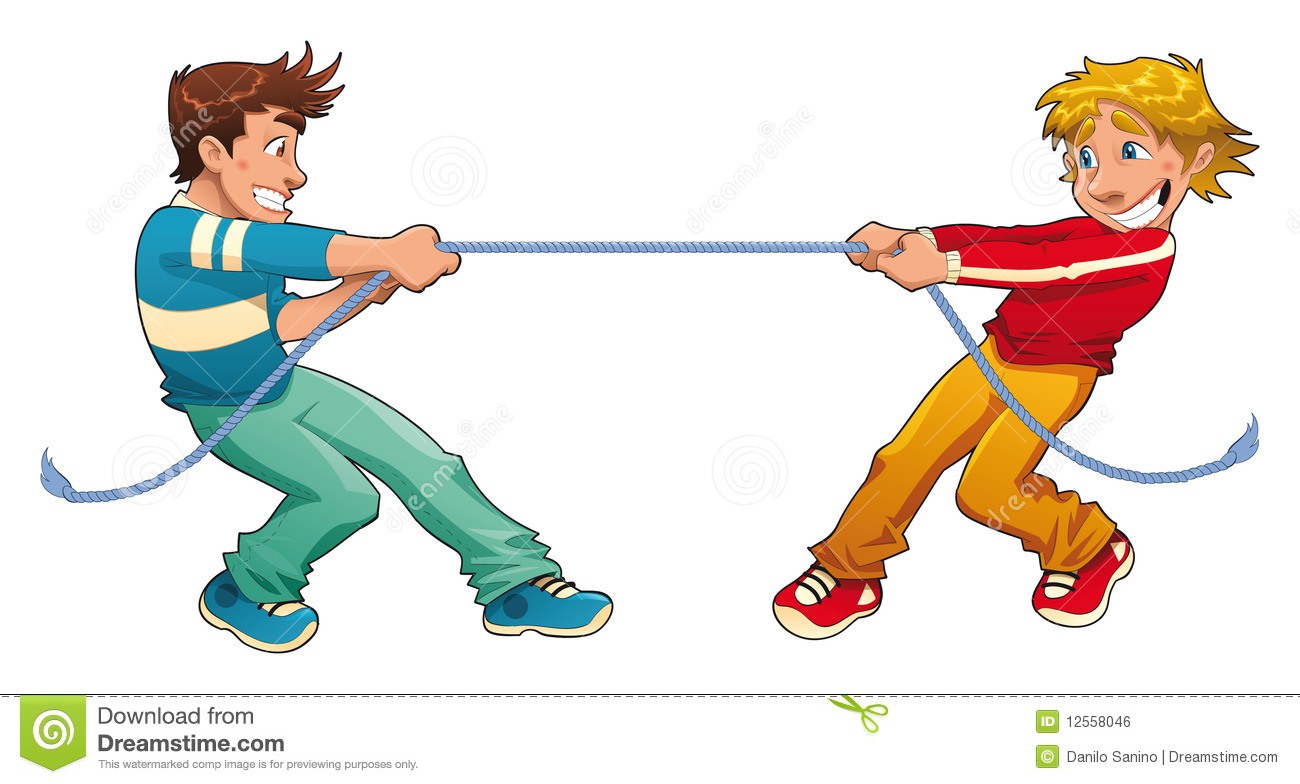
If these boys are pulling with the same amount of force. What will happen?
a)
The boy in blue will win.
b)
They will not move at all.
c)
The boy in red will win.
d)
Both will fall down.
52.
What is the standard unit force is measured in?
a)
Newtons
b)
pounds
c)
grams
d)
meters
53.
Which will be different on the moon?
a)
Mass of an object
b)
Weight of an object
54.
When an unbalanced force acts on an object, the force...
a)
Changes the motion of the object
b)
Is canceled by another force
c)
Does not change the motion of the object
d)
Is equal to the weight of the object
55.

What does this graph represent?
a)
Constant Speed
b)
Acceleration
c)
Deacceleration
d)
Not moving
56.

What is the person doing from 5 seconds to 10 seconds?
a)
Walking
b)
Running
c)
Standing Still
d)
Walking Fast
57.
Any change in position.
a)
acceleration
b)
speed
c)
motion
d)
force
58.
If the net force is equal to zero, the forces acting on the object are
a)
balanced
b)
unbalanced
59.
An _______ force must act on an object for it to CHANGE it's motion
a)
balanced
b)
unbalanced
c)
gravitational
d)
electrical
60.
Speed is
a)
the distance covered per unit of time
b)
the time it takes something to move a certain distance
c)
distance x time
d)
time x distance
61.
Objects tendency to resist change
a)
Friction
b)
Inertia
c)
Force
d)
Gravity
62.

A student leaves a pencil on a desk and the pencil stays in the same spot until another student picks it up.
a)
Law of Inertia
b)
Law of Acceleration
c)
Law of Conservation of Momentum
63.

A person not paying attention while skateboarding hits a rock. The skateboard stops...they don't.
a)
The Law of Inertia
b)
The Law of Acceleration
c)
The Law of Conservation of Momentum
64.

When you step on a Lego. You push on the Lego and the Lego pushes back on you.
a)
Newton's 1st Law
b)
Newton's 2nd Law
c)
Newton's 3rd Law
65.

What is the net force?
a)
400 N Up
b)
400 N Down
c)
- 400 N Down
d)
800 N Down
66.

Balanced or Unbalanced?
a)
Balanced
b)
Unbalanced
67.
What is the formula for force?
a)
F=M/A
b)
F=A/M
c)
F=M*A
d)
F=M*F
68.

What is the net force?
a)
10 N
b)
0 N
c)
25 N
d)
1 N
69.
An object is moving to the right at a constant velocity. What will happen if a force of 20N starts acting on it in the opposite direction?
a)
The object’s velocity will increase.
b)
The object’s velocity will decrease.
c)
The object will come to a stop.
d)
The object will move at the same velocity.
70.
How much work is done if you pull a wagon with 40 N and it moves 4 m?
a)
10 J
b)
160 J
c)
1600 J
d)
0.1 J
71.
The unit used to measure work is the
a)
Watt
b)
Newton
c)
Joule
d)
meter
72.
A force exerted over a distance to move an object is ______________________.
a)
power
b)
work
c)
momentum
d)
Watt
73.
A 5000N block is lifted 10 m. How much work was done?
a)
50000 J
b)
5000 J
c)
500 J
d)
50 J
74.
W=125 J
d=10 m
F=???
d=10 m
F=???
a)
12.5 N
b)
1250 N
c)
0.08 N
d)
135 N
75.
If 150 Joules of work is needed to move a box 10 meters, what force was used?
a)
1500 N
b)
15 N
c)
1.5 N
d)
150 N
76.
What is work?
a)
the amount of energy
b)
the transfer of force over a distance
c)
rate of work in a given time
d)
the change in distance in a given time
77.
What is the equation for work?
a)
W = mass * acceleration
b)
W = force * distance
c)
W = force/distance
d)
W = speed/time
78.
How much work is produced when 350 N is used to move a car 5 m?
a)
70 J
b)
1750 J
c)
355 J
d)
175 J
79.
If 68 Joules were necessary to move a 4 Newton crate, how far was the crate moved?
a)
272 m
b)
17 m
c)
4.05 m
d)
272 cm
80.
How much work is done in holding a 15 N sack of potatoes while waiting in line at the grocery store for 3 minutes?
a)
15 J
b)
45 J
c)
0 J
d)
5 J
81.
Work done = Force x _________
a)
a. distance
b)
b. acceleration
c)
c. velocity
d)
d. speed
82.
A joule is defined as __________
a)
One watt per second
b)
One horsepower per second
c)
A force of one pound over a distance of one foot
d)
A force of one newton over a distance of one meter
83.
A girl pushes a box across the floor. Did she do work?
a)
no
b)
yes
84.
If W=Fd
Then how much work is done if it takes 20N to move a box 10 meters
Then how much work is done if it takes 20N to move a box 10 meters
a)
0
b)
2
c)
20
d)
200
85.

What is the work done by the man?
a)
0 J
b)
65 J
c)
6500 J
d)
0.0065 J
86.
What is weight?
a)
It is the amount of matter in a body
b)
It is the amount of force in a body
c)
it is the gravitational force acting on a body
d)
it is the kinetic force acting on a body
87.
What is mass?
a)
It is the amount of matter in a body
b)
It is the amount of force in a body
c)
it is the gravitational force acting on a body
d)
it is the kinetic force acting on a body
88.
A man of weight 900 N walks up a hill of height 10 m. What is the total work done?
a)
0 J
b)
90 J
c)
900 J
d)
9000 J
89.
Calculate the work done on a 12 N backpack that is lifted 1.5 m.
a)
18 J
b)
0 J
c)
8 J
d)
180 J
90.

Why is pushing up a barrel up a ramp easier than lifting it up
a)
the reason why is because of fish
b)
the reason is because you are applying less force to push
c)
the reason why because you are using a machine
91.
The law of conservation of momentum states that,
a)
p before is less than p after
b)
p before is the same as p after
c)
p before is more than p after
92.
A 0.250 kg cart moving at 0.400 m/s has how much momentum?
a)
0.1 kg-m/s
b)
1 kg-m/s
c)
10 kg-m/s
d)
100 kg-m/s
93.
If 2 objects collide and stick together, what will happen to their velocities?
a)
velocities will increase
b)
velocities will decrease
c)
velocities will stay the same
d)
none of the above
94.
A 10kg toy truck moves at 5m/s East. It collides head-on with a 5kg toy car moving 10 m/s moving west. What is the total momentum of the system?
a)
0 kgm/s
b)
30 kgm/s
c)
50 kgm/s
d)
10 kgm/s
95.
A large box slides across a frictionless surface with a velocity of 12 m/s and a mass of 4 kg, collides with a smaller box with a mass of 2 kg that is stationary. The boxes stick together. What is the velocity of the two combined masses after collision?
a)
0 m/s
b)
4 m/s
c)
8 m/s
d)
12 m/s
96.
A 2.5 kg ball moving at 4.2 m/s collides with a 2.5 kg stationary ball in a perfectly elastic collision. What is the velocity of the second ball after the collision?
a)
2.1 m/s
b)
2.5 m/s
c)
4.2 m/s
d)
8.4 m/s
97.
A biker with a mass of 75 kg moves along the path with a constant velocity of 5 m/s. What is the biker's momentum?
a)
25 m/s
b)
375 m/s
c)
25 kg m/s
d)
375 kg m/s
98.
When the speed of an object is doubled, its momentum
a)
remains unchanged in accord with the conservation of momentum.
b)
doubles
c)
quadruples
d)
decreases
99.
When the speed of an object is doubled, its momentum
a)
remains unchanged in accord with the conservation of momentum.
b)
doubles
c)
quadruples
d)
decreases
100.
In this type of collision, objects tend to "stick" together.
a)
elastic
b)
inelastic
c)
They "stick" together in both types of collisions
101.
At the top of a rollercoaster loop, In what directions do gravity and the normal force point. A free body diagram is useful to help answer the question
a)
gravity: down, normal force: up
b)
gravity: down, normal force: down
c)
gravity: down: normal force: direction of motion
102.
A satellite of mass m and speed v orbits the Earth at a distance r from the centre of the Earth. The gravitational field strength due to the Earth at the satellite is equal to.
a)
v/r
b)
v2/r
c)
mv/r
d)
mv2/r
103.

A pilot experiences centripetal acceleration of 2g's while maneuvering a loop at a speed of 400 m/s. What is the radius of the loop?
a)
203 m
b)
8163 m
c)
80,003 m
d)
23 m
104.

What is the SI unit for circumference?
a)
meter
b)
pi
c)
inches
d)
kilometer
105.
What happens to the centripetal force exerted on an object if you triple the velocity?
a)
it increases to 3X
b)
it decreases to 6X
c)
it increases to 6X
d)
it increases to 9X
106.
Calculate the velocity of an object moved around a circle with a radius of 1.65 m and an acceleration of 3.5 m/s2.
a)
2.4 m/s
b)
3.6 m/s
c)
3.9 m/s
d)
4.2 m/s
107.
Calculate the centripetal force required to make a 5 kg ball move 4 m/s in a circle with a radius of 2 m.
a)
10 N
b)
20 N
c)
30 N
d)
40 N
108.
Centripetal force is...
a)
the resultant force acting on a body moving at constant speed in a circle
b)
the outwards force acting on a body moving at constant speed in a circle
109.

What was Sir Isaac Newton known for?
a)
His hair
b)
His discovery of the laws of motion
c)
How good he was at math
d)
How athletic he was
110.
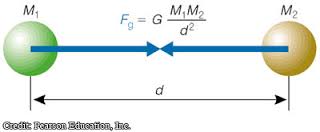
Complete the following statement: The farther away two planets are the _______ the gravitational force between them.
a)
more
b)
same
c)
dosen't matter
d)
less
111.

The sun is the anchor point of our solar system because of
a)
the gas Hydrogen
b)
its small density
c)
its huge mass
d)
its location
112.

What is gravitational force?
a)
a force that attracts any object
b)
a force that pushes any object
c)
a force that shrinks any object
d)
a force that enlarges anyobject
113.

What is the Universal law of gravitation equation?
a)
G=F ⋅ m⋅m2/r2
b)
F=G ⋅ m⋅m2/(r)2
c)
F=G ⋅ r2/m⋅m2
d)
G=F ⋅ r2/m⋅m2
114.

The mass of Jupiter is 300 x that of the Earth, but a person on its surface would only experience a gravitational attraction 3x that of Earth. What is the best explanation for this according to the Universal Law of Gravitation?
a)
Jupiter has a really big radius
b)
Jupiter has many moons
c)
Jupiter is mostly a rocky planet
d)
Jupiter is smaller than Saturn
115.

A moon is located at 1 unit out from the planet it orbits. If that moon was orbiting at 2 units out from the planet, how much would the gravitational force on the moon be compared to its distance at 1 unit?
a)
1/4
b)
1/6
c)
2x as much
d)
4 times as much
116.
The number 6.67 x 10 -11 N* m^2 / kg^2 is called the _______________.
a)
universal speed constant
b)
the speed force
c)
universal gravitational constant
d)
Earth's gravitational constant
117.

Kepler's first law that refers to the shape of planetary orbits is called ___________.
a)
the Law of Equal Areas
b)
the Law of Ellipses
c)
the Law of Harmonies
d)
the Universal Law of Gravitation
118.

Kepler's second law that refers to the amount of distance covered in equal time intervals along an orbit is referred to as ____________.
a)
the Law of Ellipses
b)
the Law of Equal Areas
c)
the Law of Harmonies
d)
the Law of Universal Gravitation
119.

A person on the Earth weighs 180 pounds. How much will they weigh on the moon? ( Note: The moons "g" is1/6 that of Earth)
a)
30 lbs
b)
360 lbs
c)
0- you are weightless in space
d)
18 lbs
120.

When speed decreases, what happens to the value of torque?
a)
increases
b)
decreases
c)
stays constant
121.
When on a bike going uphill, what happens to the speed and torque?
a)
Speed decreases; torques increases
b)
Speed decreases; torques decreases
c)
Speed increases; torques decreases
d)
Speed increases; torques increases
122.
On a Ferris wheel, what happens to the speed and torque from the control panel motor to the gear attached to the ferris wheel?
a)
Speed decreases; torques increases
b)
Speed decreases; torques decreases
c)
Speed increases; torques decreases
d)
Speed increases; torques increases
123.
When on a bike going downhill, what happens to the speed and torque?
a)
Speed decreases; torques increases
b)
Speed decreases; torques decreases
c)
Speed increases; torques decreases
d)
Speed increases; torques increases
124.

When speed increases, what happens to the value of motor load torque?
a)
increases
b)
decreases
c)
stays constant
125.

What is an example of a 3rd class lever?
a)
nut cracker
b)
fishing pole
c)
scissors
d)
car door
126.

What is an example of a 2nd class lever?
a)
scissors
b)
wheel barrel
c)
bat
d)
fishing pole
127.

What is an example of a 1st class lever?
a)
broom
b)
tweezers
c)
wheel barrel
d)
scissors
128.

The direction is changed if...
a)
MA<1
b)
MA=1
c)
MA>1
d)
all of the above
129.
What is the Unit for Torque
a)
Nm
b)
N
c)
M
d)
no unit
130.

The centripetal force of satellites is similar to gravitational force because they are both a net force towards the center of earth.
a)
True
b)
False
100 %

