
 Worksheets
Physics Quiz
Total questions: 130
Worksheet time: 2hrs 25mins
What is the equation that links gravitational field strength, mass and weight?
weight = mass x gravitational field strength
weight = mass ÷ gravitational field strength
weight = gravitational field strength ÷ mass
What is the equation that links distance, force, and work done?
work done = force x distance
work done = force ÷ distance
work done = distance ÷ force
What is the equation that links extension, force applied to a spring, and spring constant?
force applied to a spring = spring constant x extension
force applied to a spring = spring constant ÷ extension
force applied to a spring = extension ÷ spring constant
What is the equation that links distance, time, and velocity?
velocity = time x distance
velocity = distance ÷ time
velocity = time ÷ distance
What is the equation that links acceleration, change in velocity, and time?
acceleration = change in velocity x time
acceleration = change in velocity ÷ time
acceleration = time ÷ change in velocity
What is the equation that links acceleration, mass, and resultant force?
resultant force = mass x acceleration
resultant force = mass ÷ acceleration
resultant force = acceleration ÷ mass
What is the equation that links mass, momentum, and velocity?
momentum = mass x velocity
momentum = mass ÷ velocity
momentum = velocity ÷ mass
What is the momentum of a toy car of mass 500 g, travelling at a velocity of 30 m/s?
0.15 kgm/s
15 kgm/s
15 000 kgm/s
15 000 000 kgm/s
What is the unit of work?
Newton
Joule
Watt
meter
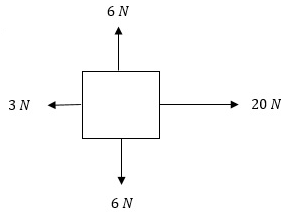
What is the resultant force in this diagram?
17 N, right
17 N, left
23 N, right
12 N, up
What equation links distance, speed, and time?
speed = time ÷ distance
speed = distance ÷ time
speed = distance x time
speed = time x distance
Which of the following is a unit for acceleration?
km/s
m/s^2
mi/hr
ft
Which of these can be measured in meters per second (m/s)?
Distance
Time
Speed
Acceleration
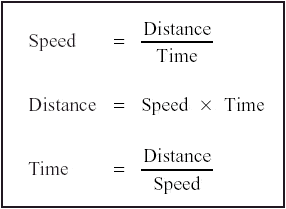
Calculate the average speed (in m/s) if a cheetah runs 180 metres in 10 seconds.
198 m/s
170 m/s
12 m/s
18 m/s
Of the following, which is a vector?
Mass
Time
Speed
Velocity
Acceleration is defined as the "change in..."
the time it takes to move from one place to another.
velocity of an object.
distance, divided by the time taken.
velocity, divided by the time taken.
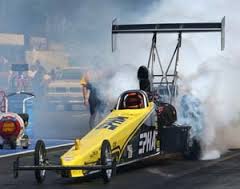
A drag racer accelerated from 0 m/s to 200 m/s in 5 s. What was the acceleration?
0 m/s
40 m/s^2
-40 m/s^2
40 m/s

A golf ball accelerates off a tee at 15m/s2, changing its velocity from 0m/s to 50 m/s down the fairway. How long did it take the golf ball to accelerate?
750 seconds
35 seconds
0.3 seconds
3.3 seconds
A dog runs with an initial speed of 7.5 m/s on a waxed floor. It slides to a stop in 15 seconds. What is the acceleration?
-7.5 m/s
-7.5 m/s^2
-0.5 m/s^2
0.5 m/s
A spring has a spring constant of 5 N/cm. What is its extension when loaded with 15 N?
3 cm
5 cm
3 m
5 m
Which statement is true about a moving object?
When an object is ....
...accelerating, the resultant force acting on it must be zero
... moving at a steady speed, the air resistance acting on it must equal zero
... moving at a steady speed, the resultant force acting on it must equal zero
... moving, there must be a resultant force acting on it.
A woman lifts 20 bricks, each of weight 6N. What other information is needed to calculate the useful work done in lifting the bricks?
the distance she lifts the bricks
the mass of the bricks
the time taken to lift the bricks
the volume of the bricks

How far does the car travel before it reaches a steady speed?
10m
20m
100m
200m
Which statement is correct about a bottle of water?
its mass at the North Pole is different from its mass at the Equator
its mass is measured in newtons
its weight and mass are the same thing
its weight is one of the forces acting on it

Which statement about mass and weight is correct?
Mass and weight are both forces
Neither mass nor weight is a force
Only mass is a force
Only weight is a force

In a race, a car travels 60 times around a 3.6 km track. This takes 2.4 hours. What is the average speed of the car?
1.5 km/h
90 km/h
144 km/h
216 km/h
Which quantity is measured in newtons?
density
energy
pressure
weight
Two forces act on an object. In which situation is it IMPOSSIBLE for the object to be in equilibrium?
The two forces act in the same direction
The two forces act through the same point
The two forces are of the same type
The two forces are the same size
What is the equation that links gravitational field strength, mass, and weight?
weight = mass x gravitational field strength
weight = mass ÷ gravitational field strength
weight = gravitational field strength ÷ mass
What is the equation that links distance, force, and work done?
work done = force x distance
work done = force ÷ distance
work done = distance ÷ force
What is the equation that links extension, force applied to a spring, and spring constant?
force applied to a spring = spring constant x extension
force applied to a spring = spring constant ÷ extension
force applied to a spring = extension ÷ spring constant
What is the equation that links distance, time, and velocity?
velocity = time x distance
velocity = distance ÷ time
velocity = time ÷ distance
What is the equation that links acceleration, change in velocity, and time?
acceleration = change in velocity x time
acceleration = change in velocity ÷ time
acceleration = time ÷ change in velocity
What is the equation that links acceleration, mass, and resultant force?
resultant force = mass x acceleration
resultant force = mass ÷ acceleration
resultant force = acceleration ÷ mass
What is the equation that links mass, momentum, and velocity?
momentum = mass x velocity
momentum = mass ÷ velocity
momentum = velocity ÷ mass
What is the momentum of a toy car of mass 500 g, travelling at a velocity of 30 m/s?
0.15 kgm/s
15 kgm/s
15 000 kgm/s
15 000 000 kgm/s
What is the unit of work?
Newton
Joule
Watt
meter
What is the resultant force in this diagram?
17 N, right
17 N, left
23 N, right
12 N, up
What equation links distance, speed, and time?
speed = time ÷ distance
speed = distance ÷ time
speed = distance x time
speed = time x distance
Which of the following is a unit for acceleration?
km/s
m/s^2
mi/hr
ft
Which of these can be measured in meters per second (m/s)
Distance
Time
Speed
Acceleration
Calculate the average speed (in m/s) if a cheetah runs 180 metres in 10 seconds.
198 m/s
170 m/s
12 m/s
18 m/s
Of the following, which is a vector?
Mass
Time
Speed
Velocity
Acceleration is defined as the "change in..."
the time it takes to move from one place to another.
velocity of an object.
distance, divided by the time taken.
velocity, divided by the time taken.
A drag racer accelerated from 0 m/s to 200 m/s in 5 s. What was the acceleration?
0 m/s
40 m/s^2
-40 m/s^2
40 m/s
A golf ball accelerates off a tee at 15m/s2, changing its velocity from 0m/s to 50 m/s down the fairway. How long did it take the golf ball to accelerate?
750 seconds
35 seconds
0.3 seconds
3.3 seconds
A dog runs with an initial speed of 7.5 m/s on a waxed floor. It slides to a stop in 15 seconds. What is the acceleration?
-7.5 m/s
-7.5 m/s2
-0.5 m/s2
0.5 m/s
A spring has a spring constant of 5 N/cm. What is its extension when loaded with 15 N?
3 cm
5 cm
3 m
5 m

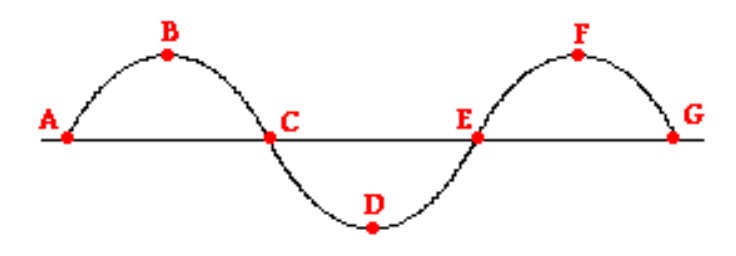
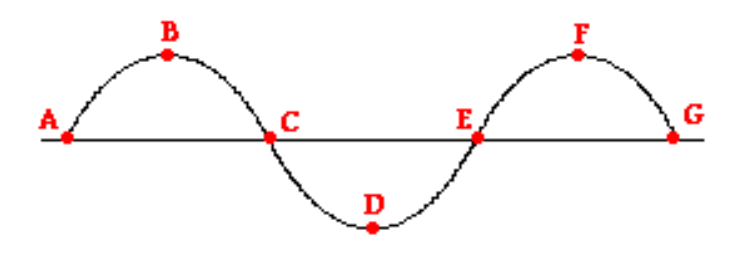
Which type of wave is illustrated in the diagram?
Longitudinal
Slinky
Transverse
Water

Which of the following are examples of transverse waves?
Gamma waves
Ultrasonic waves
Ultraviolet waves
Sound waves
Visible light

Which letter(s) represents the wavelength of the wave?
a
b
c
d
e

What is the amplitude of this wave?
0.20 m
0.40 m
2.0 s
4.0 s
What is the time period of this wave?
0.20 m
0.40 m
2.0 s
4.0 s
What is the frequency of this wave?
0.25 Hz
0.50 Hz
2.0 s
4.0 s

Which of the following is the wave equation used to find wave speed?
T = 1/f
f = 1/T
v = f/λ
V = f x λ

The time period of this wave is 2 seconds. What is the wave speed?
1.0 m/s
2.0 m/s
4.0 m/s
8.0 m/s

A gamma ray has a frequency of 1.0 x 10 20 Hz and travels at 3.0 x 10 8 m/s. What is it’s wavelength?
3.3 x 10 -13 m
3.0 x 10 -12 m
3.3 x 10 11 m
3.0 x 10 12 m

Max is sitting in his boat observing water waves enter the harbour. He counts 20 waves passing into the harbour in one minute. What is the frequency?
0.33 Hz
3.0 Hz
20 Hz
1200 Hz

All waves transfer energy?
True
False

Which of the following is the correct order for the electromagnetic spectrum shown above?
Gamma, X-ray, UV, Visible, IR, Microwave, Radio
Radio, IR, Microwave, Visible, UV, X-ray, Gamma
Gamma, UV, X-ray, Visible, IR, Microwave, Radio
Radio, Microwave, IR, Visible, UV, X-ray, Gamma

Which of the following types of electromagnetic radiation has the longest wavelength?
Gamma
X-ray
Radio
Microwave

Which of the following types of electromagnetic radiation has the largest frequency?
Gamma
X-ray
Radio
Microwave

Which of the following do all regions of the electromagnetic spectrum have in common?
Travel at the speed of light (3.0 x 10 8 m/s)
Cannot travel in a vacuum
Can be reflected, refracted and polarised
Need a medium to travel in

Other than scanning for broken bones, which of the following is a use of gamma radiation?
Night vision equipment
Destroying bacteria in water chillers
Satellite communication
Location of tumours

Which of the following is a danger of UV radiation?
Causes skin cancer
Causes hearing damage
Easily absorbed by water in the body’s cells
Can cause cancer of the brain

Other than cooking food, which of the following is a use of microwave radiation?
Night vision equipment
Destroying bacteria in water chillers
Satellite communication
Location of tumours

Which of the following is a danger of IR radiation?
Causes burns
Causes hearing damage
Easily absorbed by water in the body’s cells
Causes cancer

Which of the following are dangers of visible light?
Can cause damage to the retina
Easily absorbed by water in the cells of the body
Causes cancer
Can burn corneas
What is the Equation for Weight?
Weight = Mass x Gravitational Field Strength
Weight = Mass / Gravitational Field Strength
Weight = Gravitational Field Strength / Mass
What is the Equation for Work Done?
Work Done = Force x Distance
Work Done = Force / Distance
Work Done = Distance / Force
What is the Equation for Force applied to a Spring?
Force applied to a Spring = Spring Constant x Extension
Force applied to a Spring = Spring Constant / Extension
Force applied to a Spring = Extension / Spring Constant
What is the Equation for a Moment of a Force?
Moment of a Force = Force x Distance
Moment of a Force = Force / Distance
Moment of a Force = Distance / Force
What is the Equation for Pressure?
Pressure = Force x Area of Surface
Pressure = Force / Area of Surface
Pressure = Area of Surface / Force
What is the Equation for Acceleration?
Acceleration = Change in Velocity x Time
Acceleration = Change in Velocity / Time
Acceleration = Time / Change in Velocity
What is the Equation for Resultant Force?
Resultant Force = Mass x Acceleration
Resultant Force = Mass / Acceleration
Resultant Force = Acceleration / Mass
What is the Equation for Momentum?
Momentum = Mass x Velocity
Momentum = Mass / Velocity
Momentum = Velocity / Mass
What is the Equation for Kinetic Energy?
Kinetic Energy = 0.5 x Mass x Speed²
Kinetic Energy = 0.5 x Mass² x Speed
Kinetic Energy = 0.5 x Mass² / Speed
What are Equations for Gravitational Potential Energy?
Gravitational Potential Energy = Mass x Gravitational Field Strength x Height
Gravitational Potential Energy = Weight x Height
Gravitational Potential Energy = Mass x Gravitational Field Strength / Height
Gravitational Potential Energy = Weight / Height
Which are the Equations for Power?
Power = Energy Transferred / Time
Power = Work Done / Time
Power = Energy Transferred x Time
Power = Work Done x Time
What is the Equation for Wave Speed?
Wave Speed = Wave Length x Frequency
Wave Speed = Wave Length / Frequency
Wave Speed = Frequency / Wave Length
What is the Equation for Charge Flow?
Charge Flow = Current x Time
Charge Flow = Current / Time
Charge Flow = Time / Current
What is another Equation for Power?
Power = Potential Difference x Current
Power = Potential Difference / Current
Power = Current / Potential Difference
What is another Equation for Power?
Power = Current² x Resistance
Power = Resistance² x Current
Power = Resistance² / Current
What are the Equations for Energy Transferred?
Energy Transferred = Power x Time
Energy Transferred = Power / Time
Energy Transferred = Charge Flow x Potential Difference
Energy Transferred = Charge Flow / Potential Difference
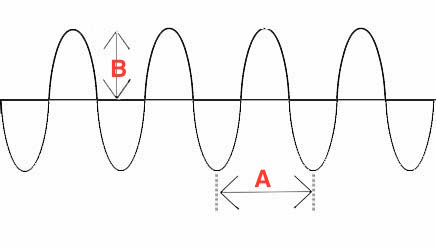
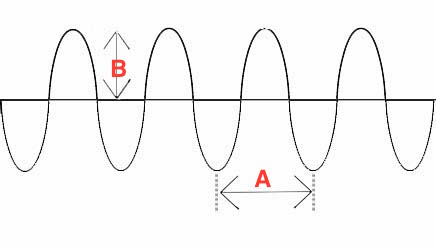
What property of this wave is represented by the letter "A"
amplitude
crest
trough
wavelength

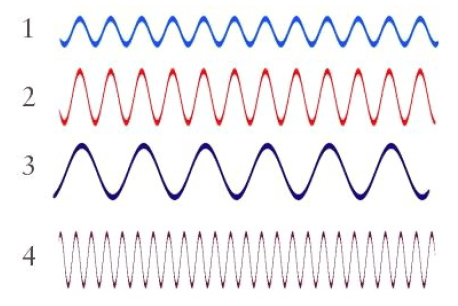
Which wave in the diagram has the highest frequency?
1
2
3
4
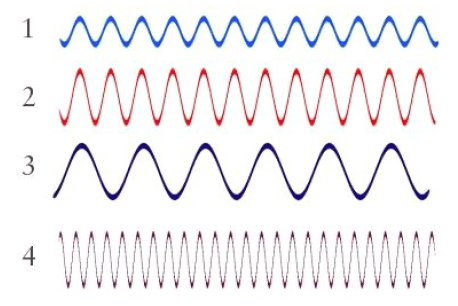
Which wave in the diagram has the longest wavelength?
1
2
3
4
What is the term describing regular disturbances that carry energy through matter or space?
crest
energy
wave
trough
Through which material does sound travel the fastest?
solid
liquid
gases
vacuum
What is the term when a wave strikes and object and bounces off (example echo).
medium
refraction
reflection
interference
What is the term describing when a wave bends, as it passes through at an angle, from one medium to another. (example: pencil in a glass of water)
medium
refraction
reflection
interference


Mobile phones use _____________ waves for the signal to link to the mobile network.
Microwaves
Gamma
XRays
Radio


The angle of incidence is _________ the angle of reflection

For Electromagnetic waves (EM waves). As frequency increases, the ___________ decreases.
amplitude
wavelength
brightness
sound
What is the correct order for the electromagnetic spectrum? (select two)
Radio, Micro, UV, Visible, IR, X-ray, Gamma
Gamma, X-ray, UV, Visible, IR, Micro, Radio
Radio, Micro, IR, Visible, UV, X-ray, Gamma
Gamma, X-ray, IR, Visible, UV, Micro, Radio
What range of wavelength does the EM spectrum cover?(from radio waves to gamma rays)
1015 to 10-4
104 to 10-15
108 to 10-8
10 to 10-32

