
 Worksheets
Electricity and Magnetism
Total questions: 127
Worksheet time: 2hrs 58mins
Name
Class
Date
1.
Electricity that flows in a closed path is called a
a)
path
b)
current
c)
circuit
2.
The flow of electricity in a circuit-
a)
current
b)
flow
c)
circuit
3.
Magnetism created by an electric current
a)
electricity
b)
electromagnetism
c)
wind energy
4.
____________ allows electricity to flow.
a)
A conductor
b)
An insulator
c)
A magnet
5.
____________ stops the flow of electricity.
a)
A conductor
b)
An insulator
c)
A magnet
6.
To complete a circuit the switch must be
a)
unattached
b)
open
c)
closed
7.
When the switch is closed, the light
a)
comes on
b)
stays off
c)
burns out
8.
The plastic around the wire is
a)
conductor
b)
insulator
c)
decoration
9.
Two batteries in a circuit make the lights in the circuit brighter than one battery.
a)
true
b)
false
10.
In a parallel circuit the current
a)
makes one circle
b)
stays in one path
c)
splits and goes through two components
11.
Two types of circuits are
a)
parallel and magnetic
b)
electromagnetic and series
c)
series and parallel
12.
An example of a parallel circuit is
a)
the wiring in a house
b)
a flashlight
c)
a single circular path
13.
The flow of electricity requires a
a)
complete path
b)
incomplete path
c)
insulated current
14.
Opposite charges
a)
attract
b)
repel
15.
What do you call an object that allows electricity to flow?
a)
Conductor
b)
Insulator
c)
Resistance
d)
Electromagnet
16.

Is this circuit open or closed?
a)
Closed
b)
Open
17.
Current is the ...
a)
pressure of electricity
b)
flow of electrons from atom to atom
c)
tendency of a material to resist the flow of electricity.
d)
total power
18.

A closed pathway through which electricity can flow is called
a)
Closed circuit
b)
switch
c)
load
d)
insulator
19.
What are the materials that make up a simple circuit?
a)
wires, switch, outlet
b)
battery, switch, motor
c)
wires, light bulb, motor
d)
wires, battery, load (like a bulb)
20.
What is one thing every circuit needs?
a)
insulator
b)
flashlight
c)
power source
d)
switch
21.

What do the lines around this magnet represent?
a)
North Pole
b)
South Pole
c)
Magnetic Declination
d)
Magnetic Field
22.

If you place the North pole of a magnet next to the South pole of another magnet, they will:
a)
Attract
b)
Repel
c)
Do nothing
23.
What is the measure of how much a material opposes the flow of electricity?
a)
Conductor
b)
Insulator
c)
Circuit
d)
Resistance
24.
Tiny particles that have a negative charge
a)
protons
b)
neutrons
c)
electrons
d)
circuits
25.
Electricity is the flow of ______.
a)
electrons
b)
protons
c)
neutrons
d)
atoms
26.
In an electrical circuit, electrons move from the __________.
a)
Negative pole to negative pole
b)
Negative pole to positive pole
c)
Positive pole to positive pole
27.

In a cell, which form of energy is converted into electrical energy?
a)
Chemical energy
b)
Solar energy
c)
Mechanical energy
d)
Electrical energy
28.
Which best describes a parallel circuit?
a)
Electricity flows along one pathway.
b)
The flow of electricity comes from one source.
c)
Electricity flows along more than one pathway.
d)
The flow of electricity comes from more than one source.
29.
Which best describes a series circuit?
a)
It has two light bulbs.
b)
The same current flows through both light bulbs.
c)
It uses a single battery.
d)
The current is divided between the light bulbs.
30.
What is one problem with using a series circuit?
a)
It has a lot of series.
b)
If one goes down, they all go down!
c)
It doesn't work properly.
d)
There are no problems.
31.
What is one benefits of using a parallel circuit?
a)
It gets confusing.
b)
There are no problems.
c)
If one goes down, it does not affect the others.
d)
Porque es para llelio.
32.

Pick the correct sentence.
a)
This circuit will work because it is a closed circuit.
b)
Energy will freely flow in this circuit.
c)
This circuit will not work because there is no energy source.
d)
This circuit will not work because there is no switch.
33.
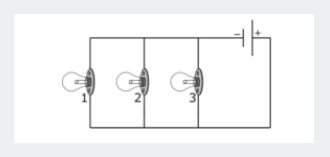
If bulb 1 burns out, what will occur?
a)
bulbs 2 and 3 will go out
b)
bulbs 2 and 3 receive more volts
c)
bulbs 2 and 3 will stay lit
d)
nothing will happen
34.

What will happen if one light bulb is removed from this circuit?
a)
the other bulbs will go out
b)
the other bulbs will get dimmer
c)
the other bulbs will get brighter
d)
the battery will become stronger
35.

What kind of circuit is this?
a)
Series
b)
Consecutive
c)
Parallel
d)
Training
36.

What kind of circuit is this?
a)
Series
b)
Consecutive
c)
Parallel
d)
Training
37.

What kind of circuit is this?
a)
series
b)
parallel
38.
Why are homes not wired in series circuits?
a)
The house will burn down
b)
If you turn off one appliance, the rest will turn off.
c)
Homes are wired in series circuits.
39.
If you add a second battery to your series circuit, what will happen to the current in your circuit?
a)
Decrease
b)
Increase
c)
Stay the same
40.

What is another name for a lightbulb in a circuit?
a)
Switch
b)
Load
c)
Power Source
41.

What is another name for a battery in a circuit?
a)
Load
b)
Power Source
c)
Switch
42.
In magnets, like poles will _______.
a)
attract
b)
repel
c)
pull
d)
come together
43.
Which situation will increase the resistance of a wire?
a)
heat
b)
cold
c)
water
d)
air
44.
Which type of wire will increase the resistance to electrical currents?
a)
thin
b)
thick
c)
copper
d)
nickel
45.
What is the measure of how much work needed to move an electric charge between 2 points?
a)
Ampere
b)
Voltage
c)
Ohms
d)
Energy
46.
What is the rate at which an electric charge passes a given point?
a)
Voltage
b)
Electric Current
c)
Ohms
d)
Resistance
47.
Which type of electric current are you using when you turn on your TV at home?
a)
AC
b)
DC
c)
Resistance
d)
Conductive
48.
Which type of electric current are you using when you text your friends while walking in the mall?
a)
AC
b)
DC
c)
Resistance
d)
Conductive
49.
What is the part of the circuit that the energy is transferred through?
a)
Energy Source
b)
load
c)
wire
d)
switch
50.
Magnets exert forces on each other and are surrounded by _____.
a)
Magnetic Field
b)
Forces of attraction
c)
Forces that repel
d)
voltage
51.
Which part of a magnet has the energy flow into it?
a)
North Pole
b)
South Pole
c)
Middle
d)
Magnetic Field
52.
Lightening is an example of _____.
a)
Insulator
b)
Electrostatic discharge
c)
Voltage
d)
Conductor
53.
Which type of object will increase the resistance of the flowing electricity?
a)
copper
b)
long wire
c)
short wire
d)
nickel
54.

What are electric fields?
a)
electric fields are jackson dabing
b)
electric fields are ballons and stuff
c)
electric fields are areas surrounding an object that are influenced by an object
d)
electric fields are electrons
55.

What is a gravitational field?
a)
gravitational fields are electrical fields
b)
a gravitational field surrounds the earth, providing a force that pulls us.
c)
gravitational fields is a bunch of brown gravy in a field
d)
gravitational field is the electric slide
56.

What three things conduct electricity?
a)
gold,silver, yoyo
b)
silver, gold, electricity,
c)
silver,carbon,copper
d)
silver,copper,Ben franklin
57.

What energy is electrical energy?
a)
energy created by electrons
b)
puppy monkey baby
c)
protons
d)
dancing
58.

What three things can't conduct electricity?
a)
rubber,wood,gold
b)
fabric,wood,rubber
c)
cold glass, wood, deer
d)
coffe,tin,book
59.

Fill in the blank: ________ energy is the ability to do work where work is done when a force moves an object
a)
gravitational fields
b)
electrical fields
c)
static
d)
electrical
60.

This is a picture of a simple electromagnet. How can the electromagnet be made stronger?
a)
Add more coils of wire to the nail.
b)
Use a smaller battery.
c)
Reverse the poles of the magnet.
d)
Remove all the coils and the nail.
61.

What kind of magnet can be turned on and off?
a)
refridgerator magnet
b)
electromagnet
c)
magnetite
d)
iron
62.
Surrounding every magnet is a __________ __________.
a)
magnetic field
b)
electrical current
c)
another magnet
63.
What is the name of the force that attracts or repels materials?
a)
current
b)
electricity
c)
magnetism
64.
Electromagnets are often used:
a)
in compasses
b)
a device on the end of a crane used to lift scrap metal
c)
in insulators
d)
in solar heaters
65.

How are electromagnets different from magnets?
a)
magnets can be turned on/off
b)
you can turn an electromagnet on/off
c)
magnets are more powerful
d)
magnets have a North and South pole
66.

Contains coils of wire that are stationary and rotating magnets that are moved by turbines.
a)
generator
b)
electric motor
c)
electromagnet
67.

Transforms mechanical energy to electrical energy.
a)
generator
b)
electric motor
c)
electromagnet
68.

Changes electrical energy into mechanical energy
a)
generator
b)
electric motor
c)
electromagnet
69.

The coil of the electromagnet must be connected to a __________ or another source of electricity.
a)
battery
b)
wire
c)
magnet
70.
What is the formula for resistance?
a)
V x I = R
b)
R = V/I
71.
Voltage is measured in __.
a)
volts.
b)
watts.
c)
coulombs.
72.
The tendency for a material to oppose the flow of electrons, changing electrical energy into thermal energy and light.
a)
Voltage
b)
Current
c)
Resistance
d)
Circuit
73.
According to this law, the current in a circuit equals the voltage difference divided by the resistance.
a)
Law of Conservation of Energy
b)
Ohm's Law
c)
Law of Conservation of Charges
d)
Newton's First Law
74.
Which one uses less wire?
a)
Parallel circuit
b)
Series Circuit
75.
Resistance is measured in ___.
a)
watts.
b)
amps.
c)
ohms.
76.
What is current measured in?
a)
Inches
b)
Amperes
c)
Centimeters
d)
Newtons
77.
The charge that stays on an object that can either repel or attract objects is
a)
static electricity
b)
conductor
c)
insulator
d)
force
78.
If two negative charges are held close together and then released, the charges will
a)
accelerate toward each other.
b)
accelerate away from each other.
c)
not move.
d)
move at a constant speed away from each other
79.
An electric field has
a)
direction.
b)
magnitude.
c)
Both A and B
80.
A volt is a unit of
a)
charge. .
b)
electric potential.
c)
energy.
d)
work.
81.
What size resistor would produce a 3 Amp current flow with a 12 Volt battery
a)
1 Ohm
b)
3 Ohms
c)
4 Ohms
d)
12 Ohms
82.
If the battery produced 12.6 Volts and what would be the current flow be for a 6 Ohm resistor
a)
2.1 Amps
b)
2.4 Amps
c)
1.71 Amps
d)
15 Amps
83.
How many Volts would we need to produce a current flow of 8 Amps through a 6 Ohm resistor
a)
12 volts
b)
24 volts
c)
1.3333
d)
48 volts
84.
A Charging system producing 14.5 Volts with a current flow of 43.5 Amps, what is the circuit resistance
a)
58 Amps
b)
0.33 Amps
c)
13 Amps
d)
1 Amp
85.

) What would happen if an extra battery cell is added?
a)
A)The lights will glow dim
b)
The wire will glow
c)
The lights will glow brighter
d)
None of the above
86.
According to this law, the current in a circuit equals the voltage difference divided by the resistance.
a)
Law of Conservation of Energy
b)
Ohm's Law
c)
Law of Conservation of Charges
d)
Newton's First Law
87.
Two resistors are connected in series. If both have a resistance of 10 Ohms, their total resistance will be?
a)
10 Ω
b)
20 Ω
c)
0.5 Ω
d)
8 Ω
88.
A solenoid is a?
a)
protective device
b)
an electromagnetic device
c)
a type of battery
d)
is very solid
89.
P = V x I can be recalled through the?
a)
Ohm's law triangle
b)
Power Circle triangle
c)
Power triangle
d)
Ohm's law circle
90.
If a transformer has 200 V coming in, and has a turns ratio of 1:2, its output voltage will be?
a)
200 V
b)
400 V
c)
50 V
d)
25 V
91.
Watts is the unit of...
a)
Power
b)
Current
c)
Voltage
d)
Resistance
92.
The power of an appliance is...
a)
the amount of voltage going through it
b)
the amount of energy transferred per second
c)
the amount of charge that passes through per second
93.
Electrical power can be calculated using
a)
Resistance x Voltage
b)
Voltage x Current
c)
Voltage ÷ Current
94.

The voltage supplied to a circuit is 17 V and the current running through is 10 A. What is the power generated?
a)
170 W
b)
170 A
c)
1.7 V
d)
1.7 W
95.

Calculate the electric power of an electrical appliance in which 10 A of current is flowing through a resistor of 2 ohms.
Remember: V=IR and P=VI
Remember: V=IR and P=VI
a)
80 W
b)
200 W
c)
2.5 A
d)
22.5 KJ
96.
What energy is electrical energy?
a)
energy created by electrons
b)
puppy monkey baby
c)
protons
d)
dancing
97.
What are the units for energy?
a)
kWh
b)
Joules
c)
Both
d)
Neither
98.
How many kilowatts are in 6500 W
a)
0.65 kW
b)
6.5 kW
c)
65 kW
d)
6,500,000 kW
99.
How many watts are in 2 kW
a)
0.2 W
b)
2 W
c)
200 W
d)
2000 W
100.
When a balloon is rubbed on clothes it acquires a charge by ___________.
a)
Induction
b)
Reduction
c)
Friction
d)
Conduction
101.
A material in which electrons are able to move easily is....
a)
Circuit
b)
Insulator
c)
Resistance
d)
Conductor
102.
An example of a conductor is :
a)
a glass paperweight
b)
a plastic cap
c)
a metal nail
d)
a wooden handle
103.

After Sarah brushed her hair with her comb, she placed it near some uncharged pieces of paper. Which of the following statements BEST describes what happened in the picture?
a)
the paper was not attracted or repelled by the comb
b)
the paper was attracted to the comb even before they touched
c)
the paper was repelled by the comb before they touched
d)
the paper was positively charged
104.

Choose the number of the picture that shows an unsuccessful circuit and the correct explanation as to why it was unsuccessful.
a)
1 because it is not a closed circuit
b)
2 because the circuit is open
c)
3 because there are too many light bulbs
d)
4 because there are too many batteries
105.
Which of the following forms of energy are BEST represented by a lit light bulb?
a)
chemical, light and potential
b)
heat, kinetic and light
c)
electrical, kinetic and potential
d)
electrical, light and heat
106.

What types of charges attract?
a)
Positive and Positive
b)
Positive and Neutral
c)
Negative and Neutral
d)
Positive and Negative
107.
Surrounding every moving electron is
a)
(a) a magnetic field
b)
(b) an electric field
c)
(c) both of these
d)
(d) none of these
108.
When there is a change in the magnetic field in a closed loop of wire
a)
(a) a voltage is induced in the wire
b)
(b) current is made to flow in the loop of wire
c)
(c) electromagnetic induction occurs
d)
(d) all of these
109.
Thrust a magnet into a coil of wire. While the magnet is being moved toward the coil
a)
(a) becomes an electromagnet
b)
(b) has a current in it
c)
(c) both of these
d)
(d) neither of these
110.
If a magnet is pushed into a coil, voltage is induced across the coil. If the same magnet is pushed
into a coil with twice the number of loops,
into a coil with twice the number of loops,
a)
a. one-half as much voltage is induced.
b)
b. the same voltage is induced.
c)
c. twice as much voltage is induced.
d)
d. four times as much voltage is induced.
111.
What condition is necessary for an electric charge to have a magnetic field around it?
a)
a. it must be in a copper wire
b)
b. it must be isolated from the opposite charge
c)
c. it must be moving
d)
d. it must be motionless
112.
Electromagnetic induction occurs in a coil when there is a change in
a)
a. electric field intensity in the coil.
b)
b. magnetic field intensity in the coil.
c)
c. voltage in the coil.
d)
d. the coil's polarity.
113.
which two poles will attract
a)
N-N
b)
S-S
c)
S-N
d)
always attract
114.
What is the major difference between static electricity and current electricity?
a)
Current electricity involves a continuous flow of neutrons; static electricity is a sudden transfer of protons
b)
Current electricity can be deadly; static electricity is almost always safe
c)
In current electricity, there's a single transfer of electrons; in static electricity, there's a steady flow of electrons
d)
Current electricity involves a flow of electrons; static electricity involves a single transfer of electrons
115.
What is static electricity caused by?
a)
A balance of power
b)
A balance of positive and negative charges
c)
An imbalance of positive and negative charges
d)
An imbalance of protons and neutrons
116.
What happens when you touch a metal doorknob after rubbing your shoes on the carpet?
a)
The doorknob sends a burst of electric current into your body
b)
Millions of electrons go from your finger into the doorknob
c)
The doorknob sends millions of electrons into your finger
d)
our finger becomes negatively charged
117.
Which of the following is caused by static electricity?
a)
a stove getting hot when it is turned on
b)
a magnet being attracted to a refrigerator
c)
a lightning strike during a storm
d)
a light bulb coming on when a switch is turned on
118.
Method of charging an object by allowing electric charge to flow by direct contact from one object to another object.
a)
friction
b)
conduction
c)
electric force
d)
induction
119.
A method of charging an object by rubbing it against another object.
a)
friction
b)
conduction
c)
electric force
d)
induction
120.
Ms Jo Jo rubbed two balloons with a piece of wool. What will happen when the balloons are brought near each other?
a)
The balloons will pop.
b)
The balloons will attract each other.
c)
The balloons will become positively (+) charged.
d)
The balloons will repel each other.
121.
Which term is not a method for charging an object with static electricity
a)
Alternating Current
b)
Induction
c)
Conduction
d)
Friction
122.
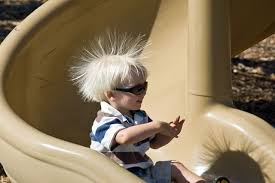
What method of static charging is shown in this picture
a)
Polarization
b)
Friction
c)
Induction
d)
Conduction
123.
Static electricity is:
a)
electricity flowing in a wire
b)
the buildup of electric charges on an object
c)
when protons move between objects
124.
Is it possible to CREATE electrons?
a)
Yes, that's what static electricity is.
b)
No, you can move them, but they are never created or distroyed.
c)
Sometimes, it depends on the voltage.
d)
Sometimes, it depends on the element.
125.
The closer the charges, the ___________ the force between them
a)
closer
b)
further
c)
stronger
d)
weaker
126.
We have discussed 3 ways to charge an object. What are they?
a)
Friction, contact, and polarization.
b)
Friction, polarization, and induction
c)
Friction, contact and induction
d)
Contact, polarization, and induction.
127.
The loss of static electricity as electric charges move from one object to another.
a)
Electric field
b)
Electric force
c)
static electricity
d)
static discharge
100 %

