wayground logo

Free Printable Worksheets

Font size

S
M
L
XL
Worksheets

Physics Review

Total questions: 127

Worksheet time: 2hrs 7mins
Name
Class
Date
1.
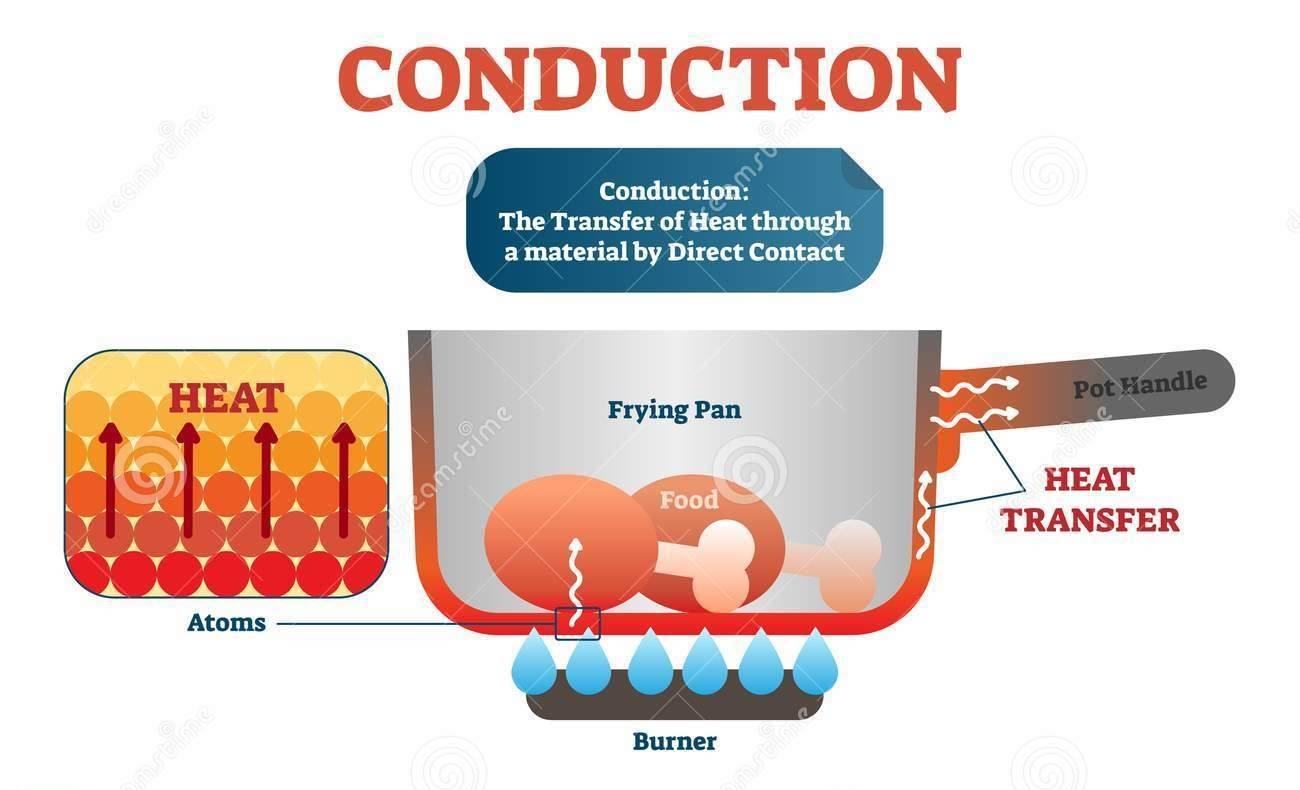
what is the meaning of conduction
a)
when heat transfers from objects that are not touching
b)
heat rise 
c)
cold fall
d)
when heat transfers from objects that are touching
2.
what kind of heat is happening when the sun heats your body
a)
conduction
b)
convection
c)
density
d)
radiation
3.
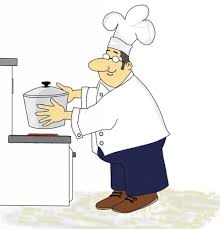
The man goes to take the hot pot off the stove with his bare hands.
a)
conduction
b)
convection
c)
radiation
4.
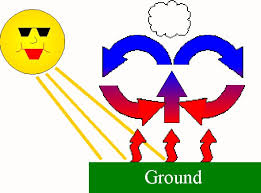
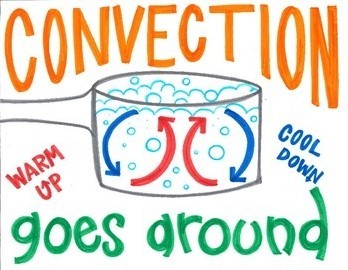
Warm air rises and the cool air sinks.
a)
conduction
b)
convection
c)
radiation
5.
What is the transfer of heat by movement of liquids or gases?
a)
conduction
b)
convection
c)
radiation
6.
You are doing your homework at a desk that is underneath a lamp. You start to feel hotter because of _?_ from the lamp.
a)
conduction
b)
convection
c)
radiation
7.

In heat transfer, heat always flows from the _?_ substance to the _?_ substance.

a)

hotter to colder

b)

colder to hotter

c)

hotter to hotter

d)

colder to colder

8.
Which of the following is the best example of conduction?
a)
A light bulb warming a lampshade
b)
An egg cooking in a frying pan
c)
Water boiling in a pot
d)
Gases circulating in the atmosphere
9.

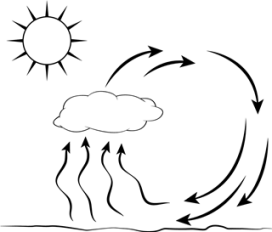
The moving of air in the image is an example of _?_.

a)

radiation

b)

convection

c)

conduction

10.

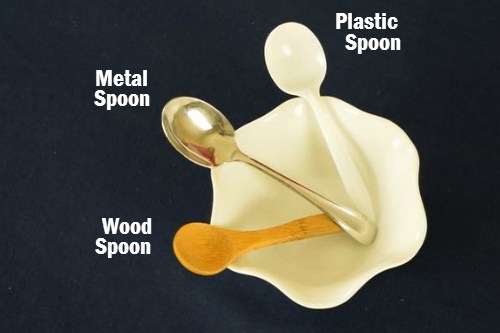
Which material will heat travel through the fastest?

a)

Plastic

b)

Wood

c)

Metal

11.

Which of the following is an example of heat transfer by Conduction?

a)

Burning your fingers on a hot iron.

b)

Heat from a heater warming up your whole house

c)

Standing by a campfire and feeling the heat.

d)

All of the above.

12.

Which of the following is an example of heat transfer by Convection?

a)

Burning your fingers on a hot iron.

b)

Heat from a heater warming up your whole house

c)

Standing by a campfire and feeling the heat.

d)

All of the above.

13.
What is a substance that does NOT conduct heat well?
a)
Conductor
b)
Insulator
c)
Convector
d)
Radiator
14.

If two objects have different temperatures, heat will flow from the warmer object to the cooler one UNTIL ____________

a)

one reaches a temperature of zero

b)

they both have an equal temperature

c)

one runs out of energy

15.
If you place some Gatorade in a cooler with ice...
a)
It's particles will speed up.
b)
It's particles will slow down.
16.
A measure of the average kinetic energy of the individual particles in an object is called:
a)
thermal energy
b)
conduction
c)
convection
d)
temperature
17.

Observe the diagram. Which statement is true about the kinetic energy of the molecules in the containers?

a)

The molecules are moving faster in Diagram A

b)

The molecules are moving slower in Diagram A

c)

The molecules are moving at the same rate in both diagrams

18.
What would be the effect on the particles if more heat is supplied to the system?
a)
They would slow down
b)
They would stop moving
c)
They would speed up
d)
There would be no effect
19.
There are four cups of hot cocoa. The cup sizes are shown. The temperature of the cocoa in each cup is 25 degrees celsius. Which cup has the MOST thermal energy?
a)
Large cup (Trenta)
b)
Small cup (Tall)
c)
Venti
d)
All three are the same temperature so they have same thermal energy
20.

Do molecules generally move faster at 45 C or 106 C?

a)

45 C because molecules have more energy than in 106C

b)

106 C because molecules have more energy than in 45C

c)

106 C because molecules have less energy than in 45C

d)

45C because molecules have less energy than in 106 C

21.

When you place the metal in boiling water, heat flows from the _________ to the _______.

a)

metal to the boiling water

b)

bottom of the metal to the top half of the metal

c)

bottom of the water to the top of the water

d)

boiling water to the metal

22.

The 1st law of Thermodynamics

a)

Energy can not be created or destroyed. It just changes forms.

b)

Energy can only be created by the sun

c)

Some energy is lost to the environment.

23.

Thermal Energy is...

a)

The internal energy of an object

b)

The temperature of a solid object

c)

Heat transfer through a liquid

24.
A slower particle has a lower energy than an identical, faster particle.
a)
True
b)
False
25.
The second  law of thermodynamics states that entropy of a system  tends to ______________. 
a)
increase
b)
decrease
c)
stay constant
d)
fluctuate wildly
26.
The first law of thermodynamics is a restatement of the
a)
Zeroth law of thermodynamics
b)
law of heat addition
c)
principle of entropy
d)
conservation of energy
27.
“When thermal energy is converted into work, some thermal energy is always transferred to the surroundings.”
a)
True
b)
False
28.

Heat will never flow from a cold object to a hot object on its own describes which law of thermodynamics?

a)

1st Law of thermodynamics

b)

2nd Law of thermodynamics

c)

3rd Law of thermodynamics

d)

4th Law of thermodynamics

29.
Entropy is a measure of:
a)
order
b)
disorder
30.
How does heat move to melt ice?
a)
from the ice to the water
b)
from the water to the ice
c)
from the water to the air
d)
from the air to the water
31.

When two bodies are in thermal equilibrium with a third body they are also in thermal equilibrium with

each other. This statement is called

a)

(a) Zeroth law of thermodyamics

b)

(b) First law of thermodynamics

c)

(c) Second law of thermodynamics

d)

(d) Kelvin Planck’s law.

32.
What is the second law of thermodynamics state
a)
Cold air always rises
b)
Hot air always rises
c)
thermal energy can be lost
d)
Thermal energy always transfers to cooler objects
33.
How can energy be transferred from a cool object to a warm object?
a)
Work must be done
b)
Increase thermal energy
c)
Use convection
d)
Q=mTC
34.

The amount of matter in an object

a)

Mass

b)

Weight

c)

Newton

d)

Joules

35.

The unit used for heat and energy

a)

Newton

b)

Joules

c)

Kelvin

d)

Kilogram

36.

Energy of Motion

a)

Thermal Energy

b)

Potential Energy

c)

Work Energy

d)

Kinetic Energy

37.

Stored up energy

a)

Kinetic Energy

b)

Thermal Energy

c)

Potential Energy

d)

Work Energy

38.

Which of the following is NOT an example of unbalanced forces?

a)

a turning car

b)

a car breaking to a stop

c)

a car sitting at a stop light

d)

a car accelerating down a hill

39.
Is work being done if I am trying to pick up a box but can not lift it?
a)
yes
b)
no
40.
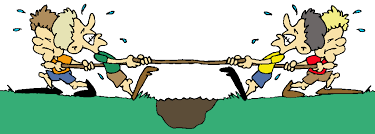
If these teams are pulling with the same amount of force what will happen?
a)
The boy in blue will win.
b)
They will not move at all.
c)
The boy in red will win.
d)
Both will fall down.
41.
Balanced or Unbalanced?
a)
Balanced 
b)
Unbalanced
42.
What direction does friction act relative to motion?
a)
in the same direction
b)
in the opposite direction 
c)
need more information
d)
depends on the force
43.

Inertia refers to _____

a)

the tendency of moving objects to remain in motion or at rest

b)

the force which keeps moving objects in motion with a constant velocity

c)

the force that keeps stationary objects at rest

d)

the force of an object to fall to the ground

44.

Which of the following factors affect Gravitational Energy?

a)

Volume

b)

Mass

c)

Height

d)

Speed

45.

Which of the following types of energy could be classified as POTENTIAL ENERGY

a)

Thermal

b)

Sound

c)

Gravitational

d)

Elastic

46.

In some situations energy can be destroyed

a)

True

b)

False

47.

Which point has the most KE?

a)

W

b)

X

c)

Y

d)

Z

48.
What is speed?
a)
how far you go
b)
how much distance is covered over a period of time
c)
how fast you accelerate
d)
the change in the location of a object
49.
What is the person doing from 5 seconds to 10 seconds?
a)
Walking 
b)
Running
c)
Standing Still 
d)
Walking Fast
50.
What is velocity?
a)
the quickness of an object
b)
the location of an object
c)
acceleration
d)
speed in a specific direction
51.
What does this graph represent?
a)
Constant Speed
b)
Acceleration
c)
Not moving
52.
When a car goes around a corner at 20 mph, why do we say it  accelerates?
a)
The car is accelerating because of the velocity is constant
b)
The car accelerates because it's going 20 mph
c)
Cars always accelerate when they are in motion
d)
The car is accelerating because it's changing direction
53.
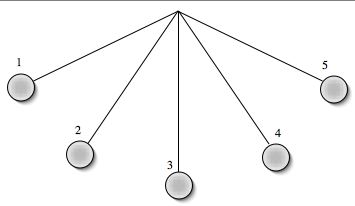
When a pendulum swings, at which point is kinetic energy highest?
a)
1
b)
2
c)
3
d)
4
54.
A person would weigh less on on the Moon than on the Earth because . . .
a)
Moon has more mass, and therefore more gravity
b)
Moon has less mass, and therefore more gravity
c)
Moon has more mass, and therefore less gravity
d)
Moon has less mass and therefore less gravity
55.

The acceleration of an object would increase if there was an increase in the

a)

mass of the object

b)

force on the object

c)

inertia of the object

d)

friction on the object

56.
The phase change from water vapor to liquid water is known as...
a)
evaporation
b)
precipitation
c)
condensation
d)
sublimation
57.
2. A change of state from a liquid to a solid is called....
a)
Melting
b)
Freezing
c)
Evaporation
58.
4. What type of state of matter is a gas that has electrons flowing through it?
a)
Gas
b)
Liquid
c)
Plasma
d)
Solid
59.
5. What is it called when a solid turns directly into a gas?
a)
Sublimation
b)
Condensation
c)
Liquid
60.
7. All phase changes (changing states) requires energy to be added or taken away.
a)
True
b)
False
61.
Change from Gas to Solid is called........
a)
Sublimation
b)
Deposition
c)
Fusion
d)
condensation
62.
Change from gas to liquid...
a)
condensation
b)
evaporation
c)
expansion
d)
movement
63.
change from liquid to gas is called....
a)
expansion
b)
evaporation
c)
condensation
d)
sublimation
64.
What happens to particles when they are heated?
a)
They speed up and spread out
b)
They slow down and compress
c)
They stop moving
d)
They move closer together and speed up
65.
What is deposition?
a)
Phase change from gas to solid
b)
phase change from liquid to solid
c)
Phase change from solid to gas
d)
Phase change from liquid to gas
66.
Melting is ...
a)
liquid to solid
b)
solid to liquid
c)
solid to gas
d)
gas to liquid
67.
Freezing is...
a)
Solid to gas
b)
Liquid to solid
c)
Gas to solid
d)
Liquid to gas
68.

A phase change is a chemical or physical change?

a)

Physical

b)

Chemical

69.

This is an example of

(Hint: Dry Ice)

a)

Deposition

b)

Sublimation

c)

Freezing

d)

Melting

70.

The temperature at which a liquid evaporates to a gas is called

a)

freezing point

b)

boiling point

c)

melting point

d)

condensation point

71.

The temperature at which a liquid freezes to a solid is called

a)

Freezing Point

b)

Melting Point

c)

Boiling Point

d)

Condensation Point

72.

The temperature at which a solid melts to a liquid is called

a)

Boiling Point

b)

Freezing Point

c)

Condensation Point

d)

Melting Point

73.

The temperature at which a gas condenses to a liquid is called

a)

boiling point

b)

condensation point

c)

melting point

d)

freezing point

74.
A gas
a)
has a definite shape but no definite volume
b)
has a definite volume but no definite shape
c)
has fast-moving particles
75.

Rank the states of matter from slowest to fastest particle speed.

a)

gas, solid, liquid

b)

solid, liquid, gas

c)

gas, liquid solid

d)

solid, gas liquid

76.

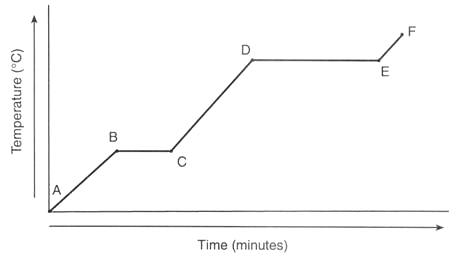
As heat is added to the substance does the temperature always increase?

a)

Yes it always increases

b)

No it does not increase during the phase change

c)

It never increases

d)

It always stays the same.

77.

What is happening to the particles in the substance between points D and E?

a)

Melting

b)

Freezing

c)

Vaporizing

d)

Sublimating

78.

Where on the graph are phase changes taking place?

a)

1

b)

2

c)

3

d)

4

e)

5

79.
No Definite Shape and No Definite Volume
a)
Gas
b)
Liquid
c)
Solid
80.
No definite shape, but has a definite volume
a)
Gas
b)
Liquid
c)
Solid
81.
The graph shows a cooling curve for an unknown substance.  What is happening during segment DE?
a)
boiling
b)
condensation
c)
freezing
d)
melting
82.
Vaporization includes _____________ and  _____________.
a)
melting and boiling
b)
condensation and boiling
c)
sublimation and freezing
d)
evaporation and boiling
83.

Which state of matter is shown?

a)

solid

b)

liquid

c)

gas

84.

During a phase change the temperature of a substance __________

a)

Stays constant

b)

Increases

c)

Decreases

d)

Vanishes

85.

the energy that an object has because it is moving

a)

kinetic energy

b)

freedom of movement

c)

refute

d)

scale

86.

When kinetic energy increases, temperature & speed of the molecules _________.

a)

increases

b)

decreases

87.

When kinetic energy decreases, temperature & speed of the molecules _______.

a)

increases

b)

decreases

88.

When you add energy INTO a substance, the molecules move and what are the phase changes that occur?

a)

faster: Solid -> Liquid -> Gas

b)

slower: Gas -> Liquid -> Solid

89.

When you take energy OUT of a substance, the molecules move and what are the phase changes that occur?

a)

faster: Solid -> Liquid -> Gas

b)

slower: Gas -> Liquid -> Solid

90.
Energy due to motion is ____________ energy. 
a)
Potential 
b)
Energy
c)
Kinetic
d)
Friction
91.
The faster an object moves, the ________ kinetic energy it has. 
a)
more
b)
less
c)
none of the above
d)
all of the above 
92.
__________ is stored energy. 
a)
Potential
b)
Kinetic
c)
None of the above 
d)
All of the above 
93.
Friction is a force that acts in an ___________ direction of movement.
a)
similar
b)
opposite
c)
parallel
d)
west
94.
A ______ is a push or a pull acting upon an object
a)
Acceleration
b)
force
c)
friction
d)
energy
95.

This is a force that moves a roller coaster car down the tracks.

a)

push

b)

magic

c)

gravity

d)

slide

96.
Where is potential energy the GREATEST on a roller coaster?
a)
At the bottom of the first hill
b)
At the top of the first hill
c)
Half way down the first hill
97.
Where is kinetic energy the LEAST on a roller coaster?
a)
At the bottom of the first hill
b)
At the top of the first hill
c)
Halfway down the first hill
98.
Velocity is both ____ and _____. 
a)
speed , direction 
b)
direction, mass
c)
volume, density 
d)
direction, magnitude 
99.
Any object with mass has gravity.
a)
True
b)
Sometimes
c)
False
d)
Never
100.
Every object in the universe attracts every other object.
a)
True
b)
False
101.
Gravity is the force objects put on each other because of their ______.
a)
Mass
b)
Friendliness
c)
Acceleration
d)
Speed
102.
The momentum of an object depends upon the object's ___________&_____________.  
a)
size and shape
b)
mass and speed
c)
mass and veloctiy
d)
mass and energy
103.
Which has more momentum: a car stopped at a red light or a bike moving at 15 mph?
a)
car
b)
bike
c)
they are equal
d)
cannot determine using the info provided
104.
Which of the following is a unit of mass?
a)
kilogram
b)
liter
c)
meter
d)
pound
105.
What is mass?
a)
the force of an object caused by gravity
b)
the amount of space something takes up
c)
the amount of matter in an object
d)
how fast something is moving
106.

According to Newton’s third law of motion, when a hammer strikes and exerts force on a nail, the nail

a)

creates a friction with the hammer.

b)

disappears into the wood.

c)

exerts an equal and opposite force on the hammer.

d)

moves at a constant speed.

107.

Define the term inertia.

a)

the amount of matter in an object

b)

the amount of space an object takes up

c)

the tendency of an object to resist a change in motion, determined by mass

d)

The force that one surface exerts on another when the two rub against each other

108.

What is the Equation for Momentum?

a)

Momentum = Mass x Velocity

b)

Momentum = Mass / Velocity

c)

Momentum = Velocity / Mass

109.

The amount of heat needed to raise the temperature of 1kg of a substance by 1 K refers to

a)

fricton

b)

melting point

c)

Specific Heat

d)

temperature

110.

According to the ESRT, which material would require the most heat energy to increase the temperature of 1 gram of the material one Celsius degree?

a)

Ice

b)

Water

c)

Basalt

d)

Granite

111.

If the same amount of heat is added to each sample, the smallest change in temperature will occur in the

a)

Iron

b)

Dry Air

c)

Granite

d)

Water

112.

What would heat up the fastest if left out in the sunlight on a clear, summer day?

a)

Liquid Water

b)

Dry Air

c)

Lead

d)

Granite

113.

Why does water heat heat up and cool down VERY SLOWLY?

a)

High Specific Heat

b)

Low Specific Heat

c)

It's solid

d)

It's always cold

114.
What would be the effect on the particles if more heat is supplied to the system?
a)
They would slow down
b)
They would stop moving
c)
They would speed up
d)
There would be no effect
115.
A high specific heat means...
a)
It heats up quickly with energy added
b)
It requires more energy to change temperature
116.

Heat ALWAYS moves from

a)

Low to High Temperature

b)

High to Low Temperature

c)

It doesn't move

d)

High to Low Pressure

117.

Specific Heat is....

a)

The speed of the particles in a substance

b)

The temperature of the substance

c)

How much energy it takes to heat something up

d)

Heat

118.

When heat is absorbed by a substance, what happens to the temperature of the substance?

a)

it increases

b)

it stays the same

c)

it decreases

d)

it depends on the substance

119.

When heat is released by a substance, what happens to its temperature?

a)

it increases

b)

it stays the same

c)

it decreases

d)

it depends on the substance

120.
If I heat up 2 pans of water one has 100 mL in it and one has 1000mL. Which one heats up the fastest?
a)
100 mL
b)
1000 mL
c)
They both heat up at the same speed
d)
They cool down.
121.

Which of the following best explains why the sand at the beach is hotter than the water?

a)

Sand has a higher specific heat than water.

b)

Sand has a lower specific heat than water.

c)

There is more water than sand at the beach.

d)

There is more sand than water at the beach.

122.
When a  piece of aluminum foil is taken out of the oven and cools from 100° to 50°, What is the change in temperature?
a)
50°
b)
c)
100°
d)
150°
123.
What is the symbol for Thermal Energy?
a)
Q
b)
t
c)
m
d)
C
124.
What unit do you use to measure Thermal Energy?
a)
J/Kg ºC
b)
Kg
c)
ºC
d)
J
125.
What is the symbol for Specific Heat
a)
Q
b)
t
c)
m
d)
C
126.
What is the equation to measure change in Thermal Energy?
a)
Q=mc∆t
b)
Q=mc
c)
Q= ∆mct
d)
m=QC
127.
A material was cooled from 100ºC to 40ºC.  What is the temperature change?
a)
60ºC
b)
40ºC
c)
-60ºC
d)
-40ºC