
 Worksheets
Unit 5 - Energy
Total questions: 126
Worksheet time: 4hrs 45mins
When you eat fruits and vegetables, chemical bonds are releasing stored energy, this is...
a. thermal energy
b. sound energy
c. electrical energy
d. chemical energy
The ability to do work
A. chemical energy
B. Friction
C. electrical energy
D. Energy

A student is holding the end of a pendulum. The student releases the pendulum. What energy transfers are taking place?
potential energy is transferred to kinetic energy
chemical energy to thermal energy
mechanical energy to chemical energy
kinetic energy is tranferred to potential energy


Stretched bow and arrow?
Select all: Work is equal to...
KE + PE
Change in energy
mg
Fd
Bobby lifts a book to the second floor in 20 seconds. Carol lifts the same book to the second floor in 10 seconds. Who did more work?
Bobby
Carol
They did the same amount of work
Not enough information
A girl weighs 400 N. She runs up a flight of stairs of height 5 m in 4 seconds. Her power is:
320 W
400 W
500 W
2 000 W


A person carries a 2.50-N pebble through the path shown in the figure, starting at point A and ending at point B. The total time from A to B is 405s. How much work did gravity do on the rock between A and B?
45 J
-45 J
37.5 J
-37.5 J
A person carries a 2.50-N pebble through the path shown in the figure, starting at point A and ending at point B. The total time from A to B is 405s. How much work did the person do on the rock between A and B?
45 J
-45 J
37.5 J
-37.5 J
Linda does four times as much work as James does and in one-third the time. Linda’s power output is ________.
four times James’ power output
the same as James’ power output
twelve times James’ power output
cannot be determined
Work is ____.
a scalar
a vector
neither a scalar nor vector
both a scalar and vector
What is the kinetic energy of a 50 N boulder resting at the top of a 25 m cliff?
1250 J
625 J
0 J
12500 J
Two objects, one of mass m and the other of mass 2m, are dropped from the top of a building. If there is no air resistance, when they hit the ground _______.
the heavier one will have half the kinetic energy of the lighter one
the heavier one will have twice the kinetic energy of the lighter one
the heavier one will have one-fourth the kinetic energy of the lighter one
the heavier one will have four times the kinetic energy of the lighter one
Three cars (car A, car B, and car C) are moving with the same speed when the drivers slam on their brakes. The most massive car is car A, and the least massive is car C. If the tires of all three cars have identical coefficients of kinetic friction with the road surface, for which car is the amount of work done by friction in stopping it the greatest?
The amount of work done by friction is the same for all cars.
Car A
Car B
Car C

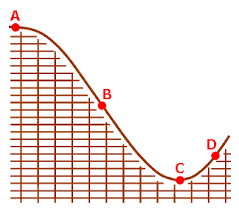
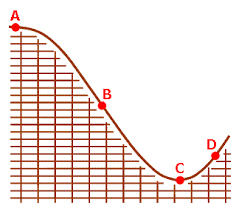
The graph plots velocity against time. During which interval is no work done?
Between A & B
Between B & C
Between C & D
Between D & E
The graph plots velocity against time. What feature of the graph shows negative work?
Velocity increases
Velocity remains constant
Velocity decreases
Cannot be determined
Constant velocity implies
a = 0 m/s2
Fnet = 0 N
Balanced forces
W = 0 J
All of the above
A closed system ____.
conserves mechanical energy
conserves potential energy
conserves kinetic energy
does not conserve energy
Energy transferred out of a system is typically transferred via ____.
tension force
friction force
spring force
gravitational force
Which is not a type of potential energy?
Chemical energy
Gravitational energy
Elastic energy
Thermal energy
Which quantity is not integral for calculating mechanical energy?
force
height
mass
velocity
acceleration
A ball is tossed straight up and later returns to the point from which it was launched. If the ball is subject to air resistance as well as gravity, which of the following statements is correct?
The speed at which the ball returns to the point of launch is less than its speed when it was initially launched.
The time for the ball to fall is the same as the time for the ball to rise.
The force of air resistance is directed down-ward both when the ball is rising and when it is falling.
The net work done by air resistance on the ball during its flight is zero.
The net work done by gravity on the ball during its flight is greater than zero.

An amusement park ride has two identical carriages that revolve around the center of the ride’s axle, as shown in the figure. Both carts travel at a constant tangential speed at all points along the circular path. At what position is the total mechanical energy of the cart-cart-Earth system at its maximum value?


The total energy of the Earth-ferris wheel ride is constant
What is Newton's first law?
For every action, there is an equal and opposite reaction.
An object in motion or at rest will stay in motion or at rest until acted upon.
F=ma
Something about penguins.
What are the units for Work?
Newtons
Kilograms
Joules
Moles
What is the equation for Work?
W = Fd
W = md
W = Fa
W = mv
If you had a force (F) of 20N pushing a ball 2 meter (m), what would be the Work (W) being done?
10 Joules
40 Joules
22 Joules
18 Joules
What is the equation for Kinetic Energy (KE)?
KE = 2mv2
KE = 2mv
KE = mv2
Work can also be shown as
W = ΔKEHow do you find ΔKE ?
KEi − KEf
KEf − KEi
KE + KPOP = BbyMtl
42?

At which point on the roller coaster is the gravitational potential energy the greatest?
W
X
Y
Z

What is the gravitational potential energy of an 85 kg mountain climber at the summit of a 6267 m volcano?
Let g = 9.8m/s2
5,220,411 J
532,695 J
73.7 J
54,356.6 J

You drop a 5 kg ball from a height of 2 m. Just before it reaches the ground, what is the ball's kinetic energy?
980 J
10 J
0.98 N
980 N
Work is defined as applying a force on an object that displaces the object in the direction of the applied force. Which of the following IS NOT an an example of work being done on an object?
A waiter walking with a tray of food that he is holding with his hand under the tray.
A horse pulling a plow through a field.
A shopper pushing a cart down the aisle of a grocery sture.
A weightlifter lifting a barbell above his head.
Which of the following is an instance of negative Work?
A car skidding to a stop on a roadway surface.
A student rolling a bowling ball down a bowling lane alley.
A pitcher throwing a baseball.
a man pushing a crate across a loading dock.
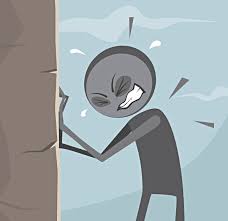
Is this an example of work?
Yes
No


What is the GPE at point A
14 J
12 J
6 J
8 J

What is the KE at point B?
14 J
12 J
6 J
8 J

What is the Total Energy of the system?
14 J
12 J
6 J
8 J

What is the KE at point D?
14 J
12 J
6 J
8 J

What is the GPE at point E?
14 J
12 J
6 J
8 J

What is the Total Mechanical Energy at point A?
500,000 J
400,000 J
200,000 J
50,000 J
What is the Kinetic Energy at point B?
500,000 J
400,000 J
300,000 J
50,000 J
What is the Kinetic Energy at point C?
500,000 J
400,000 J
300,000 J
50,000 J
What is the Kinetic Energy at point D?
500,000 J
250,000 J
300,000 J
50,000 J
What is the GPE at point E?
500,000 J
250,000 J
300,000 J
100,000 J
What is the GPE at point F?
500,000 J
250,000 J
300,000 J
0 J
What is the KE at point F?
500,000 J
250,000 J
300,000 J
0 J

What is the Total Energy at the top?
15,000 J
3,750 J
7,500 J
11,250 J
What is the KE 1/4th of the way down?
15,000 J
3,750 J
7,500 J
11,250 J
What is the KE 1/2 of the way down?
15,000 J
3,750 J
7,500 J
11,250 J
What is the KE 3/4th of the way down?
15,000 J
3,750 J
7,500 J
11,250 J
What is the KE at the bottom?
15,000 J
3,750 J
7,500 J
11,250 J

What is the GPE at the top?
50 J
25 J
0 J
100 J
What is the KE half way down?
50 J
25 J
0 J
100 J
What is the Total Energy at the bottom?
50 J
25 J
0 J
100 J
What is not a true statement about energy?
Energy cannot be destroyed
Energy is created in a form heat and mechanical energy
Energy cannot be created
Energy can only be transform from one form to another
What are the types of energy? (Select the ones that apply)
Elastic Energy
Potential
Energy
Kinetic Energy
Body Energy
What is the formula of Mechanical Energy?
1/2mv^2
m*g*h
2+3x
1/2mv^2 + m*g*h
What is the formula of KE?
1/2mv2
m*g*h
x+5x2
0.5*m*g*h
What is the formula for PE?
1/2mv2
m*g*h
9.8 0.5g
x+4x
What is the acceleration of gravity (g)?
(a)

There are three shelves in a closet. The first one is 1.5 meters above the floor, the second shelf is 2.0 meters above the floor, and the third shelf is 2.5 meters above the floor.
A 10 kg box rests on the first shelf. How much gravitational potential energy does the box have relative to the second shelf?
50 J
100 J
150 J
200 J

There are three shelves in a closet. The first one is 1.5 meters above the floor, the second shelf is 2.0 meters above the floor, and the third shelf is 2.5 meters above the floor.
The box is lifted to the third shelf. How much gravitational potential energy does the box have relative to the first shelf?
100 J
50 J
-50 J
150 J

A roller coaster uses a motor to take a car to the top of its first hill. The roller coaster then travels down a 35 meter hill and to the top of the next hill. It travels with a speed of 15 m/s at the top of the second hill.
How high is the second hill? Assume no energy is lost to friction and the coaster starts from rest at the top of the first hill.
12.5 m
24 m
34 m
This cannot be determined without the mass of the car.

In July 1971, Apollo 15 astronaut Dave Scott performed an experiment on the Moon. Scott held a feather and a hammer at the same height, and let them drop at exactly the same time. Both fell at the same rate and hit the ground at the same time.
At which time did the feather have the greatest kinetic energy?
time 1
time 2
time 3
both times 1 and 3

In July 1971, Apollo 15 astronaut Dave Scott performed an experiment on the Moon. Scott held a feather and a hammer at the same height, and let them drop at exactly the same time. Both fell at the same rate and hit the ground at the same time.
At which time did the hammer have the greatest gravitational potential energy?
time 1
time 3
times 1 and 3
time 2
In July 1971, Apollo 15 astronaut Dave Scott performed an experiment on the Moon. Scott held a feather and a hammer at the same height, and let them drop at exactly the same time. Both fell at the same rate and hit the ground at the same time.
Which of the following is true about the relationship between the gravitational potential energy and the kinetic energy of the hammer?
The kinetic energy + gravitational potential energy stays the same at all times.
The kinetic energy and potential energy are the same as each other at all times.
The kinetic energy at time 1 is equal to the gravitational potential energy at time 1.
The kinetic energy at time 3 is equal to the gravitational potential energy at time 3.

An apartment building has two floors and a basement. The floors are 3.5 meters apart and the basement is 2.5 meters underground as shown.
A 100 kg man enters the apartment building at the ground floor and walks up to his second floor apartment. How much gravitational potential energy does he have relative to the ground? Use g = 10 m/s2.
350 J
700 J
3500 J
7000 J
An apartment building has two floors and a basement. The floors are 3.5 meters apart and the basement is 2.5 meters underground as shown.
The man’s 50 kg son is in the basement doing laundry. How much gravitational potential energy does the son have relative to his father on the second floor? Use g = 10 m/s2.
-3000 J
-300 J
300 J
3000 J

A crate slides down a 5-meter-long, 2-meter-high ramp as shown.
Alli places the 35 kg crate at an undesignated height and lets it slide to the bottom. Her lab partner measures the speed at the bottom of the ramp to be 5.5 m/s. Assuming the ramp is frictionless, at what height did Alli release the crate? Use g = 10 m/s2.
1.5 m
2.0 m
0.5 m
1.0 m

A temporary ladder can be used to escape from an upper story window in case of fire. The diagram shows a temporary ladder hanging from a second floor window and descending to a deck below. The ladder has 8 steps, each of which is 0.5 meters high. The surface of the deck is 1.0 meters above the ground.
A 10 kg cat is three steps below the window. What is its gravitational potential energy relative to the ground? Use g = 10 m/s2.
-350 J
-150 J
350 J
150 J
A temporary ladder can be used to escape from an upper story window in case of fire. The diagram shows a temporary ladder hanging from a second floor window and descending to a deck below. The ladder has 8 steps, each of which is 0.5 meters high. The surface of the deck is 1.0 meters above the ground.
A 50 kg dog is on the deck. What is its gravitational potential energy relative to the window? Use g = 10 m/s2.
-2000 J
-500 J
500 J
2000 J
A construction worker dropped a cement block from an undesignated height. The block had a speed of 30.0 m/s when it hit the ground. Assuming that no forces other than gravity acted on the block as it fell, from what height was the block dropped? Use g = 10 m/s2.
45 m
90 m
450 m
The height cannot be calculated without knowing the mass.
A 1,000-kg car is driving down the road at 5 m/s. The driver increases the speed of the car to 10 m/s. What is the correct amount of the increase in the kinetic energy of the car?
12,500 J
50,000 J
37,500 J
25,000 J

The Great American Soapbox Derby is an annual summer event in Akron. Soapbox cars have no engines. They roll down the hill due to the force of gravity. Use the diagram of the derby car and track to answer the question. Assume no energy loss due to friction.
At which point will the kinetic energy be the same as the gravitational potential energy of the soapbox car as it rolls down the incline?
point 1, because the car is highest
point 3, because it is still moving down the ramp
between points 2 and 3, when it is halfway down the ramp
point 4, because it will have the greatest speed

