wayground logo

Free Printable Worksheets

Font size

S
M
L
XL
Worksheets

PS Q1 Final

Total questions: 130

Worksheet time: 2hrs 31mins

Name
Class
Date
1.

Name what defines the capacity for something to do work.

(a)  

2.

An object is held above the ground it has what kind of energy?

a)

Potential

b)

Kinetic

c)

Chemical

d)

Thermal

3.

An object is dropped to the ground it has what kind of energy?

a)

Potential

b)

Kinetic

c)

Chemical

d)

Thermal

4.

An object is thrown in to the sky it has what kind of energy?

a)

Potential

b)

Kinetic

c)

Chemical

d)

Thermal

5.

An object is at rest on a planet with gravity it has what kind of energy?

a)

Potential

b)

Kinetic

c)

Chemical

d)

Thermal

6.

An object is dragged along the ground other than kinetic energy it produces what kind of energy due to friction?

a)

Potential

b)

Kinetic

c)

Chemical

d)

Thermal

7.

An object is dragged along the ground other than kinetic energy it produces what kind of energy due to friction?

a)

Potential

b)

Kinetic

c)

Chemical

d)

Thermal

8.

A skateboarder takes off at point 1. Without friction what is the furthest point the skater can go?

a)

2

b)

3

c)

4

d)

Off the track

9.

A skateboarder takes off at point 1. With friction what is the furthest point the skater can go?

a)

2

b)

3

c)

4

d)

Off the track

10.

A skateboarder takes off at point 4 towards 1. What is the furthest point the skater can go?

a)

2

b)

3

c)

4

d)

Off the track

11.

A skateboarder takes off at point 4 towards 1. Without gravity what is the furthest point the skater can go?

a)

2

b)

3

c)

4

d)

Off the track

12.

The first law of thermodynamics states that energy can’t be …

(a)  

13.

A battery that is heating up with foil around it is turning _________ energy into ____________.

a)

Chemical/thermal

b)

Thermal/chemical

c)

Chemical/mechanical

d)

Chemical/gravitational

14.

A turbine that is running by heating up water is turning _________ energy into ____________.

a)

Chemical/thermal

b)

Thermal/mechanical

c)

Chemical/mechanical

d)

Chemical/gravitational

15.

A turbine that generating electricity is turning _________ energy into ____________.

a)

Chemical/electric

b)

Thermal/mechanical

c)

electric/mechanical

d)

Mechanical/electric

16.

A meteor going through the atmosphere is turning _________ energy into ____________.

a)

Gravitational/thermal

b)

Thermal/mechanical

c)

Thermal/gravitational

d)

Mechanical/thermal

17.

Energy goes through out our universe in what form

a)

Matter

b)

Waves

c)

Particles

d)

Gravity

18.

You measure the energy of a chemical reaction and find that you lost energy that you you put in. What happened?

a)

It lost the energy

b)

chemical energy was converted into some other form of energy

c)

The energy was used up in the reaction

d)

Energy was transferred into matter

19.

Which of the following has the longest wavelength?

a)

microwaves

b)

UV rays

c)

Infrared

d)

Gamma rays

20.

Which of the following has the most energy?

a)

Red

b)

Blue

c)

Green

d)

Yellow

21.

Which of the following has the most energy?

a)

X-rays

b)

The color green

c)

Microwaves

d)

Infrared

22.

Which of the following has the least amount of energy?

a)

UV rays

b)

The color yellow

c)

Radio waves

d)

Gamma rays

23.

Which of the following would have the highest frequency?

a)

Gamma rays

b)

The color red

c)

X-rays

d)

UV rays

24.
Select the correct order of waves on the EMS 
a)
Radio, Micro, Infra, Visible, Ultra, X-ray, Gamma
b)
Gamma, X-ray, Ultra, Vis, Infra, Micro, Radio
c)
Vis, Micro, Infra, Ultra, X-ray, Gamma, Radio
d)
Micro, Radio, Vis, Infra, Ultra, X-ray, Gamma
25.
As the frequency of an electromagnetic wave increases, the amount of energy in that wave...
a)
increases.
b)
decreases.
c)
stays the same.
26.
The blue section of the wave is measuring _________________.
a)
wavelength
b)
crest
c)
trough
d)
amplitude 
27.
Light behaves like both a particle and a ______.
a)
Mass
b)
Wave
c)
Current
28.

The _______ of a wave is the number of complete waves passing a fixed point per second.

a)

wavelength

b)

frequency

c)

amplitude

d)

speed

29.

Which type of radiation has the HIGHER frequency?

a)

(a)

b)

(b)

30.

Considering frequency of 109 Hz and frequency of 1011 Hz, which type of radiation has the LONGER wavelength?

a)

109 Hz

b)

1011 Hz

31.

How do Microwaves cook food?

a)

The electromagnetic waves cause the molecules to vibrate quicker. This creates friction and heats/cooks food

b)

The electromagnetic waves heat up the food molecules in a similar way as a conventional oven

c)

The electromagnetic waves create a dry heat that warms the molecules in the food

d)

The electromagnetic waves send heat to the molecules which makes them begin to vibrate and cook

32.

Which electromagnetic waves are used in radar and cell phone communications?

a)

Infrared rays

b)

ultraviolet rays

c)

microwaves

d)

radio waves

33.
What is infrared radiation?
a)
The circulation of a fluid caused by heating it.
b)
Transfer of heat inside a metal.
c)
Heat energy transfer by electromagnetic waves
d)
Transfer of light energy
34.

Sunlight is made of bundles of radiation called

a)

electrons

b)

protons

c)

neutrons

d)

photons

35.

The diagram above shows a wind turbine. Which section of the wind turbine converts wind energy to electrical energy?

a)

blades

b)

generator

c)

rotor

d)

pitch system

36.

Coal is burned to heat water so that the _______ can turn turbines.

a)

fire

b)

steam

c)

water

d)

heat

37.
A north pole and a south pole will attract.
a)
True
b)
False
38.
The picture is an example of an:
a)
Electric circuit
b)
Electromagnet
c)
Electric nail
d)
Electric power cell
39.

To make this electromagnet stronger you could:

a)

use less wire

b)

have fewer wire coils around the nail

c)

have more wire coils around the nail

d)

use a plastic core

40.
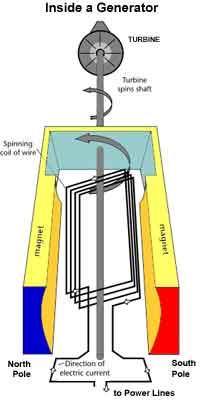
In large generators in power plants, ___________ rotate inside a coil of wire to produce an electric current.
a)
Wind
b)
Water
c)
Magnets
d)
Circuits
41.

What is created when a wire moves between the poles of a magnet?

a)

a ferromagnet

b)

a solenoid

c)

an electromagnet

d)

an electric current

42.

A coil of wire with that can be used to generate an electric current is called a(n)

a)

transformer.

b)

electric generator.

c)

electric motor.

d)

solenoid.

43.

Surrounding every moving electron in a wave/field at perpendicular angles is

a)

a magnetic field

b)

an electric field

c)

a photon field

d)

an electromagnetic field

44.

This contraption scatters electrons through a metal cage preventing certain types of macroscopic electromagnetic waves from entering or leaving.

a)

Faraday Cage

b)

Electrical Cage

c)

Microwave Cage

d)

Nicholas Cage

45.
At one point in time, many people thought disease was caused by fate or by incorrect behavior. Following the invention of the microscope, bacteria were discovered. After this, a new theory of what causes disease arose that was known as the germ theory.  Why was the original theory modified? 
a)
It quickly became obvious that germs cause disease.
b)
The person who invented the microscope became ill.
c)
New evidence prompted revision to the original ideas.
d)
The proponents of the germ theory had political power.
46.
Joe tells Mai his theory about why sea turtles nest on the beach instead of in the ocean. He says, “The turtle eggs would sink to the bottom of the ocean, and the baby turtles would drown.” Joe says his uncle is a fisherman, who told Joe this information. Mai tells Joe that his theory is not scientific. Which explanation supports Mai’s evaluation of Joe’s theory?
a)
Joe’s idea is already a scientific law. 
b)
Joe’s idea is not supported by scientific evidence. 
c)
Joe’s idea is a good guess that can be tested by experiments. 
d)
Joe’s idea accurately explains why sea turtles nest on the beach. 
47.
Scientists discuss and debate experimental results and possible explanations in studying phenomena. Which best explains why scientists debate while searching for explanations?
a)
because debating helps scientists focus on empirical evidence, analyzing both the strengths and weaknesses of the evidence
b)
because debating helps the scientific community to present interesting and exciting science to the public
c)
because debating gives scientists an opportunity to express their feelings and opinions about the subject
d)
because every scientist wants to find an accurate explanation and disprove others’ explanations
48.
Unprotected exposure to the sun’s rays is a factor in the development of skin cancer. Which   of the following is an example of empirical evidence that supports this hypothesis?
a)
a model of a skin cell showing where DNA is in the cell
b)
a skin cancer survivor’s recollection that he had a bad sunburn as a child
c)
data demonstrating a relationship between amount of sun exposure and incidences of skin cancer
d)
an advertisement for a sun block product that claims it protects skin for ultraviolet rays
49.
Which explanation best describes why theories can change?
a)
Scientists like to make kids learn new things
b)
Textbooks need to be updated
c)
More money is needed for research
d)
Scientists are always learning new things.
50.

When trying to get accurate information it is best to...

a)

Use multiple credible sources

b)

Use one single, credible source

c)

Use as many sources as possible, even if they are unreliable

d)

Not use any sources

51.

Which of the following are good steps to take when you encounter something online that you’re unsure about:

a)

Do a quick web search to see if other credible sources of information are reporting the same thing

b)

Assume that if your info is posted online, it had to be well-checked so it's credible

c)

If there are photos, it's automatically more authentic news

d)

Post the story on social media and crowdsource an opinion

52.
Where do most teens get their news from?
a)
Newspapers
b)
TV
c)
Parents or family
d)
Social Media
53.
Why is fake news a problem?
a)
The public is getting misinformation
b)
Most people who see fake news believe it's actual news
c)
Fake news often looks like real news
d)
all of the above
54.

Which of the following are ways to be sure that you should do to best choose your news?

a)

only trust .com URLs

b)

give it time- wait to see how a story develops

c)

only get news from sources where you know the media bias

d)

check other social media accounts

55.

If the speaker is a celebrity, you can believe what they are saying is valid and true.

a)

true

b)

false

56.

In the Dark Ages, how were books produced?

a)

Books were not produced in the dark ages.

b)

Books were carved into stone tablets.

c)

Books were copied by hand by people known as monks.

d)

Books were copied by hand by women who were imprisoned.

57.

The Gutenberg printing press truly changed the world. Which answer best summarizes how the invention of the printing press leads to world change?

a)

The Gutenberg printing press allows schools to begin teaching reading.

b)

The Gutenberg printing press allows for the development of an alphabet. Before the printing press, people only wrote in hieroglyphs.

c)

The Gutenberg printing press allowed for mass production of books, leading to an explosion of ideas being shared.

d)

The Gutenberg press was used to mass-produce the bible, which led to an expansion of religious ideas.

58.

Beyond the Gutenberg printing press, there were four major revolutions in communication. The development of the Gutenberg press was the first major revolution, what is the last?

a)

The last revolutionary change came with the development of TV.

b)

The last revolutionary change came with the development of t cellular phones in the 1980s.

c)

The last revolutionary change came with the development of social media and electronic technology for idea-sharing.

d)

The last revolutionary change came with the development of live radio broadcasting.

59.
You should be skeptical of media.  Skeptical means
a)
doubtful
b)
daring
c)
deceiving
d)
delighted
60.
Which phrase MOST accurately describes the relationship between bias and media? 
a)
If a piece of media is biased, it has no value
b)
bias can be avoided easily
c)
biased media is more interesting
d)
all media has a bias
61.
Thinking that does not blindly accept arguments and conclusions. Rather, it examines assumptions, discerns hidden values, evaluates evidence, and assesses conclusions.
a)
Absolute Thinking 
b)
Genius Thinking 
c)
Critical Thinking 
d)
Awesome Thinking 
62.
A material in which electrons are able to move easily
a)
Circuit
b)
Insulator 
c)
Resistance 
d)
Conductor 
63.
A material in which electrons are not able to move easily 
a)
Circuit 
b)
Insulator 
c)
Resistance 
d)
Conductor
64.
Electric current that flows in only one direction. 
a)
Voltage 
b)
Direct Current 
c)
Alternating Current
d)
Series Circuit 
65.
The flow/movement of electric charges 
a)
Voltage
b)
Resistance 
c)
Current 
d)
Circuit 
66.
A closed path that electric current follows 
a)
Voltage
b)
Current
c)
Resistance 
d)
Circuit
67.
According to this law, the current in a circuit equals the voltage difference divided by the resistance. 
a)
Law of Conservation of Energy 
b)
Ohm's Law 
c)
Law of Conservation of Charges
d)
Newton's First Law 
68.
The current has only has one loop to flow through in this circuit. 
a)
Series Circuit 
b)
Parallel Circuit 
69.
This circuit contains two or more branches for current to move through. 
a)
Series Circuit 
b)
Parallel Circuit 
70.
The accumulation of excess electric charge on an object is called
a)
Static electricity 
b)
Electric discharge
c)
Resistance
d)
Circuit 
71.
What kind of circuit is this?
a)
series
b)
parallel
72.
What type of circuit is show in the image?
a)
Series Circuit
b)
Parallel Circuit
73.
What material would be safest to use as an insulator to cover electrical wires?
a)
rubber
b)
tin
c)
aluminum
d)
water
74.
Which of these substances conducts electricity the best?
a)
wood
b)
brick
c)
copper
d)
plastic
75.
What size resistor would produce a 3 Amp current flow with a 12 Volt battery
a)
1 Ohm
b)
3 Ohms
c)
4 Ohms
d)
12 Ohms
76.
What is current measured in?
a)
Ω (Ohms)
b)
V (Volts)
c)
A (Amps)
d)
W (Watts)
77.
What is the Voltage of a circuit that has a resistance of 5 Ω and a current of 2 A?
a)
25 V
b)
10 V
c)
2.5 V
d)
0.4 V
78.
How many Volts would we need to produce a current flow of 8 Amps through a 6 Ohm resistor
a)
12 volts
b)
24 volts
c)
1.3333
d)
48 volts
79.
What is the voltage across   the plates of the capacitor if  the capacitance is 10 uF and the Charge stored is  30 uC?
a)
0.333 V
b)
3 V
c)
300 V
80.

With respect to the capacitor, which relationship is true? •

a)

C = Q×V

b)

V = C×Q

c)

V = Q/C

d)

Q = C/V

81.

A capacitor of capacitance 30μF is fully charged from a 10 V d.c. supply. Calculate the charged stored by the capacitor

a)

3.0 mC

b)

0.30 mC

c)

300 mC

d)

330 kC

82.

How to you calculate the total resistance in a series circuit?

a)

R1 + R2+ R3

b)

R1 - R2 - R3

c)

1/R1 + 1/R2 + 1/R3

d)

R1 = R2 = R3

83.

How do you calculate total resistance in a parallel circuit?

a)

R1 + R2 + R3

b)

R1 - R2 - R3

c)

1/R1 +1/R2 + 1/R3 = 1/RT

d)

R1 = R2 = R3

84.

What is the equivalent or total resistance (Re) across this circuit?

a)

3 kΩ

b)

10 kΩ

c)

13 kΩ

d)

18 kΩ

85.

How would the equivalent resistance be determined?

a)

1 / Req = (1/5) + (1/8) + (1/3) Ω

b)

120 Ω

c)

1.5189873 Ω

d)

1 / Req = (1/5) * (1/8) * (1/3) Ω

86.
What subatomic particles would you find in the nucleus of an atom?
a)
Protons only
b)
Protons and Neutrons
c)
Neutrons and Electrons
d)
Protons and Electrons 
87.
Protons and Electrons balance the charge of an atom.
a)
True
b)
False
88.
Electric charges that are different _______ each other.
a)
Attract
b)
Repel
89.
What charge does a proton have?
a)
negative (-)
b)
positive (+)
c)
neutral or no charge (0)
90.
What charge does an electron have?
a)
negative (-)
b)
positive (+)
c)
neutral or no charge (0)
91.
If a substance has an excess number of electrons on its surface, what type of charge does it have?
a)
A negative charge
b)
A positive charge
c)
A neutral charge
d)
A nuclear charge
92.
The closer the charges, the ___________ the force between them
a)
closer
b)
further
c)
stronger
d)
weaker
93.
What is the SI unit used to measure force? 
a)
pounds 
b)
grams 
c)
newtons 
d)
friction
94.

According to Coulomb's Law, The greater the separation distance between two charges the greater the magnitude of the electric force. True or False?

a)

True

b)

False

95.
What variable is a Coulomb the unit for?
a)
Charge
b)
Force
c)
Distance
d)
Mass
96.

Which of the following units provides the best measure for the amount of space that matter occupies (volume)?

a)

mL

b)

grams

c)

cm3

d)

Both mL and cm3

97.

Density =

a)

Mass x Volume

b)

Volume x Mass

c)

Mass / Volume

d)

Volume / Mass

98.
What is the density of water?
a)
1 mL
b)
1 gram
c)
1 g/cm3
d)
All of the above
99.

When a metal mailbox is rusting because of the weather, the rust is an example of

a)

a physical change

b)

a chemical change

c)

magnetism

d)

texture

100.

When a hammer breaks a large rock into smaller pieces, the broken rock is an example of

a)

a physical change

b)

a chemical change

c)

solubility

d)

density

101.

Properties of matter that can be measured or observed without changing the basic nature of the matter.

a)

Chemical properties

b)

property

c)

matter

d)

Physical properties

102.

A property of matter that can only be observed by changing the basic nature of the matter (e.g. combustibility)

a)

physical property

b)

physical change

c)

chemical change

d)

chemical property

103.
Where are electrons of an atom found?
a)
Nucleus
b)
Electron Cloud
c)
Some are in the nucleus and some in the electron cloud.
d)
They are moving everywhere.
104.
Which of the following is a positively charged subatomic particle found in the nucleus of an atom?
a)
Electron
b)
Proton
c)
Neutron
d)
Quark
105.
What carries no charge 
a)
Neutrons
b)
Electrons
c)
Protons
106.

Which is the smallest particle of an atom?

a)

electron

b)

proton

c)

atom

d)

neutron

107.
The negatively charged particles of an atom are the ______.
a)
electrons
b)
protons
c)
neutrons
d)
protons & neutrons
108.
Which two particles make up the nucleus of an atom?
a)
Protons and Electrons
b)
Protons and Neutrons
c)
Molecules and Compounds
d)
Neutrons and Electrons
109.

What is the atomic number?

a)

35

b)

18

c)

17

d)

52

110.
Which is an electron?
a)
A
b)
B
c)
C
111.

After mixing two substances you notice some bubbling has occurred. What can you infer about this interaction?

a)

It's a chemical reaction

b)

It's a physical reaction

c)

It's a magical reaction

d)

It's a physical change

112.

When moving a metal bar next to some iron shavings you notice that the iron shavings stick to the metal bar. This is an example of what property of matter?

a)

Magnetism

b)

Electricity

c)

Chemical Reaction

d)

Plasma

113.

Electricity was summarized in class by the _________ of electrons.

a)

Flow

b)

Waves

c)

Particles

d)

Field

114.

Light, electricity and magnetism are all part of the electromagnetic spectrum.

a)

True

b)

False

115.

Which of the following statements is an observation. (Checkboxes mean there may be more than 1 correct answer)

a)

The light got brighter

b)

The light is powered by electricity

c)

The electrons are flowing through the light bulb.

d)

The light got dimmer

116.
The pH scale is a range from:
a)
1-7
b)
0-14
c)
1-5
d)
1-20
117.
A(n) ______ is a substance with a pH less than 7
a)
Acid
b)
Alkaline
c)
Base
d)
Buffer
118.
A(n) _______ is a substance with a pH greater than 7.
a)
Base
b)
Acid
c)
Buffer
d)
Water
119.

A base is a substance

a)

That releases OH- ions when dissolved in water

b)

That releases H+ ions when dissolved in water

c)

Does not release any ions when dissolved in water

d)

None of the above

120.

An acid

a)

is a substance that releases H+ ions when dissolved in water

b)

is a substance that does not release any ions when dissolved in water

c)

is a substance that releases OH- when dissolved in water

d)

releases an equal amount of OH- and H+ ions when dissolved in water

121.

Water has a neutral pH because

a)

it has more H+ ions than OH-

b)

it has more OH- ions than H+

c)

it does not produce any ions

d)

it has an equal amount of H+ and OH- in solution

122.
A solution has a pH of 7.0.  What would happen to the pH if H ions were added?
a)
pH would go up
b)
pH would go down
c)
pH would stay the same
d)
None of these
123.
A solution has a pH of 7.0.  What would happen to the pH if OH ions were added?
a)
pH would go up
b)
pH would go down
c)
pH would stay the same
d)
None of these
124.
A solution has a pH of 7.0.  What would happen to the pH if OH ions were added?
a)
pH would go up
b)
pH would go down
c)
pH would stay the same
d)
None of these
125.

Bright Red pH indicator indicates that the solution is a(n)

a)

Base

b)

Acid

126.

Dark blue pH indicator indicates that the solution is a(n)

a)

Base

b)

Acid

127.
A  pH and a pOH will add up to:
a)
0
b)
7
c)
14
d)
1.0 x 10⁻¹⁴
128.

If a solution has a hydroxide (OH-) ion concentration of 6 what is the Hydronium (H+) concentration?

a)

6

b)

7

c)

8

d)

9

129.

If a solution has a hydroxide (OH-) ion concentration of 6 what is the pH?

a)

6

b)

7

c)

8

d)

9

130.

According to the video, H+ and H3O+ are symbols essentially representing the same idea.

a)

True

b)

False