
 Worksheets
Speed and Acceleration
Total questions: 127
Worksheet time: 3hrs 38mins
speed of an object in a particular direction
motion
velocity
speed
acceleration
when an object changes its position compared to a reference point.
acceleration
speed
motion
reference point
total distance traveled divided by total time taken to travel that distance
velocity
motion
acceleration
average speed
the rate at which speed or velocity changes
acceleration
average speed
motion
reference point
an object that appears to stay in place and that helps you detect motion in another object
acceleration
average speed
motion
reference point

Is this a speed or acceleration graph?
speed
acceleration

What is happening at segment E?
acceleration
deceleration
constant speed
no motion/object at rest
What is happening at segment B?
acceleration
deceleration
constant speed
no motion/object at rest

Is this a speed or acceleration graph?
speed
acceleration
What is happening at segment A?
no motion/object at rest
constant speed
deceleration
A runner crossed the 1 mile marker of a race running at a speed of 9 miles per hour. She crossed the finish line running at a speed of 9.8 miles per hour. Did the runner change her velocity?
Yes
No
A runner crossed the 1 mile marker of a race running at a speed of 9 miles per hour. She crossed the finish line running at a speed of 9.8 miles per hour. This is an example of...
positive acceleration
negative acceleration
no acceleration

The formula for calculating speed is...(x means multiply; / means divide)
time x distance
distance x speed
distance / time
time / distance
Speed = _______________
Distance + time
Distance – time
Distance x time
Distance / time
Velocity = _______________
Speed – direction
Speed + direction
Speed x direction
Speed / direction
At what speed would a car have to move in order to travel 20 kilometers in 2 hours.
5 km/hr
10 km/hr
20 km/hr
40 km/hr


What is this?
"This airplane is traveling at 500 mph, West"
Speed
Velocity
Acceleration

A helicopter flies west 200 miles in 2 hours. What is its velocity?
99 mph
100 mph south
400 mph south
297 mph south
What two things must you know to determine speed?
distance and direction
direction and time
speed and direction
time and distance
Basic SI unit of length or distance is:
Meter
Seconds
Grams
Minutes
Which of the following is an example of a SPEED?
35 seconds
45 minutes
60 mph (miles per hour)
50 meters
Which of the following choices is an example of VELOCITY?
35 mph
35 meters
35 mph EAST
35 minutes
The state in which one object's distance from another is changing:
Acceleration
Motion
Velocity
Speed
The speed of an object at one instant of time is called:
Average Speed
Instantaneous Speed
Velocity
Acceleration
Speed in any given direction is:
Acceleration
Average speed
Velocity
Slope
Distance an object travels per unit of time and can be written like 35 mph is:
Acceleration
Velocity
Slope
Speed
Steepness of a line on a graph:
Slope
Acceleration
Speed
Velocity
The rate at which velocity changes and can be seen by speeding up, slowing down, or changing direction:
Speed
Velocity
Acceleration
Slope
To calculate speed:
Speed = time + distance
Speed = time X distance
Speed = distance X distance
Speed = distance ➗ time

Using the graph, which person finished the race first?
Biker
Runner
Walker
All of these finished at the same time.

Using which point shows the object at REST?
from O to A
from A to B
from C to D
from D to E
A rocket travels 500 meters in 5 seconds. What was the speed of the rocket?
300 m/s
200 m/s
100 m/s
50 m/s
Chase drove for 4 hours and went 240 miles. What was Chase's speed?
100 mph
75 mph
60 mph
45 mph
Using which point shows the object at speeding UP?
from A to B
from C to D
from D to E
from E to F

How long does it take a car to travel 40m at 12m/s?
4.8 s
480 s
3.33 s
33.3 s

the unit of acceleration is
(m/s2)
jouls
m
s
A negative acceleration means that your object is
constant
speeding up
at rest
slowing down
A positive acceleration means that your object is
at rest
speeding up
moving
slowing down
When is an object under uniform acceleration?
none of the following
when the direction is straight
when the velocity change is constant per unit time
when the time is constant
A bus starts from rest and accelerates to 14 m/s in 4 s. What is the average acceleration of the bus?
3.5 m/s2
5.9 m/s2
10.5 m/s2
24 m/s2

What is the acceleration during the first 5 seconds?
2 m/s2
4 m/s2
5 m/s2
10 m/s2


A runner races in the 100 meter dash. It takes her 10 seconds to finish. What is her average speed?
10 m/s
1000 m/s
100 seconds
10 seconds


Velocity is speed with __________________________.
a unicycle helmet
direction
fight

The clown walked 27 feet in 9 seconds. what was his speed?
18 feet/sec
243 feet/sec
36 feet/sec
3 feet/sec
Jose wandered 4 km at 2 km/hr. How long did Jose wander?
2 hours
8 hours
0.5 hours
2 km
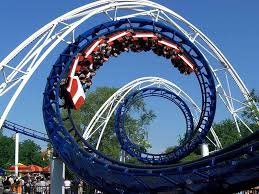

Describe the motion in the graph:
Constant Speed (positive slope)
Stopped (at rest)
Acceleration (increasing speed)
Return Home (negative slope)

Describe the motion in the graph:
Constant Speed (positive slope)
Stopped (at rest)
Acceleration (increasing speed)
Return Home (negative slope)

Describe the motion in the graph:
Constant Speed (positive slope)
Stopped (at rest)
Acceleration (increasing speed)
Return Home (negative slope)

Describe the motion in the graph:
Constant Speed (positive slope)
Stopped (at rest)
Acceleration (increasing speed)
Return Home (negative slope)

At 60 seconds, how far had this object traveled?
0 m
10 m
20 m
40 m
Which graph below shows 2 runners moving at the same speed?


A ping-pong ball rolls forward 6 meters, and bounces backward 3 meters. What was its displacement (distance from the origin)?
A car travels 100km. The journey takes two hours. The highest speed of the car is 80km/ h, and the lowest speed is 40km/ h. What is the average speed for the journey?
40km/ h
50km/ h
60km/ h
120km/ h
An object is released from rest and falls to Earth. During its fall, the object is affected by air resistance. The air resistance eventually reaches a constant value. Which description about successive stages of the motion of the object is correct?
constant acceleration, then constant deceleration
constant deceleration, then zero acceleration
decreasing acceleration, then constant deceleration
decreasing acceleration, then zero acceleration

On Earth, a ball is dropped and falls 2.0 m in a vacuum. The acceleration of the ball at 1.0 m is 10 m/s2 .
What is the acceleration of the ball at 0.5 m?
5.0 m / s2
10 m / s2
15 m / s2
20 m / s2
An ice crystal falls vertically from a cloud. What happens to the acceleration of the ice crystal as it falls?
It decreases because of air resistance.
It decreases because of gravity.
It increases because of air resistance.
It increases because of gravity.
An athlete runs at a speed of 8 m / s for 10 s, and then at a speed of 6 m / s for 12s. Which calculation gives the average speed of the athlete in m / s?
28+6
22(8×10)+(6×12)
22(8÷×10)+(6÷×12)
22(10÷×8)+(12÷6)
A boy runs 400 m at an average speed of 4.0 m / s. He runs the first 200 m in 40 s. How long does he take to run the second 200 m?
60 s
66.7 s
80 s
140 s
An object is moving with uniform deceleration. Which statement describes its motion?
Its rate of change of speed is decreasing.
Its speed is constant.
Its speed is decreasing.
Its speed is increasing.
The velocity of an object increases from 30 m / s to 50 m / s in 5.0 seconds.
What is the average acceleration of the object?
0.10 m / s2
0.25 m / s2
4.0 m / s2
10 m / s2
A car travels at an average speed of 60 km / h for 15 minutes. How far does the car travel in 15 minutes?
4.0 km
15 km
240 km
900 km

A student investigates the motion of a ball rolling down a slope. The diagram shows the speed v of the ball at different times t.
Which statement describes the motion of the ball?
The acceleration is not constant.
The acceleration is negative.
The speed is decreasing.
The velocity is constant.
A car is travelling at a velocity of 2.0 m / s. It accelerates at a constant 0.20 m / s2 for 2.5 minutes. What is the final velocity of the car?
2.5 m / s
5.2 m / s
30 m / s
32 m / s

A ball falls from rest through the air towards the ground. The diagram shows two forces acting on the ball.
As the ball falls, the air resistance increases. Which statement is correct?
The acceleration of the ball decreases.
The acceleration of the ball increases.
The speed of the ball decreases.
The gravitational force on the ball decreases.
Which statement about acceleration is correct?
It is the force acting on an object when it is near to the Earth.
It is the distance an object travels in one second.
It is the force acting on an object divided by the distance it travels in one second.
It is related to the changing speed of an object.
A train begins a journey from a station and travels 60 km in a time of 20 minutes. What is the average speed of the train?
3.0 m / s
5.0 m / s
50 m / s
60 m / s
A light object is dropped from rest. It falls a large distance vertically through air. How can the motion of the object be described?
constant acceleration
increasing acceleration
decreasing acceleration and then moving at terminal velocity
increasing acceleration and then moving at terminal velocity

Fast
Slow
Stopped

Who's Faster?
Barkus
Arctica

Speeding Up
Slowing Down
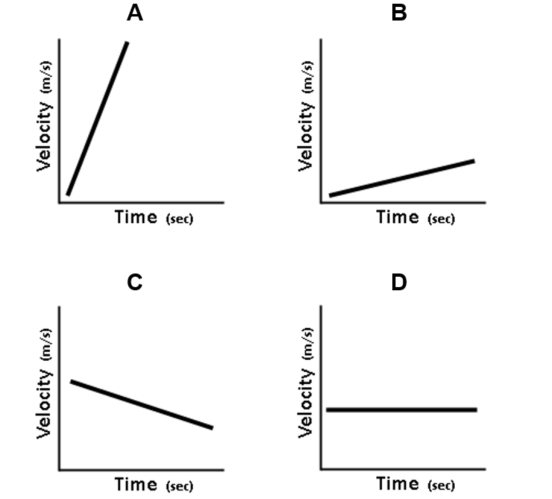
What is happening at segment E?
acceleration
deceleration
constant speed
no motion/object at rest
What is happening at segment B?
acceleration
deceleration
constant speed
no motion/object at rest

What was occurring from point B to point C?


___ refers to how fast an object is moving.
Speed
Velocity
Acceleration
Motion
Which two factors does speed depend on?
distance and direction
direction and time
distance and time
distance, time and direction
___ refers to the rate at which an object changes position.
Speed
Velocity
Acceleration
Motion
What two factors does velocity depend on?
speed and direction
distance and time
speed and time
distance and direction
Which is an example of speed?
A car driving 55 miles per hour south.
A bicyclist traveling 10 meters per hour toward the next town.
A roller coaster is traveling 10 meters per second.
A rocket blasting off at 2,500 meters per second toward space.
Which is an example of velocity?
A car driving 55 miles per hour south.
A bicyclist traveling 10 meters per hour.
A roller coaster is traveling 10 meters per second.
A rocket blasting off at 2,500 meters per second.
Which is NOT an example of Acceleration?
An object speeds up
An object slows down
An object changes direction
An object is in constant motion.
Speed or Velocity?:
A turtle is crawling 34 cm/min.
Speed
Velocity
Neither
Both
Speed or Velocity?:
A train is travelling North 220 km/hr
Speed
Velocity
Neither
Both
Acceleration is a speeding up, slowing down or a change in direction. Is the following acceleration and if so, which one?
A swimmer has 10 meters left in the race and he is neck-in-neck with his competitor. He has a surge of adrenaline and pulls ahead to win.
Yes, this is acceleration since the swimmer starts to speed up to pull ahead.
Yes, this is acceleration since the swimmer uses the wall to change directions.
No, this is not acceleration since there is no speeding up, slowing down, or change in direction.
Acceleration is a speeding up, slowing down or a change in direction. Is the following acceleration and if so, which one?
A dancer is warming up. She turns on music with a good beat and does 10 pirouettes in a row perfectly on the beat. (pirouette is a body spin in ballet)
Yes, this is acceleration since the dancers is going a certain speed.
Yes, this is acceleration since the dancer is changing direction when she spins.
No, this is not acceleration since there is no speeding up, slowing down, or change in direction.
True or False: You are standing at the bus stop and not moving at all. Since you are not moving, your acceleration would be 0 (zero). Support with how you know.
True since you are not speeding up, slowing down or changing directions.
True since you are traveling no distance in a certain amount of time.
False since you are speeding up, slowing down and/or changing directions.
False since you were going to get on a moving bus.
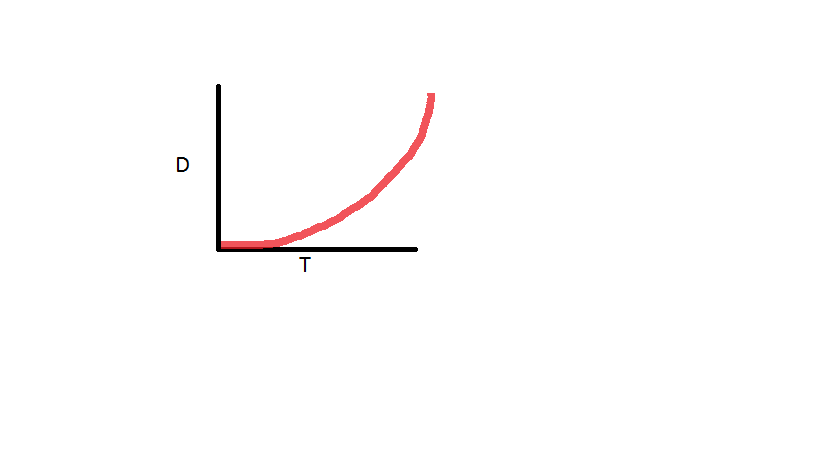
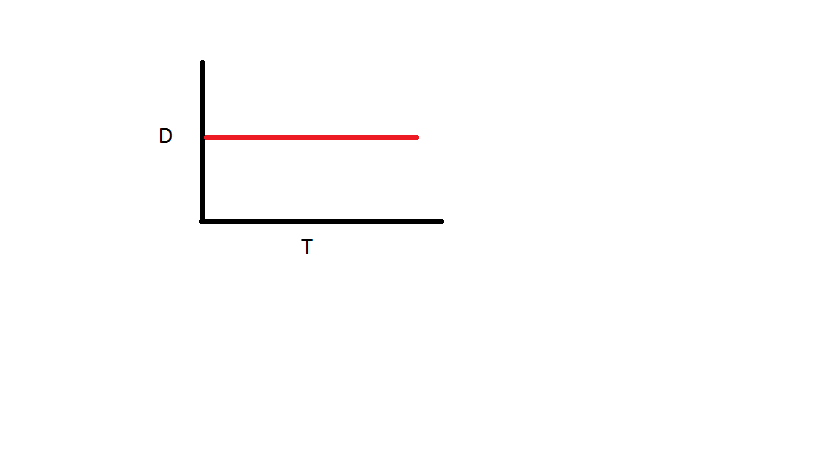
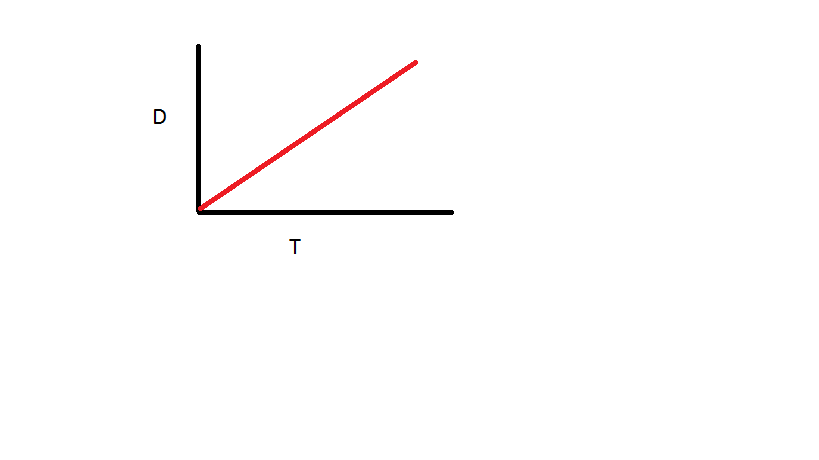


0-2 seconds using the distance vs. time graph.


the unit of acceleration is
(m/s2)
jouls
m
s
A negative acceleration means that your object is
constant
speeding up
at rest
slowing down
A positive acceleration means that your object is
at rest
speeding up
moving
slowing down
Acceleration: is the rate of change in
velocity
speed
displacement
direction
When is an object under uniform acceleration?
none of the following
when the direction is straight
when the velocity change is constant per unit time
when the time is constant
As the ball falls towards the ground, its velocity
zero
decreases
at rest
increases
which isn't an example of acceleration
When the car is speeding up.
When the car slows down.
When you fall off a bridge.
no change in velocity
Which of the following is/are true about acceleration
Acceleration is defined as the rate of change of velocity
Its SI unit is m/s2
Negative acceleration is called retardation
none of the following
A bus starts from rest and accelerates to 14 m/s in 4 s. What is the average acceleration of the bus?
3.5 m/s2
5.9 m/s2
10.5 m/s2
24 m/s2
Which of the following objects is accelerating?
A car driving in a northwest at a constant speed of 35 mph.
A car driving southwest at a constant speed of 35 mph.
A car driving in a circle at a constant speed of 35 mph.
Back
A car driving south at a constant speed of 45 mph.

