wayground logo

Free Printable Worksheets

Font size

S
M
L
XL
Worksheets

Midterm Physics

Total questions: 132

Worksheet time: 5hrs 4mins

Name
Class
Date
1.

a 170 lb halfback is tackled by a 245 lb guard. Each, of course, exerts a force on the other. Which of the players exerts the LARGER force on the other?

a)

the 170 lb halfback

b)

the 245 lb guard

c)

neither player

d)

not enough information

2.

a 170 lb halfback is tackled by a 245 lb guard. each, of course, has a resulting acceleration. Which of the players has a LARGER acceleration after the hit?

a)

the 170 lb halfback

b)

the 245 lb guard

c)

neither player

d)

not enough information

3.

A car slides down a frictionless incline. How does the normal force of the incline on the car compare with the weight (or force of gravity) of the car?

a)

the normal force must be equal to the car's weight

b)

the normal force must be less than the car's weight

c)

the normal force must be greater than the car's weight

d)

the normal force must be 0

4.
Looking at the roller coaster, were does the cart have the most potential energy?
a)
A
b)
B
c)
C
d)
D
5.
A dropping a book shows both gravitational potential energy and kinetic energy.  What could be said about the change in energy as the book falls?
a)
Kinetic energy increases, and the graviational energy increases
b)
Kinetic energy decreases, and the gravitational energy decreases
c)
Kinetic energy decreases, and the gravitational energy increases
d)
Kinetic energy increases, and the gravtiational energy decreases
6.
At which point does the cart have the greatest amount of kinetic energy?
a)
W
b)
X
c)
Y
d)
Z
7.
When does a rubber band have the most elastic energy? 
a)
When it is fully stretched
b)
When you start to stretch it
c)
When you release it
d)
After it has been released
8.

There is a book sitting at rest on a chair. Which of the following is true?

a)

There are many forces acting on the book, but they balance each other out

b)

The book exerts no force on the chair

c)

The chair exerts no force on the book

d)

all of these

9.

What letter represents an object moving toward the point of reference?

a)

A

b)

B

c)

C

d)

D

10.
As a pendulum swings from its highest to lowest position, what happens to its kinetic and potential energy? 
a)
Both the potential energy and kinetic energy decrease
b)
The potential energy decreases while the kinetic energy increases 
c)
The kinetic energy decreases while the potential energy increases 
d)
Bothe the potential energy and kinetic energy increase 
11.
How far does the car travel before it reaches a steady speed?
a)
10m
b)
20m
c)
100m
d)
200m
12.
Which statement about mass and weight is correct?
a)
Mass and weight are both forces
b)
Neither mass nor weight is a force
c)
Only mass is a force
d)
Only weight is a force
13.

A light plastic cart and a heavy steel cart are both pushed with the same force for a distance of 1.0 m, starting from rest. After the force is removed, the velocity of the light plastic cart is ________ that of the heavy steel cart.

a)

greater than

b)

equal to

c)

less than

d)

can't say unless we know how big the force is

14.

A light plastic cart and a heavy steel cart are both pushed with the same force for a distance of 1.0 m, starting from rest. After the force is removed, the kinetic energy of the light plastic cart is ________ that of the heavy steel cart.

a)

greater than

b)

equal to

c)

less than

d)

can't say unless we know how big the force is

15.

A small child slides down the four frictionless slides A–D. Rank in order, from largest to smallest, her speeds at the bottom.

a)

vD > vA > vB > vC

b)

vD > vA = vB > vC

c)

vC > vA > vB > vD

d)

vA = vB = vC = vD

16.

Starting from rest, a marble first rolls down a steeper hill, then down a less steep hill of the same height. Ignoring friction, for which is it going faster at the bottom?

a)

Faster at the bottom of the steeper hill

b)

Faster at the bottom of the less steep hill

c)

Same speed at the bottom of both hills

d)

Can’t say without knowing the mass of the marble

17.

Four students run up the stairs in the time shown. Which student has the largest power output?

a)

A

b)

B

c)

C

d)

D

18.

A basketball that is dropped bounces back up to its original height. Pick the correct energy transformation from the point when it was dropped until it returns to the original height.

a)

KE --> PE --> Elastic

b)

PE --> KE --> Elastic --> KE --> PE

c)

KE --> PE --> Elastic --> PE --> KE

d)

Elastic --> PE --> KE --> Elastic

19.
An insect flying through the air smacks into the windshield of a rapidly-moving train. The force the windshield exerts on the insect is higher than the force the insect exerts on the windshield.
a)
TRUE
b)
FALSE
20.

Here are 3 FBD diagrams for an elevator. Consider them to be A, B, C. Which one shows an elevator accelerating upward?

a)

A

b)

B

c)

C

d)

none of these

21.

Here are 3 FBD diagrams for an elevator. Consider them to be A, B, C. Which one shows an elevator moving upward but braking?

a)

A

b)

B

c)

C

d)

none of these

22.

Here are 3 FBD diagrams for an elevator. Consider them to be A, B, C. Which one shows an elevator moving at a constant rate of 2.5 m/s?

a)

A

b)

B

c)

C

d)

none of these

23.

Is it possible for the object in the diagram to be moving to the right and have this FBD?

a)

Yes. It's possible that the x forces were just left off the diagram.

b)

Yes. It could be moving at a constant velocity.

c)

No. The FBD shows that the system is in equilibrium.

d)

No. An FBD shows all F.

24.

As the angle of the incline increases, what happens to the normal force?

a)

The normal force increases

b)

The normal force decreases

c)

The normal force is not affected by the incline

d)

The normal force is only dependent on the force due to gravity

25.
Which of the following is true about the system shown?
a)
The system is not accelerating.
b)
The tension between m2 and m1 is less than the tension between m2 and m3
c)
The acceleration of the system only depends on m3
d)
None of the other answers are true
26.

If there is no friction, then the acceleration would be equal to

a)

mg

b)

sin(θ)mg

c)

g

d)

sin(θ)g

27.
a)
A
b)
B
c)
C
d)
D
28.
a)
A
b)
B
c)
C
d)
D
29.
a)
A
b)
B
c)
C
d)
D
30.
a)
It is at a maximum when the pendulum is at its lowest point
b)
It is at a maximum when the pendulum is at its maximum height h
c)
It is constant throughout the pendulum's motion
d)
It is at a minimum when the pendulum is somewhere between its lowest and highest positions
31.
a)
FB = FA = Fg
b)
(FB = FA) < Fg
c)
FB < (FA = Fg)
d)
FFB < FA
32.
Each of the figures above shows a tractor attached to an object. The tractor exerts the same constant force F on each object in each case. Which of the following is a true statement about an object and the relative magnitude of the force exerted by the object on the tractor?
a)
The magnitude of the force exerted by the truck on the tractor is greatest, because the resulting motion is in direction opposite the tractor's pull
b)
The magnitude of the force exerted by the boulder on the tractor is least, because no motion results
c)
The magnitude of the force exerted by the wagon on the tractor is least, because the resulting motion is in the direction of the tractor's pull
d)
The magnitude of the force exerted by each object on the tractor is equal, because tractor exerts an equal force on the object
33.
What is this graph representing?
a)
Constant Speed
b)
Acceleration (speeding up)
c)
Deceleration (slowing down)
d)
No motion
34.
At 60 seconds, how far had this object traveled? 
a)
0 m
b)
10 m
c)
20 m
d)
40 m
35.
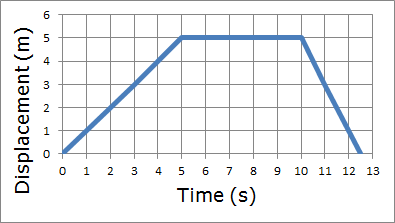
What is the person doing from 5 seconds to 10 seconds?
a)
Walking 
b)
Running
c)
Standing Still 
d)
Walking Fast
36.
Which graph represents zero acceleration (constant velocity)?
a)
A
b)
B
c)
C
d)
D
37.
What is happening at D?
a)
Stationary
b)
Accelerating
c)
Fast steady speed; moving away from the starting position
d)
Slower steady speed; moving away from the starting position
38.
What is happening at A?
a)
Stationary
b)
Accelerating
c)
Slower steady speed; moving away from the starting position
d)
Steady speed; returning to start position
39.
What is happening at B?
a)
Stationary
b)
Accelerating
c)
Slower steady speed; moving away from the starting position
d)
Steady speed; returning to start position
40.
Which runner won the race?
a)
A
b)
B
c)
C
41.

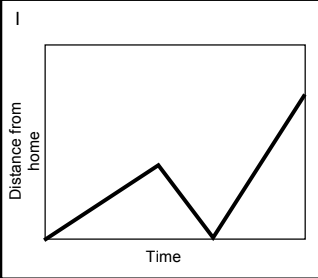
Suzie goes from Home to shopping to lunch to the movies to the gas station. What was her DISTANCE traveled?

a)

24 miles

b)

28 miles

c)

16 miles

d)

29 miles

42.

Suzie goes from Home to shopping to lunch to the movies to the gas station. What was her DISPLACEMENT?

a)

5 miles

b)

13 miles

c)

4 miles

d)

8 miles

43.
You are throwing a ball straight up in the air. At the highest point in this motion, the ball’s
a)
velocity and acceleration are both zero.
b)
velocity is nonzero but its acceleration is zero.
c)
acceleration is nonzero, but its velocity is zero.
d)
velocity and acceleration are both nonzero.
44.
What is happening in this graph from point B to C?
a)
The object is going down a hill.
b)
The object is returning to its starting location.
c)
The object is slowing down.
d)
The object is staying still.
45.
Which runner won the race?
a)
Albert
b)
Bob
c)
Charlie
46.
During which interval is the object slowing down?
a)
A to B
b)
D to E
c)
E to F
d)
G to H
47.
During which interval is the object speeding up?
a)
A to B
b)
B to C
c)
D to E
d)
E to F
48.

A ball is thrown into the air at some angle between 10 and 90 degrees. At the very top of the ball's path, its velocity is _____.

a)

entirely vertical

b)

entirely horizontal

c)

both vertical and horizontal

d)

zero

49.
An object is projected horizontally from a cliff.  The time it takes to hit the ground is
a)
more than if it was just dropped
b)
less than if it was just dropped
c)
the same amount of time than if it was just dropped
d)
impossible to determine
50.
A ball is thrown upwards and caught when it comes back down. In the absence of air resistance, the speed of the ball when caught would be 
a)
less than the speed it had when thrown upwards.
b)
more than the speed it had when thrown upwards.
c)
the same as the speed it had when thrown upwards.
51.
 Every morning, Tom walks along a straight road from his home to the bus stop. Below, is a graph representing Tom’s trip to school.
-
 What is the distance travelled from 0 to 70 seconds?
a)
40 meters
b)
160 meters
c)
80 meters
d)
20 meters
52.
 Every morning, Tom walks along a straight road from his home to the bus stop. Below, is a graph representing Tom’s trip to school.
-
 What is the displacement from Tom's house at the end of 70s?
a)
40 meters
b)
60 meters
c)
80 meters
d)
20 meters
53.
Who had the greatest average speed after 100 seconds?
a)
Mike
b)
Katelyn
c)
Alex
d)
They had the same average speed
54.
When no air resistance acts on a fast-moving baseball, its acceleration is
a)
opposite to the force of gravity.
b)
due to a combination of constant horizontal motion and accelerated downward motion.
c)
downward, g.
d)
centripetal.
55.
A cannon fires a cannonball at 200 m/s at an angle of 60 degrees above horizontal. At the peak of its flight, the cannon ball has a speed of
a)
173 m/s
b)
100 m/s
c)
200 m/s
d)
0 m/s
56.
A merry-go-round spins freely when Diego moves quickly to the center along a radius of the merry-go-round. As he does this, it is true to say that
a)
the moment of inertia of the system increases and the angular speed increases.
b)
the moment of inertia of the system decreases and the angular speed remains the same.
c)
the moment of inertia of the system decreases and the angular speed decreases.
d)
the moment of inertia of the system decreases and the angular speed increases.
57.
A person sits on a freely spinning lab stool that has no friction in its axle. When this person extends her arms,
a)
her moment of inertia increases and her angular speed decreases.
b)
her moment of inertia decreases and her angular speed increases.
c)
her moment of inertia increases and her angular speed increases.
d)
her moment of inertia increases and her angular speed remains the same.
58.
When a rigid object rotates about a fixed axis, what is true about all the points in the object? 
a)
They all have the same tangential acceleration.
b)
They all have the same angular speed.
c)
They all have the same tangential speed.
d)
They all have the same radial acceleration.
59.
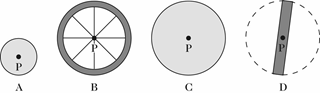
The figure shows scale drawings of four objects, each of the same mass and uniform thickness, with the mass distributed uniformly. Which one has the greatest moment of inertia when rotated about an axis perpendicular to the plane of the drawing at point P?
a)
A
b)
B
c)
C
d)
D
60.
The weight of an object _________ as it moves away from the center of Earth.
a)
increases
b)
stays the same
c)
triples
d)
decreases
61.
Suppose that an astronaut throws a rock in outer space at a location far from significant influences of gravity and air resistance.  One would expect that that the rock would
a)
Eventually stop since all objects ultimately “lose their steam”
b)
Eventually stop as its inertia slowly becomes used up
c)
Continue in motion with the same speed and direction
d)
Either a,b,c… depending on whether the astronaut continues to push it.
62.
A stone disk is sliding on a frictionless ice to the west with speed v. As the disk slides by, a child uses a rubber mallet to hit the disk at point X, exerting a force directly toward the center of the disk. The child hits point X every half second for about 10 s, changing the trajectory of the disk but not causing it to rotate. Which of the following most closely approximates the path of the disk while the child is hitting it?
a)
A
b)
B
c)
C
d)
D
63.
A system consists of a disk rotating on a frictionless axle and a piece of clay moving toward it. The outside edge of the disk is moving at a linear speed v, and the clay is moving at a speed of v/2. The clay sticks to the outside edge of the disk. How does the angular momentum of the system after the clay sticks compare to the angular momentum of the system before the clay sticks, and what is an explanation for the comparison?
a)
It is the same because there is no external torque acting on the system
b)
It is greater because the rotating mass increases, which increase the rotational intertia
c)
It is less because the speed of the disk decreases when the clay sticks to it
d)
It is less because the angular momentum of the clay opposes that of the disk
64.
A solid  metal bar is at rest on a horizontal frictionless surface. It is free to rotate about a vertical axis at the left end. The figures show forces of different magnitudes that are exerted on the bar at different locations. In which case does the bar's angular speed about the axis increase at the fastest rate?
a)
A
b)
B
c)
C
d)
D
65.

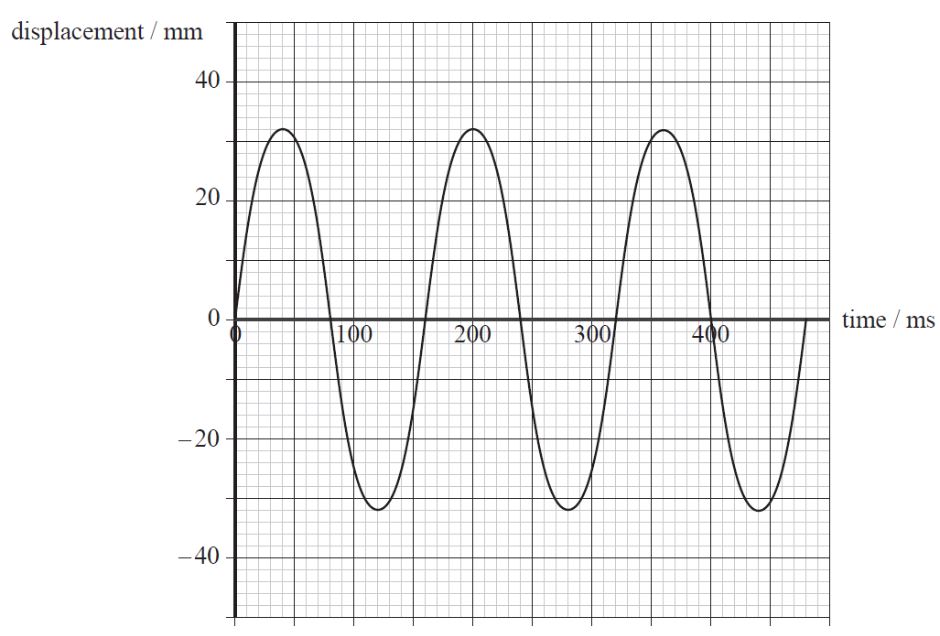
The graph shows the variation with time of the displacement of an object undergoing simple harmonic motion. At which of the following time values is kinetic energy zero?

a)

0 ms

b)

40 ms

c)

80 ms

d)

100 ms

66.

Which of the following is/ are characteristics of simple harmonic motion?

I. The acceleration is constant .

II. The restoring force is proportional to the displacement.

III. The frequency is independent of the amplitude.

a)

II only

b)

I and II only

c)

I and III only

d)

II and III only

e)

I, II, and III

67.

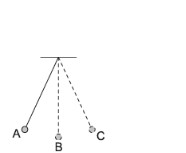
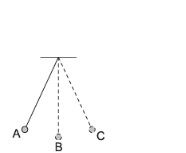
A pendulum oscillates as shown. At which of the following positions is the potential energy equal to the total energy?

a)

A

b)

B

c)

C

d)

Not enough information

68.

A pendulum oscillates as shown. At which of the following positions is the kinetic energy equal to the total energy?

a)

A

b)

B

c)

C

d)

Not enough information given.

69.

Which tube, if the same length, would have the lowest frequency?

a)
b)
c)
d)
70.

The length of the tube is 2 meters. How long is the wavelength of the wave?

a)

1 meter

b)

2 meters

c)

1/2 meter

d)

1/4 meter

71.

This string is in the

a)

1st harmonic

b)

2nd harmonic

c)

3rd harmonic

d)

4th harmonic

72.

Which of the following is true about the speed of sound through different mediums?

a)

V(gas) > V(liquid) > V(solid)

b)

V(liquid) > V(gas) > V(solid)

c)

V(solid) > V(liquid) > V(gas)

d)

V(solid) > V(gas) > V(liquid)

73.

Two waves of amplitude A are initially traveling in the same direction through a rope that is fixed at both ends. When the two waves meet, the resultant wave will have an amplitude of:

a)

A

b)

A2

c)

2A

d)

0

74.

A wave with amplitude A is traveling through a rope. If the rope is fixed on the left but not on the right, then which of the following represents the wave as it returns?

a)
b)
c)
d)
75.

A wave of amplitude A is traveling through a rope that is fixed on both ends. Which of the following represents the wave upon return?

a)
b)
c)
d)
76.

Which is a Longitudinal Wave?

a)
b)
77.

Which is a Transverse Wave?

a)
b)
78.
What does pitch depend on?
a)
amplitude 
b)
frequency
c)
intensity 
d)
volume of sound
79.
When a pendulum swings, the highest velocity is observed ...
a)
as it crosses equilibrium
b)
when it is farthest from equilibrium
c)
½ way between the highest and lowest point
d)
to be constant as the pendulum swings.
80.

Look at the diagram. At which positions will the overlapping waves have the most constructive interference?

a)

Positions #1 & #2

b)

Positions #2 & #3

c)

Positions #4 & #5

d)

Positions #6 & #7

81.
What phenomenon does this image demonstrate?
a)
Constructive interference
b)
Destructive interference
c)
Increasing frequency
d)
Increasing period
82.
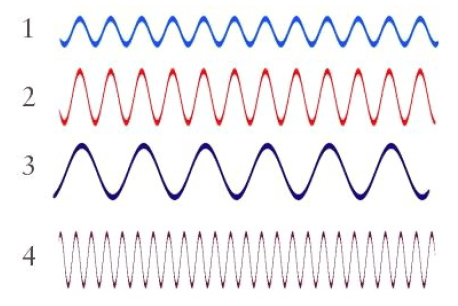
Which wave in the diagram has the greatest frequency?
a)
1
b)
2
c)
3
d)
4
83.

If the net torque on an object is 0, then the object will

a)

not rotate or rotate at a constant angular velocity.

b)

rotate with a constant angular acceleration.

c)

not rotate or move in a straight line.

d)

not move in a straight line.

84.
What direction is the torque acting with respect to post A?
a)
clockwise
b)
Counter clockwise
c)
Neither Direction
d)
Depends on the mass of the diver
85.
A seesaw is unbalanced with two people of different masses sitting equal distances from the center. Which of the following will result in equilibrium?
a)
The larger person moving further away from the center.
b)
Moving the smaller person closer to the center.
c)
Moving the smaller person further from the center.
d)
Making the larger person do nothing.
86.
What force is equal to the normal force from the wall acting on the ladder?
a)
Friction from the floor
b)
Normal force from the floor
c)
Friction from the wall
d)
Weight of the ladder
87.
In the diagram above, two masses, one with mass m, the other with mass M = 2m are resting on a uniform plank of length L that pivots at its midpoint. If the mass m is at the far end of the plank, how far away from the pivot should the mass M be to balance the plank in a horizontal position shown?
a)
L/2
b)
L/3
c)
L/4
d)
L/6
88.

A long rod is suspended by a frictionless bearing near its top. A lump of clay is projected from the right, collides with the block and sticks to it. Which one of the following statements is correct about the clay and rod system for this collision?

a)

The mechanical energy, linear momentum and angular momentum remain constant.

b)

The linear momentum and the angular momentum remain constant but the mechanical energy changes.

c)

Only the angular momentum remains constant.

d)

None of the quantities of mechanical energy, linear momentum, or angular momentum remain constant.

89.
A bug on a turning phonograph record will make more turns per minute if it is located toward the center of the record.
a)
True
b)
False
90.
If a ball moves with slipping down a ramp
a)
it goes slower than if it had rolled down
b)
it moves faster than if it had rolled down.
c)
It doesn't make a difference about friction or not friction.
d)
Friction slows it down.
91.

Two uniform solid balls, one of radius R and mass M, the other of radius 2R and mass 8M, roll down a high incline. They start together from rest at the top of the incline. Which one will reach the bottom of the incline first?

a)

The small sphere arrives first.

b)

The large sphere arrives first.

c)

Both reach the bottom at the same time.

92.
a)
b)
c)
d)
93.
a)
b)
c)
d)
94.
What will be the resultant direction of a boat pointing due south while the river's current running due east?
a)
due south
b)
due east
c)
somewhere south of east
d)
none of these
95.

A skateboarder rolls off a bridge into the river as shown. If the skateboarder was originally moving at 7.0 m/s, how much time did the skateboarder spend in the air?

a)

1.3 s

b)

0.79 s

c)

38.5 s

d)

0.70 s

e)

Not enough information given.

96.
While standing on a 10.0 m-high wall, Dennis tosses a rock into the water below. If Dennis throws the rock horizontally with a velocity of 3.0 m/s, how far out (displacement) from the edge of the cliff will it hit the water
a)
30 meters
b)
4.2 meters
c)
3.3 meters
d)
2 meters
97.
Observe the diagram. Which set of displacement, velocity, and acceleration graphs best represent a ball rolling down an incline?
a)
Graph Set A
b)
Graph Set B
c)
Graph Set C
d)
Graph Set D
98.

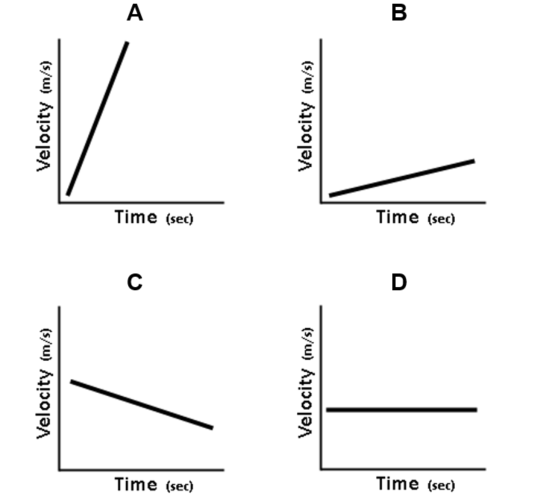
Which graph could represent a velocity-time graph for an object thrown straight downwards with no air resistance?

a)
b)
c)
d)
99.
 Jermaine runs exactly 2 laps around a 400 meter track. What is the displacement?
a)
800
b)
400
c)
0
d)
200
100.
If a net force is acting on an object, 
a)
its velocity must be constant
b)
its velocity must be changing
c)
its mass must be changing
d)
its acceleration = 0 
101.
Most modern vehicles have padded dashboards. This reduces collision injuries by...
a)
reducing the driver's change in momentum
b)
increasing the driver's change in momentum
c)
increasing the force of impact
d)
increasing the time of impact
102.
The recoil speed of a rifle is much less than the exit velocity of a bullet because...
a)
the rifle experiences a smaller force
b)
the rifle experiences a smaller change in momentum
c)
the rifle has a much greater mass
d)
the rifle does not obey the laws of physics
103.
Parkour Peter bends his knees upon landing in order to ____
a)
reduce his change in momentum
b)
increase his change in momentum
c)
increasing his landing time
d)
increasing his landing force
104.
Both students experience the same ____
a)
force of impact
b)
time of impact
c)
change in momentum
d)
all of the above
105.

A ball of mass m is thrown at a wall with speed u. After it strikes the wall, the ball bounces back with a speed v. What represents the magnitude of the force acting on the ball during the collision?

a)

m(u-v) / t

b)

m(v-u) / t

c)

m(u+v) / t

d)

0

106.

A block of mass M slides across a frictionless surface with velocity v until collides with a stationary block of mass m. If the two blocks stick together, what is their velocity after the collision?

a)

(M+m)v / m

b)

(M-m)v

c)

Mv / (M+m)

d)

(M-m)v / M

107.
Energy is lost during this type of collision
a)
elastic
b)
inelastic
c)
energy is lost in both types of collisions
108.
Momentum is conserved in this type of collision
a)
elastic
b)
inelastic
c)
momentum is conserved in both types of collisions
109.
An open cart on a level surface is rolling without frictional loss through a vertical downpour of rain. As the cart rolls, an appreciable amount of rainwater accumulates in the cart. The speed of the cart will
a)
increase because of conservation of mechanical energy
b)
decrease because of conservation of momentum
c)
decrease because of conservation of mechanical energy
d)
remain the same because the raindrops are falling perpendicular to the direction of the cart's motion
110.

The table below shows the velocity and the mass of a golf ball and a bowling ball.

The golf ball and bowling ball undergo an elastic collision. What is the total momentum and energy of the system after the collision?

a)

p = 16 kg*m/s, KE = 84 J

b)

p = 16 kg*m/s, KE = -76 J

c)

p = 0 kg*m/s, KE = -76 J

d)

p = 0 kg*m/s, KE = 84 J

111.

Which of the following statements is true about the image above?

a)

The accelerations of the blocks will vary according to their mass

b)

The net force acting on each block is the same

c)

The blocks will experience the same acceleration

d)

The 3m box will eat the 2m and the m boxes

112.
A student stands at one end of a raft floating in a pool with equally spaced marks along the bottom. The student and the raft have the same mass. The student walks to the opposite end of the raft. Which of the following best shows the final locations of the raft and student relative to the marks at the bottom of the  pool? Assume there is no drag force between raft and the water.
a)
A
b)
B
c)
C
d)
D
113.
a)
A
b)
B
c)
C
d)
D
114.

A stationary horn broadcasts an emergency distress signal at a constant frequency f. A stationary observer hears the signal then begins to walk away from the source. The observer will perceive a frequency that is:

a)

constantly the same as f.

b)

Initially the same as f, with the frequency decreasing.

c)

always greater than f.

d)

Initially the same as f, with the frequency increasing.

115.

According to the information and diagram shown above, what position will have the greatest magnitude of vertical acceleration?

a)

A

b)

B

c)

C

d)

All positions have the same magnitude of acceleration

116.

The diagram below represents two concurrent forces.

Which vector represents the force that will produce equilibrium with these two forces?

a)
b)
c)
d)
117.
To find the normal force
a)
mg
b)
sin(θ)mg
c)
cos(θ)mg
d)
tan(θ)mg
118.
If an object is at rest on an inclined plane, which of the following forces is greatest?
a)
Normal Force
b)
Friction
c)
Weight
d)
Both Normal Force and Weight are equal, so they both are the greatest.
119.

At the instant shown in the diagram, the car's centripetal acceleration is directed-

a)

toward E

b)

toward N

c)

toward W

d)

clockwise

120.
a)
A
b)
B
c)
C
d)
D
121.
Sphere rolls from rest down an inclined plane. 
a)
B
b)
C
c)
D
d)
E
122.
a)
A
b)
B
c)
C
d)
D
123.
a)
A
b)
B
c)
C
d)
D
124.
A simple pendulum has a period of 2 s. 
a)
A
b)
B
c)
C
d)
D
125.
a)
A
b)
B
c)
C
d)
D
126.
a)
A
b)
B
c)
C
d)
D
127.
a)
A
b)
B
c)
C
d)
D
128.
a)
A
b)
B
c)
C
d)
D
129.
The more mass an object has, the faster it will fall.
a)
True
b)
False
130.
What happens to the total distance that a ball travels as it falls off the side of a cliff?
a)
The distance remains constant 
b)
The distance increases at a uniform rate
c)
The distance increases at a nonuniform rate 
d)
The distance decreases at a uniform rate
131.
What happens to the velocity of a ball as it is dropped off a cliff? 
a)
It decreases at a uniform rate 
b)
It increases at a uniform rate 
c)
It is constant 
d)
It increases at a non-uniform rate
132.
a)
A
b)
B
c)
C
d)
D