wayground logo

Free Printable Worksheets

Font size

S
M
L
XL
Worksheets

Combo Q1-3

Total questions: 132

Worksheet time: 2hrs 55mins

Name
Class
Date
1.

a)

linear

b)

quadratic

c)

absolute value

d)

inverse

2.
a)

constant

b)

linear

c)

cubic

d)

square root

3.
a)

cube root

b)

cubic

c)

quadratic

d)

logarithmic

4.
a)

linear

b)

cube root

c)

square root

d)

quadratic

5.
a)

quadratic

b)

absolute value

c)

square root

d)

inverse

6.
a)

inverse squared

b)

reciprocal

c)

greatest integer

d)

exponential

7.
a)

cube root

b)

cubic

c)

logarithmic

d)

inverse

8.
a)

Linear Identity Function

b)

don't miss this one

c)

you know this one

d)

spell it RIGHT

9.
a)

y=xy=x

b)

y=xy=\sqrt{x}

c)

y=xy=\left|x\right|

d)

y=x2y=x^2

10.
a)

y=xy=x

b)

y=xy=\sqrt{x}

c)

y=x2y=x^2

d)

y=xy=\left|x\right|

11.
a)

y=xy=x

b)

y=xy=\sqrt{x}

c)

y=xy=\lfloor x\rfloor

d)

y=x2y=x^2

12.
a)

y=x3y=x^3

b)

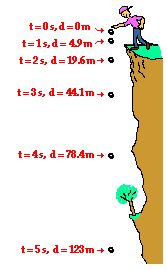
y=1xy=\frac{1}{x}

c)

y=xy=x

d)
13.
a)

y=x3y=x^3

b)
c)

y=1xy=\frac{1}{x}

d)

y=bx , b>1y=b^x\ ,\ b>1

14.
a)

y=1x2y=\frac{1}{x^2}

b)

y=1xy=\frac{1}{x}

c)

y=logbx, b>1y=\log_bx,\ b>1

d)

y=xy=\sqrt{x}

15.
a)

y=xy=x

b)

y=xy=\sqrt{x}

c)

y=cy=c

d)

y=bx, b>1y=b^x,\ b>1

16.
a)

y=x2y=x^2

b)

y=logbx, b>1y=\log_bx,\ b>1

c)

y=1xy=\frac{1}{x}

d)

y=xy=\sqrt{x}

17.

What type of function is this?

a)

linear

b)

linear identify

c)

quadratic

d)

absolute value

18.

What is the equation of this function?

a)

y = -2x

b)

y=12xy=-\frac{1}{2}x

c)

y=12xy=\frac{1}{2}x

d)

y=2x

19.

Newtons could be used to measure __________ and __________.

a)

mass, speed

b)

momentum, work

c)

force, weight

d)

direction, power

20.

The SI unit for mass is _________.

a)

Pounds

b)

Inches

c)

Kilograms

d)

Ounces

21.

A system of units of measure widely accepted by the scientific community (SI for short)

a)

International System of Units

b)

World Wide Weight

c)

Science Instruments

d)

Use These Measures

22.

Speed and velocity are measured in the same SI unit

a)

True

b)

False

23.

Average speed is measured in

a)

meters per second (m/s)

b)

miles per day (m/d)

c)

kilograms per second (k/s)

d)

newtons per meters (n/m)

24.

SI unit for weight

a)

Pound

b)

Liter

c)

Newton

d)

Second

25.

Acceleration is measured in

a)

m/d3

b)

g/n

c)

m/s2

d)

k/j2

26.

Kilograms times meters divided by seconds gives you

a)

Power

b)

Work

c)

Acceleration

d)

Momentum

27.

Newton meters is an other term for

a)

Watts

b)

Joules

c)

Kilograms

d)

Seconds

28.

All of these are measured in joules EXCEPT

a)

Work

b)

Potential Energy

c)

Kinetic Energy

d)

Weight

29.

The SI unit for power is

a)

meters

b)

mass

c)

kilograms

d)

watts

30.

Work is measured in

a)

Joules

b)

Watts

c)

Seconds

d)

Meters

31.

Potential and kinetic energy are both measured in

a)

Watts

b)

Kelvins

c)

Joules

d)

Newtons

32.

SI unit for weight is

a)

Newton

b)

Kilogram

c)

Meter

d)

Watt

33.

Force is measured in

a)

Space

b)

Time

c)

Nyes

d)

Newtons

34.

Newtons could be used to measure __________ and __________.

a)

mass, speed

b)

momentum, work

c)

force, weight

d)

direction, power

35.

The SI unit for mass is _________.

a)

Pounds

b)

Inches

c)

Kilograms

d)

Ounces

36.

A system of units of measure widely accepted by the scientific community (SI for short)

a)

International System of Units

b)

World Wide Weight

c)

Science Instruments

d)

Use These Measures

37.

Speed and velocity are measured in the same SI unit

a)

True

b)

False

38.

Average speed is measured in

a)

meters per second (m/s)

b)

miles per day (m/d)

c)

kilograms per second (k/s)

d)

newtons per meters (n/m)

39.

SI unit for weight

a)

Pound

b)

Liter

c)

Newton

d)

Second

40.

Acceleration is measured in

a)

m/d3

b)

g/n

c)

m/s2

d)

k/j2

41.

Kilograms times meters divided by seconds gives you

a)

Power

b)

Work

c)

Acceleration

d)

Momentum

42.

Newton meters is an other term for

a)

Watts

b)

Joules

c)

Kilograms

d)

Seconds

43.

All of these are measured in joules EXCEPT

a)

Work

b)

Potential Energy

c)

Kinetic Energy

d)

Weight

44.

The SI unit for power is

a)

meters

b)

mass

c)

kilograms

d)

watts

45.

Work is measured in

a)

Joules

b)

Watts

c)

Seconds

d)

Meters

46.

Potential and kinetic energy are both measured in

a)

Watts

b)

Kelvins

c)

Joules

d)

Newtons

47.

SI unit for weight is

a)

Newton

b)

Kilogram

c)

Meter

d)

Watt

48.

Force is measured in

a)

Space

b)

Time

c)

Nyes

d)

Newtons

49.
During which interval is the object not moving?
a)
B to C
b)
C to D
c)
D to E
d)
only at point A
50.
During which interval is the object traveling at a constant velocity?
a)
B to C
b)
D to E
c)
F to G
d)
it traveling at a constant velocity during all of the intervals shown.
51.
During which interval is the object speeding up?
a)
A to B
b)
B to C
c)
D to E
d)
E to F
52.
During which interval is the object slowing down?
a)
A to B
b)
D to E
c)
E to F
d)
G to H
53.
Acceleration occurs when an object changes its speed or ______.
a)
direction
b)
force
c)
inertia
d)
mass
54.
Which runner stopped for a rest?
a)
Albert
b)
Bob
c)
Charlie
55.
Which runner won the race?
a)
Albert
b)
Bob
c)
Charlie
56.
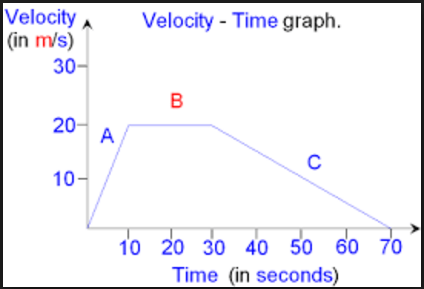
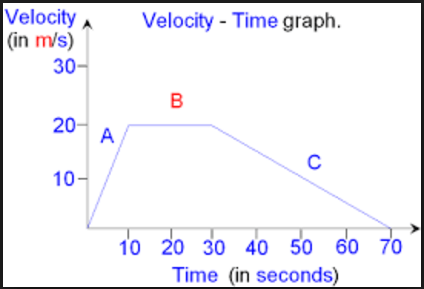
This is a velocity-time graph.  What is the object doing in segment A?
a)
Positive acceleration
b)
Negative acceleration
c)
Constant Velocity
d)
Not moving
57.
This is a velocity-time graph.  What is the object doing in segment C?
a)
Positive acceleration
b)
Negative acceleration
c)
Constant Velocity
d)
Not moving
58.
Calculate the acceleration for segment A.
a)
2 m/s2
b)
20 m/s2
c)
-2 m/s2
d)
0 m/s2
59.
A car driving at 50 miles per hour drives for 2 hours. What distance did it cover?
a)
50 miles
b)
25 miles
c)
100 miles
d)
75 miles
60.
A truck driving at 60 miles per hour travels 150 miles. How long is it driving for?
a)
9000 hours
b)
0.4 hours
c)
210 hours
d)
2.5 hours
61.
What does this graph represent?
a)
Constant speed
b)
Acceleration
c)
Not moving
62.
What does this graph represent?
a)
Constant Speed
b)
Acceleration
c)
Not moving
63.
What does this graph represent?
a)
Constant speed
b)
Acceleration
c)
Not moving
64.
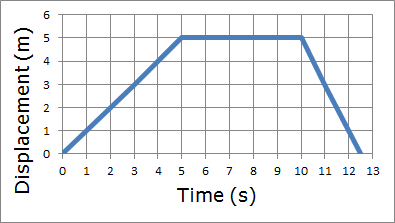
According to the graph how fast does the person travel in the first 5 seconds?
a)
2 m/s
b)
10 m/s
c)
12.5 m/s
d)
1 m/s
65.
The speed of the vehicle between points A-B is...
a)
12m/s
b)
8m/s
c)
10m/s
d)
16m/s
66.
Acceleration of an object happens when things ________
a)
slow down
b)
go faster
c)
change direction (turn)
d)
All of the above
67.
The SI unit for acceleration is
a)
mph
b)
m/s
c)
m/s2
68.
Acceleration: is the rate of change in ___________.
a)
speed
b)
distance
c)
velocity 
d)
displacement 
69.

What does the term displacement mean?

a)

The direction of motion

b)

The distance traveled divided by time

c)

The change of position of an object

70.
Which of the following is the closest match to the definition of motion?
a)
An objects change in position relative to a reference point
b)
The change in position of an object
c)
Constant speed
71.
What is the definition of velocity?
a)
A force that opposes motion
b)
Uniform circular motion
c)
The speed of an object in a particular direction
72.
What is the definition of speed?
a)
Distance/Time
b)
Change in velocity/Time
c)
A change in momentum
73.
How is velocity different than speed?
a)
Speed opposes velocity
b)
Velocity is speed with a direction
c)
None of the answers are correct
74.
Which of the following represents the equation for acceleration?
a)
a = ƒt/v
b)
a = Δt/f
c)
A = Λd/t
d)
a = Δv/t
75.
An object traveling in a circular motion is always changing its ______ and ______.
a)
rotation, velocity
b)
direction, velocity
76.
A force is an action exerted on a body in order to change the body's state of ______.
a)
Balance
b)
Being
c)
Proximity
d)
Motion
77.
A force that opposes motion between two surfaces that are in contact.
a)
Speed
b)
Velocity
c)
Friction
d)
Force
78.
The force that opposes the motion of two surfaces that are in contact and are sliding over each other.
a)
Static Friction
b)
Kinetic Friction
79.
a)
Balance Force
b)
Unbalanced Force
80.
a)
Speed
b)
Acceleration
c)
Displacement
81.
a)
Velocity
b)
Speed
c)
Uniform Circular Motion
82.
a)
Static Friction
b)
Kinetic Friction
c)
Sliding Friction
83.

What is the formula for speed?

a)

speed = distance x time

b)

speed=distance / time

c)

speed = time / distance

d)

speed = distance + time

84.

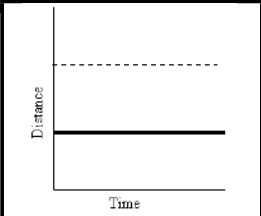
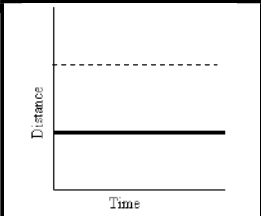
What does the solid line on this graph represent?

a)

Constant speed

b)

Acceleration

c)

At rest

d)

deceleration

85.

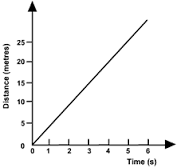
What is the line on this graph showing?

a)

moving away from starting point at a constant speed

b)

moving back towards the starting point at a constant speed

c)

acceleration (getting faster)

d)

deceleration (getting slower)

86.

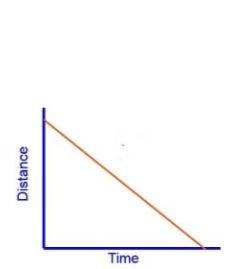
What is this line of this graph showing?

a)

moving away from starting point at a constant speed

b)

moving back towards the starting point at a constant speed

c)

acceleration (getting faster)

d)

deceleration (getting slower)

87.
Which graph is showing acceleration (getting faster)
a)
D
b)
E
c)
both D and E
d)
neither D or E
88.
How long did it take this object to travel 10 m?
a)
0 s
b)
10 s
c)
15 s
d)
20 s
89.
At 60 seconds, how far had this object traveled? 
a)
0 m
b)
10 m
c)
20 m
d)
40 m
90.

What is represented by this graph?

a)

constant speed

b)

not moving

c)

speed increasing

d)

speed increasing at a constant rate

91.

what is the motion described in the graph

a)

all of above

b)

constant speed

c)

acceleration

d)

constant position

92.

What does this graph represent?

a)

Constant speed

b)

Acceleration

c)

Stationary object

93.
Velocity is
a)
speed and acceleration
b)
constant speed
c)
a frame of reference
d)
speed in a given direction
94.
Acceleration is
a)
increasing speed
b)
decreasing speed
c)
changing direction
d)
all of the above
95.

What is happening at E?

a)

Stationary

b)

Accelerating

c)

Constant speed; moving away from the starting position

d)

Constant speed; returning to start position

96.
What happened during C to D point?
a)
not moving
b)
increasing speed at a constant rate
c)
moving at a constant speed
d)
moving at 0 m/sacceleration
97.

What happened during E to F point?

a)

not moving

b)

increasing speed at a constant rate

c)

constant speed

d)

acceleration

98.

What happened during B to C point?

a)

deceleration

b)

constant speed

c)

at rest

d)

acceleration

99.
This graph demonstrates an object that is -
a)
Increasing speed
b)
At a constant speed
c)
Decreasing speed
d)
Stationary
100.
This graph demonstrates an object that is -
a)
Increasing speed
b)
At a constant speed
c)
Decreasing speed
d)
Stationary
101.
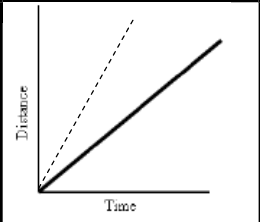
Which line represents an object moving at a faster speed?
a)
A
b)
B
102.
Which line represents an object moving at a slower speed?
a)
A
b)
B
103.
A runner races in the 100 meter dash.  It takes her 10 seconds to finish.  What is her average speed?
a)
10 m/s
b)
1000 m/s
c)
100 seconds
d)
10 seconds
104.
Which is correct?
a)
speed = distance x time
b)
speed = speed divided time
c)
speed = Distance divide time
d)
Speed = time x speed
105.

The gradient of a velocity-time graph represents (a)   .

106.

The area under a velocity-time graph represents (a)   .

107.

A flat section of a velocity-time graph represents (a)   .

108.

Describe the motion in section D.

(a)  

109.

A curve on a velocity-time graph shows that the acceleration is (a)   .

110.

Which section represents a steady speed?

a)

A

b)

B

c)

C

d)

D

111.

Calculate the acceleration in section A

(a)  

112.

Calculate the acceleration in section C.

(a)  

113.

State the size of the acceleration in section B.

(a)  

114.

Calculate the distance travelled in section B.

(a)  

115.

Calculate the distance travelled in section D

(a)  

116.

Calculate the distance travelled in section C.

(a)  
117.
What happens to the velocity of a ball as it is dropped off a cliff? 
a)
It decreases at a uniform rate 
b)
It increases at a uniform rate 
c)
It is constant 
d)
It increases at a non-uniform rate
118.

A car is traveling to the right with a speed of 29​​m/s when the rider slams on the accelerator to pass another car. The car passes in 110 m with constant acceleration and reaches a speed of 34m/s. We want to find the acceleration of the car as it sped up. What equation should you choose?

a)

v=vo+at

b)

d=vot+1/2at2

c)

v2=vo2+2ad

d)

d=1/2(v+vo)t

119.

Kinematic equation can only be used when you have a constant ....

a)

Position

b)

Velocity

c)

Acceleration

d)

Time

120.

The unit we use to measure acceleration is ___.

a)

m/s

b)

m

c)

s

d)

m/s2

121.

A ball is dropped from a building. How fast is it traveling after falling for 1.77 s? (Hint: It's a free falling object)

a)

14.76 m/s

b)

17.35 m/s

c)

18.91 m/s

d)

20.03 m/s

122.

A car starts from rest and accelerates uniformly over a time of 5.21 seconds for a distance of 110 m. Determine the acceleration of the car. Choose the appropriate equation.

a)

v=vo+at

b)

d=vot+1/2at2

c)

v2=vo2+2ad

d)

d=1/2(v+vo)t

123.

The unit we use to measure speed is ___.

a)

m/s

b)

m

c)

s

d)

m/s2

124.

The unit we use to measure distance is ___.

a)

m/s

b)

m

c)

s

d)

m/s2

125.

The unit we use to measure time is ___.

a)

m/s

b)

m

c)

s

d)

m/s2

126.

Which of the following symbols represent speed when time is zero?

a)

v

b)

v0

c)

a

d)

x

127.

Which of the following symbols represent speed at any time?

a)

v

b)

v0

c)

a

d)

x

128.
A boat travels 12.0 m while it reduces its velocity from 9.5 m/s to 5.5 m/s. What is the magnitude of the boat’s acceleration while it travels the 12.0 m?
a)
1.3 m/s2
b)
2.5 m/s2
c)
3.0 m/s2
d)
7.5 m/s2
129.

A car starts from rest and accelerates uniformly over a time of 5.21 seconds for a distance of 110 m. Determine the acceleration of the car. Choose the appropriate equation.

a)

v=vo+at

b)

d=vot+1/2at2

c)

v2=vo2+2ad

d)

d=1/2(v+vo)t

130.

Rocket-powered sleds are used to test the human response to acceleration. If a rocket-powered sled is accelerated to a speed of 444 m/s in 1.83 seconds, then what is the distance that the sled travels?

Choose the appropriate equation.

a)

v=vo+at

b)

d=vot+1/2at2

c)

v2=vo2+2ad

d)

d=1/2(v+vo)t

131.

If Michael Jordan has a vertical leap of 1.29 m, then what is his takeoff speed if his acceleration is -9.8 m/s2 and his velocity at the top of his leap i 0 m/s?

a)

v=vo+at

b)

d=vot+1/2at2

c)

v2=vo2+2ad

d)

d=1/2(v+vo)t

132.

An engineer is designing the runway for an airport. Of the planes that will use the airport, the lowest acceleration rate is likely to be 3 m/s2. The takeoff speed for this plane will be 65 m/s. All airplanes will start from rest. Assuming this minimum acceleration, what is the minimum allowed length for the runway?

a)

v=vo+at

b)

d=vot+1/2at2

c)

v2=vo2+2ad

d)

d=1/2(v+vo)t