
 Worksheets
Ch 1, 2, and 3 Test Review 2024
Total questions: 131
Worksheet time: 3hrs 2mins
Vertical angles are always
90 degrees
180 degrees
equal measure
adjacent
complementary

(a)

(a)

(a)

(a)

(a)

(a)

(a)

(a)

Round to the tenth.
(a)

(a)

(a)

Find the measure of the indicated angle.
(a)

Find the value of t
(a)

(a)

(a)

Find the value of x.
(a)

Which pairs of angles are vertical? Select all that apply.
<COA & <BOD
<AOD & <COB
<COA & <AOD
<DOB & <BOC

Which angles are vertical angles? Select all that apply.
<FGE & <DGC
<DGE & <CGF
<AGB & <BGC
<DGC & <FGA
<EGF & <FGA
Which angles are adjacent angles? Select all that apply.
<FGE & <DGC
<DGE & <CGF
<AGB & <BGC
<DGC & <FGA
<EGF & <FGA

Which angles are adjacent angles? Select all that apply.
<EKH & <GKF
<GKH & <EKF
<GKJ & <JKH
<JKH & <HKE
<HKE & <EKF

Which angles are vertical angles? Select all that apply.
m and k
i and g
c and d
e and b
f and e
Find the midpoint of the line segment with the given endpoints (3,9) and (5,9). Write your answer as an ordered pair.
(a)
What is the midpoint between (-4,4) and (-2,2)? Write your answer as an ordered pair.
(a)
Use the distance formula to find the distance between (-5, 5) and (1, -2). Round to the tenth, if necessary.
(a)

7.2

Troop 175 is designing their new campground by first mapping everything on a coordinate grid. They have found a location for the mess hall and for their cabins. They want the bathrooms to be halfway between these two. What will be the coordinates of the location of the bathrooms? Write as an ordered pair.
(a)

If m∠EBF=6x+4 and m∠CBF=7x−2, find m∠EBF
(a)
If m∠3=4x+10 and m∠4=5x, find m∠4
(a)
Let m∠1=m∠2. If and m∠ABE=100 and m∠ABD=2(r+5), find m∠DBE
(a)

If m∠EBD=4x+16 and m∠DBC=6x+4, find m∠EBD.
(a)

If m∠DCE=4x+15 and m∠ECF=6x−5, find m∠DCE
(a)
If m∠FCG=9x+3 and m∠GCB=13x−9, find m∠GCB
(a)

Find the midpoint of the line segment. Write your answer as an ordered pair.
(a)
Find the distance between (3, 24) and (7, 56). Round to the tenth, if necessary. Do not type x= or use units.
(a)
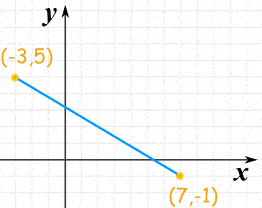
Find the distance between (-3, -11) and (8, -42). Round to the tenth, if necessary. Do not type x= or use units.
(a)
Use the Distance Formula to find the distance between:
(-6,-3) and (-4,-8). Round to the tenth, if necessary. Do not type x= or use units.
(a)
Use the Distance Formula to find the distance between:
(3,7) and (-5,-9) Round to the tenth, if necessary. Do not type x= or use units.
(a)


Line q
Line p
Line r

Which three line segments intersect at point A?
AB
AD
AG
BH
CD

Use the Distance Formula to find the distance between the points given. Round to the tenth, if necessary. Do not type x= or use units.
(a)

Use the Distance Formula to find the distance between the points given. Round to the tenth, if necessary. Do not type x= or use units.
(a)
Which of the following is the CONVERSE of the statement below?
If a student ordered a yearbook, then they paid BK $75.
If a student paid BK $75, then they ordered a yearbook.
If a student did not order a yearbook, then they did not pay BK $75.
If a student did not pay BK $75, then they did not order a yearbook.
There is no converse of the statement.

Which of the following is the CONVERSE of the statement below?
If an object is a bird, then it can fly.
If an object can fly, then it is a bird.
If an object is not a bird, then it cannot fly
If an object cannot fly, then it is not a bird
There is no converse of the statement
Which of the following is the CONVERSE of the statement below?
If your grade is a 96, then you are
making an A.
If you are making an A, then your grade is a 96.
If you are not making an A, then your grade is not a 96.
If your grade is not a 96, then you are not making an A.
There is no converse of the statement.

Which of the following is the CONVERSE of the statement below?
If you play football, then you wear
a uniform.
If you wear a uniform, then you play football.
If you do not play football, then you do not wear a uniform.
If you do not wear a uniform, then you do not play football.
There is no converse of the statement.
Which of the following is the INVERSE of the statement below?
If an object is a computer, then it
has a hard drive.
If an object is not a computer, then it does not have a hard drive.
If an object does not have a hard drive, then it is not a computer.
If an object has a hard drive, then it is a computer.
There is no inverse of the statement.
Which of the following is the INVERSE of the statement below?
If an object is a battery, then it is
rechargeable.
If an object is not a battery, then it is not
rechargeable.
If an object is rechargeable, then it is not a battery.
If an object is not rechargeable, then it is not a battery.
There is no inverse of the statement.
Which of the following is the INVERSE of the statement below?
If an animal is black and white,
then it is a penguin.
If an animal is not black and white, then it is not a penguin
If an animal is a penguin, then it is black and white.
If an animal is not a penguin, then it is not black and white.
There is no inverse of the statement.

Which of the following is the CONTRAPOSITIVE of the statement below?
If a species walks on two feet, then
it is human.
If a species is not human, then it does not walk on two feet.
If a species is human, then it walks on two feet.
If a species does not walk on two feet, then it is not human.
There is no contrapositive of the statement.
Which of the following is the CONTRAPOSITIVE of the statement below?
If a gem is a ruby, then it is red.
If a gem is not red, then it is not a ruby.
If a gem is not a ruby, then it is not red.
If a gem is red, then it is a ruby.
There is no contrapositive statement.

Which of the following is the CONTRAPOSITIVE of the statement below?
If a species is a fish, then it lives in
water.
If a species does not live in water, then it is not a fish.
If a species is not a fish, then it does not live in water.
If a species lives in water, then it is a fish.
There is not contrapositive of the statement.
Which of the following is a valid conditional statement for the following phrase:
An acute angle has a measure less than 90°.
If an angle is acute, then it has a measure less than 90°.
If an angle is not acute, then it does not have a measure less than 90°.
If an angle is acute, then it is acute.
If an angle does not measure less than 90°, then it is not acute.
If the conditional statement was "If an angle is acute, then it has a measure less than 90°.", which type of statement is the following?
An angle is acute if and only if (iff) it has a measure less than 90°.
Biconditional
Converse
Inverse
Contrapositive
If the conditional statement was "If an angle is acute, then it has a measure less than 90°.", which type of statement is the following?
If an angle does not have a measure less than 90°, then it is not acute.
Contrapositive
Converse
Biconditional
Inverse
If the conditional statement was "If an angle is acute, then it has a measure less than 90°.", which type of statement is the following?
If an angle has a measure less than 90°, then it is acute.
Converse
Contrapositive
Biconditional
Inverse
If the conditional statement was "If an angle is acute, then it has a measure less than 90°.", which type of statement is the following?
If an angle is not acute, then it does not have a measure less than 90°.
Inverse
Contrapositive
Biconditional
Converse


Does this image show a rotation? If so, what is the angle of rotation?
90° counterclockwise
180° counterclockwise
270° counterclockwise
Not a rotation

Does the image show a rotation? If so, what is the angle of rotation?
90° counterclockwise
180° counterclockwise
270° counterclockwise
Not a rotation

Rotation Rules (clockwise):
270o rotation: (x, y)→(-y, x)
What are the coordinates of B' after a 270° clockwise?
(4, 4)
(4, -4)
(-3, 4)
(-4, 4)

Rotation Rules (clockwise):
90o rotation: (x, y)→(y, -x)
What are the coordinates for A' after a 90⁰ rotation clockwise?
(1, 3)
(3, 1)
(3, -1)
(1, -3)


Determine how to translate triangle A'B'C' to triangle ABC.
(x+2, y-5)
(x+2, y-9)
(x-2, y-9)
(x-2, y+9)
(x+2, y+9)

Where would point J' be if you translated point J 5 units to the left and 2 units up?
(5, 3)
(3, -5)
(-5, 3)
(-3, 5)

Determine where T' would be if you translated T 3 units to the right and 6 units up.
(5, 1)
(2, -5)
(-1, 1)
(8, -2)

If trapezoid DEFG has vertices D(0,-3), E(1,3), F(3,3) and G(4,-3), find G' if DEFG is reflected over the y axis. Write your answer as an ordered pair.
(a)
If trapezoid DEFG has vertices D(0,-3), E(1,3), F(3,3) and G(4,-3), find G' if DEFG is reflected over the x-axis. Write your answer as an ordered pair.
(a)

Find A' if the figure is reflected over the x-axis. Write your answer as an ordered pair. Each square is scaled as one.
(a)

Find G' if the figure is reflected over the line y=2. Write your answer as an ordered pair. The scale of the graph goes by 1 each square.
(a)
Find G' if the figure is reflected over the line x=1. Write your answer as an ordered pair. The scale of the graph goes by 1 each square.
(a)

What axis is the image reflected over?
X-axis
Y-axis
Neither. It is a translation.

Flipping a figure is a ...
Rotation
Reflection
Dilation
Translation


Solve for y. Round to the tenth, if necessary. Do not type y=
(a)

Solve for y. Round to the tenth, if necessary. Do not type y=
(a)
Solve for x. Round to the tenth, if necessary. Do not type x=
(a)

Solve for x. Round to the tenth, if necessary. Do not type x=
(a)
Solve for y. Round to the tenth, if necessary. Do not type y=
(a)

Identify the correct statement(s) if lines l and m are parallel. Select all that apply.
∠C=116°
∠C=64°
∠D=116°
∠D=64°
∠C and ∠D are complementary

Identify the correct statement(s) if lines l and m are parallel. Select all that apply.
x=105
∠J=75°
x=21
∠J and ∠I are complementary
∠J and ∠I are supplementary

What is the measure of ∠6?
(a)
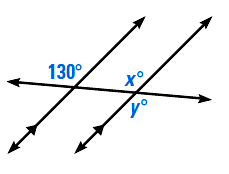
Find y. Do not type y=
(a)

Which of the following are vertical angles? Select all that apply.
∠4 and ∠5
∠1 and ∠2
∠3 and ∠6
∠2 and ∠5
∠3 and ∠8
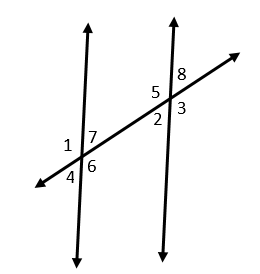
Which angle pairs are vertical angles? Select all that apply.
∠4 and ∠7
∠6 and ∠5
∠3 and ∠2
∠2 and ∠8
∠3 and ∠8
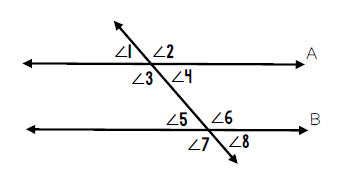
Find the value of x if the m∠1 = 11x − 9° and the m∠5 = 7x +9° and lines A and B are parallel. Do not type x=. Round to the tenth, if necessary.
(a)

Lines A and B are parallel lines cut by a transversal. Find the value of x. Do not type x=. Round to the tenth, if necessary.
(a)

Find the m∠1 if the lines are parallel. Round to the nearest tenth, if necessary.
(a)
Solve for x if the lines are parallel. Do not type x=. Round to the tenth, if necessary.
(a)

Find the m<5
(a)

Match the angle pairs to the correct term.
<1 and <3
Vertical Angles
<6 and <4
Alternate Interior Angles
<2 and <8
Alternate Exterior Angles
<3 and <4
Supplementary Angles

Identify the correct statement(s). Select all that apply.
∠1 & ∠2 are corresponding angles
∠2 & ∠4 are alternate interior angles
∠5 & ∠8 are vertical angles
∠1 & ∠5 are corresponding angles
∠3 & ∠7 are corresponding angles

Identify the correct statement(s) if lines l and m are parallel. Select all that apply.
∠B=82°
∠B=98°
∠A and ∠B are complementary
∠A=98°
∠A and ∠B are supplementary
Identify the correct statement(s) if lines l and m are parallel. Select all that apply.
∠C=116°
∠C=64°
∠D=116°
∠D=64°
∠C and ∠D are complementary
Identify the correct statement(s) if lines l and m are parallel. Select all that apply.
x=105
∠J=75°
x=21
∠J and ∠I are complementary
∠J and ∠I are supplementary
What is the measure of ∠6?
(a)
Find y. Do not type y=
(a)
Which of the following are vertical angles? Select all that apply.
∠4 and ∠5
∠1 and ∠2
∠3 and ∠6
∠2 and ∠5
∠3 and ∠8
Which angle pairs are vertical angles? Select all that apply.
∠4 and ∠7
∠6 and ∠5
∠3 and ∠2
∠2 and ∠8
∠3 and ∠8
Find the value of x if the m∠1 = 11x − 9° and the m∠5 = 7x +9° and lines A and B are parallel. Do not type x=. Round to the tenth, if necessary.
(a)
Lines A and B are parallel lines cut by a transversal. Find the value of x. Do not type x=. Round to the tenth, if necessary.
(a)
Find the m∠1 if the lines are parallel. Round to the nearest tenth, if necessary.
(a)
Solve for x if the lines are parallel. Do not type x=. Round to the tenth, if necessary.
(a)
Find the m<5
(a)
Find the m<4
(a)
Match the angle pair to the correct definition
∠4 and ∠7
Vertical Angles
∠6 and ∠5
Alternate Interior Angles
∠3 and ∠2
Supplementary Angles
∠4 and ∠8
Alternate Exterior Angles
Find the m∠1 if the m∠1 = 11x − 9° and the m∠5 = 7x +9° and lines A and B are parallel. Do not type =. Round to the tenth, if necessary.
(a)
Find the m∠2 if the m∠1 = 11x − 9° and the m∠5 = 7x +9° and lines A and B are parallel. Do not type =. Round to the tenth, if necessary.
(a)
Solve for x if the lines are parallel. Round to the nearest tenth, if necessary. Do not type x=.
(a)
Solve for x. Round to the tenth, if necessary. Do not type x=
(a)
Solve for y. Round to the tenth, if necessary. Do not type y=
(a)
Solve for y. Round to the tenth, if necessary. Do not type y=
(a)
Solve for x. Round to the tenth, if necessary. Do not type x=
(a)
Solve for x. Round to the tenth, if necessary. Do not type x=
(a)
Solve for y. Round to the tenth, if necessary. Do not type y=
(a)

Solve for y. Round to the tenth, if necessary. Do not type y=
(a)
Solve for x. Round to the tenth, if necessary. Do not type x=
(a)
Find the m∠1 if the m∠1 = 11x − 9° and the m∠5 = 7x +9° and lines A and B are parallel. Do not type =. Round to the tenth, if necessary.
(a)
Find the m∠2 if the m∠1 = 11x − 9° and the m∠5 = 7x +9° and lines A and B are parallel. Do not type =. Round to the tenth, if necessary.
(a)
Solve for x if the lines are parallel. Round to the nearest tenth, if necessary. Do not type x=.
(a)

