Worksheets
Unit 4 Earthquakes 2023
Total questions: 50
Worksheet time: 2hrs 34mins
What is the crust and upper area of the mantle called?
focus
tsunami
epicenter
lithosphere
What is the beginning point of an earthquake?
focus
epicenter
tsunami
lithosphere
What are the vibrations of energy flowing from the focus?
epicenter
tsunami
focus
seismic waves
What is the point on Earth's surface directly above the focus?
tsunami
seismic wave
epicenter
focus
The strength of an earthquake's seismic waves...
epicenter
magnitude
tsunami
focus
Giant ocean waves are called?
epicenter
seismic wave
focus
tsunami
When plate boundaries move horizontally past each other?
reverse fault
normal fault
abnormal fault
strike-slip fault
Plate boundaries that push together forcing rock upward is called?
reverse fault
normal fault
abnormal fault
strike-slip fault
Plate boundaries move apart forming a gap is called?
reverse fault
normal fault
abnormal fault
strike-slip fault
Slower destructive waves that occur on the surface of the earth are what type of earthquake waves?
love wave
surface waves
P wave
body waves

Which of the following is NOT a cause of an earthquake?
Collapse of Cavern
Eruption of Volcano
Lightning Strikes
Moving Tectonic Plates
The focus of an earthquake is
The point (below Earth's surface) where rock breaks
The closest seismic station
The place where the greatest damage occurs
A fault


What is this area known as
Earthquake Epicenter
Ring of Fire
San Andres Fault
What is the fault in California called?
San Diego Fault
Pacific Plate
San Andres Fault
After an earthquake this could happen.
Tsunami
Landslide
Fires
All of the Above
A tsunami is
an earthquake aftershock
A large wave that occurs after an earthquake
An area in the pacific ocean
A sudden and violent shaking of the ground.
Earthquake
Tsunami
Volcanic Eruption
What happens to P-waves and S-waves from an earthquake when they reach the outer core?
S-waves are transmitted through the outer core, but P-waves are not transmitted.
P-waves are transmitted through the outer core, but S-waves are not transmitted.
Both P-waves and S-waves are transmitted through the outer core.
Neither P-waves nor S-waves are transmitted through the outer core.
The distance between an epicenter and seismograph’s location can be calculated by using the
arrival time of the first P-wave
difference in arrival times between P- and S- waves
amplitude of the p-wave
energy released by an earthquake

Only P-waves were recorded at seismic station C because P-waves travel
only through Earth’s interior, and S-waves travel only on Earth’s surface
fast enough to penetrate the core, and S-waves travel too slowly
through iron and nickel, while S-waves cannot
through liquids, while S-waves cannot
After a sudden snap in the earthquake, the rock returns back to its original shape.
rebound
deformed
larger
small

Use the diagram to answer #12
Epicenter
Wave Fronts
Fault
Focus

Use the diagram to answer #11
Epicenter
Wave Fronts
Fault
Focus
Which type of stress causes deformation that leads to earthquakes at converging plate boundaries?
tension
stretching
shear stress
compression

Use the diagram to answer #13
Epicenter
Wave Fronts
Fault
Focus

Use the diagram to answer #14
Epicenter
Wave Front
Fault
Focus
Earthquakes most often occur
in the middle of plates
near plate boundaries
where thunderstorms are
along the coast


Around what time did the first P wave get detected?
100 sec
120 sec
150 sec
160 sec

Which location is farther from the epicenter?
Seismogram B (top)
Seismogram C (bottom)
Which portion of the Earth can S waves NOT travel through?
Crust
Mantle
Core

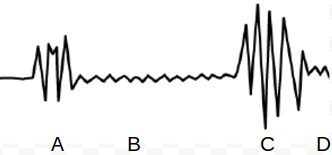
Which letter represents surface waves?
A
B
C
All are surface waves

Which station was closest to the earthquake's epicenter?
Station A
Station B
Station C

Scientists are able to create an image like this by studying
electromagnetic waves
P and S waves
P and Surface waves
S and Surface waves
This type of wave travels along Earth's crust and can be very destructive.
P wave
S wave
Surface wave
EM waves
Second waves to arrive in an earthquake
P waves
S waves
Surface waves
The crack in the surface of the Earth along which rocks break and earthquakes sometime occur:
focus
fault
epicenter
hypocenter

The place where an earthquake originates inside the Earth's surface is called...
Epicenter
Focus
Underground
Crust

The place on the Earth's surface, above the origin of the earthquake.
Epicenter
Focus
Surface
Crust
What is the minimum number of seismograph stations needed to locate an earthquake epicenter?
1
2
3
5