
 Worksheets
Science Genetics for Twins
Total questions: 81
Worksheet time: 41mins
What is a trait?
A type of organelle found within a cell.
Our talents that make us behave the way we do
Traits are the physical things that make us look the way we do, they may influence how we behave, and also our talents, abilities, and disease risks.
Inheritable talents that are passed on in our families

Which trait can be influenced by both our DNA and our environment?
Having six fingers
Freckles
How tall we are
The colors of our eyes

Scientists like to study identical twins in genetics because..
They are identical in every single way so scientists like to find out why.
They have the same talents and that must therefore be part of their DNA.
They have almost exactly the same DNA and this helps scientists figure out what traits come from the environment or from DNA
Their environment always stays the same so they are useful to find out what diseases people can get.

How many Chromosomes do we inherit from our parents?
23 from dad and 23 from mom, or 46 total
13 from dad and 13 from mom, or 26 total
13 from dad and 33 from mom, or 46 total

What are chromosomes?
They are thread like structures containing DNA found inside the nucleus of our cells
They are X shaped blobs made of ribosomes
They are the inherited traits we recieve from our parents
They are types of alleles found in the mitochondria of a cell

What is a gene?
An entire chromosome.
A small part of DNA found in a chromosome that gives our body instructions to build for a specific trait that we have
Things that are sometimes refered to as XX and XY inside of our cell membranes
Kind of like a "flavor" because there are 23 kinds from each parent.

The chemicals found in DNA are referred to as bases that are represented by the letters
QRTP
ABCD
DTPG
ACTG

What is a Chromosome?
a threadlike structure found in the nucleus of most living cells, carrying genetic information in the form of genes.
An X shaped thing found in the mitochondria of the cell that helps create energy in the form of ATP.
A threadlike structure found in the lysosome carrying genetic information in the form of proteins.
A colorful and fluorescent type of sugar that our body uses to break down and get energy.4
Chromosomes are found in their tightly packed threadlike form when the cell is....
Doing Nothing.
Reproducing
Creating Energy
Removing Waste
Many of our traits can come from both our ______ and ______
Brain and Liver
Nucleus and Mitochondria
Mom and Dad
DNA and Environment
Which trait will not likely be influenced by the environment?
Height
Ability to play basketball
How good we are at math
Our Eye Color
What makes one persons DNA different from someone elses?
The amount of pairs of bases on the strand of DNA.
The order of the bases of ATCG
The amount of mutations found in the DNA
The type of chemicals it's made out of.
What is a mutation?
A mistake that happens when our cells code for a type of base.
A genetic defect caused by our genes that always leads to cancer
Another way to name the proteins that make up a strand of DNA
What happens to the chromosomes when our cells are ready to reproduce.
Our DNA is made up of about _______ bases
3 billion
3 million
60
50-200
The average person has about ______ mutations in their DNA that didn't exist in either there father or mother
3 billion
3 million
60
10-40
Our genes are ______ % the same when compared to another human
99
99.9
50-60
80
What is an allele?
A trait
Different forms of a gene
DNA
Different types of parents
What is a genotype?
Pair of alleles that determine a specific trait
Observable physical trait
A trait that is observed with only one copy of an allele
What is a phenotype?
Pair of alleles that determine a trait
Observable physical trait
Different forms of a gene
What is a dominant gene?
A trait that is observed when there are one OR two copies of the allele
A trait that is observed only when there are two copies of the allele
A trait that can be hidden in a generation
A person who is homozygous for a trait can have a genotype of....
AA, Aa
Aa, aa
AA, aa
aa
If a person is heterozygous for a trait, their genotype can be...
Aa
AA, aa
AA, Aa
AA
If "B" represents brown hair, and "b" represents blond hair, what will the genotype be for a homozygous brown haired person?
BB
Bb
bb
If "B" is brown and "b" is blond, what is the phenotype of someone who's genotype is "bb"
Brown Hair
Blond Hair
Red Hair
If a person is heterozygous for brown hair, what is their genotype?
BB
Bb
bb
Heterozygous: Different, Homozygous:_____________
The same
Less Than
Greater Than
4 copies
Natural or Artificial Selection: A dog breeder selects two dogs that are best at herding animals to breed
Natural
Artificial
This type of disease CANNOT be spread from person to person
Contagious
Infectious
Genetic
P= purple petals and p= white petals. What genotype(s) would result in purple petals?
pp
Pp, pp
PP, Pp
PP, pp
Natural or Artificial? Birds have a variety of beak sizes to help harvest different seeds
Natural Selection
Artificial Selection
How many copies of the recessive gene must there be for that phenotype to show up?
1
2
3
4

What is the missing pairing?
AA
Aa
aa

Using the Punnett Square, identify the correct Genotypic ratio
2:2:1
1:2:1
2:1:1
1:1:1

Based on the missing letter, what is the parent's genotype?
AA
Aa
aa
Genotype or Phenotype: Freckles
Genotype
Phenotype
Genotype or Phenotype: Black hair
Phenotype
Genotype
Genotype or Phenotype: ff
Genotype
Phenotype
Homozygous or Heterozygous: ff
Homozygous
Heterozygous
Homozygous or Heterozygous: Ff
Homozygous
Heterozygous
The heterozygous DOMINANT trait of dimples?
DD
dd
Dd
The homozygous recessive trait for no taste of PTC paper
tt
Tt
TT
A mom with the heterozygous gene for Widows peak and a father with the heterozygous gene for Widows peak: odds their baby HAS a widow's peak?
0%
25%
75%
100%
A mom with a dominant HOMOZYGOUS gene of a hitchhiker's thumb and a dad with a homozygous recessive gene for a straight thumb. What is the baby's phenotype?
50% straight thumb
100% Hitchhiker's Thumb
25% Hitchhiker's Thumb
If a mother has the homozygous dominant trait FF, what is her phenotype?
Freckles
Tall
No PTC taste
Widow's Peak
Carry hereditary information, located in the nucleus.
Alleles
Gene
Chromosome
Offspring

The trait that always appears in the offspring if it is present.
Dominant
Recessive
Hybrid
Incomplete Dominance
Segments of DNA that carry hereditary information and are passed from parent to offspring.
Chromosomes
Probability
Ressesive
Genes
The gene combination that is present in a cell or organism for a particular trait.
Phenptype
Hybrid
Pure
Genotype
The passing of traits from parents to offspriing.
Chromosomes
Genes
Heredity
Alleles

An organism or cell in which the pair of genes for a particular trait are different.
Hybrid
Heredity
Pure
Dominant

Occurs when 2 dominant traits are present in an organisn but neither shows up in the organisms appearance.
Co-Dominance
Dominant
Recessive
Incomplete Dominance

What an organism physically looks like.
Genotype
Phenotype
Chromosomes
Traits
The chance that something will occur.
Probability
Phenotype
Pure
hybrid

A special grid used to predict the possible outcomes of different crosses.
Genotype
Offspring
Probability
Punnett Square

An organism or a cell in which the pair of genes for a particular trait are identical.
Pure
Hybrid
Dominant
Recessive
A trait the recedes into the background or is present in the alleles but hidden in appearance.
Dominant
Pure
Hybrid
Recessive

A characteristic passed from parents to offspring.
Probability
Incomplete Dominance
Punnett Square
Trait
Hair color, height, eye color and freckles are examples of human traits. What do we call the physical expression of the genetic material of an organism?
genetics
heredity
genotype
phenotype

In animals, shaggy fur is dominant to short fur. The Punnett Square shows the genotypes of the offspring of a shaggy fur animal and a short fur animal. What were the genotypes of the parents?
FF and FF
Ff and ff
ff and ff
Ff and Ff

In animals, shaggy fur is dominant to short fur. According to the genotypes shown, what percent of offspring will have short fur?
0
25
50
75
100
Heterozygous is when...
the alleles are the same.
the alleles are different.
the alleles are absent.
the alleles are present.

T = tall and t = short
In the punnett square shown, what belongs in the missing square
tt
Tt
Bb
TT
In a heterozygous genotype, the ___________ allele takes over in the phenotype.
recessive
dominant
The genotype for a yellow plant is...
The genotypes AA and Aa always show up as the __________ phenotype.
dominant
recessive
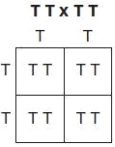
Which of the following genotypes is homozygous dominant?
A
Aa
AA
aa
Which of the following genotypes is heterozygous?
Bb
BB
bb
B
A recessive allele is represented by a ______ letter.
lower-case
capital
A dominant allele is represented by a ______ letter.
lower-case
capital
Blue-eyed is a ______.
genotype
phenotype
Bb is a ______.
genotype
phenotype
If a black guinea pig (BB) and a white guinea pig (bb) mate, there is a ______ chance that a white guinea pig will be born.
0%
25%
50%
75%
100%
AA
heterozygous
homozygous dominant
heterozygous dominant
homozygous recessive
aa
heterozygous dominant
homozygous recessive
homozygous dominant
phenotype
father of modern genetics
Charles Darwin
Gregor Mendel
James Watson
Rosalind Franklin
Study of heredity
inheritance
meiosis
genetics
gene
The physical appearance of an organism (eye color, height, freckles)
phenotype
gene
genotype
homozygous

What is the percentage of the Aa genotype that will result from this cross?
25%
100%
50%
0%

What is the percent chance of the aa genotype resulting from this cross?
100%
75%
25%
0%

