wayground logo

Free Printable Worksheets

Font size

S
M
L
XL
Worksheets

WH Chapter 10 Review

Total questions: 85

Worksheet time: 2hrs 23mins
Name
Class
Date
1.
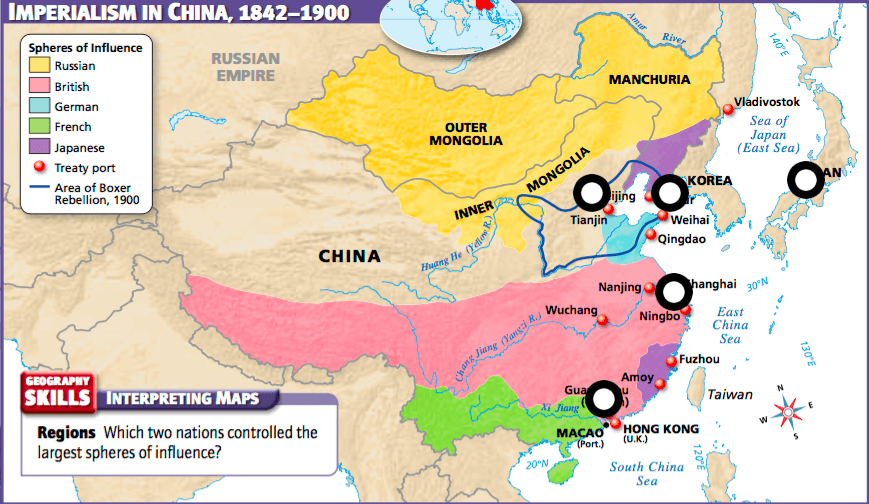
Which two nations controlled the largest spheres of influence in China?
a)
Britain and Russia
b)
Russia and France
c)
France and Britain 
d)
Japan and Germany 
2.
Who illegally smuggled opium into China in the mid-1800's?
a)
France
b)
Great Britain 
c)
Japan
d)
Russia 
3.
Which statement best expresses the motive for 19th-century European imperialism?
a)
Living space was needed for the excess population in western Europe.
b)
European leaders believed imperialism was an effective method of reducing the number of wars
c)
European nations would benefit from some aspects of the conquered nation's culture.
d)
Imperialism would benefit the economies of the colonial powers.
4.
Which situation led to the defeat of China in the Opium War (1839-1842)?
a)
a civil war on the Sino-Tibetan border
b)
the technological advantages of the European powers
c)
a famine that weakened the Chinese military
d)
the lack of support for the Manchu government from Chinese scholars
5.
A major goal of the Boxer Rebellion in China was to:
a)
rid their countries of foreigners
b)
expand their respective territories
c)
receive international military support
d)
restore an absolute monarch to the throne
6.
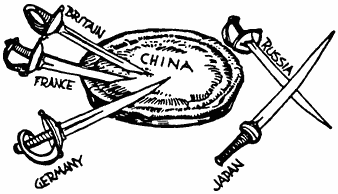
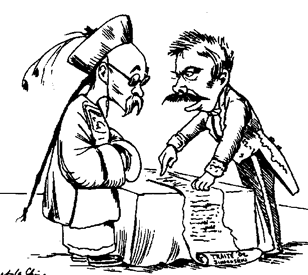
The situation depicted in the cartoon was brought about by the:
a)
economic agreements with Western nations signed by Deng Xiaoping
b)
low level of cultural and economic development in China throughout its history
c)
military weakness of China and the European desire for expansion
d)
alliance of the Soviet Union with the Communists and the aid given to the Nationalists by Western Europe
7.
What happened to the Boxers at the end of the rebellion?
a)
They were rounded up by their own government and executed.
b)
They were victorious in riding their country of foreigners. 
c)
They accepted the religious teachings of the foreign missionaries. 
d)
They became part of China's Imperial Army
8.
What term is used for the various regions in which foreigners controlled their own affairs in China in the 19th and 20th centuries?
a)
spheres of influence
b)
extraterritorial regions
c)
special economic zones
d)
foreign administered regions
9.
One result of the Opium War was that China:
a)
adopted democratic reforms
b)
gained control of Hong Kong
c)
regained control of Manchuria
d)
was divided into spheres of influence
10.
During the 1840's, China signed "unequal treaties" with Western nations mainly because:
a)
China had won the Opium War
b)
Western nations had superior military technology
c)
leaders in China favored expansion
d)
China had requested economic assistance from the West
11.
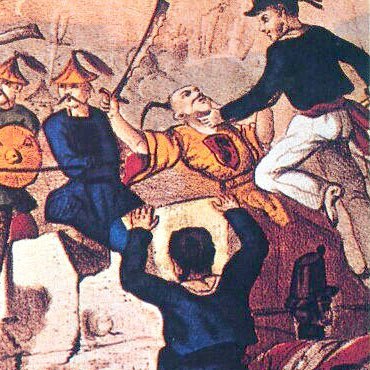
The image shown here shows the work of WHAT GROUP in China?
a)
Missionaries 
b)
Government Agencies of China
c)
Foreign Entrepreneurs
d)
The Boxers
12.
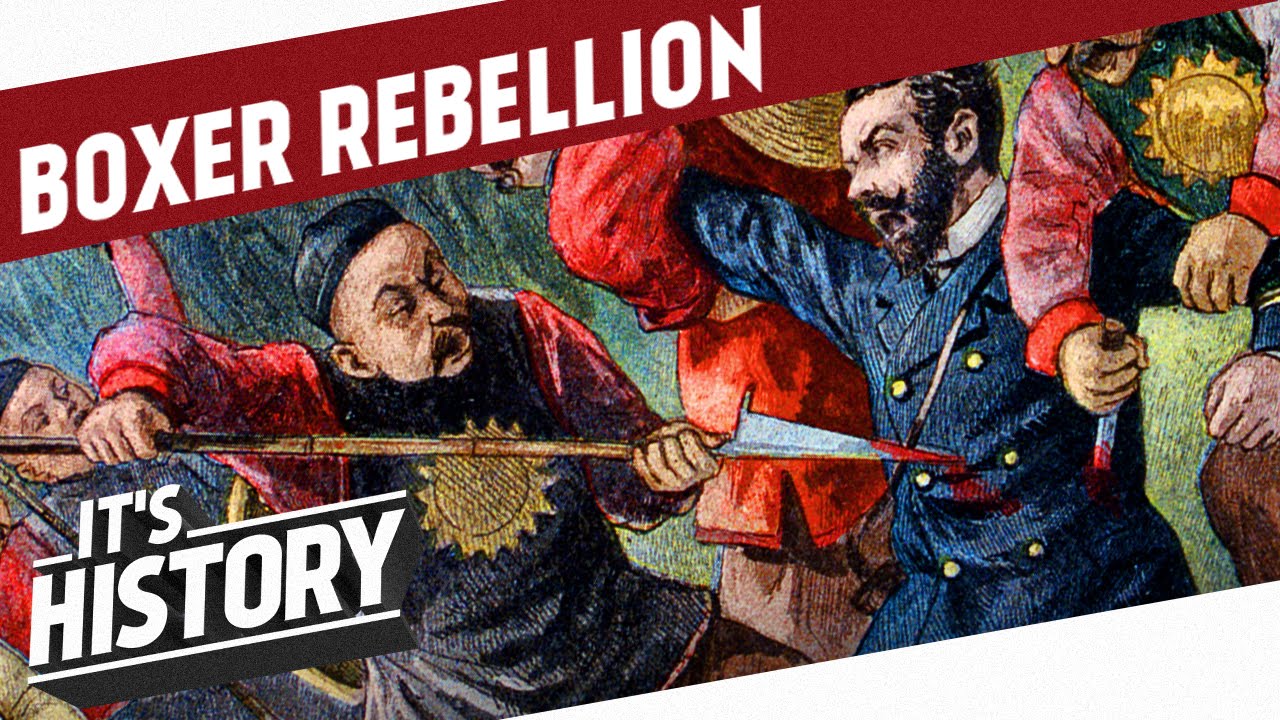
The people shown in this image were targeted by the Boxers and were referred to as:
a)
Secondary Devils 
b)
Westerners 
c)
Spiritually Enlightened 
d)
Alien Barbarians 
13.
The Boxer Rebellion of the early 20th century was an attempt to:
a)
eliminate poverty among the Chinese peasants
b)
bring Western-style democracy to China
c)
restore trade between China and European nations
d)
remove foreign influences from China
14.
The Boxer Rebellion FAILED to achieve its goal in China.  TRUE or FALSE
a)
True
b)
False
15.

Why did the British think trade with China was unbalanced?

a)

China was buying too many European goods

b)

Britain was exporting more goods from China than they were importing to China

c)

India was not making any profit within the trade relationship

16.

Which Dynasty was in control of China at the height of the Opium Wars?

a)

Ming

b)

Yuan

c)

Qing

d)

Zhou

17.

After they lost the Opium War, foreign countries (especially England) had more control over this large nation

a)

China

b)

Japan

18.

What product did the government of China try to prevent the British from trading in their country?

a)

opium

b)

silver

c)

tea

d)

silk

19.

What product did England want?

a)

opium

b)

Silver

c)

tea

d)

silk

20.

Prior to the arrival of the American fleet, led by Cdre. Matthew Perry, the main policy of the Japanese Shogunate was on of...

a)

Protectionism

b)

Militarism

c)

Imperialism

d)

Isolationism

21.

What event made the Shogunate so afraid of the Americans?

a)

Cdre. Perry threatened to attack Japan with gunboats.

b)

The United States had the largest Navy in the Pacific.

c)

The defeat of the Chinese by the British is the Opium Wars.

d)

The rise of American backed rebels in support of the Emperor.

22.

The Japanese Emperor Mutsuhito began rapidly modernizing Japan, including building modern industrial factories and a modern military. This period in reform was known as

a)

the Meiji Restoration.

b)

the Japanese Enlightenment.

c)

the Mutsuhito Reformation.

d)

the Mutsuhito Restoration.

23.
Imperialism is __________.
a)
when a powerful nation uses its resources to help a weaker nation
b)
when a weaker nation invites a powerful nation to help it industrialize
c)
when a powerful nation takes control of the economy and government of a weaker nation
24.
Why did nations want to be imperialistic?
a)
They wanted prestige among other nations
b)
They needed more natural resources
c)
They needed more markets to sell industrial goods
d)
All of the Above
25.
Which of the following is NOT one of the reasons/ideas behind imperialism? 
a)
Military Needs
b)
To isolate your country from the rest of the world. 
c)
Cultural Superiority 
d)
Nationalism 
26.
Who did the U.S. buy Alaska from?
a)
Cuba
b)
Germany
c)
Russia
d)
Canada
27.
Describe how the United States acquired Hawaii. 
a)
The U.S government won Hawaii in a battle with Japan
b)
After Queen Liliuokalani died the U.S. purchased Hawaii for 20 million dollars
c)
U.S. won a war with Spain and Spain sold Hawaii for $7million to the U.S.
d)
U.S. Overthrew Queen Liliuokalani and became a U.S. territory in 1898
28.
In __, sugar planters staged a rebellion.  It was annexed into the US in 1898. 
a)
Japan 
b)
Hawaii 
c)
Panama
d)
China  
29.

Two Social reasons for Imperialism and the Race for Africa were:

a)

The White Man's Burden and Communism

b)

Social Darwinism and the White Man's Burden

c)

Social Darwinism and Communism

30.

A feeling that people have of being proud of their country with the belief that it is better and more important than other countries.

a)

Nationalism

b)

Exploitation

c)

Yellow Journalism

31.

The theory of natural selection to society. The phrase "survival of the fittest" is applied to politics and society.

a)

Nationalism

b)

Social Darwinism

c)

Racism

32.
At the end of the Spanish American War, the United States gained which 3 territories? 
a)
Puerto Rico, Cuba, Spain
b)
Spain, Cuba, Guam
c)
Marianas Islands, Philippines, Russia
d)
Philippines, Guam, Puerto Rico
33.
The USS Main exploded while it was in Havana, _____. This was a leading cause to the start of the Spanish American War.
a)
Cuba
b)
Guam
c)
Mexico
d)
Panama
34.

Why was the Conference called?

a)

For fun/reunion

b)

To split up Africa countries in between all European powers

c)

To talk about the distribution of free trade

d)

To talk about attacking Africa

35.

Who organized the Berlin Conference?

a)

Chancellor Otto von Bismarck

b)

Napoleon

c)

George Washington

d)

King Leopold II

36.

What did Europeans not take into consideration when dividing Africa amongst themselves?

a)

Their troops incase they went to war

b)

Africa's military power

c)

Ethnic or linguistic groups

d)

Formed governments in the colonies

37.
Why did European countries want to imperialize Africa?
a)
They wanted more raw materials and new people to sell too
b)
They were just mean
c)
They needed the land for their people
d)
Their military needed bases
38.

Where in Africa did King Leopold conquer?

a)

Congo

b)

Sudan

c)

Libya

d)

Nigeria

39.

When a stronger country takes over and controls a less powerful nation or territory economically, politically, and culturally, it is called....

a)

imperialism

b)

direct rule

c)

indirect rule

d)

nationalism

40.

Approximately what percentage of the world was controlled by Western powers by the year 1900?

a)

20%

b)

40%

c)

60%

d)

80%

41.

What product did the government of China try to prevent the British from trading in their country?

a)

opium

b)

gold

c)

tea

42.

Who fought in the Opium Wars?

a)

Britain and Japan

b)

Britain and Russia

c)

Britain and China

43.
What happened due to the Opium Wars?
a)
China won and Great Britain was forced to stop trading with China
b)
Great Britain won and opened China up to trade with the West
c)
Great Britain won and took control of China's military
44.

Which of the following became a British colony as part of the Treaty of Nanking?

a)

Hong Kong

b)

Shanghai

c)

Singapore

d)

Nanjing

45.

What was the purpose of the Open Door Policy in China?

a)

To end the Boxer Rebellion

b)

To secure trading rights with China

c)

To establish a colony

46.

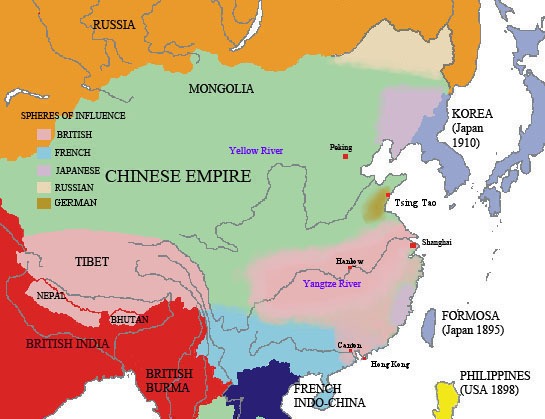
Which two nations controlled the largest spheres of influence in China? (if you can read the map! if not choose #1)

a)

Britain and Russia

b)

Russia and France

c)

France and Britain

d)

Japan and Germany

47.

A major goal of the Boxer Rebellion in China was to:

a)

To remove foreign influence from China

b)

To expand their respective territories

c)

To receive international military support

48.
What happened to the Boxers at the end of the rebellion?
a)
They were rounded up by their own government and executed.
b)
They were victorious in riding their country of foreigners. 
c)
They accepted the religious teachings of the foreign missionaries. 
d)
They became part of China's Imperial Army
49.
The Boxer Rebellion of the early 20th century was an attempt to:
a)
eliminate poverty among the Chinese peasants
b)
bring Western-style democracy to China
c)
restore trade between China and European nations
d)
remove foreign influences from China
50.

The Boxer Rebellion FAILED to achieve its goal in China. TRUE or FALSE

a)

True

b)

False

51.

What 14-year long Chinese conflict, led by Hong Xiuquan to overthrow the Qing Dynasty, and establish a "heavenly kingdom" where wealth is shared, was one of the deadliest wars in the history of the world?

a)

Taiping Rebellion

b)

Boxer Rebellion

c)

Opium War

52.

A form of imperialism in which a power nation has exclusive rights and privileges in trade or investment?

a)

protectorate

b)

colonialism

c)

sphere of influence

d)

imperialism

53.
Which country opened Japan's doors to trade?
a)
United States
b)
Britain
c)
France
d)
Russia
54.
Which country won the Sino-Japanese war of 1885?
a)
Japan
b)
China
c)
Korea
d)
Russia
55.
In the Russo-Japanese War of 1904-05 what were the two countries fighting over?
a)
Korea
b)
China
c)
Vietnam
d)
Germany
56.

What was one effect of the Russo-Japanese War (1904–1905)?

a)

Japan emerged as a major world power.

b)

Korea gained its independence.

c)

Czar Nicholas II gained power in Russia.

d)

Russia formed a military alliance with Japan.

57.

Which of the following was a result of the Sino-Japanese War

a)

China was forced out of Korea

b)

China and Japan signed a hands-off agreement on Korea

c)

Russia was forced out of Manchuria and Korea

d)

Korea was divided into Chinese and Japanese spheres of influence

58.

Latin America was colonized largely by

a)

Spain

b)

Portugal

c)

United States

59.
Indirect rule of a colony is 
a)
a colony is ruled by local leaders directed by Euro country.
b)
when a European country did not gain full control of colony
c)
when the European country allowed elections to elect leaders
d)
when a colony is ruled by Euro country governed by European officials
60.
A territory that an imperialistic power ruled directly was
a)
a colony.
b)
unlucky
c)
fortunate to have someone care enough about them.
d)
a protectorate.
61.

The main motivation for imperialism was

a)

economic.

b)

religious.

c)

ideological.

d)

political.

62.

Which of the following events led to Japan being opened up to foreign trade?

a)

Admiral Matthew Perry landing in Tokyo with warships

b)

The Boxer Rebellion

c)

Queen Liliuokalani being overthrown

d)

The Sepoy Mutiny

63.

What American system did the Japanese adopt during the Meiji era?

a)

a military draft

b)

universal public education

c)

sepapration of local and central governments

d)

the development of naval and land based military operations.

64.

A country or a territory governed internally by a foreign power is what form of Imperialism?

a)

Protectorate

b)

Sphere of Influence

c)

Colony

d)

Economic Imperialism

65.

A country or a territory with its own internal government but under the control of an outside power is what form of Imperialism?

a)

Colony

b)

Protectorate

c)

Economic Imperialism

d)

Sphere of Influence

66.

An country or territory controlled

by private business interests

rather than other governments

is which form of Imperialism?

a)

Colony

b)

Sphere of Influence

c)

protectorate

d)

Economic Imperialism

67.

Direct or indirect control?


Foreign officials are brought in to rule the country. There is no longer self rule.

a)

Direct

b)

Indirect

68.

Direct or Indirect?


The goal was to assimilate the natives into another culture/value system.

a)

Direct

b)

Indirect

69.

Direct or Indirect?


The goal was to train local leaders with skills but allowing them to keep their existing government.

a)

Direct

b)

Indirect

70.
How did Haiti win its independence from France? 
a)
In a revolution started by Simon Boliva
b)
When the British defeated Napolean at Waterlo
c)
In a revolt led by the former slave, Toussaint L’Ouverture
d)
In a revolt let by Miguel Hidalgo
71.
Miguel Hidalgo is best known as the Father of Independence in _________.
a)
Mexico
b)
Haiti
c)
Colombia
d)
Venezuela
72.
“The Liberator” who led Venezuela, Colombia, Peru, Bolivia, and Ecuador in their successful fight for independence from Spain was _____________.
a)
Simon Bolivar
b)
Miguel Hidalgo
c)
Toussaint L'Ouverture
d)
Hernan Cortez
73.
Who did Toussaint L’Ouverture lead forces against?
a)
France
b)
Italy
c)
Germany
d)
Spain
74.
In what way was the independence movement in Haiti DIFFERENT from the independence movement led by Simon Bolivar in South America?
a)
Haiti's was a violent slave revolt
b)
Haiti's independence movement was not successful
c)
Haiti revolted against Portuguese control
d)
Haiti won their independence with the help of the U.S
75.
Which European country colonized Haiti?
a)
Spain
b)
Portugal
c)
France
d)
Britain
76.

In Latin America, both Simón Bolívar and José de San

Martin were leaders who

a)

advocated a return to traditional ways

b)

attempted imperialistic expansion

c)

worked for independence

d)

led Communist-inspired revolutions

77.

Which document is most closely associated with United States involvement in Latin America?

a)

The Declaration of Independence

b)

The Monroe Doctrine

c)

The Truman Doctrine

78.

What do Toussaint LOuverture, Miguel Hidalgo, and Simon Bolivar all have in common?

a)

religious and political leaders in the Spanish conquest of LA

b)

all wanted independence from ruling European colonial powers

c)

wanted to conquer the Native Americans that lived in Latin America

79.

By the early 1900s Japan was the strongest power in Asia.

a)

True

b)

False

80.
What was the name of the treaty between the Japanese and the Americans that was signed in 1854?
a)
Treaty of Tokyo
b)
Treaty of 1854
c)
Treaty of Tokugawa
d)
Treaty of Kanagowa
81.

During the Meiji Restoration, the Japanese began to modernize their country primarily to:

a)

compete with Western powers

b)

isolate their people from foreign influences

c)

reemphasize traditional values

82.

Unlike Japan, it took China a long time to make changes and become a more modern country.

a)

True

b)

False

83.

What are the long-lasting effects of the take over of Latin America?

a)

Spanish Language and Catholic Religion

b)

Loss of Native American culture and tradition

c)

Native American history was lost and/or rewritten

84.

Extraterritorial Rights are

a)

rights given to foreign resident that allows them to follow the laws of their own government rather than those of the host country.

b)

basic human rights given to all people in the world.

85.

What is one thing that China and Japan had in common?

a)

Both went to war with European powers to resist imperialism.

b)

Both were open to trading with the West.

c)

Both countries wanted to stay isolated from the rest of the world.