wayground logo

Free Printable Worksheets

Font size

S
M
L
XL
Worksheets

Check-In #2 Review

Total questions: 167

Worksheet time: 3hrs 20mins

Name
Class
Date
1.
What is the definition of CONDUCTION?
a)
When heat is transferred from objects like rays of light or electromagnetically.
b)
a  hot liquid or air that  expands, becomes less dense, and rises or becomes more dense, and sinks.
c)
When heat transfers from objects that are touching.
d)
When heat transfers through the heater or AC in your house.
2.
What is the definition of CONVECTION
a)
When heat transfers through the heater or AC in your house.
b)
When heat transfers from objects that are touching.
c)
a  hot liquid or air that  expands, becomes less dense, and rises or becomes more dense, and sinks.
d)
 hot liquid or air that  expands, becomes less dense, and rises or becomes more dense, and sinks.
3.
What is the definition of RADIATION
a)
 hot liquid or air that  expands, becomes less dense, and rises or becomes more dense, and sinks.
b)
When heat is transferred from objects like rays of light or electromagnetically.
c)
When heat transfers from objects that are touching.
d)
When heat transfers through the heater or AC in your house.
4.
What kind of heat transfer happens when the sun is heating your body?
a)
Conduction
b)
Radiation
c)
Convection
d)
Density
5.
What heat transfer happens when you burn your hand by touching a fire?
a)
Radiation
b)
Conduction
c)
Convectio
d)
I don't know!!!!!!!!!!!
6.
When a pot is  touching a stove that is on, what heat transfer is happening?
a)
I don't know??????
b)
Radiation
c)
Conduction
d)
Convection
7.
This is a lava lamp. When the light bulb heats the wax, the wax rises. When the wax cools, it falls. This cycle of rising/falling is an example of:
a)
Conduction.
b)
Convection.
c)
Radiation.
8.
Heat transfers from an area of ____temperature to an area of ___ temperature.
a)
high to low
b)
low to high
c)
high to high
d)
It can travel high to low and low to high. 
9.
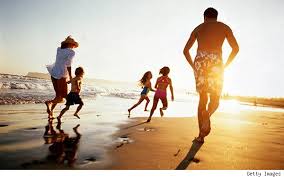
The sun shines down on this family as the play on the beach.
a)
conduction
b)
convection
c)
radiation
10.
A group of friends gather around a fire to stay warm.
a)
conduction
b)
convection
c)
radiation
11.
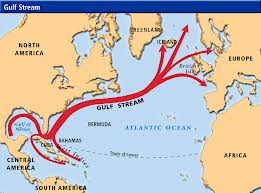
The Gulf Stream is a current that brings warm ocean water from the south to the north.
a)
conduction
b)
convection
c)
radiation
12.
Walking on the warm sand sand with your bare feet.
a)
conduction
b)
convection
c)
radiation
13.
Which direction will the heat flow while this person holds a hot cup of tea?
a)
from the cup to her hand
b)
from her hand to the cup
c)
no heat is transferred
14.
Which direction will the heat flow while this ice cap melts?
a)
there is no heat transfer
b)
from the icecap to the water
c)
from the water to the icecap
15.
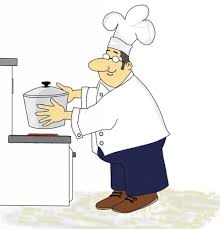
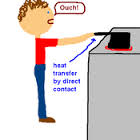
The man goes to take the hot pot off the stove with his bare hands.
a)
conduction
b)
convection
c)
radiation
16.
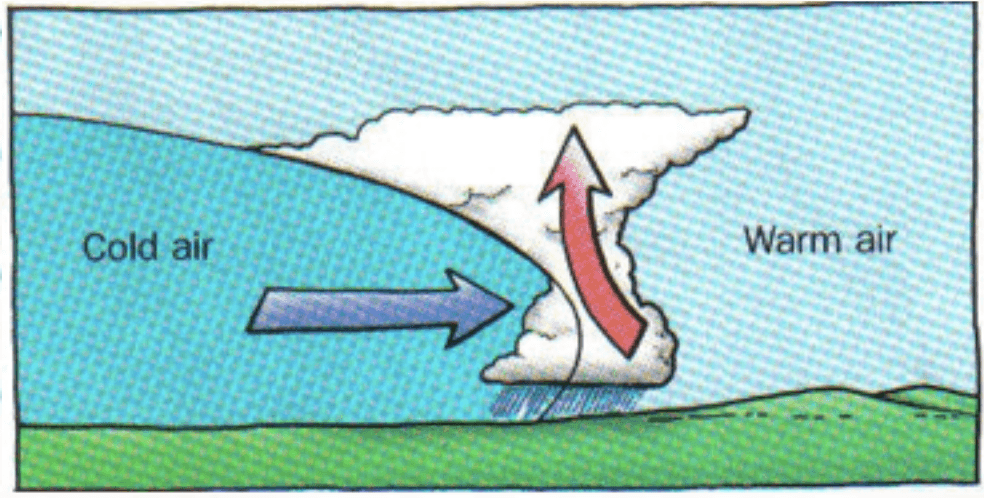
Warm air rises and the cool air sinks.
a)
conduction
b)
convection
c)
radiation
17.
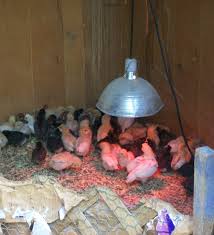
The baby chickens are kept warm from the heat lamps.
a)
conduction
b)
convection
c)
radiation
18.
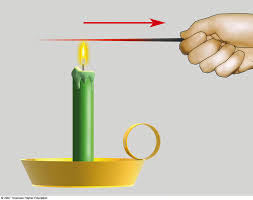
The candle will slowly heat the metal and transfer the heat directly to the mans hand.
a)
conduction
b)
convection
c)
radiation
19.
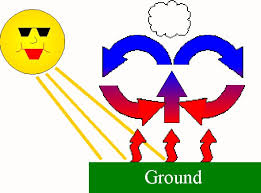
The warm air from this heater creates a current when the warm air rises and the cold air sinks.
a)
conduction
b)
convection
c)
radiation
20.
Johnny accidentally grabbed the handle of the hot pot.
a)
conduction
b)
convection
c)
radiation
21.
a)
land breeze
b)
sea breeze
22.
Name the type of heat transfer?
a)
convection
b)
conduction
c)
radiation
23.
How does this heat reach the person?
a)
radiation
b)
conduction
c)
convection
24.
a)
conduction
b)
convection
c)
radiation
25.
a)
conduction
b)
convection
c)
radiation
26.
a)
convection current
b)
air current
c)
water current
d)
current
27.
a)
convection current
b)
radiation
c)
conduction
d)
convection
28.
a)
radiation
b)
convection
c)
conduction
29.
a)
sea breeze
b)
land breeze
30.
a)
boiling water
b)
convection current
c)
hot air sinks
d)
cold air rises
31.
Westerlies
a)
1
b)
2
c)
3
d)
4
32.
How does this transfer heat?
a)
radiant
b)
convection
c)
conduction
33.
Weather occurs in this atmospheric layer
a)
thermosphere
b)
troposphere
c)
mesosphere
d)
stratosphere
34.

In a high pressure systems

a)

there are few clouds because the air in moving downward

b)

there are many clouds because the air is very humid

c)

there are few clouds because the air is moving outward

d)

there are many clouds because the air is moving upward

35.

A front is

a)

where warm air is cooling at earth's surface

b)

a boundary where hot and cold air are separating

c)

a boundary where two different air masses meet

d)

where cold air is rising and forming rain clouds

36.

Air masses are named for ______.

a)

the type of air they contain

b)

animals

c)

people

d)

where they form

37.
A cold front usually brings what kind of weather?
a)
snow  
b)
sunny and fair
c)
heavy rain and/or thunderstorms 
d)
 cool and dry 
38.

What is an air mass?

a)

a place where weather always changes in an extreme way

b)

a large body of air with the same temperature and moisture

c)

any cloud that produces rain, sleet, snow or hail

d)

any kind of air, as long as it is always wet and freezing

39.

What is the purpose of a barometer?

a)

Tells you that it is going to rain.

b)

Measures the amount of wind.

c)

Measusres the amount of clouds in the sky.

d)

It measure the amount of pressure in the air.

40.
Which weather tool measures wind?
a)
anemometer
b)
therometer
c)
wind vane
d)
barometer
41.
Ryan is working on his Science Fair project. He plans to measure the amount of rainfall that has fallen in his neighborhood over the past two weeks. What instrument should he use?
a)
Rain gauge
b)
Wind Vane
c)
Barometer
d)
Thermometer 
42.
The weather forecast tomorrow says there will be a 15 mph wind, a high temperature of 52 degrees and a pressure of 720 mb. What three instruments will a meteorologist use to make this prediction?
a)
anemometer, barometer, thermometer
b)
barometer, hygrometer, thermometer
c)
thermometer, satellite image, hygrometer
d)
anemometer, satellite image, barometer
43.
Which tool measures humidity or the amount of moisture in the air?
a)
wind vane
b)
barometer
c)
anemometer
d)
hydrometer
44.
What does this symbol on a weather map indicate? 
a)
High pressure system
b)
Low pressure system
c)
Cold front
d)
Warm front
45.
What does this symbol indicate on a weather map? 
a)
High pressure system
b)
Low pressure system
c)
Cold front
d)
Warm front
46.
What kind of pressure predicts clear weather?
a)
high
b)
low
c)
cold
d)
stationary
47.

What would you expect from a Continental Polar air mass?

a)

moist, warm air

b)

dry, cold air

c)

dry, warm air

48.
What would you expect from a Maritime Tropical air mass? 
a)
dry, warm air
b)
moist, cold air
c)
moist, warm air
49.
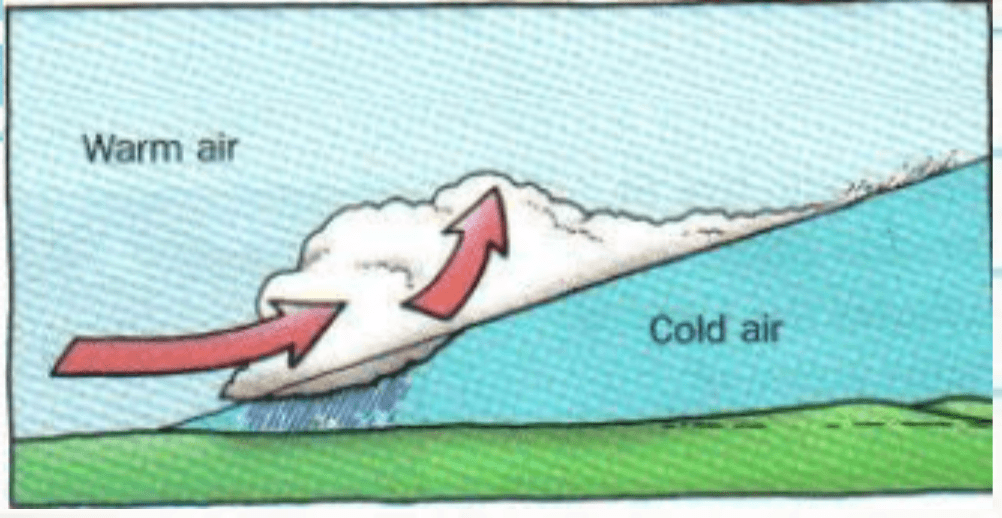
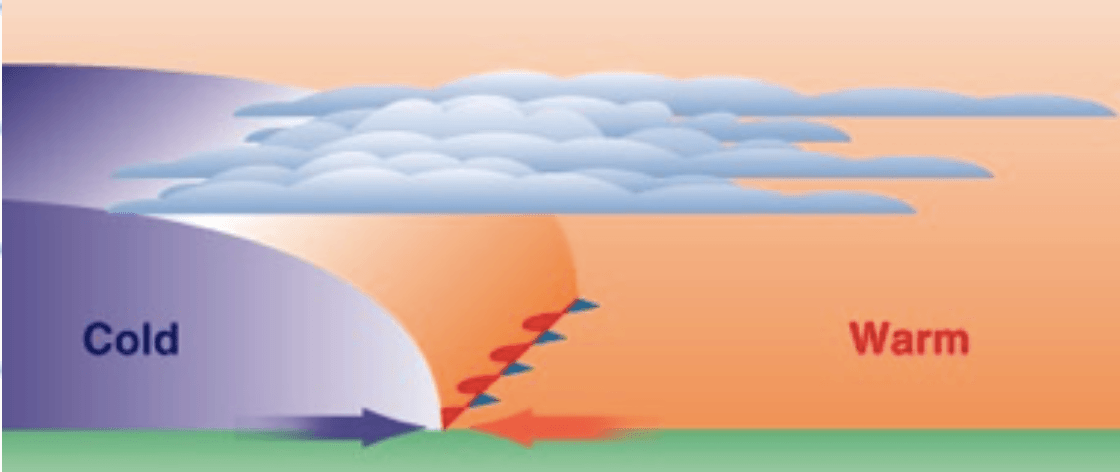
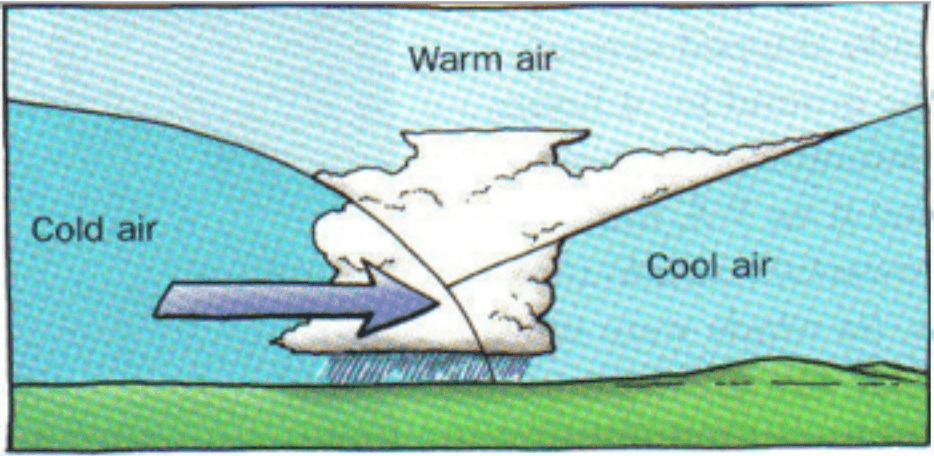
What type of front is this? 
a)
warm front
b)
cold front
c)
stationary front
d)
occluded front
50.
What type of front is this?
a)
warm front
b)
cold front
c)
stationary front
d)
occluded front
51.
In order for a hurricane to form, the water must be ________.
a)
Cool
b)
Warm
c)
Cold
d)
Hot
52.
The center of a hurricane is called the ______.
a)
center
b)
brain
c)
eye
d)
circle
53.
What causes damage in a hurricane?
a)
Winds
b)
Flooding
c)
Storm Surge
d)
All of the above
54.
Air pressure is greatest when near Earth's surface because?
a)
The air molecules are farther apart.
b)
The air molecules are closer together.
c)
Air molecules collide.
d)
Air molecules are tightly packed.
55.
What happens to air pressure as you move upward into the atmosphere?
a)
increases
b)
decreases
c)
stays the same
56.
What causes warm air to rise?
a)
the fact that it's less dense than cold air 
b)
The fact that it weighs more than cold air 
c)
The fact that it has higher pressure than cold
d)
the fact that its more dense than cold air 
57.
What causes wind to blow?
a)
Differences in longitude 
b)
Shock waves from clouds 
c)
Differences in air temperature and pressure 
d)
The rotation of the earth
58.
Which term best describes how the earth's atmosphere is heated?
a)
Spirally
b)
Unevenly
c)
Circularly
d)
Kinetically
59.
When Earth's rotation causes the wind to curve 
a)
cloudy 
b)
Coriolis effect
c)
high pressure
d)
low pressure 
60.
Is this a land or a sea breeze?
a)
land breeze
b)
sea breeze
61.

Why do winds change during the day and night near a beach?

a)

The warm air over land sinks and stays there

b)

The warm air over water sinks and stays there

c)

The temperature over air and the land change

d)

Cool air sinks over the land and stays there

62.

How does air move?

a)

Warm air rises and cool air sinks

b)

Warm air sinks and cool air rises

63.

What kind of weather would you expect when you have decreased air pressure?

a)

Warm temperatures

b)

Cool temperatures

c)

Clear conditions

d)

Cloudy conditions

64.

What kind of weather would you expect in a low pressure system?

a)

Rain

b)

Clear skies

65.

What kind of weather would you expect in a high pressure system?

a)

Warm temperatures

b)

Cool temperatures

c)

Clear conditions

d)

Cloudy conditions

66.

How does wind move?

a)

From area of high pressure to low pressure

b)

From areas of low pressure to high pressure

67.

Which is the best explanation for how air masses move across the United States?

a)

The trade winds move air masses from west to east across the United States.

b)

The polar easteriles move air masses from west to east across the United States.

c)

The prevailing westerlies move air masses from west to east across the United States but may be deflected by the jet stream.

d)

The warm air of the Gulf Stream causes air masses to move from the Atlantic Ocean to the Pacific Ocean.

68.

A student in northern Ohio lost a balloon in a storm. Toward which state would the balloon MOST likely travel?

a)

Michigan

b)

Indiana

c)

Kentucky

d)

Pennsylvania

69.

In which direction do weather patterns move in the United States?

a)

east to west

b)

north to south

c)

west to east

d)

south to north

70.

What two factors determine the direction in which prevailing winds blow?

a)

the rotation of the Earth on its axis and the sun’s uneven heating of the earth

b)

the revolution of the earth around the sun and the sun’s uneven heating of the earth

c)

the rotation of the Earth on its axis and the cool air from the poles

d)

the revolution of the Earth around the sun and the cool air from the poles

71.

Weather patterns in the US move from west to east because

a)

the tradewinds move them

b)

the prevailing westerlies move them

c)

the polar easterlies move them

d)

sea breezes move them

72.

The trade winds and polar easterlies DO NOT typically impact NC's weather because

a)

they are sea breezes at the coast

b)

they are found near the equators or at the poles.

c)

they almost never are blowing

d)

they cancel each other out

73.

To move air masses to North Carolina the prevailing westerlies are helpful. In addition,...

a)

wind speed will increase.

b)

the Jet Stream moves air masses west to east.

c)

colder weather in the Great Lakes region.

d)

high

74.

In the United States, weather patterns generally move in which direction?

a)

south to north

b)

north to south

c)

west to east

d)

east to west

75.

The temperature at the poles is....

a)

Warmer and less dense

b)

Warmer and more dense

c)

Colder and less dense

d)

Colder and more dense

76.

What type of front occurs when a warm air mass and a cold air mass do not have enough energy to move the other one out of the way?

a)

Cold front

b)

Occluded front

c)

Stationary front

d)

Warm front

77.

The tropical winds running from 0 to 30 degrees latitude are called:

a)

Polar Westerlies

b)

Subtropical Westerlies

c)

Polar Winds

d)

Trade Winds

78.

Most of the United States is located in the wind belt known as the...

a)

Polar Easterlies

b)

Prevailing Westerlies

c)

Trade winds

79.

The temperature at the equator is...

a)

Cold and less dense

b)

Cold and more dense

c)

Warm and more dense

d)

Warm and less dense

80.

The "dragging" of air around the earth is called the Coriolis Effect.

a)

True

b)

False

81.

Name that front.

a)

Cold Front

b)

Warm Front

c)

Stationary Front

d)

Occluded Front

82.

Name that front.

a)

Cold Front

b)

Warm Front

c)

Stationary Front

d)

Occluded Front

83.

Name that front.

a)

Cold Front

b)

Warm Front

c)

Stationary Front

d)

Occluded Front

84.

Name that front.

a)

Cold Front

b)

Warm Front

c)

Stationary Front

d)

Occluded Front

85.

Name that symbol.

a)

Cold Front

b)

Warm Front

c)

Stationary Front

d)

Occluded Front

86.

Foggy.

a)

Cold Front

b)

Warm Front

c)

Stationary Front

d)

Occluded Front

87.

Brings some clouds and gentle rains.

a)

Cold Front

b)

Warm Front

c)

Stationary Front

d)

Occluded Front

88.

Temperature drops quickly. Strong winds, heavy precipitation.

a)

Cold Front

b)

Warm Front

c)

Stationary Front

d)

Occluded Front

89.

Cold dense air slides underneath warm air. The warm air is forced up, cools, and condenses.

a)

Cold Front

b)

Warm Front

c)

Stationary Front

d)

Occluded Front

90.

Neither air mass really takes over the other.

a)

Cold Front

b)

Warm Front

c)

Stationary Front

d)

Occluded Front

91.

Biotic factors are...

a)

living things

b)

non-living things

c)

undead things

92.

Abiotic factors are...

a)

living things

b)

non-living things

c)

undead things

93.

Some examples of biotic factors would be

a)

trees

b)

insects

c)

bacteria

d)

all of the above

94.

Which of these is NOT an abiotic factor?

a)

water

b)

temperature

c)

grass

d)

soil

95.

Which of the following is an abiotic factor that plants depend on?

a)

seed-eating birds

b)

insect pollinators

c)

ants building their nests in trees

d)

nutrients in the soil

96.

Which of the following is a biotic factor?

a)

humans

b)

bridges

c)

roads

d)

water

97.
The following picture is an example of...
a)
population
b)
community
c)
microorganism
d)
predator
98.
Which aquatic ecosystem has both salt and fresh water that is mixed together (brackish water)?
a)
estuary
b)
lakes
c)
ponds
d)
oceans
99.

Identify the ecosystem

a)

Forest

b)

Tundra

c)

Freshwater

d)

Desert

100.

Identify the ecosystem

a)

Forest

b)

Tundra

c)

Freshwater

d)

Grassland

101.
This ecosystem contains salt water.
a)
Forest
b)
Grassland
c)
Ocean
d)
Lakes/Ponds
102.
This ecosystem has very few trees and a lot of varieties of grasses.
a)
Forest
b)
Grassland
c)
Wetland
d)
Lakes/Ponds
103.
This ecosystem receives direct sunlight all day because it has few trees.
a)
Forest
b)
Grassland
c)
Swamp-Wetland
104.
_________ are large bodies of saltwater divided by continents.
a)
Oceans
b)
Lakes
c)
Ponds
d)
Estuaries
105.
_____________ are bodies of freshwater that are surrounded by land.
a)
Oceans
b)
Estuaries
c)
Lakes/Ponds
d)
Forests
106.
__________ are areas of land that, at least part of the year, are under water.
a)
Forests
b)
Grasslands
c)
Wetlands
d)
Oceans
107.
Prairies, steppes, and savannas are all types of ____________. 
a)
forests
b)
grasslands
c)
wetlands
d)
estuaries
108.
Swamps and marshes are both examples of ______________.
a)
forests
b)
grasslands
c)
wetlands
d)
lakes/ponds
109.

A place where living and nonliving things interact

a)

population

b)

community

c)

ecosystem

d)

nutrient cycle

110.

Competition

a)

A group of populations living and interacting with each other in an area.

b)

A group of organisms of the same species who live in the same area at the same time.

c)

The struggle between organisms to survive in a habitat with limited resources.

111.
An ecosystem is made up of _______ and ________ things.
a)
Living and nonliving
b)
Alive and dead
c)
Plants and animals
d)
Land and water
112.
Communities are made up of living things only. Which one of these is a community?
a)
Trees, birds, dirt, worms
b)
Deer, grass, leaves, bunnies
c)
Whales, water, seashells, fish
d)
Sand, camels, mountains, coyotes
113.
Populations contain more than one member of the species. Which one of these is a population?
a)
Deer and mice
b)
10 squirrels
c)
squirrel
d)
squirrel, deer, and mice
114.
What is another word for population of living things?
a)
Niche
b)
Habitat
c)
Species
d)
Organism 
115.
What does the word organism mean?
a)
Living thing
b)
Nonliving thing
c)
Organs in your body
d)
Organ player
116.
What is another word for an animal's home?
a)
Habitat
b)
Niche
c)
Population
d)
Organism
117.
What is the role an organism plays in its ecosystem?
a)
Habitat
b)
Niche
c)
Organism
d)
Population
118.
Any characteristic that helps an organism survive in its ecosystem is an ____________. 
a)
Niche
b)
Habitat
c)
Adaptation
d)
Organism
119.
An adaptation a walrus has is:
a)
It has long tusks to pull itself up on ice
b)
It eats fish
c)
It likes to sleep and be awake
d)
It lives in the tundra
120.
An adaptation a desert tortoise has is:
a)
Long, fin-like legs to move easily in water
b)
Short, stumpy legs with claws to walk easily across sand
121.
Which of these rabbits would be able to survive in the hot grasslands?
a)
Jackrabbit with long ears
b)
Snowshoe hare with short ears
122.
What 4 things does an organism need to survive?
a)
Food, water, shelter, space
b)
Food, friends, shelter, space
c)
Water, shelter, prey, predators
d)
Shelter, food, water, humans
123.
What is the long-lasting relationship between two different organisms?
a)
Symbiosis
b)
Mutualism
c)
Parasitism
d)
Commensalism
124.
Which type of symbiosis has both organisms benefit?
a)
Symbiosis
b)
Commensalism
c)
Parasitism
d)
Mutualism
125.
In which type of symbiosis does one organism benefit and one is not affected?
a)
Symbiosis
b)
Commensalism
c)
Mutualism
d)
Parasitism
126.
In which type of symbiosis does one benefit and one is harmed?
a)
Symbiosis 
b)
Mutualism
c)
Parasitism
d)
Commensalism
127.
A clownfish cleaning a sea anemone and the anemone protecting the clownfish is an example of what?
a)
Commensalism
b)
Parasitism
c)
Organism
d)
Mutualism
128.
A hookworm living in the intestines of a dog and taking nutrients away from the dog, making it sick shows:
a)
Parasitism
b)
Organism
c)
Mutualism
d)
Commensalism
129.
A cattle egret hanging out on top of an elephant and eating insects that fly up out of the grass as the elephant walks shows:
a)
Parasitism
b)
Commensalism
c)
Mutualism
d)
Organism
130.

Which of the following is an abiotic factor that plants depend on?

a)

seed-eating birds

b)

insect pollinators

c)

ants building their nests in trees

d)

nutrients in the soil

131.

How does a plant get energy?

a)

Soil and Water

b)

Water and Sun

c)

Sun only

d)

none of the answers

132.

"The white owl eats the field mouse." Which animal is the prey?

a)

The mouse

b)

The owl

c)

Both

d)

None

133.

What is this?

a)

Producer

b)

Consumer

c)

Decomposer

134.

A carnivore is_____.

a)

An animal that eats plants only

b)

An animal that eats both plants and other animals.

c)

An animal that only eats other animals.

d)

Something that makes its own food.

135.

What is this?

a)

Producer

b)

Consumer

c)

Decomposer

136.

An Herbivore is_____

a)

An animal that eats other animals only.

b)

An animal that only eats plants.

c)

An animal that eats both plants and other animals.

d)

None of the answers

137.

What is this?

a)

Producer

b)

Consumer

c)

Decomposer

138.

What eats an Eagle?

a)

A Hawk

b)

A Lion

c)

A Snake

d)

Nothing

139.

What eats a panther?

a)

An Eagle

b)

An Alligator

c)

Nothing

d)

Another Panther

140.

What does "Apex predator" mean?

a)

An animal that eats other animals

b)

An animal that no other animal eats

c)

A small animal

d)

A big animal

141.

The cat ate the squirrel. Which animal is the predator?

a)

The Squirrel

b)

There isn't one

c)

Both

d)

The cat

142.

The arrows in the food chain show_______.

a)

The path that the nutrients flow

b)

Animals in order of size

c)

Animals in alphabetical order

d)

They are there for decoration

143.

What is this?

a)

Producer

b)

Consumer

c)

Decomposer

144.

A penguin is captured and eaten by a leopard seal. Who is the predator?

a)

The Penguin

b)

The Leopard

c)

The Leopard Seal

d)

All of the answers.

145.

________ makes their own energy

a)

Producers

b)

Consumers

c)

Decomposers

146.

Where do all living things get their energy from?

a)

The Sun

b)

Plants

c)

Each other

d)

Nothing

147.

What is prey?

a)

An animal that is hunted and eaten for food.

b)

An animal that hunts other animals for food.

c)

An animal that produces its own energy

148.
Which is an abiotic part of an ecosystem?
a)
feather
b)
dead log
c)
spider web
d)
clouds
149.
Organisms in an area and their non-living parts
a)
a food chain
b)
a habitat
c)
an ecosystem
d)
a food web
150.
Rocks and sand are
a)
biotic
b)
abiotic
151.

Which best describes the flow of heat?

a)

A. From a larger object to a smaller object

b)

From a cooler object to a warmer object

c)

From a warmer object to a cooler object

d)

From a warmer object to a warmer object

152.

People sitting around a campfire are able to feel the heat from the fire.

How are the people able to feel the heat form the fire without touching the fire?

a)

A. The heat from the fire travels through the ground & heats the ground around the people.

b)

B. The heat from the fire is conducted through air molecules to the people.

c)

C. The heat from the fire rises in the air and then settles around the people.

d)

D. The heat from the fire radiates from the fire to the people.

153.

You hold a bowl of hot soup that warms your hands; this is

a)

A. Radiation

b)

B. Conduction

c)

C. Convection

d)

D. Conviction

154.

Steam from a hot bowl of soup warms your face as you lean over it; this is

a)

A. Radiation

b)

B. Conduction

c)

C. Convection

d)

D. Conviction

155.

Why is it better to have a cooking pot with a plastic handle instead of a metal handle?

a)

A. Plastic looks better than metal.

b)

B. . Plastic is not a good conductor of heat

c)

C. Plastic washes easier than metal.

d)

D. Plastic is a good conductor of heat

156.

Jim wakes up early in the morning and walks from his carpeted bedroom to the tiled kitchen. Which BEST describes why, despite being the same temperature, the tile floor feels cooler to his feet than the carpet?

a)

A. Tile is a better conductor of heat and transfers heat away from his skin.

b)

B. Carpet is a bad conductor of heat and transfers heat to his skin.

c)

C. Tile is a poor conductor of heat and transfers heat to his skin.

d)

D. The tile and carpet are the same temperature

157.

Raegan wants to determine the best material to make a new type of cookware. What type of material should she choose?

a)

A. A material that conducts heat evenly.

b)

B. A material that can be easily bent into shape.

c)

C. material that does not transmit electricity

d)

D. A material that will remain cool to the touch.

158.

Serenity wants to keep drinks cold during an afternoon sports game. Which container would MOST LIKELY keep her drinks cold for several hours?

a)

A Plastic, because it will conduct heat.

b)

B. Metal, because it will conduct heat.

c)

C. Plastic, because it will insulate from heat.

d)

D. Metal, because it will insulate from heat.

159.

What is another name for Heat energy?

a)

Conductor

b)

Radiation

c)

Convection

d)

Thermal

160.

Which best explains why a hot air balloon floats?

a)

The heated air expands to fill the balloon. The air in the balloon is now lighter than the surrounding air, causing the balloon to rise.

b)

The heated air expands to fill the balloon. The air in the balloon is now heavier than the surrounding air, causing the balloon to rise.

c)

The heated air contracts to fill the balloon. The air in the balloon is now denser than the surrounding air, causing the balloon to rise.

d)

The heated air contracts to fill the balloon. The air in the balloon is now lighter than the surrounding air, causing the balloon to rise.

161.

Which best explains how ice melts in a person’s hand?

a)

The heat from a person’s hand transfers by radiation to the ice, causing it to melt.

b)

The heat from a person’s hand transfers by conduction to the ice, causing it to melt.

c)

The cool temperature of the ice transfers by radiation to a person’s hand, cooling it off.

d)

The cool temperature of the ice transfers by conduction to a person’s hand, cooling it off.

162.

A boy touches a stove and gets burned. What transfer of heat caused his hand to get burned?

a)

radiation

b)

conduction

c)

convection

d)

combustion

163.

What is the original source of most of the energy that people use?

a)

Energy that reaches Earth’s surface by radiation from the Sun.

b)

Energy that reaches Earth’s surface by convection from the Sun.

c)

Energy that reaches Earth’s surface by radiation from Earth’s core.

d)

Energy that reaches Earth’s surface by conduction from Earth’s core.

164.

Which is the best choice for the handle of a frying pan?

a)

Metal, because it conducts heat.

b)

Wood, because it conducts heat.

c)

Metal, because it does not conduct heat.

d)

Wood, because it does not conduct heat.

165.

Which substance will conduct the least amount of heat?

a)

glass

b)

copper

c)

plastic

d)

aluminum

166.

Which part of the diagram shows conduction?

a)

Part A

b)

Part B

c)

Part C

167.

Ice cubes are placed in a glass of water that is at room temperature. Which statement best describes the temperature of the water after 10 minutes?

a)

The temperature decreases because some of the water’s heat is lost to the ice.

b)

The temperature decreases because some of the ice’s heat is lost to the water.

c)

The temperature increases because some of the coolness of the water is absorbed by the ice.

d)

The temperature increases because some of the coolness of the ice is absorbed by the water.