
 Worksheets
cells
Total questions: 168
Worksheet time: 4hrs 34mins
Which cell structure acts as a brain/control center for the cell?
Cell wall
Vacuole
Nucleus
Cytoplasm
.
Which of the following, found ONLY in plant cells, provides structure?
cell wall
vacuole
mitochondria
chloroplast

What kind of cell is this?
Animal
Plant

What kind of cell is this?
Plant
Animal
Name two parts that are in the plant cell but that are NOT in an animal cell.
cell membrane and chloroplasts
cell wall and cytoplasm
cell wall and chloroplasts

What is number 2?
cell membrane
cytoplasm
nucleus
vacuole

Which organelle is #3?
Cell Wall
Cytoplasm
Vacuole
Chloroplast

Which organelle is #1?
Nucleus
Vacuole
Chromosomes
Cell Wall

Which organelle is #3?
Chloroplast
Cytoplasm
Mitochondria
Organelle
Large, oval shape in the center of animal cells and at the edge of plant cells
Mitochondria
Cell membrane
Chloroplast
Nucleus
Breaks down sugar molecules into energy
Nucleus
Cell membrane
Mitochondria
Which kind of cell has one large vacuole?
Plant
Animal
Which part of the cell is a STIFF STRUCTURE that gives the plant cell its BOXY SHAPE?
Cell Membrane
Cell Wall
Ribosome
Chloroplast
Chloroplast in cells do this
Make food for the cells
Keep all the organelles within the cell
Protect the cell and give it support
Make energy for the cell
Both a plant and animal cells have a cell wall
False
True
Surrounds the plant cell and maintains the cell shape and structure.
Cell wall
Cell membrane
Nucleus
Ribosome
Makes food for the plant cell.
Ribosome
nucleus
chloroplast
cytoplasm
Controls what goes in and out of the cell.
cell membrane
cell wall
organelle
cell
The "garbage can" of the cell; digestion and waste removal.
cell wall
cell membrane
lysosome
nucleus
Houses gel-like fluids that support cell organelles and holds them in place.
cytoplasm
endoplasmic reticulum (e.r.)
golgi bodies
nucleus
The control center for the cell.
ribosome
cytoplasm
nucleus
cell membrane
Place where materials are processed and moved around inside the cell.
endoplasmic reticulum (e.r.)
mitochondria
cytoplasm
chloroplast
Makes protein for the cell.
ribosome
mitochondria
endoplasmic reticulum
cell membrane
Storage space for water, wastes, food, and other cellular material
mitochondria
cell membrane
cell wall
vacuoles
The "powerhouse" of the cell; breaks down food to make energy for the cell.
organelles
cell
mitochondria
cytoplasm
Packages and transmits cellular materials throughout the cell.
golgi bodies
plant cell
endoplasmic reticulum
organelles
The basic unit of structure and function in living things.
cell
cell wall
plant cell
cell membrane
Where are the ribosomes attached in a cell?
Smooth ER
Cell Membrane
Mitochondria
Rough ER
What two jobs does the nucleus have?
Breaks down proteins
Makes cell laws
Animal cells don't have a nucleus
Stores the cell's DNA
How many chromosomes do humans have?
9
90
46
72
What is the cellular process that takes place within the mitochondria?
Respiration
Cell waste
rRNA
mRNA
What is the product of cellular respiration? Energy in the form of __________?
ATP
USD
LPS

The two kinds of cells are Prokaryotes and Eukaryotes. How are they different?
Prokaryotes have a nucleus.
Eukaryotes have a nucleus.
There is no difference.

Where do plants get the energy for photosynthesis to take place?
nutrients in the soil
the sun
chlorophyll
bee pollination
What part of the plant soaks up water for photosynthesis?
roots
petals
leaf
stem
What is the food manufacturing process in plants?
respiration
chlorophyll
glucose
photosynthesis
If plants breathe in carbon dioxide, what do they breathe out?
nitrogen
oxygen
carbon
helium
TRUE or FALSE: Plants make their own food and use the energy from the food that is made.
True
False
What creates the green color in plants?
chlorophyll
clorox
chemical
chromosomes
Plants take in water and ___ from the soil and roots.
sunlight
soil
water
nutrients
Plants need photosynthesis to make ___.
oxygen
carbon dioxide
food
new plants
Select all that are products of Photosynthesis.
Water
Carbon Dioxide
Oxygen
Sunlight (Light Energy)
Glucose (Sugar/food)
Exit: Carbon dioxide
Exit: Glucose
Exit: Oxygen
Exit: Water vapor
What is the pigment in chloroplasts that performs photosynthesis?
Chlorosynthesis
Chlorophyll
Chloroplast
Green

Select all that are raw materials for Photosynthesis.
Water
Carbon Dioxide
Oxygen
Sunlight (Light Energy)
Glucose (Sugar/food)
Select all that are products of Photosynthesis.
Water
Carbon Dioxide
Oxygen
Sunlight (Light Energy)
Glucose (Sugar/food)
Exit: Carbon dioxide
Exit: Glucose
Exit: Oxygen
Exit: Water vapor
What is the pigment in chloroplasts that performs photosynthesis?
Chlorosynthesis
Chlorophyll
Chloroplast
Green
What role does NADPH play in cellular respiration
It is long term energy storage
it is a high-energy hydrogen carrier
it breaks down glucose
it is an enzyme
what are the products of the light reactions
thylakoid
oxygen
ATP
NADPH
what are the inputs of the calvin cycle?
NADPH
ATP
CO2
H2O
chlorophyll
In what organelle does photosynthesis take place in?
chlorophyll
chloroplast
cytoplasm
mitochondria
What is the ultimate source of energy for all living things?
electricity
plants
sun
food
What is the correct equation for cellular respiration?
O2 + C6H12O6 -> CO2 + H2O + Energy
O2 + C6H12O6 + Energy -> CO2 + H2O
CO2 + H2O -> O2 + C6H12O6 + Energy
CO2 + H2O + Energy -> O2 + C6H12O6

Why are many plants green?
plant cells are green
plants absorb green light
chlorophyll reflects green light
rigid cell walls are green
Animals can...
Do the processes photosynthesis
do the processes of cellular respiration
Use photosynthesis and cellular respiration
All living things are made of?
things
plants
cells
stuff
The _____________ controls the activities of a cell.
cell wall
cytoplasm
plant
nucleus
The vacuole stores _________________.
energy
chloroplasts.
watery gel
food, water and waste
The _______________ is the watery gel that the other parts float in.
chloroplasts
cytoplasm
vacuole
cell wall

What cell organelle is the blue line and question make pointing at in the cell diagram?
cytoplasm
chloroplasts
vacuole
nucleus
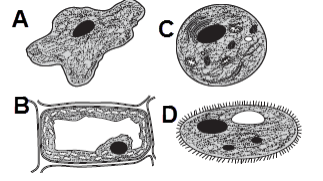
Which of these cells most likely came from an animal?

The part of the cell that controls the cells activities is called the ______.
Cell Membrane
Cytoplasm
Nucleus
Vacuole

The shape that animal cells tend to be is _______>
Round or Irregular
Rectangular

The ______ allows substances to pass in and out of the cell.
Cell Membrane
Vacuole
Nucleus
Cytoplasm

Which part on the diagram decides what goes in and out of the cell?
1
4
2
3
Which part on the diagram is like a brain?
1
4
2
3
Which part on the diagram is like a door?
1
4
2
3
Which part on the diagram is like Jell-O?
1
4
2
3
Which part on the diagram stores food, waste, and fluid?
1
4
2
3

It contains the genetic material of the cell (DNA)
Cytoplasm
Nucleus
Ribosome
Golgi complex

They produce energy
Vacuole
Nucleus
Lysosome
Mitochondria

They store waste, water solutes and enzymes
Vacuoles
Lysosomes
Mitochondria
Plasma membrane

The function of mitochondria is...
Packages the cell products for transport.
Store nutrient and water.
Produce proteins that helps the cell grow.
Releases energy from digested foods.
What is the typical shape of a plant cell?
Square/Rectangle
Circle/Oval
Triangle/Pyramid
Circle and Square
Plant cells are different from animal cells because they have:
Chloroplasts, Cell wall, and Rough ER
Cell membrane, mitochondria, and lysosomes
Lysosomes, chloroplasts, and cell wall
Rough ER, Smooth ER, and mitochondria
What is the difference between the plant and animal kingdom?
Plants need sunlight and animals can live in harsh/toxic environments.
Plants produce their own food using sunlight and animals need other organisms for nourishment.
Animals eat animals and plants. Plants consume other plants.
This was an opening question last week.
What is a cell?
Check your notes.
A process in which plants consume sunlight.
A cell is the smallest unit that is capable of performing life functions.
Are found in non-living things.
Chloroplasts:
Is where photosynthesis takes place and is only found in plant cells.
Houses the cells energy.
Helps maintain the shape of the cell.
Contains genetic material for cells.
Nucleus:
•Produces energy through chemical reactions – breaking down fats & carbohydrates
•Make proteins
•Moves materials around in cell
•Directs cell activities
•Separated from cytoplasm by nuclear membrane
•Contains genetic material - DNA
What is NOT part of the cell theory?
all cells come from existing cells
all living things are made of cells
all cells have a nucleus
Cells are the basic unit and structure of all living things
Robert Hooke, Anton Van Leeuwenhoek, Theodor Schwann, Rudolf Virchow, and Matthias Schliden were responsible for what theory?
Theory of gravity
Theory of Relativity
Cell Theory
The Theory of Continental Drift
An amoeba is a unicellular, animal-like protist that lives in ponds and streams. According to the cell theory, where did this cell come from?
another pre-existing amoeba cell
energy from the sun allowed the protist to reproduce
a multicellular organism
the nonliving environment
What tool is used to magnify and look at cells?
metric ruler
centrifuge
microscope
telescope
All living things are made up of.......
cells
cell tissues
organs
organ systems
What is the basic structural and functional unit of all living things?
atom
cell
molecule
human
How are unicellular organisms different from multicellular organisms?
There are no differences
Unicellular organisms are made of many cells
Unicellular organisms are only classified as prokaryotes
Unicellular organisms are made of only 1 cell
Which organelle is the control center of the cell? It directs the cell and the activities of the cell.
cytoplasm
cell wall
nucleus
mitochondria
Which organelle is bean-like and releases energy that has been stored in sugars to carry out the cell's activities?
cell membrane
mitochondria
lysosomes
cell wall
Which organelle is found only in plants and is responsible for making the plant food through photosynthesis?
cell wall
Mitochondria
chloroplast
nucleus
Which organelle is responsible for storing a cells food, waste and water?
vacuole
cytoplasm
mitochondria
lysosomes
Which organelle is responsible for breaking down worn out cells or worn out cell parts?
cell wall
endoplasmic reticulum
golgi bodies
lysosomes
Which organelle is the jelly like substance that holds the parts of the cell organelles?
cell wall
cell membrane
cytoplasm
lysosomes
Which organelle is responsible for holding the cells material and controlling what goes in and out of the cell?
cytoplasm
cell membrane
cell wall
lysosomes
What is found only in plant cells, protects the cell, and gives it shape?
cell membrane
cell wall
cytoplasm
lysosomes
Which organelle is the "power house" of the cell?
nucleus
golgi apparatus
protein
mitochondria
Which of these organelles is NOT found in an ANIMAL cell?
nucleus
cytoplasm
cell wall
cell membrane
Where is DNA stored in the cell?
mitochondria
nucleus
ribosomes
vacuole
Which organelle is the "brains" of the cell?
mitochondria
nucleus
protein
cytoplasm
Bacteria is what kind of cell?
eukaryotic
prokaryotic
Did we look at a plant or animal cell ?
plant
animal
both
neither
What is an organelle?
The part of the cell that stores, packages, and secretes energy.
A part of a cell that performs a specific function.
A small organ inside the body, like one of your kidneys.
Which organelle is the highway of the cell?
Mitochondria
Nucleus
Endoplasmic Reticulum (E.R.)
What is the cell membrane’s function?
Allows materials to enter/exit cell.
Contains the DNA.
Cleans up cell waste.
Which organelle is the “powerhouse”?
Lysosomes
Mitochondria
Golgi Apparatus
The nucleus contains _____, which makes you who you are genetically.
Ribosomes
Lysosomes
DNA
What is the function of the Golgi Apparatus?
Packages, stores, and secretes energy.
Controls basic cell processes
Controls what enters/exits cell
What do lysosomes do?
Deliver materials to other parts of the cell.
Clean up cell waste.
Store food and water
Think hard – which organelle has not been an answer so far? (Hint: it holds the other organelles in place!)
Golgi Apparatus
Cytoplasm
Mitochondria

The drawing of the cell organelles used in the lesson is an example of a
Model
Reflective Picture
Timeline
What is the nucleus ?
Is the cell activity cordinator and manager.
Is the distributor of the cell.
Are the protein factories.
Is the power generator of the cell.
Is like the floor of the cell.
What is the Golgi Apparatus or Golgi Body?
Is the cell activity cordinator and manager.
Is the distributor of the cell.
Are the protein factories.
Is the power generator of the cell.
Is like the floor of the cell.
What is the Ribosomes?
Is the cell activity cordinator and manager.
Is the distributor of the cell.
Are the protein factories.
Is the power generator of the cell.
Is like the floor of the cell.
What is the Mitochondria?
Is the cell activity cordinator and manager.
Is the distributor of the cell.
Are the protein factories.
Is the power generator of the cell.
Is like the floor of the cell.
What is the Cytoplasm?
Is the cell activity cordinator and manager.
Is the distributor of the cell.
Are the protein factories.
Is the power generator of the cell.
Is like the floor of the cell.
What is the Endoplasmic Reticulum?
Are the channels of transportation and storage of cell substances.
Is the cell gate.
Is the solar panel that produces food.
Is the skeleton of the plant cell.
Is the storage system of the plant cell.
What is the Cellular Membrane?
Are the channels of transportation and storage of cell substances.
Is the cell gate.
Is the solar panel that produces food.
Is the skeleton of the plant cell.
Is the storage system of the plant cell.
What is the Chloroplasts?
Are the channels of transportation and storage of cell substances.
Is the cell gate.
Is the solar panel that produces food.
Is the skeleton of the plant cell.
Is the storage system of the plant cell.
What is the Cellular Wall?
Are the channels of transportation and storage of cell substances.
Is the cell gate.
Is the solar panel that produces food.
Is the skeleton of the plant cell.
Is the storage system of the plant cell.
What is the Vacuole?
Are the channels of transportation and storage of cell substances.
Is the cell gate.
Is the solar panel that produces food.
Is the skeleton of the plant cell.
Is the storage system of the plant cell.

Who am I?
Vacuole
Ribosome
Nucleus
Golgi Body or Golgi Apparatus

What is this?
Mitochondria
Cell Wall
Chloroplast
Endoplasmic Reticulum

Which part of the cell is often called "the brain of the cell"? Is the part where you can see the cell activity cordinator and manager.
Cell Membrane
Endoplasmic Reticulum
Nucleus
Mitochondria

What is this part of the cell?
Ribosomes
Vacuole
Mitochondria

The skeleton of the plant cell is called:
Nucleus
Chloroplast
Cell Wall

A plant cell is being shown. What is structure #2?
Mitochondria
Nucleus
Ribosome
Chloroplast

A plant cell is being shown. What is the structure labeled 1?
Nucleus
Vacuole
mitochondria

What is this part called:
Nucleus
Cytoplasm
Mitochondria

