
 Worksheets
Ms. Dunn's 8th Grade Comp Science Review
Total questions: 168
Worksheet time: 2hrs 6mins

Identify the dependent variable according to this graph.
Seed Type
Number of Bird Species
Sunflower and Sorghum
Sunflower
What is the relationship between dependent and independent variables?
The independent variable changes based on the dependent variable
The dependent variable changes based on the independent variable
the are not related
they are the same
An experiment was designed to determine the effect of fertilizer on plant growth. Two groups of plants were grown under identical conditions except one group was watered with a dilute fertilizer solution and one was received water without fertilizer. The group of plants without the fertilizer is known as the
abiotic factor
control
variable

Andre planted wheatgrass in three different types of soil to see which one was the best for growing wheatgrass. Miguel and Darla decided to do the same experiment to see if they would get the same results.
What is this called?
Repetition
Replication
Reptiliation
Reposition
Jennifer wanted to study the effect of sunlight on plant growth. So she decided to expose 10 identical plants to various amounts of sunlight each day (2 hours, 3 hours, 4 hours, 5 hours, and 6 hours). After one month, she measured the weight of the plants. What was the independent variable?
Hours of sunlight
Plant weight
Type of plant

Alex is showing his friend what he learned about comparing the objects of space by their relative sizes.
If “W” represents the universe, what would “X” most likely represent?
A solar system because it contains planets and stars.
A nebula because that is what the planets formed from.
A galaxy because it contains billions of stars and the planets.
A universe because it contains billions of stars and the planets.
A huge collection of stars , gas and dust
Universal
Universe
Galaxy
Solar system
Inner and Outer planets
How is this technology such as satellites demonstrate improving our understanding of the universe?
It can cont individual atoms in a substance in order for scientists to study them.
It can send audio to communicate to other planets in our solar system.
It has sent pictures of aliens and stars in other universes.
Satellites have sent clear, distinct images of distant objects, like other galaxies that way we can learn about them
A huge collection of stars
Solar system
Universe
Gravity
Galaxy
Galaxium
The distance light travels in one year.
2 AUs
An astronomic unit
A light year.
93 trillion miles.
Which statement below best describes the Universe?
The Universe is a black hole made of dark matter.
The Universe is a giant cloud of dust and gas in space.
The Universe contains the Milky Way galaxy which contains most of the stars in space.
The Universe contains many billions of galaxies and each galaxy contains many billions
of stars.
The sun is much larger than the moon. However, as viewed from Earth, the sun and moon appear to be the same size. Why do the sun and moon appear to be the same size when viewed from Earth?
The moon is much hotter than the sun.
The moon is much denser than the sun.
The moon is much brighter than the sun.
The moon is much closer to Earth than the sun.
Which unit of measurement would we use to measure the distance between Earth and another body within our Solar System.
Astronomical Unit (AU)
Light Year (ly)
Miles (mi)
Kilometers (km)
Which statement best describes stars?
large planets that are composed mostly of gases
celestial bodies made up of gas that give off light
faint dots of light that can be seen from Earth’s surface
objects that form in the outer parts of the solar system
One physical property of a star is apparent magnitude. Which of the following is used in determining the apparent magnitude of a star?
the constellation the star is in
the distance the star is from Earth
the number of times the star rotates
the number of prominences the star makes

The chart below displays the names of different stars and their colors. Which of the groups below best orders the stars from hottest to coolest?
A. Antares, Spica, Sun, Aldebaran
B. Sun, Spica, Antares, Aldebaran
C. Spica, Sun, Aldebaran, Antares
D. Antares, Aldebaran, Sun, Spica
One physical property of a star is absolute brightness. Which of the following is used in determining the absolute brightness of a star?
how bright the star actually is
how bright the star appears to be from the Earth
the number of prominences the star makes
the direction the star rotates
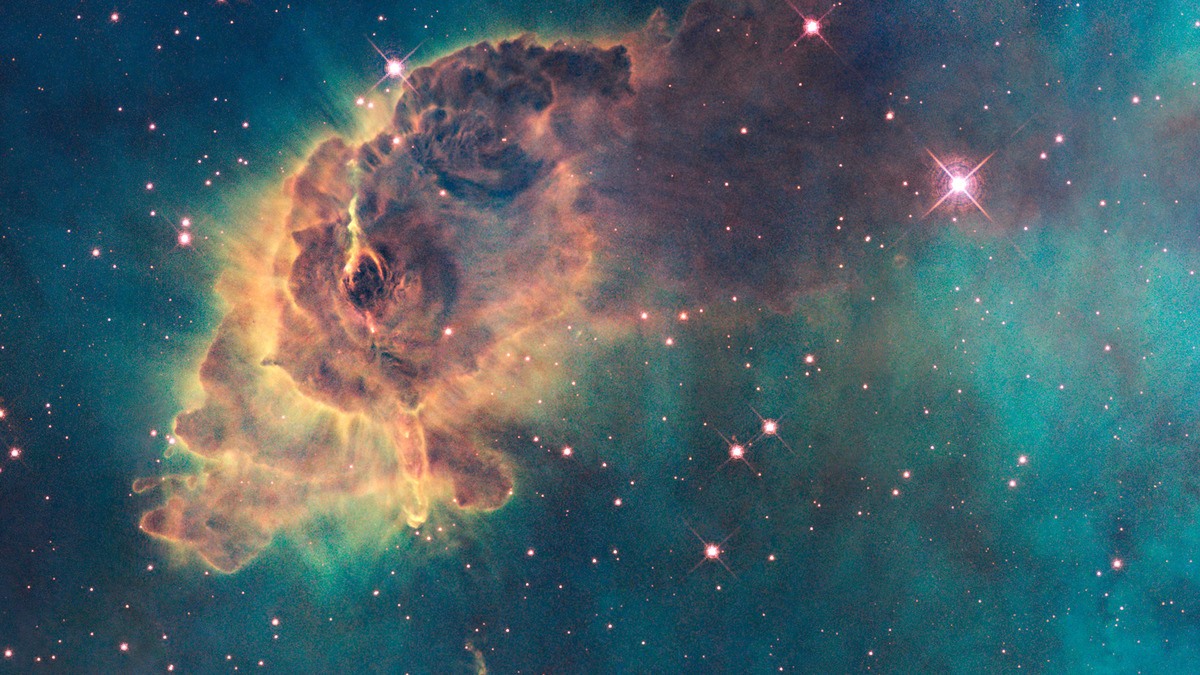

Stars that are very bright, large & burn at the highest temperature
Blue Giant stars
Red Giant
White dwarves
Proton stars

Which star is the coldest?
Yellow Star
Red Star
Orange Star
Blue Star


Which star is considered a main sequence star?
Vega
Betelgeuse
Pollux
Van Maanan's Star

What is the Hertzsprung-Russel Diagram?
A map which tells the approximate location of stars in the Milky Way galaxy and their distance from Earth.
A table that alphabetically lists stars by name and includes dates of when the star was first charted.
A chart which organizes stars into categories based on the amount of Hydrogen they burn.
A graph used to classify stars according to their luminosity, color, temperature, and stage.

Which category is our Sun located in?
White Dwarfs
Supergiants
Main Sequence
Giants
Which factor is MOST responsible for the average temperature of a planet?
distance from the sun
the availability of water
the length of a day on the planet
the composition of the atmosphere

Consider the data table. On which planet would you weigh less than you would weigh on Earth? (Table 1)
Jupiter
Neptune
Saturn
Uranus

This is a diagram of the inner solar system (not to scale) including the four inner planets, the asteroid belt, and the sun. The orbital paths of the planets have been added.
The pattern of motion of objects in the solar system indicates that which of these planets will be revolving the fastest around the sun?
Mercury
Venus
Earth
Mars
A star begins as a ball of dust particles and gases pulled together by
heat energy
protostars
inertia
gravity
How many planets are there in the solar system?
6
8
9
14
The outer planets are also called ________.
terrestrial planets
larger planets
gas giants
farthest planets
The four inner planets are:
Jupiter, Saturn, Uranus and Neptune
Mercury, Venus, Earth and Pluto
Mercury, Venus, Earth and Mars
Jupiter, Saturn, Neptune and Pluto
The four outer planets are:
Jupiter, Saturn, Uranus and Neptune
Mercury, Venus, Earth and Pluto
Mercury, Venus, Earth and Mars
Jupiter, Saturn, Neptune and Pluto
Which of the following provides the best reasoning for a planet being able to form and maintain its spherical shape while also remaining in orbit around the Sun?
The gravitational pull originating from the center of the planets allows them to retain their
shape and the gravitational pull of the Sun keeps them in orbit.
The gravitational attraction of planets towards neighboring planets allows them to retain
their shape and the gravitational pull of the Sun keeps them in orbit.
The gravitational pull originating from the center of the planets allows the planets to retain
their shape and the magnetic force exerted on the planets by the Sun keeps them in orbit.
The gravitational attraction of the planets towards neighboring planets allows them to
retain their shape and the magnetic force exerted on the planets by the Sun keeps them
in orbit.
Which statement below best describes how scientists explain gravity’s role in the formation of our Solar System?
The combined gravitational attraction between our planets was so large that it pulled the
Sun away from a nearby star cluster into the center of our Solar System.
The eight planets in our Solar System were originally orbiting a nearby star, and the Sun’s
gravity was large enough to pull those planets into orbit around the Sun.
Due to the expansion of neighboring solar systems, the gravitational attraction of our
planets to those solar systems forced the formation of the planets around our Sun.
As the Sun was forming, the force of gravity caused surrounding dust grains to collide and
stick together, forming dust granules into increasingly larger bodies that became planets.
Throughout history different models of the solar system have been used to describe where the sun and planets are in relation to each other. Which statement below best compares the heliocentric model to the geocentric model?
The heliocentric model has the Sun at the center of the solar system, while the geocentric
model does not.
The geocentric model has the Sun at the center of the solar system, while the heliocentric
model does not.
The heliocentric model has the elliptical orbits of the solar system, while the geocentric
model shows circular orbits.
The geocentric model has the elliptical orbits of the solar system, while the heliocentric
model shows circular orbits.
What is an example of natural satellite
a nebula
the Hubble Space telescope
the moon
a galaxy
Mercury is closer to the Sun than Venus but the average temperature of Venus is higher than Mercury. Which of the following statements best describe the reason the Venus has overall higher temperature than Mercury?
Venus is larger in size when compared to Mercury.
Venus has a thicker atmosphere that traps heat energy.
Venus’ revolution around the Sun is shorter.
Venus’ rotation is shorter than Mercury’s


If Katherine wanted to represent a solar eclipse, at what position should she place the Moon?
A
B
C
D

Name the eclipse.
solar eclipse
lunar eclipse


Wha type of tide would this arrangement of earth-moon-sun create?
full moon tide
new moon tide
neap tide
spring tide

The slower the particles in a substance move,
the colder it is.
the warmer it is.
the more energy it has.
Basic state of matter with the greatest amount of energy.
solid
liquid
gas
What happens to particles when their temperature increases?
The particles move slower
The particles move faster
The particles lose mass
The particles gain mass
Liquid to Gas
Condensation
Evaporation
Sublimation
Solid to Gas
Deposition
Sublimation
Evaporation

The state of matter that has no definite size or shape is
Solid
Liquid
Gas

Boiling
liquid to gas
gas to solid
gas to liquid

Freezing
Solid to gas
Liquid to solid
Gas to solid


A substance that cannot be broken down any further without losing its properties.
Compound
Mixture
Element
Suspension
Subatomic particle with a positive charge
Proton
Neutron
Electron
The subatomic particle(s) found in the nucleus of an atom
Proton
Neutron
Electron
Subatomic particle with a negative charge
Proton
Neutron
Electron
Subatomic particle(s) located in the shells outside the nucleus
Proton
Neutron
Electron
Atoms are mostly...
Tightly packed
Empty space
The mass of an atom is found by adding which subatomic particles?
Protons
Neutrons
Electrons
The number of _______________ in an atom is represented by its atomic number.
Protons
Neutrons
Electrons
If an atom has 12 neutrons and 11 protons, what is its atomic mass?
(a)
In an electrically-neutral atom, what two subatomic particles are equal in number?
Protons
Neutrons
Electrons

How many protons does Helium (He) have?
1
2
3
4

How many neutrons does Hydrogen (H) have?
(a)

Steel
Heterogeneous
Homogeneous
Compound
Element

Sugar
Homogeneous
Heterogeneous
Compound
Element
Table Salt (NaCl)
Heterogeneous
Homogeneous
Compound
Element

Coffee
Homogeneous
Heterogeneous
Compound
Pure Substance
Orange juice with pulp
Homogeneous
Heterogeneous
Compound
Pure Substance

Copper
Homogeneous
Heterogeneous
Compound
Element

Bronze
Homogeneous
Heterogeneous
Element
Compound

Milk
Heterogeneous
Homogeneous
Element
Compound

Ice water
Homogeneous
Heterogeneous
Element
Compound
Pure Substances: matter that is always made up of the same combination of atoms.
Elements and compounds can both be considered pure substances.
True
False
Heterogeneous: A mixture in which the substances that make up the mixture are not evenly mixed.
True
False
Compounds are two or more substances chemically bonded together.
True
False
Depends on the compound
Compounds are not chemically bonded together
Which of the following is an example of a compound?
Iron
Water
Bronze
Steel
Which of the following best describes compounds?
They can only be separated chemically
They are always liquid at room temperature
They contain the atoms of just one element
They are the same properties as their elements
Air
Homogeneous
Mixture
Heterogeneous
Mixture
Pure Substance
Element
___________ are the smallest unit of an element that maintains the properties of that element.
Atoms
Elements
Compounds
Mixtures
An _______________ is made up of one or more of the same kind of atom chemically combined.
atom
element
molecule
compound
A ______________ is made up of different kinds of atoms chemically combined.
element
compound
mixture
molecule
True or False: elements AND compounds are pure substances.
True
False
Elements are broadly classified as metals, nonmetals, and _________________.
compounds
organic
metalloids
Metallica
A ______________ mixture is one that does not have a uniform composition.
heterogeneous
homogenous
pure substance
A _________________ mixture is one where the substances are evenly spread throughout.
heterogeneous
homogeneous
pure substance
In a ______________, one substance is dissolved in another substance.
solution
suspension
colloid
Fruit Loops, pizza, and Skittles are examples of ____________________ mixtures.
heterogeneous
homogeneous
pure
Coffee, mouthwash, and vinegar are examples of __________________ mixtures.
heterogeneous
homogeneous
pure
Which of these is an element?
Salt (NaCl)
Water (H20)
Oxygen (O)
Carbon Dioxide (CO2)
Air is:
An element
A compound
A mixture
None of these
cutting a piece of paper in half
a sliced banana turns brown after sitting out for a while
sugar is dissolved into hot tea
density
the ability of a substance to be hammered into thin sheets
the ability of a substance to carry heat from one area to another
The ability of a substance to be pulled into thin wires
Flammability?
Physical
Chemical
Chemical or Physical:
A characteristic of matter that can be observed with your 5 senses is a ____________ property.
Chemical
Physical
Chemical or Physical:
A characteristic of matter that can only be observed when matter is changed into a new kind of matter.
Chemical
Physical
Chemical or Physical:
The words "blue", "large", and "soft" all describe __________ properties.
Chemical
Physical
Chemical or Physical:
The ability to cook, burn, rust, tarnish, or explode is an example of a ___________ property.
Chemical
Physical

This change is a
chemical reaction
physical change
musical change
Ice Ice baby
Anything that has mass and takes up space is
matter
mass
concentration
dissolve
Cellular Respiration occurs in what cell organelle?
chloroplast
cytoplasm
mitochondria
animal
Which molecule is the reactant of Glycolysis?
water
glucose
carbon dioxide
ATP

What are the reactants (taken into) of cellular respiration? (Mark all of them!)
oxygen
glucose
carbon dioxide
water
energy

Which of the following structure is where cellular respiration (Kreb's Cycle and Electron Transport Chain) occurs in the cell?
nucleus
cytoplasm
mitochondria
vacuoles

Cellular Respiration's goal is to
make water
make ATP
make glucose
make oxygen

What are the products (what is released) of cellular respiration? (Mark all of them!)
oxygen
glucose
carbon dioxide
water
ATP (energy)
Which gas do plants release, that humans depend on for survival?
Water
Carbon Dioxide
Oxygen
Sugar
The process of plants turning carbon dioxide and water into oxygen and sugar is called
Respiration
Oxidation
Photosynthesis
Combustion
How does the human body return carbon to the atmosphere in the carbon cycle?
Waste products
Photosynthesis
Cellular respiration
Formation of glucose

