wayground logo

Free Printable Worksheets

Font size

S
M
L
XL
Worksheets

DNA Pre-Assessment

Total questions: 25

Worksheet time: 25mins

Name
Class
Date
1.

Which series is arranged in order from smallest to largest?

a)

Nucleus, chromosome, cell, nucleotide, DNA

b)

nucleotide, DNA, chromosome, nucleus, cell

c)

Chromosomes, nucleus, cell, DNA, nucleotide

d)

Cell, nucleus, chromosome, DNA, nucleotide

2.

What have scientists stated that the structure of DNA was?

a)

double helix

b)

single helix

c)

circle shaped

d)

nucleotide

3.

Individual units in DNA are called

a)

nucleotides

b)

amino acids

c)

lipids

d)

nucleic acids

4.

Which answer is not a part of a DNA nucleotide?

a)

thymine

b)

deoxyribose

c)

ribose

d)

phosphate

5.

The nitrogenous bases in DNA are...

a)

deoxyribose, guanine, cytosine, thymine

b)

adenine, guanine, cytosine, uracil

c)

adenine, guanine, cytosine, thymine

d)

amine, guanine, cytosine, thymine

6.

What pairs in DNA and causes genetic variation?

a)

ribose and deoxyribose

b)

nitrogen bases

c)

amino acids

d)

phosphates and sugars

7.

Which is the correct representation of a nucleotide in DNA?

a)

deoxyribose sugar, phosphate group, uracil

b)

deoxyribose sugar, phosphate group, thymine

c)

ribose sugar, phosphate group, thymine

d)

ribose sugar, phosphate group, uracil

8.

Two people each have a gene that codes for a form of hemoglobin. Person #1 has a gene that encodes for normal hemoglobin, whereas Person #2 has a gene that encodes a mutated form of hemoglobin Sickle Cell Anemia. The difference between these two genes is due to

a)

the change of sugar in the molecule

b)

the addition of a nitrogen base

c)

the sequence of nitrogen bases

d)

the broken covalent bonds between the phosphate and sugar

9.
What will be the resulting mRNA from this DNA sequence:
GAT-TAC-AGA-TTA-CAT?
a)
CTA-ATG-TCT-AAT-GTA
b)
GAU-UAG-UGA-UUA-GUT
c)
CUA-AUG-UCU-AAU-GUA
d)
CAT-ACA-TAC-ATA-TAG
10.
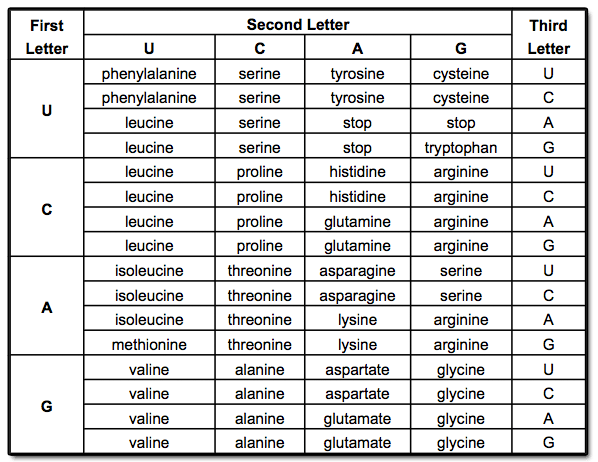
What is the correct amino acid sequence for the mRNA code AUGCCAGUAUGA
a)
Met-Pro-Ala-Val
b)
Met-Pro-Val
c)
Tyr-Gly-His
d)
Tyr-Gly-Arg-His
11.
Every three letters (example: ATC) in DNA codes for what??
a)
Amino Acid
b)
Nucleotide
c)
Lipid
d)
Carbohydrate
12.
One difference between DNA and RNA is that RNA....
a)
is double stranded 
b)
contains the base Thymine
c)
contains the base Uracil 
d)
contained the base Guanine
13.
The anti-codon 
a)
contains a sequence the same as the codon
b)
contains a sequence complementary to the codon 
c)
contains the base thymine
14.
tRNA is involved in
a)
carrying amino acids 
b)
carrying ribosomes
c)
carrying glucose
d)
carrying lipids
15.
Amino acids are joined together in order to form
a)
DNA
b)
ribosomes
c)
proteins 
d)
RNA
16.
Transcribe the following piece of DNA:
ATCGTA
a)
UAGCAU
b)
TAGCAT
c)
ATCGTA
d)
AUCGUA
17.
Which amino acid is made from the RNA codon UUA?
a)
Phenylalanine
b)
Leucine
c)
Serine
d)
Tyrosine
18.
Which amino acid is made from the RNA codon GUA?
a)
Phenylalanine
b)
Leucine
c)
Serine
d)
Valine
19.
What has DNA?
a)
animals
b)
plants
c)
bacteria
d)
all of the above
20.
The process of making RNA (i.e. mRNA) from DNA is called
a)
Replication
b)
Transcription
c)
Translation
d)
Protein synthesis
21.
Which  represents the bases of mRNA?
a)
A U C G
b)
A T U G
c)
A T C G
d)
U T C G
22.
In eukaryotes, DNA is located in the
a)
cytoplasm
b)
nucleus
c)
cell membrane
d)
ribosome
23.
If an mRNA codon is AGU, which of the following would be the appropriate tRNA anticodon?
a)
TCA
b)
UGA
c)
AGU
d)
UCA
24.
An mRNA molecule is produced in the step of protein synthesis:
a)
replication
b)
transcription
c)
duplication
d)
translation
25.
How many bases are in one codon?
a)
1
b)
2
c)
3
d)
4