
 Worksheets
Quiz 4: Weather Front/ Convection
Total questions: 30
Worksheet time: 20mins

An air mass is
a large body of air with about the same temperature and humidity throughout
the amount of moisture in the air
a place where two different air masses meet
a cold air mass that bumps against a warm air mass
What is humidity?
cold air
hot air
the amount of moisture in the air
direction of a front
What is a front?
where warm air mass meets
measurements to make weather maps
a large body of air
a place where two different air masses meet.
A cold front is,,,,,
a cold air mass that bumps against a warm air mass
a warm air mass meets a colder air mass and slowly rises over it.
What is a warm front?
a cold air mass bumps against a warm air mass
a warm air mass meets a colder air mass and slowly rises over it
two air masses meet and stop moving
warm air mass gets caught between 2 cold air masses
What kind of front is: A warm air mass gets caught between 2 cold air masses, warm air rises up between the 2
warm front
occluded front
warm front
cold front
Where do tornadoes occur more frequently?
Tornado Alley and Dixie Alley
Indian Ocean and Atlantic Ocean
Fujita Alley and Tornado Alley
Dixie Alley and Bowling Alley

Which tornado is the most rare?
F1
F3
F4
F5
What happens in Tornado Alley to create so many tornadoes?
The rate of condensation is higher than the rate of precipitation
A Nor'easter moves to the Midwest
Cold, dry air from Canada meets warm humid air from Gulf of Mexico
Warm air in Texas clashes with even warmer air in Kansas
An air mass has similar
temperature and moisture
cold and wind
rain and temperature
warm and dry

Which is not a safe place to go during a tornado warning?
Face down in a ditch
In a bathtub
Under a tree
In the basement

Which of the following statements is not true?
There are about 1000 tornadoes in the U.S. every year.
More tornadoes occur in Mexico than in the U.S.
Only a small number of tornadoes actually strike buildings.
Every year hundreds of people are killed or injured by tornadoes.
The states of Texas, Oklahoma, Nebraska and Kansas are part of an area called:
Cyclone Center
Tornado Alley
Thunderstorm Alley
Tornado Tunnel
Tornadoes are measured using what scale?
Enhanced Fujita
Mercalli
Richter
Mohs
Under what conditions will the vortex of a tornado form?
When greenhouse gases trap the earth’s heat
When deep ocean currents result from changes in temperature
When water spirals in a whirlpool
When air masses of very different temperature and humidity conditions meet
What is the main source of heat energy for weather on the earth?
Precipitation
The sun
Air
Metals
Which term describes a circulation of air or water that is caused by uneven heating?
Convection current
Conduction current
Radiation current
Emission current
Which of the following are used to study and forecast most weather-related events?
Doppler radar
Satellites and satellite images
Weather maps
All of the above


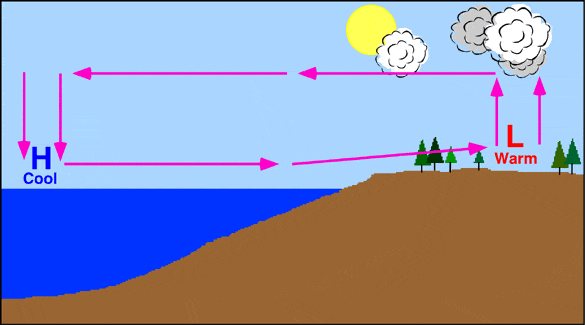
Local winds blow over:
short distances
long distances
the poles
the equator
Which statement correctly defines wind?
Wind is the movement of air from areas of low pressure to areas of high pressure
Wind is the movement of air from areas of high pressure to areas of low pressure.
Wind is the movement of air to a colder area in the atmosphere.
Wind is the movement of air pushed around and bouncing off Earth's surface.

