
 Worksheets
Types of Bonds
Total questions: 20
Worksheet time: 1hrs 4mins
When forming an ionic bond, a metal atom
Gains electrons to form a cation
Loses electrons to form a cation
Gains electrons to form an anion
Loses electrons to form an anion
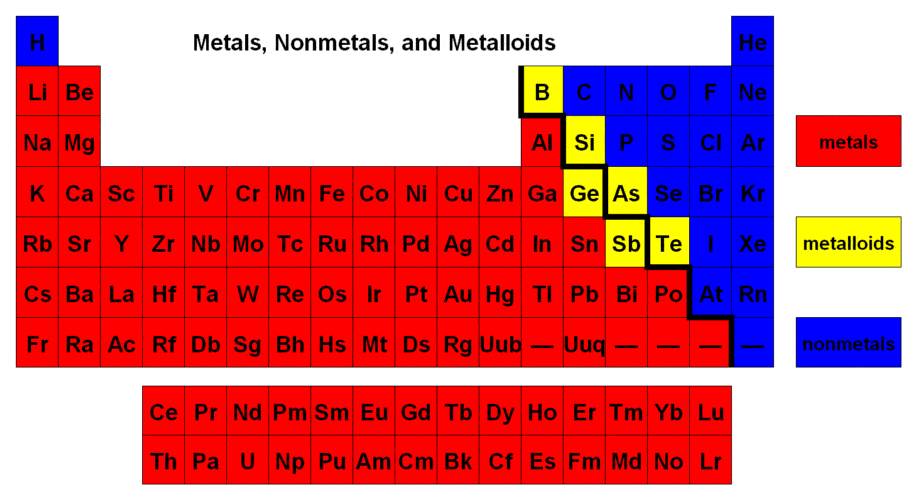
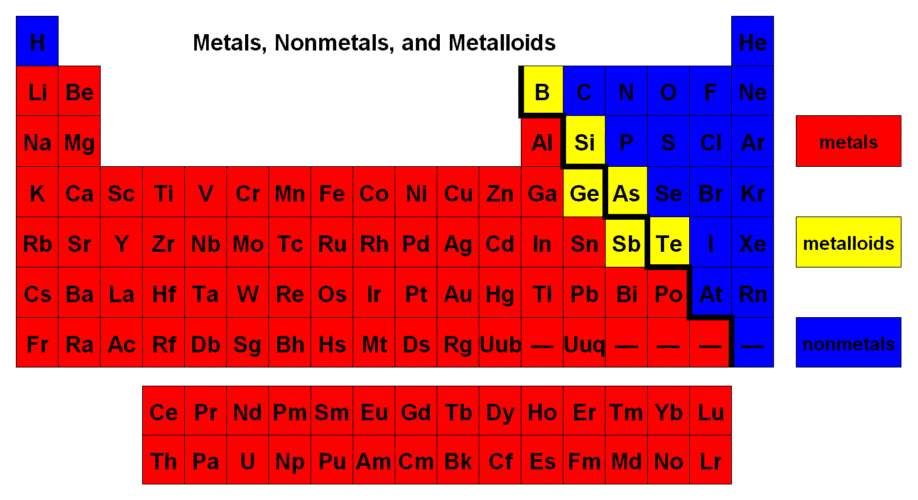
In chemical compounds, covalent bonds form when
the electronegativity difference between two atoms is very large.
electrons are completely transferred between two metals.
pairs of electrons are shared between two nonmetal atoms.
two nonmetal atoms are attracted to each other by opposite charges.
An ionic bond forms when
Valence electrons are shared
a sea of mobile electrons surround the cations
valence electrons are transferred between atoms
none of the above
Predict the bond that will form between Cu and F.
Ionic
Covalent
Metallic
Predict the bond that will form between Se and Cl.
Ionic
Covalent
Metallic
Predict the bond that will form between Sr and S.
Ionic
Covalent
Metallic
Ca3(PO4)2
ionic bond
covalent bond
metallic bond
cannot be determined
NaCl
covalent bonding
ionic bonding
hydrogen bonding
metallic bond
Which substance contains bonds that involve a sharing of electrons from one atom to another?
CuO
NH3
KBr
FeCl2
Ca + O
Which substance contains bonds that involve a sharing of electrons from one atom to another?
CuO
PO33-
KBr
FeCl2
NaF
What type of bonding would be in this polyatomic ion: CN-?
Ionic bond
Covalent bond
Metallic bond
Hydrogen bond

