
 Worksheets
Unit 3: DNA & Protein Synthesis
Total questions: 38
Worksheet time: 31mins
Where are proteins synthesized (made)?
outside of the cell
in the nucleus, next to the DNA
in the ribosomes, which are located in the cytoplasm
in the mitochondria, which are located in the cytoplasm
DNA contains the template to make RNA
True
False
The molecule that synthesizes (builds) the mRNA inside the nucleus
DNA polymerase
Nucleotides
RNA polymerase
helicase
Put these steps of protein synthesis in chronological order
Messenger RNA is produced using DNA as a template
mRNA attaches to the ribosome
a anti-codon on tRNA bonds to a specific codon on mRNA
Amino acids bond together to create a peptide chain
A protein is created


Which RNA carries the DNA instructions to the ribosome ?
mRNA
rRNA
tRNA
cRNA
Through the process of transcription, DNA makes a complementary strand of
DNA
RNA
CNA
PLB
After transcription mRNA goes from the nucleus to the _________.
Ribosome
Mitochondria
Endoplasmic Reticulum
Vacuoles
If the mRNA codon is AUG, what would the matching tRNA anticodon be?
UAC
AUG
TAC
GUA

If the mRNA codon is AUG, what amino acid would the tRNA bring?
Met
GLu
Ala
Phe
When these monomers bond together, they form a protein
Amino Acids
Peptide Bonds
Nucleic Acides
Nucleotides
During transcription, this type of RNA is responsible for copying the DNA and brining it out of the nucleus.
tRNA
mRNA
rRNA
cRNA
During translation, this type of RNA is responsible for delivering amino acids to help make a protein.
mRNA
rRNA
tRNA
dRNA
How many amino acids are found on one tRNA?
20
4
1
3
This type of mutation causes all the codons in an mRNA sequence to change.
Frameshift mutation
point mutation
missense mutation
nonsense mutation
Which type of mutation is more likely to have a negative effect on protein synthesis?
Frameshift Mutation
Point Mutation
An accidental change in the genetic code (DNA) is known as a
(a)
When a codon that codes for an amino acid mutates and becomes a stop codon, it is called a _____ mutation
missense
nonsense
silent
frameshift
When a codon mutates, but the amino acid it codes for does not change, it is called a _____ mutation
missense
nonsense
silent
frameshift


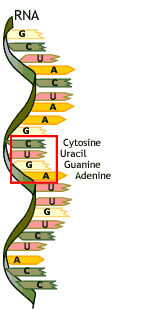
The molecule pictured is a building block of _______.
a lipid

The picture below shows an enzyme unwinding and unzipping DNA.
What is the name of this enzyme?
DNA Helicase
DNA Ligase
DNA polyermase
RNA Polymerase
Which is the role of DNA polymerase?
Unwinds the original DNA strand
Lays down RNA primer for new nucleotide bases.
Builds new strands by bringing in new nucleotide bases.
Remove Okazaki fragments for new nucleotides.
Which of the following is not a difference between DNA and RNA?
Only DNA contain phosphate groups
RNA uses Uracil
DNA is double stranded
DNA uses Thymine
Transcription occurs in the ____ and Translation occurs in the ____ of the cell.
Ribosome, Nucleus
Cytoplasm, Ribosome
Nucleus, Mitochondria
Nucleus, Ribosome
To produce billions of copies of a specific GENE
To cut DNA
To remove DNA from the nucleus
A technique for making millions of copies of a specific region of DNA.
DNA ligase
restriction enzymes
gel electrophoresis
polymerase chain reaction

