
 Worksheets
LC--Science Review, 2/6/23
Total questions: 52
Worksheet time: 38mins

Is a fern classified as a seed or non-seed plant?
seed plant
non-seed plant

Does the moss in this picture reproduce using seeds?
yes
no
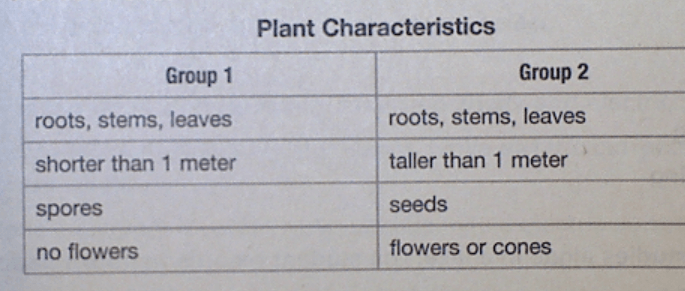
A student researches several plants. She then groups them according to their characteristics.
Which are MOST LIKELY the names of the plant groups.
ferns, trees
mosses, flowering plants
spore producers, seed producers
flowering plants, coniferous plants
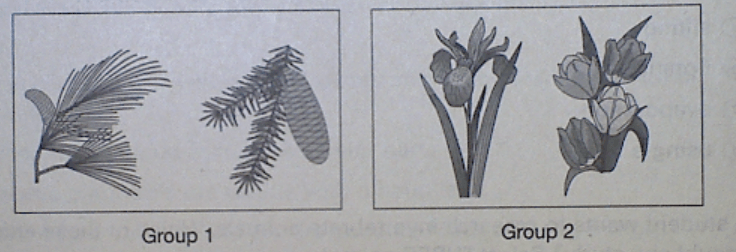
A student researches four plants that are in the same group. He sorts the plants into two smaller groups.
How does the student MOST LIKELY sort the plants?
by seed size
by flower shape
by whether they have cones or flowers
by whether they produce seeds or spores

What cell part is NOT found in all cells?
Chloroplasts
Cell Membrane
Cytoplasm
Nucleus
True or False:
Plant cells have a more rigid structure than animal cells.
True
False
This cell part is in ALL cells. It is the gel-like substance that provides cell shape.
Chloroplasts
Cell membrane
Cytoplasm
Nucleus

What type of cell is pictured above?
Plant Cell
Animal Cell
Reptiles are known for:
Having fur.
Having feathers.
Having scales and laying eggs.
Feeding their young with milk.
Birds are known for:
Having scales.
Having fur.
Living partly in water and partly on land.
Having feathers and laying eggs.
Vertebrate means that an animal has a:
nose
ears
spine
fur
An animal that's body temperature is controlled by the outside temperature is called:
cold blooded
warm blooded
An animal that can control its own body temperature is called:
cold blooded
warm blooded

What makes up an electric circuit?
Bulb and battery
Bulb, battery and switch
Bulb, battery and wire

Why is a battery important in an electrical circuit?
As a source of energy.
As a path for electricity to flow through.
As a connector to connect all parts of a circuit.

Why must parts of a circuit be properly connected before the bulb can light up?
To ensure that the bulb can light up.
To ensure that the battery can produce light in a closed circuit.
To ensure that electric current can flow through the closed circuit.

Look at the diagram. Why did the bulb not light up?
The bulb was fused.
The battery had not enough electric current to light up the bulb.
The switch was opened and prevented electric current from flowing through the circuit.

The diagram shows a complete circuit but the bulb did not light up. Why?
The plastic spoon is an insulator of electricity and prevented electric current from flowing through the circuit.
The plastic spoon is not connected properly and prevented electric current from flowing through the circuit.
The plastic spoon is a conductor of electricity and prevented electric current from flowing through the circuit.
A material that allows energy to flow through easily
Conductor
Insulator
A material that does not allow energy to flow through easily
Conductor
Insulator
Which of the following is an insulator?
Glass
Copper
Human body
Water is an insulator.
True
False

Conductor
Insulator

Conductor
Insulator

Will this circuit work?
Yes
No

Will this circuit work?
Yes
No


What do we call a behavior that is learned from observations?
inherited behaviors
learned behaviors
imprinting
acquired traits
A behavior animals are born knowing how to do is an __________.
example
animal
option
instinct


Which of these is not an instinctive behavior?
a bird building a nest
a turtle burying its eggs
a bear hibernating in winter
a horse pulling a plow
Instinct, inherited trait, or learned behavior?
Jamal is very tall.
Instinct
Inherited trait
Learned behavior
Eye color

