wayground logo

Free Printable Worksheets

NEW

Font size

S
M
L
XL
Worksheets

Microbiology Review

Total questions: 28

Worksheet time: 27mins

Name
Class
Date
1.

How are bacterial cells different from the cells of eukaryotes?

a)

The bacteria are prokaryotes, and the genetic material is not contained in the nuclei.

b)

The bacteria are eukaryotes, and the genetic material is not contained in the nuclei.

c)

The bacteria are prokaryotes, and the genetic material is contained in the nuclei.

d)

The bacteria are eukaryotes, and the genetic material is contained in the nuclei.

2.

Tiny structures that produce proteins inside bacteria

a)

bacteria

b)

ribosomes

c)

cytoplasm

d)

endospore

3.

A process by which bacteria reproduce asexually

a)

binary fission

b)

cellular respiration

c)

pasteurization

d)

decomposers

4.

A process by which bacteria reproduce sexually

a)

conjugation

b)

binary fission

c)

endospore

d)

decomposers

5.

Allows a bacteria to withstand unfavorable conditions

a)

Endospore

b)

Cellular Respiration

c)

Pasteurization

d)

Flagellum

6.
This bacteria is 
a)
Baccilus
b)
Cocci
c)
Staphylococcus 
d)
Spirilla
7.
The bacteria pictured here are 
a)
Spirochete
b)
Cocci
c)
Spirilla
d)
Bacilli
8.
Bacteria that are considered "extremophiles" because of the harsh environments they inhabit are in the kingdom
a)
Archaebacteria
b)
Eubacteria
c)
both kingdoms
9.
The carbohydrate found in the cell walls of Eubacteria is called
a)
cellulose
b)
peptidoglycan
c)
glucose
d)
chitin
10.

Bacteria that require oxygen in order to survive are called

a)

Obligate anaerobes

b)

Obligate aerobes

c)

Facultative anaerobes

11.

Can antibiotics (chemicals created in a lab designed to kill disease-causing living things) destroy viruses?

a)

yes

b)

no

12.

Can antibiotics (chemicals created in a lab designed to kill disease-causing living things) destroy bacteria?

a)

yes

b)

no

13.
Reasons that viruses are considered to be nonliving is because
a)
They are not cellular
b)
They cannot reproduce on their own
c)
They cannot make proteins
d)
all of the above
14.
What do viruses need to reproduce?
a)
they need genetic material
b)
They need a host cell
c)
They need  bacteria
d)
They need insulin
15.
When a virus invades a living cell, its _______
takes over the cell's functions.
a)
outer coat
b)
genetic material
c)
core
d)
cytoplasm
16.
What provides direct energy for the virus?
a)
food
b)
its host
c)
the sun
d)
a parasite
17.
How could you describe the size of a virus?
a)
Smaller than bacteria
b)
Larger than a parasite
c)
About the size of a dime
d)
Smaller than a proton
18.
A(n) _____ is a virus that enters a bacterial cell.
a)
endospore
b)
decomposer
c)
plasmid
d)
bacteriophage
19.
Which of the following occurs right after a virus attaches to a host cell in the viral reproduction process?
a)
The host cell dies
b)
The virus dies
c)
The virus inserts its genetic information into the host cell
d)
copies of the virus are immediately released from the host
20.
A capsid is
a)
a structure that directly causes cell lysis
b)
the type of virus that attacks bacteria
c)
the genetic material of a virus
d)
the protein coat of a virus
21.
The genetic material of a virus is in the form of
a)
RNA
b)
DNA
c)
either RNA or DNA
22.
Lysis is 
a)
rupture of a cell membrane
b)
replication of a virus
c)
bacterial reproduction
d)
a process that rarely happens
23.
How do viruses reproduce?
a)
They copy their own genetic material inside a protein coat.
b)
They kill a cell and reproduce inside it.
c)
They invade a living cell and use the cell's functions to replicate their genetic material.
d)
They do not reproduce because they are not technically living things.
24.
What is one way that a lysogenic infection differs from a lytic infection?
a)
A lysogenic virus does not act on bacteria as a lytic virus does.
b)
A lysogenic virus can remain in the host DNA for a longer period without becoming active.
c)
A lysogenic virus contains RNA instead of DNA.
d)
A lysogenic virus directs the production of new viruses right away.
25.
Viruses are exceptions to the cell theory, but they have some characteristics of living things. What is one of these characteristics?
a)
they contain chlorophyll
b)
they reproduce by mitosis
c)
they contain genetic material
d)
they are made up of many specialized cells
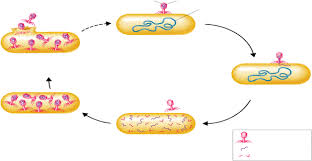
26.
What is shown here?
a)
Lysogenic Cycle
b)
Lytic Cycle
c)
Binary Fission
d)
Conjugation
27.
This infectious viral disease has many symptoms, from chills, fever, and aching muscles to coughing and sneezing to nausea and vomiting. The symptoms show up within 2-7 days after the cell is infected.  This is an example of?
a)
Lytic Cycle
b)
Lysogenic Cycle
c)
Meiosis
28.
  1. The first step in the lytic cycle is called?
a)

Attachment

b)

Entry

c)

Replication

d)

Assembly

e)

Release