
 Worksheets
Economic Problem & Demand & Supply
Total questions: 60
Worksheet time: 47mins
Who are producers in economics?
An individual who buys goods and services
An individual or organization that creates and sells goods and services
A government entity responsible for controlling prices and distribution of goods and services
What is the difference between a want and a need?
Wants are things we desire, while needs are things we require to survive.
Wants are things we require to survive, while needs are things we desire.
There is no difference between wants and needs.
Choose the correct statement:
All wants are needs.
All needs are wants.
Not all wants are needs.
Not all needs are wants.
Which of the following is an example of a want in economics?
Food
Shelter
A luxury car
Clothing
Fill in the blank: Resources are limited, but wants are (a)
What are the four factors of production?
Land, labor, capital, and entrepreneurship
Water, wind, solar, and natural gas
Food, shelter, clothing, and healthcare
Education, entertainment, transportation, and communication
What is the result of the economic problem?
Scarcity
Abundance
Equilibrium
Surplus
What is the economic problem?
Unlimited resources and unlimited wants
Unlimited wants and limited resources
Limited wants and unlimited resources
None of the above
Who is a consumer in economics?
An individual or organization that creates and sells goods and services
An individual who buys goods and services
A government entity responsible for controlling prices and distribution of goods and services
True or False: The distinction between wants and needs is subjective and can vary between individuals.
True
False
These are always limited. Individuals, businesses, and government must decide on how to use these.
Economic resources
Factors of Production
Market Forces
What are the four factors of production?
The work performed by people in an organization.
Land
Labor
Capital
Entrepreneurship
Includes all of a nation's natural resources
Land
Labor
Capital
Entrepreneurship
Cash or liquid assets are considered _____________.
Capital
Economics
Efficiency
Labor
_____________ is the work being done by a person.
Labor
Entrepreneurship
Human capital
Machine capital
Demand refers to the willingness and _______ of buyers to purchase goods
credit
opportunity cost
scarcity
ability
Draw your own demand curve. Be sure to include your graph, price, quantity and the curve.


Based on the demand schedule, pick the correct demand graph


Becky is low on money as she is getting paid next week. In order to make her money last, she buys ramen to eat throughout the week. Fast forward a week later, Becky has received her paycheck and can now afford to buy pasta and steak at store without the need to buy ramen. Ramen is an example of a
inferior good
normal good
neutral good
delicious meal
When the median household income increases, car sales also increase. When the median household income falls, car sales also fall. Car sales in this scenario is a form of a
normal good
inferior good
neutral good
our materialistic society causing us to participate in the capitalist rat race
When demand increases, the demand curve goes to the . . .
left
right
When demand decreases, the demand curve shifts to the
left
right
Which is not a factor that causes a shift in the demand curve
preferences
number of buyers
income
equity

The desire tow own something and the ability to buy it is...
elasticity
law of demand
supply
demand

This shows a demand
increase
decrease

This shows a demand
increase
decrease
If someone buys fewer Starbucks coffees because they had to take a different job the reason for their change in demand for Starbucks is due to....
change in consumer tastes
change in income
level of price
substitute availability
If someone stops buying Starbucks and starts making coffee at home their shift in demand is due to...
level of price
change of income
substitute availability
Which of these goods has no easily available substitute?
Gatorade
JIF peanut butter
gasoline
Domino's pizza
Why does scarcity exist?
Each year workers tend to produce less than previously
Machines wear out in time
There are not enough resources to meet everyone's wants
There is a limit to people's wants
What factor of production does a road fall under?
Capital
Enterprise
Labour
Land
Resources (also know the factors of production) are ...
Land and Labour
Land and Capital
Enterprise
Land, Labour, Capital and Enterprise
Raw materials (i.e. cotton, oil...etc.) fall under which category
Land
Labour
Capital
Enterprise
The people who bring all the factors of production together to create a new product or service is ...
Land
Labour
Capital
Enterprise

An individual or group who buys goods or services is called ...
producer
consumer
goods
services
Which of the following is NOT one of the determinants of supply?
Change in cost of production/resources
Change in number of sellers
Substitutes
Change in technology
Identify the correct determinant of supply:
Example: If the cost of electricity used to power an automotive factories falls, the supply of cars in the market increases
Cost of production/resources
Number of sellers
Change in expectations
Change in technology
Examples: When auto manufacturer were able to implement robotics on the production line, automobiles were produced more quickly and at a smaller cost per unit. This allowed the industry to supply more cars.
Labor costs are rising through the roof! Minimum wages are now at $25 an hour. This means even the basic item will need to cost more to keep up with rising costs. What determinant of supply does this most relate to?
Change in technology
Change in number of sellers
Change in cost of production/ resources
Consumer taste/ preference
The amount of a product available at all possible prices is called
Quantity supplied
Supply
The Law of Supply states that when the price of a good INCREASES, quantity supplied (Qs)
Increases
Decreases
The Law of Supply states that when the price of a good DECREASES, quantity supplied (Qs)
Increases
Decreases
What is supply?
The amount of money you have
When stores don't have enough of something
The total amount of goods or services provided
The cost of labor for a service
An example of goods would be:
Sunlight in the sky
Food in a store
Money in the bank
Wind
Shortages are:
When there is too little of something
When there is too much of something
Lots of Money
Lots of Food
The Law of Supply states that
As price increases quantity supplied increases
As price increases quantity supplied decrease
As price increases quantity demanded decreases
As price increases the happier you get 💁🏼
An increase in supply causes the supply curve to shift to the
right
left
no change
A technological improvement usually leads to a decrease in supply.
True
False
If producers of lemonade expect a heatwave next week, today their supply of lemonade will
increase
decrease
stay the same
This part of the market determines DEMAND
buyers
sellers
suppliers
store owners
This part of the market determines SUPPLY
buyers
sellers
consumers
us

What does this curve represent?
demand
supply
equilibrium
shortage
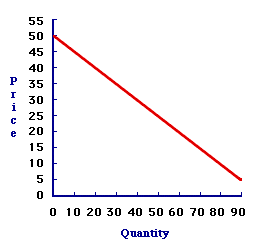
What does this curve represent?
supply
equilibrium
demand
surplus

The amount of goods and services people can actually buy is their
voluntary exchange.
purchasing power.
utility.
substitution effect.

A shift to the left in the demand curve indicates a(n)
decrease in price.
decrease in demand.
increase in population.
increase in demand.

