
Font size
 Worksheets
Climate, Atmosphere, Hydrosphere Practice Test
Total questions: 39
Worksheet time: 40mins
Normal Conditions
El Nino
During (a) air pressure weakens in the Eastern Pacific.
Normal Conditions
El Nino
Normal Conditions
El Nino
Normal Conditions
El Nino
Normal Conditions
El Nino
One consequence of El Nino is (a) in Southeast Asia.
stronger Tradewinds
flooding
strong winter storms
drought
One consequence of El Nino is (a) and increased rainfall in South America..
El Nino
La Nina
During (a) surface temperatures in the eastern Pacific are colder than average.
the heat of the day
the difference between the temperature of the sea and the land
the wind speed
the amount of precipitation that day
From east to west
From west to east
From the land to the ocean
From the ocean to the land
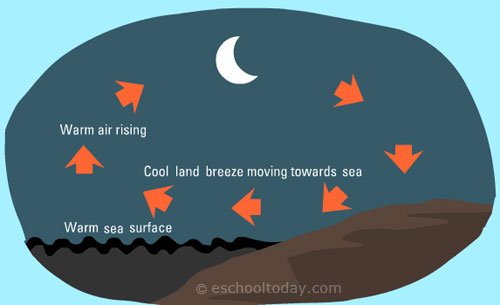
Is this a land or a sea breeze?
(a)
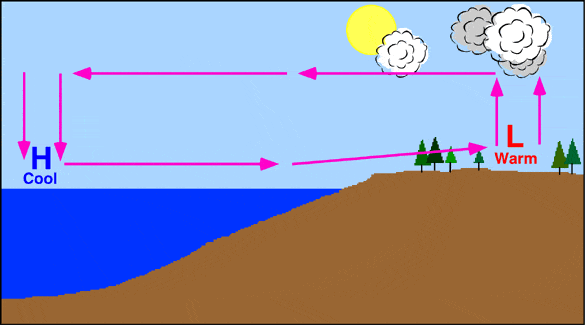
Is this a land or a sea breeze?
(a)
wind moves from north to south
wind moves from ocean to the land
wind moves from the land to the ocean
wind moves from south to north
In a sea breeze, the air is warmer above the (a) .
Which term best describes how the earth's atmosphere is heated?
(a)

Which climate zone contains the largest variety of plants and animals?
Hot Desert
Tropical Monsoon
Tropical Savanna
Tropical Rainforest

What climate zone best matches the graph?
Tropical Rainforest
Hot Desert

Which hot desert pictured is likely closer to an ocean?
Baghdad
Mogadishu

Based on the monthly temperatures, Baghdad is likely in which hemisphere
(a)

Based on the monthly temperatures, this graph likely belongs to...
Phoenix, AZ, USA
Alice Springs, Australia

Based on the number and size of the trees pictured, this is likely the...
polar climate zone.
tropical savanna climate zone.
tropical rainforest climate zone.

Based on the monthly temperatures and monthly rainfall, the location pictured is likely located in the...
tropical rainforest climate zone.
hot desert climate zone.
tropical monsoon climate zone.

The higher the elevation or altitude, the...
cooler the temperatures.
warmer the temperatures.

Based on the monthly temperatures and monthly rainfall, Mexico City is likely in the...
how desert climate zone.
tropical rainforest climate zone.
subtropical highland climate zone.

Which has the greater seasonal temperature variation, Death Valley, or Singapore?
Death Valley
Singapore

Which gets more rainfall, Death Valley, or Singapore?
Death Valley
Singapore

Based on rainfall amount, which is likely located in a hot desert climate zone?
Death Valley
Singapore

Which is more likely to have a larger variation of seasonal temperatures?
A location on the equator, at 2,000 feet altitude.
A location 500 miles north of the equator, at 4,000 feet altitude.
A location on the equator, at sea level.
The three (3) primary heat absorbing gases in the atmosphere are (CHOOSE THREE):
Carbon dioxide
Water vapor
Nitrogen
Hydrogen
Methane
What do greenhouse gases do in our atmosphere?
They absorb radiation given off by the Earth
They keep all the air within the Earth
They block harmful radiation from reaching the Earth
They make the Earth cooler
Which of the following would occur if the greenhouse gasses were not present:
There would be no change
The average temperature on Earth would decrease by ~thirty (30) degrees Celsius, far below freezing
The average temperature on Earth would increase by ~thirty (30) degress Celsius
The Average temperature on Earth would be far too hot for any life to exist
Greenhouse gasses allow ______________wavelength light to pass through while absorbing the ______________ wavelength light that is emitted from the Earth's surface.
short, long
long, short
What harmful health effects do scientist say that the UV radiation that passes through our "shield" will cause?
increase in skin cancer
immune deficiencies
cataracts
all of the answers
What happens to form ozone gas?
Oxygen molecules interact with the UV rays from the Sun.
Chlorine molecules interact with the UV rays from the Sun.
Oxygen and chlorine molecules produce a gas.
What are "holes" in the ozone layer?
places where the ozone concentrations are lower than under normal conditions, allowing more UV radiation to reach the Earth's surface.
places where the ozone concentrations are higher than under normal conditions, allowing more UV radiation to reach the Earth's surface.
places where the ozone concentrations are higher than under normal conditions, allowing lessUV radiation to reach the Earth's surface.
Which of the following is the most common ozone destroying pollutants?
Chloroflurocarbons
particular matter
Nitrogen dioxide
carbon monoxide

