Wayground logo

Free Printable Worksheets

Font size

S
M
L
XL
Worksheets

Osmosis and Diffusion

Total questions: 38

Worksheet time: 2hrs 43mins

Name
Class
Date
1.
Osmosis is the diffusion of _____ across a selectively permeable membrane.
a)
food
b)
air
c)
water
d)
oxygen
2.
During diffusion
a)
substances (things) moves from high to low concentration
b)
water moves when energy is used
c)
large or oddly shaped molecules move across a cell membrane
d)
water moves from high to low concentration
3.
 In the given scenario what will happen?  An egg with a dissolved shell is placed in pure water for 48 hours.
a)
Water will move in and out of the cell equally, and the cell with neither shrink nor swell.
b)
The egg will gain water and swell.
c)
The egg will lose water and shrink.
4.
 An animal cell placed in a hypertonic (salty) solution will
a)
Stay the same
b)
Shrink- get smaller
c)
Swell- get bigger
5.
Ideally, your cells should be in a(n) _______ solution
a)
isotonic
b)
hypertonic
c)
hypotonic
d)
isometric
6.
The movement of water through a semi-permeable membrane is called?
a)
cell membrane
b)
respiration
c)
osmosis
d)
diffusion
7.
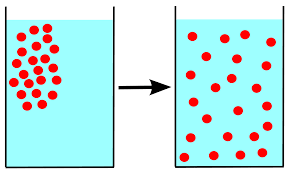
The picture  is an example of _________________.
a)
isotonic
b)
diffusion
c)
osmosis
d)
active transport
8.
When both inside and outside of a cell have the same amount of water it is said that the cell has reached a state of ___________.
a)
osmosis
b)
equilibrium
c)
diffusion
d)
hypertonic
9.
In a solution, salt is considered the _______.
a)
solvent
b)
solute
c)
solution
10.
In this given scenario, corn syrup is hypertonic to an egg with a dissolved shell. What will happen to the egg when it is place in corn syrup?
a)
It will stay the same.
b)
It will swell- get bigger.
c)
It will shrink- get smaller.
11.
In a scenario, salt is placed into a bowl of water.  What is the solvent?
a)
salt
b)
water
c)
saltwater
12.
If you looked at red blood cells under a microscope and saw the blood cells exploded, what would you say happened?
a)
The cells were placed in a hypotonic solution.
b)
the solution was isotonic.
c)
The solution was hypertonic.
13.
What does selectively-permeable mean?
a)
The cell controls what passes in and out of the cell
b)
Nothing gets through
c)
The cell lets only large substances through
14.
 If a cell containing 5% salt is placed into a glass of water with 20% salt, the water is _______ compared to the cell.
a)
hypertonic-
b)
hypotonic
c)
isotonic
15.
Both side of a selectively- permeable membrane are equal. The sides are ______.
a)
isotonic
b)
hypertonic
c)
hypotonic
16.
Mrs. Crandall placed 2 tablespoons of salt into a glass of water and then placed a selectively- permeable membrane into the glass that divided the glass into left and right halves.  The left side is _______ to the right side.
a)
isotonic
b)
hypertonic
c)
hypotonic
17.
The cell wall________.
a)
is a selectively permeable membrane
b)
is involved in protection and structure in plants
c)
is found in plants and animals
18.
If a cell is placed in a hypotonic solution, the cell will _______.
a)
stay the same
b)
swell (get bigger)
c)
shrink (get smaller)
19.
The picture below is an example of _________________.
a)
osmosis
b)
isotonic
c)
diffusion
d)
active transport
20.
During osmosis
a)
water moves from high to low concentration
b)
large or oddly shaped molecules move across a cell membrane
c)
water moves when energy is used
d)
proteins are built
21.
Permeable means
a)
things can pass through
b)
the concentration levels are different
c)
it is permanent
d)
things are stuck
22.
What is diffusion?
a)
when molecules move 
b)
when molecules move from a high concentration to a low.
c)
no movement 
d)
molecules move everywhere
23.
_______ regulates what enters and leaves a cell.  
a)
Cell Membrane
b)
Nucleus
c)
Mitochondria
d)
Cytoplasm
24.
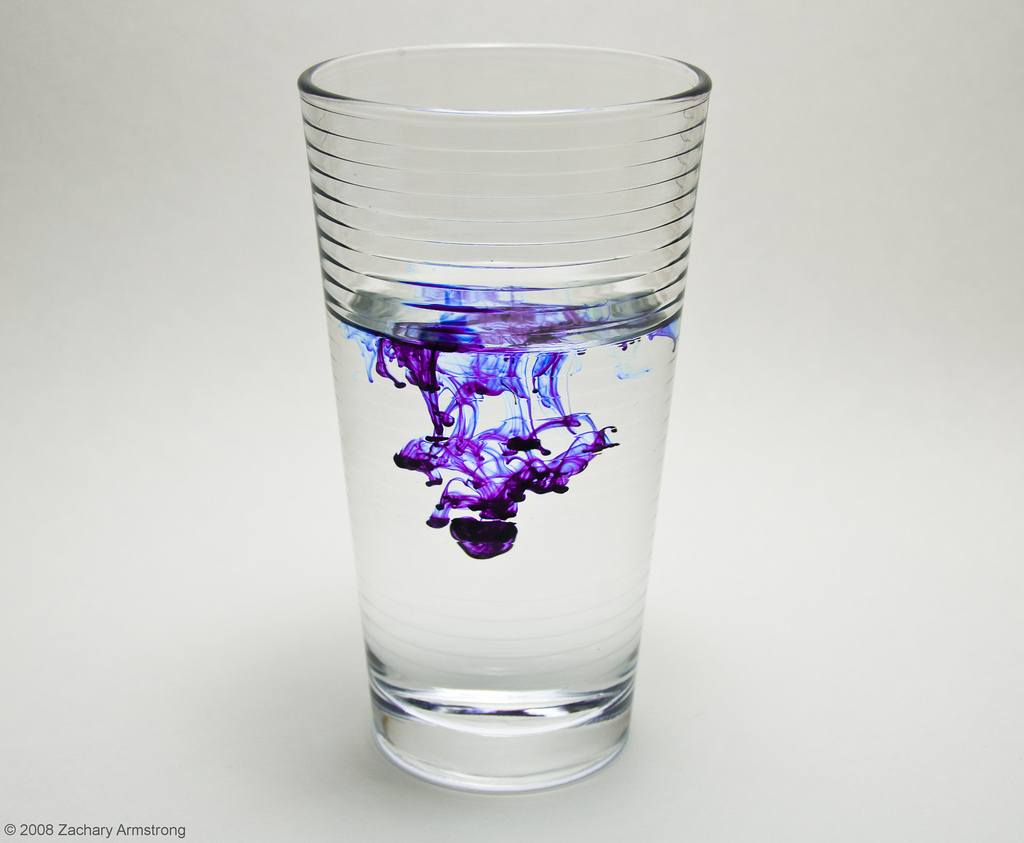
Where is there a low concentration of dye?
a)
at the bottom of cup
b)
in the color
c)
at the top of cup 
d)
no concenteraion gradient
25.
When both inside and outside of a cell have the same amount of water it is said that the cell has reached a state of
a)
Osmosis
b)
Diffusion
c)
Equilibrium
26.
A person would never have pure water put into their veins in a hospital because their cells would...
a)
Shrink/Dehydrate
b)
Expand
27.
A person should never drink salty water because their cells would
a)
shrink
b)
expand
28.

Osmosis needs _____ energy.

a)

zero

b)

a lot of

c)

10 kilowatts

d)

some

29.

_____ is the amount of a given substance contained in a solution

a)

concentration

b)

equilibrium

c)

diffusion

d)

facilitated diffusion

30.

If the dots represent sugar which is more concentrated

a)

Inside the cell

b)

Outside the cell

c)

Neither they are equal (equilibrium)

31.

If the dots represent sugar, what direction will water flow?

a)

Into the cell

b)

Out of the cell

c)

Into and out equally (equilibrium)

32.

If the percentage represents sugar, what direction will water flow?

a)

Into the cell

b)

Out of the cell

c)

Into and out equally (equilibrium)

33.

If the miligrams are referring to the amount of sugar, what direction will water flow?

a)

Into the cell

b)

Out of the cell

c)

Into and out equally (equilibrium)

34.

If the numbers and dots represent solutes, which cell would water move into?

a)
b)
c)
d)
35.

If the numbers and dots represent solutes, which cell would water move out of?

a)
b)
c)
d)
36.

A substance that can dissolve a solute to create a solution.

a)

Solvent

b)

Solute

c)

Solution

37.

A substance that can be dissolved by a solvent to create a solution

a)

Solvent

b)

Solute

c)

Solution

38.

What are TWO ways you can predict the movement of water?

a)

from a [High] of water to a [Low] of water

b)

towards the [Lower] of solutes

c)

towards the [Higher] of solutes

d)

from a [Low] of water to a [High] of water