wayground logo

Free Printable Worksheets

NEW

Font size

S
M
L
XL
Worksheets

Cell Processes Pretest

Total questions: 50

Worksheet time: 30mins

Name
Class
Date
1.

If a cell has 38 chromosomes and undergoes mitosis, how many chromosomes will each daughter cell have?

a)

19

b)

76

c)

38

d)

24

2.

95% of the cells life cycle

Stage where DNA is copied

a)

Interphase

b)

Metaphase

c)

Telophase

d)

Prophase

3.

Chromosomes line up at the equator of the cell

Spindle fibers extend from the centrioles to the middle of the chromosomes

a)

Prophase

b)

Metaphase

c)

Anaphase

d)

Interphase

4.

Chromatids separate

a)

Anaphase

b)

Metaphase

c)

Prophase

d)

Telophase

5.

Nuclear membrane reforms around the new daughter cells.

Cytoplasm begins to "pinch" in.

a)

Anaphase

b)

Metaphase

c)

Telophase

d)

Interphase

6.

Two replicated cells split from each other and are able to move on their own.

a)

Metaphase

b)

Prophase

c)

Cytokinesis

d)

Telophase

7.

95% of the cells life cycle

Stage where DNA is copied

a)

Interphase

b)

Metaphase

c)

Telophase

d)

Prophase

8.

Nuclear membrane disappears

Chromosomes can now be seen

Centrioles move to opposite sides

a)

Metaphase

b)

Interphase

c)

Telophase

d)

Prophase

9.

Identify the following stage of the life cycle of the cell in the picture.

a)

interphase

b)

prophase

c)

metaphase

d)

anaphase

e)

telophase

10.

Identify the following stage of the life cycle of the cell in the picture.

a)

interphase

b)

prophase

c)

metaphase

d)

anaphase

e)

telophase

11.

Identify the following stage of the life cycle of the cell in the picture.

a)

interphase

b)

prophase

c)

metaphase

d)

anaphase

e)

telophase

12.

Identify the following stage of the life cycle of the cell in the picture.

a)

interphase

b)

prophase

c)

metaphase

d)

anaphase

e)

telophase

13.

Identify the following stage of the life cycle of the cell in the picture.

a)

interphase

b)

prophase

c)

metaphase

d)

anaphase

e)

telophase

14.
What phase of mitosis is shown in the picture?
a)
Prophase
b)
Anaphase
c)
Telophase
d)
Metaphase
15.
What phase of mitosis is shown in the picture?
a)
Prophase
b)
Anaphase
c)
Telophase
d)
Metaphase
16.
Chromatid pairs separate and move to opposite ends of the cell
a)
Metaphase
b)
Telophase
c)
Interphase
d)
Anaphase
17.
Chromosomes duplicate, the cell grows and develops
a)
Metaphase
b)
Telophase
c)
Interphase
d)
Anaphase
18.

What phase of the cell cycle does the cell spend most of its time in?

a)

Metaphase

b)

Interphase

c)

Anaphase

d)

Telophase

19.
Mitosis produces cells with haploid or diploid number of chromosomes?
a)
Haploid
b)
Diploid
20.
How many cells are produced in Mitosis?
a)
1
b)
2
c)
3
d)
4
21.
Are the cells in Mitosis identical or unique?
a)
Identical 
b)
Unique
c)
It's random
22.
A Goat has 60 chromosomes in its body cells.  What is the haploid number?
a)
60
b)
30
c)
100
d)
120
23.
A human has 46 chromosomes in their body cells.  What is the haploid number?
a)
46
b)
92
c)
23
d)
12
24.

The reactants of photosynthesis

a)

CO2

b)

CO2, H2O

c)

CO2, H2O, Sunlight

d)

none of the above

25.

The products of cellular respiration

a)

CO2

b)

CO2, H2O

c)

CO2, H2O, glucose

d)

CO2, H2O, ATP

26.

Occurs in plants

a)

photosynthesis only

b)

cellular respiration only

c)

photosynthesis and cell respiration

d)

all of the above

27.

Occurs in animals

a)

photosynthesis only

b)

cellular respiration only

c)

cellular respiration and photosynthesis

d)

all of the above

28.

The reactants of cellular respiration

a)

CO2, H2O, sunlight

b)

O2, glucose

c)

CO2, glucose

d)

H2O, sunlight

29.

The products of photosynthesis

a)

CO2, H2O, sunlight

b)

CO2, H2O, ATP

c)

O2, Glucose

d)

CO2, Glucose

30.

Location for photosynthesis

a)

mitochondria

b)

chloroplasts

c)

cytoplasm

d)

vesicle

31.
Photosynthesis is important because....
a)
plants need air to breathe
b)
it makes the plants green
c)
it is the process by which plants make their own food
d)
without it the Earth would all be a desert
32.
The process by which cells use oxygen to produce energy from food is called?
a)
photosynthesis
b)
transpiration
c)
cellular respiration
d)
germination
33.
By which process do plants make their own food from carbon dioxide and water?
a)
cellular respiration
b)
transpiration
c)
chlorophyll
d)
photosynthesis
34.
What is the correct equation for cellular respiration?
a)
6O2 + C6H12O6 -> 6CO2 + 6H2O + Energy
b)
6O2 + C6H12O6 + Energy -> 6CO2 + 6H2O
c)
6CO2 + 6H2O -> 6O2 + C6H12O6 + Energy
d)
6CO2 + 6H2O + Energy -> 6O2 + C6H12O6
35.

Which statement about photosynthesis is correct?

a)

Plants get the energy they need for photosynthesis from water.

b)

Plants get the energy they need for photosynthesis from soil.

c)

Plants get the energy they need for photosynthesis from sunlight.

d)

Plants do not require energy to perform photosynthesis.

36.

Which of the following is the correct equation for PHOTOSYNTHESIS?

a)

6CO2 + 6H2O → 6O2 + C6H12O6

b)

6CO2 + C6H12O6 + 6H2O → O2

c)

6O2 +6H2O → 6CO2 +C6H12O6

d)

C6H12O6 + 6O2 → 6H2O + 6CO2

37.

Which molecule synthesized by plants is a major source of energy for cellular processes in both plants and animals?

a)

Wax

b)

Glucose

c)

Nucleic Acid

d)

Chlorophyll

38.

Which of these statements best explains the process of energy conversion that takes place in the mitochondria?

a)

Energy is required for carbon dioxide molecules to form six-carbon sugar molecules

b)

Water molecules and radiant energy are necessary for anaerobic respiration to take place.

c)

Oxygen molecules release energy in the form of heat during combustion reactions.

d)

The energy in glucose molecules is transferred to the phosphate in ATP.

39.

Photosynthesis and cellular respiration both involve the use and release of gases. Which statement correctly identifies the role of gases in the two processes?

a)

Photosynthesis and cellular respiration both use carbon dioxide and release oxygen.

b)

Photosynthesis and cellular respiration both use oxygen and release carbon dioxide.

c)

Cellular respiration uses oxygen and releases carbon dioxide, while photosynthesis uses carbon dioxide and releases oxygen.

d)

Cellular respiration uses carbon dioxide and releases oxygen, while photosynthesis uses oxygen and releases carbon dioxide.

40.
What is diffusion?
a)
when molecules move from a low concentration to a high concentration 
b)
when molecules move from a high concentration to a low concentration.
c)
no movement 
d)
molecules move everywhere
41.
What is the definition of  Selective Permeability?
a)
The movement of materials across the cell membrane that requires NO ENERGY from the cell.
b)
The movement of materials through (or across) the cell membrane
c)
The ability of the cell membrane to allow some things to pass through while preventing other things from passing through.
d)
The movement of molecules from an area of high concentration (where the molecules are more crowded together) to a area of low concentration (where molecules are more spread apart)
42.
Osmosis
a)
diffusion of water molecules through a semi-permeable mebrane from an area of low concentration to an area of high concentration
b)
the diffusion of particles from an area of high concentration to an area of low concentration
c)
diffusion of water molecules through a semi-permeable membrane from an area of high concentration to an area of low concentration
d)
the diffusion of particles from an area of low concentration to an area of high concentration
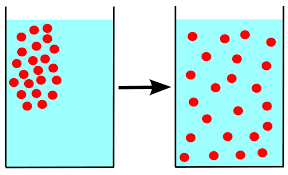
43.
The picture below is an example of _________________.
a)
osmosis
b)
isotonic
c)
diffusion
d)
active transport
44.
Osmosis is the movement of _____ across a membrane.
a)
food
b)
energy
c)
oxygen
d)
water
45.
_______ regulates what enters and leaves a cell.  
a)
Cell Membrane
b)
Nucleus
c)
Mitochondria
d)
Cytoplasm
46.
In the given scenario what will happen to the organism: salt is poured onto eggplant.
a)
Water will move out of the eggplant cells and the cells will shrink.
b)
Water will move out of the eggplant cells and the cells will swell.
c)
Water will move into the eggplant cells and the cells will swell.
47.
In the given scenario what will happen?  An egg is placed in pure water for 48 hours.
a)
The egg will gain water and swell.
b)
Water will move in and out of the cell equally, and the cell with neither shrink nor swell.
c)
The egg will lose water and shrink.
48.
An animal cell placed in a hypertonic (salty) solution will
a)
Shrink
b)
Swell
c)
Stay the same
49.
Which way will the water molecules move during osmosis?
a)
Out of the cell, so the cell shrinks.
b)
Out of the cell, so the cell swells.
c)
Into the cell, so the cell shrinks.
d)
Into the cell, so the cell swells.
50.
Just like Coke is a type of soda, __________ is a type of ___________.
a)
diffusion, osmosis
b)
concentration, equilibrium
c)
equilibrium, concentration
d)
osmosis, diffusion