
Font size
 Worksheets
States of Matter
Total questions: 50
Worksheet time: 37mins

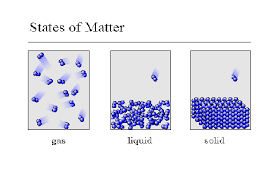
What is the order of the states of matter shown? (from left to right)
Solid, Liquid, Gas
Gas, Liquid, Solid
Liquid, Gas, Solid
Solid, Gas, Liquid

expanding
heating
cooling

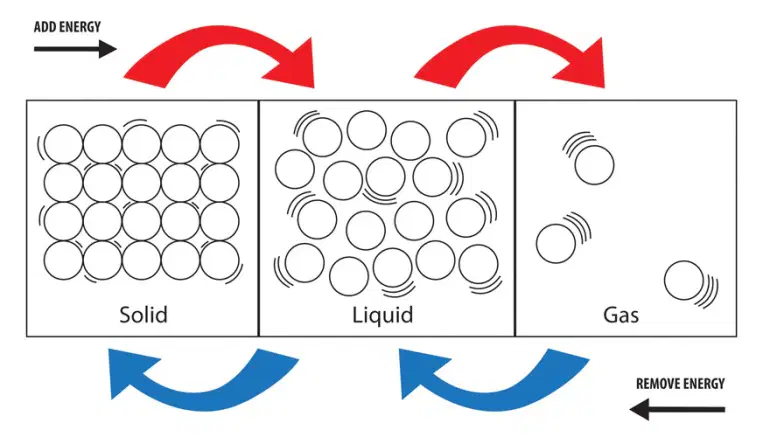
Particles in solid have the greatest amount of energy.
Particles in a liquid have the greatest amount of energy.
Particles in a gas have the greatest amount of energy.
Particles have equal amounts of energy.

In this substance, the _____ has the greatest temperature oC.
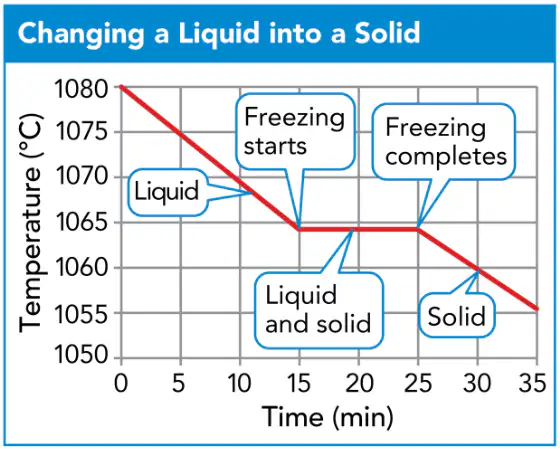
According to the graph, the substance is in a mixed state (solid and liquid) between:
0-15 minutes
15-25 minutes
25-35 minutes
0-5 minutes


True/False: There is very little space between the particles of a liquid compared to the lot of space between the particles of a gas.
True
False

When solids reach their melting point they become _______
liquids
solids
gases

vaporization
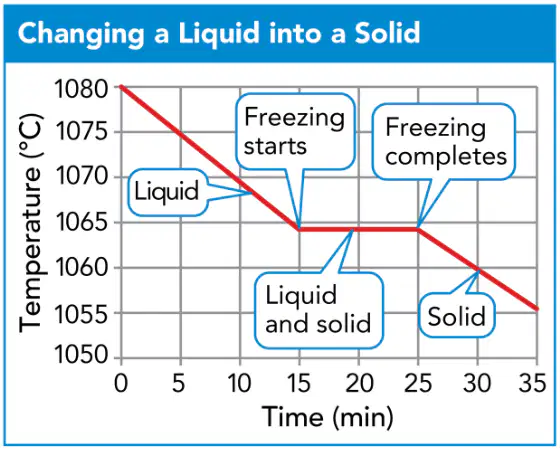
In the graph, the substance is completely solid after:
15 minutes
20 minutes
25 minutes
30 minutes


Matter in a gas has (a) volume and (b) shape.
Matter in a liquid has (a) volume and (b) shape.
Matter in a solid has (a) volume and (b) shape.

When enough energy is added to a liquid, it changes phase (state) to a ___.
solid
liquid
gas

When a liquid loses enough energy it changes phase to a _____.
solid
liquid
gas
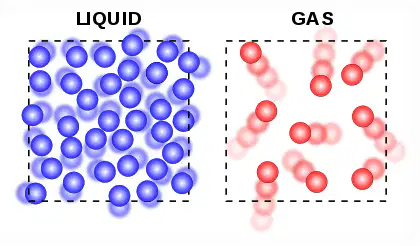
Decreasing the pressure above a liquid will:
Cause the liquid to condense.
Make it harder for the liquid to vaporize.
Make it easier for the liquid to vaporize.
Have no effect on the liquid's state.

Freezing is going from...
Solid to gas
Liquid to solid
Gas to solid

Boiling is going from
liquid to gas
gas to solid
gas to liquid
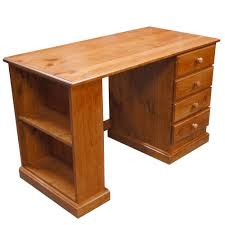

The state of matter that has no definite size or shape is
Solid
Liquid
Gas

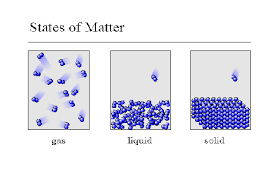
Particles in a (a) move quickly and are far apart.
The process of a solid changing directly into a gas is
Deposition
Sublimation
Vaporization
Condensation
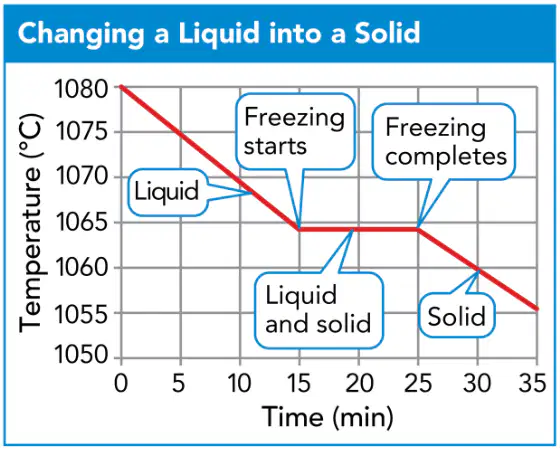
Using the graph, estimate the time it takes for the freezing process to complete after it starts.
10 minutes
25 minutes
15 minutes
0 minutes
Liquid to Gas
Condensation
Vaporization
Sublimation
Particles move relative to each other, but remain in contact with each other.
solid
liquid
gas
Basic state of matter with the greatest amount of energy.
solid
liquid
gas
What happens to particles when their temperature increases?
The particles move slower
The particles move faster
The particles lose mass
The particles gain mass
How does evaporation differ from boiling in terms of where it occurs?
Boiling occurs at the surface.
Evaporation occurs at the surface.
Evaporation occurs throughout the liquid.
Boiling occurs only at a specific temperature.
The temperature at which a liquid changes to a solid is called the:
Boiling point.
Condensation point.
Melting point.
Freezing point.
Vaporization
Amorphous solids differ from crystalline solids in that amorphous solids:
Have a regular, repeating pattern of atoms.
Have a definite melting point.
Have a disordered arrangement of atoms.
Are generally harder than crystalline solids.
Which of the following statements about crystalline solids are true?
Particles are arranged in a regular repeating pattern
They form crystals
They are shapeless
An example is table salt
What happens to particles when their temperature increases?
The particles move slower
The particles move faster
The particles lose mass
The particles gain mass
A high viscosity indicates:
A liquid flows easily.
A liquid resists flow.
A liquid has low surface tension.
A liquid has a high boiling point.
The energy of MOTION is...
chemical energy
radiant energy
potential energy
kinetic energy

Which of the following statements is true about solids?
Particles do not move around much, but vibrate
Particles have a lot of free space and spread out
Solids have fixed shape but not volume.
Particles are less closely packed than gas.

Look at the picture. Which state of matter is in beaker C?
Solid
Liquid
Gas
Look at the picture. Which state of matter is in beaker A?
Solid
Liquid
Gas
Look at the picture. Which state of matter is in beaker B?
Solid
Liquid
Gas

