wayground logo

Free Printable Worksheets

Font size

S
M
L
XL
Worksheets

Geometry Unit 4 Test Review

Total questions: 101

Worksheet time: 8hrs 25mins

Name
Class
Date
1.

Triangles can be classified by what two characteristics?

a)

Side length and angle measure

b)

Number of Vertices and number of sides

c)

Angle color and side height

d)

Number of points and number of lines

2.
Classify the triangle by its angles.
a)

Acute Triangle

b)

Obtuse Triangle

c)

Right Triangle

d)

Equiangular Triangle

3.

True or False:

A right, isosceles triangle has 1 right angle and 2 congruent sides.

a)

True 

b)

False

4.

If G is the midpoint of AB\overline{AB} , select all that classify the following triangle: ΔCFE\Delta CFE

​ ​By Angles: (a)  

By Sides:​ (b)  

Choose from the below words
Right
Scalene
Acute
Obtuse
Equiangular
Equilateral
Isosceles
5.

If G is the midpoint of AB\overline{AB} , select all that classify the following triangle: ΔBEC\Delta BEC

​ ​By Angles: ​​ (a)  

By Sides:​ ​ (b)  

Choose from the below words
Acute
Isosceles
Obtuse
Equiangular
Equilateral
Right
Scalene
6.

If G is the midpoint of AB\overline{AB} , select all that classify the following triangle: ΔBFG\Delta BFG

​ ​By Angles: ​​ (a)  

By Sides:​ ​ (b)  

Choose from the below words
Equiangular
Equilateral
Obtuse
Right
Scalene
Acute
Isosceles
7.

If G is the midpoint of AB\overline{AB} , select all that classify the following triangle: ΔGAF\Delta GAF

​ ​By Angles: ​​ (a)  

By Sides:​ ​ (b)  

Choose from the below words
Obtuse
Isosceles
Right
Scalene
Acute
Equiangular
Equilateral
8.

Select all that classify the following triangle: ΔABE\Delta ABE

​ ​By Angles: ​​ ​ (a)  

By Sides:​ ​ (b)  

Choose from the below words
Right
Scalene
Acute
Equiangular
Equilateral
Obtuse
Isosceles
9.

Select all that classify the following triangle: ΔBEC\Delta BEC

​ ​By Angles: ​​ ​ (a)  

By Sides:​ ​ ​ (b)  

Choose from the below words
Acute
Isosceles
Equiangular
Equilateral
Obtuse
Right
Scalene
10.

Select all that classify the following triangle: ΔDEF\Delta DEF

​ ​By Angles: ​​ ​ (a)  

By Sides:​ ​ ​ (b)  

Choose from the below words
Equiangular
Equilateral
Obtuse
Right
Scalene
Acute
Isosceles
11.

Select all that classify the following triangle: ΔCDF\Delta CDF

​ ​By Angles: ​​ ​ (a)  

By Sides:​ ​ ​ (b)  

Choose from the below words
Obtuse
Scalene
Right
Acute
Isosceles
Equilateral
Equiangular
12.

 Given ΔDEF\Delta DEF with the coordinates of D(8, 6)D\left(8,\ -6\right) , E(1, 3)E\left(-1,\ -3\right) , and F(2, 5)F\left(-2,\ 5\right) , what is the measure of EF\overline{EF} ?

a)

63\sqrt[]{63}

b)

65\sqrt[]{65}

c)

77

d)

37\sqrt[]{37}

13.

 Given ΔDEF\Delta DEF with the coordinates of D(8, 6)D\left(8,\ -6\right) , E(1, 3)E\left(-1,\ -3\right) , and F(2, 5)F\left(-2,\ 5\right) , what is the measure of DF\overline{DF} ?

a)

221\sqrt[]{221}

b)

21\sqrt[]{21}

c)

11

d)

55

14.

If W(10, 4)W(-10,\ 4) , X(3, 1)X(-3,\ -1) , and Y(5, 11)Y(-5,\ 11) , classify ΔWXY\Delta WXY by its sides.

a)

Equilateral

b)

Isosceles

c)

Scalene

15.

If W(7, 1)W(-7,\ 1) , X(0, 4)X(0,\ -4) , and Y(2, 3)Y(2,\ 3) , classify ΔWXY\Delta WXY by its sides.

a)

Equilateral

b)

Isosceles

c)

Scalene

16.
The Triangle Sum Theorem states that the sum of all angles in a triangle is ______. 
a)
45°
b)
90°
c)
180°
d)
360°
17.
If two of the angles of a triangle are 30 and 70 degrees, the third angle measures...
a)

80 degrees

b)

100 degrees

c)

60 degrees

d)

90 degrees

18.
Which of the following terms best describes Angle d? 
a)
Remote interior angle
b)
Corresponding angle
c)
Exterior angle
d)
Interior angle
19.
Which of the following angles can you add together to equal angle d? 
a)
Angle a and Angle b
b)
Angle b and Angle c
c)
Angle a and Angle c
d)
Angle a and Angle b and Angle c
20.
Find the missing angle.
a)
29° 
b)
39° 
c)
49° 
d)
59° 
21.
Find the measure of the indicated angle. 
a)
95
b)
85
c)
35
d)
45
22.
Find the measure of the indicated angle. 
a)

145 degrees

b)

113 degrees

c)

102 degrees

d)

78 degrees

23.
What is the measure of angle b?
a)
36o
b)
56o
c)
63o
d)
117o
24.
Find the measure of the indicated angle. 
a)

40 degrees

b)

108 degrees

c)

72 degrees

d)

68 degrees

25.
Solve for x.
a)
5
b)
12
c)
-7
d)
-6
26.

Find the measure of the missing angle.

a)

A

b)

B

c)

C

d)

D

27.

Find the measure of the missing angle.

a)

A

b)

B

c)

C

d)

D

28.

Find the measure of the missing angle.

a)

A

b)

B

c)

C

d)

D

29.

Find the measure of the missing angle.

a)

A

b)

B

c)

C

d)

D

30.
Solve for x.
a)
16
b)
11
c)
50
d)
6
31.
Find the measure of angle A.  (You will need to solve for x, then plug it into <A)
a)
44o
b)
96o
c)
-14o
d)
63o
32.

Solve for x.

a)

A

b)

B

c)

C

d)

D

33.

Find the measure of the indicated angle. 

a)

145 degrees

b)

24 degrees

c)

20 degrees 

d)

21 degrees

34.
Find the measure of the indicated angle. 
a)

34 degrees

b)

46 degrees

c)

62 degrees

d)

36 degrees

35.

Which of the following statements about this figure are true?

a)

m1=24°, m2=45°, and m3=62°m\angle1=24\degree,\ m\angle2=45\degree,\ and\ m\angle3=62\degree  

b)

m1=118°, m2=73°, and m3=49°m\angle1=118\degree,\ m\angle2=73\degree,\ and\ m\angle3=49\degree  

c)

m1=62°, m2=45°, and m3=24°m\angle1=62\degree,\ m\angle2=45\degree,\ and\ m\angle3=24\degree  

d)

m1=38°, m2=69°, and m3=19°m\angle1=38\degree,\ m\angle2=69\degree,\ and\ m\angle3=19\degree  

36.

BONUS:

Determine the interior angle sum for a regular hexagon.

HINT: How many TRIANGLES can you break the shape into?

(a)  

37.
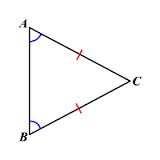
Which angle is the vertex angle?
a)

A\angle A

b)

B\angle B

c)

C\angle C

38.
Which segment is the base?
a)
Segment AB
b)
Segment BC
c)
Segment AC
39.

Which angle(s) is/are the base angle(s)?

(Select ALL that apply)

a)

A\angle A

b)

B\angle B

c)

C\angle C

40.
a)

40 degrees

b)

70 degrees

c)

180 degrees

d)

90 degrees

41.

What is the measure of ∠A?

a)

46

b)

134

c)

90

d)

88

42.

What is the measure of ∠S?

a)

60⁰

b)

52⁰

c)

45⁰

d)

36⁰

43.

What is the measure of BC?

a)

12

b)

6

c)

not enough information

d)

10

44.

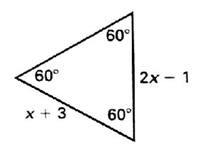
What is the value of x?

a)

16

b)

60

c)

8

d)

not enough information

45.

What is the measure of ∠T?

a)

not enough information

b)

30 degrees

c)

60 degrees

d)

180 degrees

46.

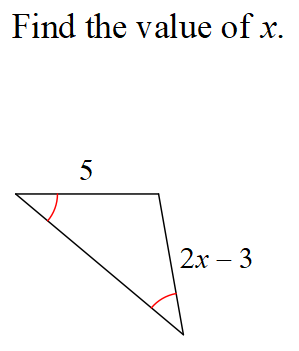
Find the value of x.

a)

1

b)

4

c)

5

d)

8

47.

Solve for "x"

a)

16

b)

1

c)

8

d)

4

48.

What is the measure of ∠T?

a)

4 degrees

b)

52 degrees

c)

76 degrees

d)

25 degrees

49.

Solve for "x"

a)

35

b)

20

c)

60

50.
Find x
a)
3
b)
4
c)
2
d)
10
51.

What is the length of DF?

a)

8

b)

4

c)

25

d)

71

52.
Use the picture to answer the question.
a)

76°76\degree

b)

28°28\degree

c)

152°152\degree

d)

56°56\degree

53.

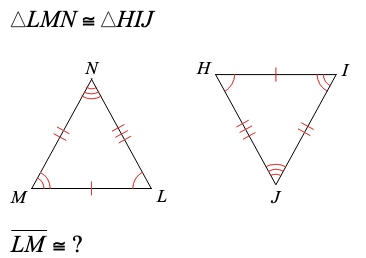
Find the length of LM.

a)

4

b)

5

c)

3

d)

6

54.

Find the value of m and n.

a)

m = 30

n = 60

b)

m = 60

n = 30

c)

m = 60

n = 45

d)

m = 90

n = 60

55.

Find the values of m and n.

a)

m = 54

n = 27

b)

m = 27

n = 54

c)

m = 27

n = 36

d)

m = 36

n = 27

56.

Triangle DEF is isosceles, angle D is the vertex angle,

DE = x + 7, DF = 3x – 1, and EF = 2x + 5.


Find the value of x.


(Hint: draw a picture)

a)

2

b)

4

c)

6

d)

8

57.
In congruent triangles, corresponding parts are always ______.
a)

opposite

b)

congruent

c)

supplementary

d)

equal

58.

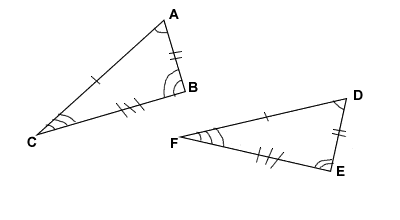
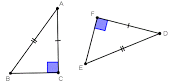
Given the two triangles, which statement is true by CPCTC?

a)

ACB   DFE\angle ACB\ \cong\ \angle\ DFE  

b)

 BAC   FDE\angle\ BAC\ \cong\ \angle\ FDE  

c)

CAB FED\angle CAB\ \cong\angle FED  

d)

ABC   DEF\angle ABC\ \cong\ \angle\ DEF  

59.

Given the two triangles, which congruence statement is NOT true?

a)

ΔACB  ΔDEF\Delta ACB\ \cong\ \Delta DEF

b)

ΔCAB  ΔEDF\Delta CAB\ \cong\ \Delta EDF

c)

Δ ABC  ΔDFE\Delta\ ABC\ \cong\ \Delta DFE

d)

ΔABC Δ DEF\Delta ABC\ \cong\Delta\ DEF

60.

Find  mFm\angle F .

a)

55°55\degree

b)

42°42\degree  

c)

96°96\degree  

d)

83°83\degree  

61.

Find the value of x.

a)

x = 60

b)

x = 55

c)

x = 15

d)

x = 65

62.

Complete the given statement.

a)

FG\overline{FG}

b)

G\angle G

c)

F\angle F

d)

E\angle E

63.

Complete the given statement.

a)

V\angle V

b)

U\angle U

c)

T\angle T

d)

UT\overline{UT}

64.

Complete the given statement.

a)

IJ\overline{IJ}

b)

J\angle J

c)

JH\overline{JH}

d)

HI\overline{HI}

65.

Complete the given statement.

a)

WV\overline{WV}

b)

VX\overline{VX}

c)

XW\overline{XW}

d)

W\angle W

66.

Complete the given statement.

a)

IA\overline{IA}

b)

AH\overline{AH}

c)

HI\overline{HI}

d)

I\angle I

67.

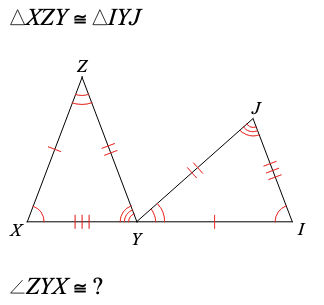
Complete the given statement.

a)

I\angle I

b)

Y\angle Y

c)

J\angle J

d)

IYJ\angle IYJ

68.

Which of the following has the correct angles and sides marked according to the congruence statement:

ΔHJIΔRST\Delta HJI\cong\Delta RST  

a)
b)
c)
69.

Which statement indicates that the given triangles are congruent?

a)

ΔXZYΔLMN\Delta XZY\cong\Delta LMN

b)

ΔXYZΔLMN\Delta XYZ\cong\Delta LMN

c)

ΔXZYΔNML\Delta XZY\cong\Delta NML

d)

ΔXYZΔMLN\Delta XYZ\cong\Delta MLN

70.

Which statement indicates that the given triangles are congruent?

a)

ΔUTSΔIHJ\Delta UTS\cong\Delta IHJ

b)

ΔTSUΔJHI\Delta TSU\cong\Delta JHI

c)

ΔUTSΔJHI\Delta UTS\cong\Delta JHI

d)

ΔTUSΔIHJ\Delta TUS\cong\Delta IHJ

71.
∆ABC≅∆XYZ
which is true?
a)
AB≅XY
b)
AB≅YX
c)
AB≅XZ
d)
BC≅CB
72.

ΔEDF ≅ Δ____

a)

ABC

b)

CAB

c)

BAC

73.
If ΔDEF ≅ ΔRST, then we can conclude that ∠T ≅ ____.
a)
∠F
b)
∠E
c)
∠D
d)
EF
74.

What value of x makes ΔSTW ≅ ΔXYZ?

a)

2

b)

3

c)

4

d)

5

75.

Given ΔABC≅ ΔDEF. AB = 15, BC = 20, AC = 2y + 5, DF = 25. DE = 6z + 9 and FE = 3x – 7. Find the values of x,y, and z.

a)

x = 9, y = 10, z = 1

b)

x = 9, y = 1, z = 8/3

c)

x = 32/3, y = 5, z = 1

d)

x = 32/3, y = 29/6,

z = 15/2

76.

Given ΔMNO ≅∆PQR, MN = 6 + 2y,

MO = 2x + 1, PQ = 3y + 4, and

PR = 10 – x. Find the lengths of PQ and PR.

a)

PQ = 2, PR = 3

b)

PQ = 3, PR = 2

c)

PQ = 10, PR = 7

d)

PQ = 7, PR = 1

77.
What does CPCTC stand for?
a)
Corresponding Parts of Congruent Triangles are Congruent
b)
Congruent Parts of Congruent Triangles are Corresponding
c)
Colorful Pieces of Corresponding Triangles are Congruent
d)
Congruent Pieces of Congruent Triangles are Congruent
78.

Which of the following are NOT sufficient to prove two triangles are congruent? Choose all that apply.

a)

SSS

b)

AAA

c)

ASA

d)

SSA

e)

AAS

79.

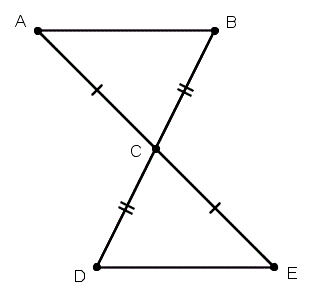
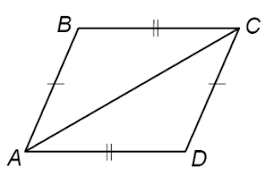
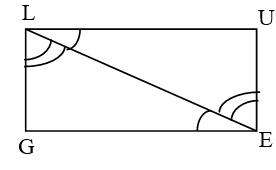
Match the triangles to the congruence theorem.

a)
1.

SSS

b)
2.

AAS

c)
3.

SAS

d)
4.

ASA

80.
Which triangle congruence theorem can be used to prove the triangles are congruent?
a)
SAS
b)
SSS
c)
ASA
d)
HL
81.
Which triangle congruence theorem can be used to prove the triangles are congruent?
a)
SSS
b)
ASA
c)
AAS
d)
SAS
82.
Which triangle congruence theorem can be used to prove the triangles are congruent?
a)
HL
b)
SSA
c)
SAS
d)
AAS
83.
Which triangle congruence theorem can be used to prove the triangles are congruent?
a)
AAS
b)
SSS
c)
SAS
d)
SSA
84.
Which triangle congruence theorem can be used to prove the triangles are congruent?
a)

SAS

b)

HL

c)

SSS

d)

AAS

85.

Name the postulate that makes the triangles congruent.

a)

SSS

b)

SAS

c)

ASA

d)

AAS

86.
What information is missing to determine if the triangles are congruent by HL?
a)
∠G ≅ ∠X
b)
∠H ≅ ∠W
c)
GI ≅ XV
d)
GH ≅ XW
87.
What information is missing to determine if the triangles are congruent by SAS?
a)
CA≅ NL
b)
∠C ≅ ∠N
c)
∠A ≅ ∠L
d)
∠B ≅ ∠M
88.

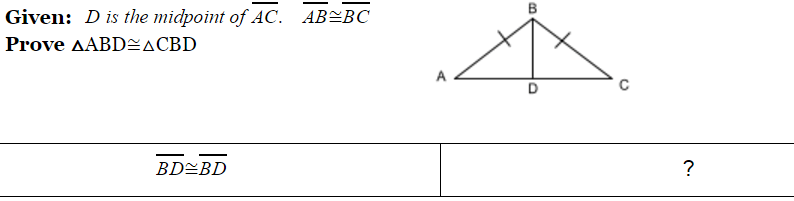
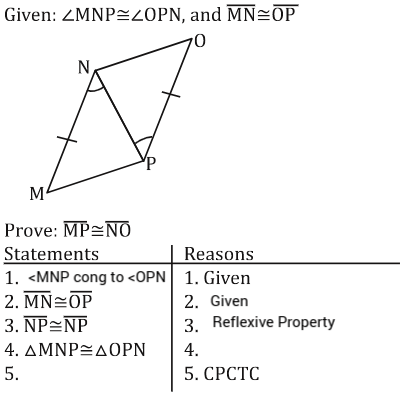
Identify the missing statement or reason

a)

Reflexive Property

b)

Definition of Midpoint

c)

Given

d)

Vertical Angles Theorem

89.
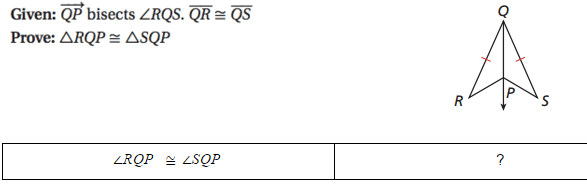
Identify the  missing statement or reason
a)
Given
b)
Vertical Angles Theorem
c)
Definition of Angle Bisector
d)
Alternate Interior Angles Theorem
90.
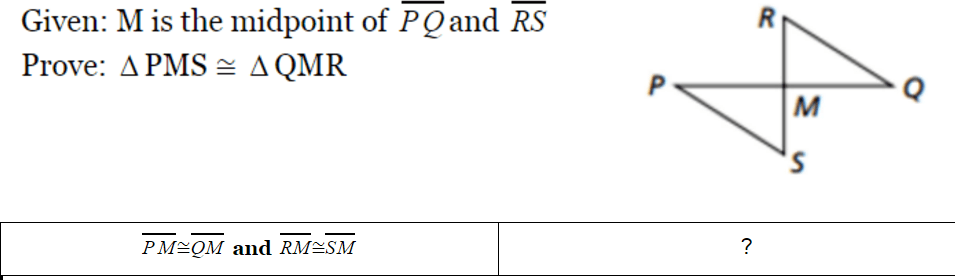
Identify the  missing statement or reason
a)
Definition of Angle Bisector
b)
Alternate Interior Angles Theorem
c)
Reflexive Property
d)
Definition of Midpoint
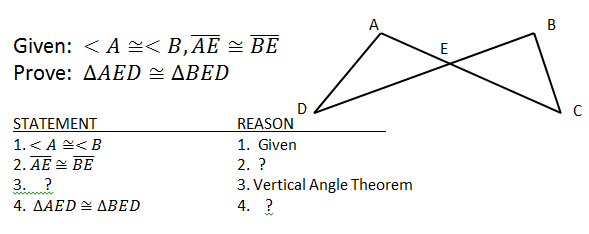
91.
What is the "statement" for step 3 of the proof? 
a)
∡EDA≅∡DCB
b)
∡AED≅∡BEC
c)
DE=CE
d)
∡AED≅∡CED
92.

What is the correct choice for Statement 4?

a)

⊿GHI ≅ ⊿JKL

b)

⊿GHI ≅ ⊿KLJ

c)

⊿GHI ≅ ⊿LJK

d)

⊿GHI ≅ ⊿LKJ

93.
What is the correct choice for Reason 4?
a)
SSS
b)
SAS
c)
ASA
d)
AAS
94.

What is #3 Reason?

a)

Same Line

b)

Perpendicular Lines

c)

Segment Bisector

d)

Reflexive Property

95.

What is #5 Statement?

a)

∠QPR ≌ ∠STR

b)

∠PQR ≌ ∠STR

c)

∠QRP ≌ ∠TSR

d)

∠QRP ≌ ∠TRS

96.

What is #4 Reason?

a)

Alternate Interior Angles

b)

Vertical Angles

c)

Reflexive Property

d)

Angle Bisector

97.

What is Reason F?

a)

CPCTC

b)

Given

c)

Definition of Congruence

d)

Definition of Perpendicular

98.

Look at this partial proof, Notice the given information. What would be the reason for statment #2?

a)

Definition of Midpoint

b)

Definition of congruence

c)

Transitive Property

d)

Substitution Property

99.

Will this proof need to use CPCTC?

a)

No, because the "Prove" statement is about triangles.

b)

Yes, because there are vertical angles.

100.

Will this proof need to use CPCTC?

a)

Yes, because the "Prove" statement is not about triangles.

b)

No, because we can use the Reflexive Property.

101.

Put the 4 steps of this proof in the correct order.

a)

AB CB, AC\overline{AB}\ \cong\overline{CB},\ \angle A\cong\angle C and DB\overline{DB} bisects ABC\angle ABC by the Given.

b)

ABDCBD\angle ABD\cong\angle CBD by the definition of angle bisector

c)

ΔABDΔCBD\Delta ABD\cong\Delta CBD by ASA

d)

ADCD\overline{AD}\cong\overline{CD} by CPCTC

1)
2)
3)
4)