
 Worksheets
EOC Prep Warm Up
Total questions: 100
Worksheet time: 4hrs 14mins
Which of the following operations are polynomials always closed under? Select ALL the APPLY
Addition
Division
Multiplication
Subtraction
Which of the following operations are polynomials always closed under? Select ALL the APPLY
Addition
Division
Multiplication
Subtraction
Which of the following operations are polynomials always closed under? Select ALL the APPLY
Addition
Division
Multiplication
Subtraction
Which of the following operations are polynomials always closed under? Select ALL the APPLY
Addition
Division
Multiplication
Subtraction
Which of the following Operations are Polynomials NOT CLOSED under?
Addition
Subtraction
Multiplication
Division
Which of the following Operations are Polynomials NOT CLOSED under?
Addition
Subtraction
Multiplication
Division
Which of the following Operations are Polynomials NOT CLOSED under?
Addition
Subtraction
Multiplication
Division
Which of the following Operations are Polynomials NOT CLOSED under?
Addition
Subtraction
Multiplication
Division
Which of the following best completes the following statement below?
Polynomials are closed under some operations (Addition, Subtraction & multiplication) because the result (the answer) of those operations...
Will NEVER be a polynomial
Will ALWAYS be a polynomial
Which of the following best completes the following statement below?
Polynomials are closed under some operations (Addition, Subtraction & multiplication) because the result (the answer) of those operations...
Will NEVER be a polynomial
Will ALWAYS be a polynomial
Which of the following best completes the following statement below?
Polynomials are closed under some operations (Addition, Subtraction & multiplication) because the result (the answer) of those operations...
Will NEVER be a polynomial
Will ALWAYS be a polynomial
Will SOMETIMES be a polynomial


What is f(4) for this graph?
Hint: This is another way of saying, "what is the y -value...when x = 4"
0
1
-4
4
What is f(4) for this graph?
Hint: This is another way of saying, "what is the y -value...when x = 4"
0
1
-4
4
What is f(4) for this graph?
0
1
-4
4
The function h(t) represents the height in inches of a plant after t weeks. What does the notation h(4) = 5 mean?
After 5 week the plant is 4 inches tall
After 4 weeks the plant is 5 inches tall
Derek works at Subway making $9.25 an hour. The function d(x)=9.25x tells us how much money Derek makes after x hours of working. What is the meaning of d(4)=37?
After 4 hours of work, Derek makes $37.
After working for 4 days, Derek makes $37 total.
Which graph represents a function?


Select the systems that have the same solution/is equivalent as the following system below.
x + y = 11
2x + y = 5
2x + 2y = 22
6x + 3y = 15
5x + 5y = 11
2x + y = 19
Select the system that have the same solution as the following below.
HINT: Remember you can add them together to make equivalent systems.
5x + y = 9
10x + 7y = 3
15x + 8y = 12
20x + 14y = 6
10x +2y = 18
-10x - 7y = 3


Which point below is NOT part of the solution set?
Hint: Which one is NOT in the shaded area?
(0, 0)
(-3, 6)
(3, 5)
(4, -2)

Which of the following equations match the given graph?
Hint: Use the y-intercept and if it is shaded above/below the line to help you find your answer.
y ≤ -3/4 x + 3
y ≥ -3/4 x + 3

SELECT ALL the ordered pairs that ARE solutions to the following inequality represented on the graph.
Hint: Which ones are in the shaded area?
(0, 0)
(3, 6)
(3, -6)


Parallel Lines never intersect because...
they have the same slopes.
they have different slopes.

When you graph the exact same equation twice,
you will have infinite solutions.
you will have one solution.


The graph of f(x) and g(x) are shown below. How many solutions does the system of equations have?
One
Two
Three

What are the solutions to the system of equations graphed below?
(2, 0)
(0, 4)
(-2,0)

Determine the number of solutions to the given linear-quadratic system.
0 solutions
1 solution
2 solutions

Which point is a solution to the system of equations ?
(0,3)
(5,0)
(8,9)

How many solutions does this system of equations have?
one solution
two solutions

How many solutions does this system of equations have?
one solution
no solution
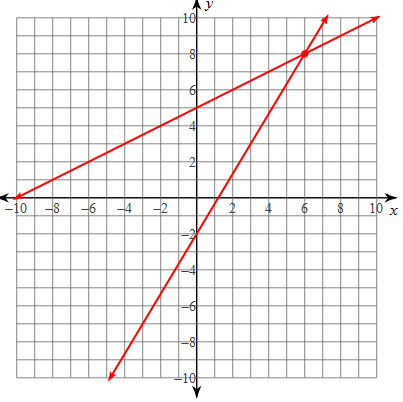
Could you eliminate RIGHT AWAY to solve this system?
4x + 4y = 4
-3x - 4y = -10
Yes, you can ADD right away b/c you have MOCS (Matching opposite coeffects)
No, you'd have to multiply one of them to create MOCS
Could you eliminate RIGHT AWAY to Solve this system:?
x + 6y = 17
x - 3y = 8
YES, b/c you have MOCS (Matching opposite coefficients)
No, you should multiply the bottom on by 2 to create MOCS then you could ADD/Eliminate
What could you multiple one of the equations by to create MOCS so you could eliminate?
x + 4y = –3
x + 7y = –12
Top one by -1 so the x's cancel out
Bottom one by 2 so the x's cancel out
What could you multiply one of the equations by so you could create MOCS so you could ELIMINATE/solve this system?
3x + 12y = −1
4x + 3y = 0
Multiply the BOTTOM one by -4, so the y's cancel out.
Multiple the BOTTOM one by 4, so the y's cancel out
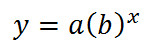
What is b, the common ratio, for the function: f(x) = 300(1.16)x?
300
1.16
Which of the following functions shows an initial amount of $15 and an GROWTH of 35% each year?
y = 15(0.65)x
y = 15(1.35)x
A=10(1.01)3

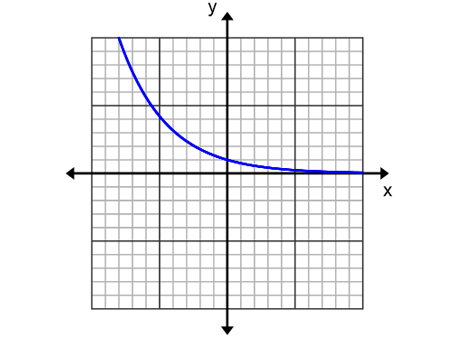
Is y = 5(1.04)x growth or decay?
Growth
Decay
Write an equation that models the following situation:
Samantha's hair was known to grow very rapidly. It began at a length of 6 in and grew at a rate of 14% a week.
y=6(0.14)x
y=6(1+14)x
y=6(1.14)x
Which of the following functions shows an initial amount of $15 and an DECAY of 25% each year?
y = 15(0.75)x
y = 15(0.25)x
Write in exponential form
∛x⁷
Hint: Remember ROOTPOWER= 6x5= x65
x⁷∕ ³
x3⁄7
Rewrite the following
∛x5
Hint: Remember ROOTPOWER= 6x5= x65
x3/5
x5/3
Write in exponential form
∜(3x)³
Hint: Remember ROOTPOWER= 6x5= x65
3x³⁄ ⁴
(3x)³∕ ⁴

Rewrite the expression using a radical exponent:
Hint: Remember ROOTPOWER= 6x5= x65
x34
x43

Rewrite the expression using a radical exponent:
Hint: Remember ROOTPOWER= 6x5= x65
x43
x34

Rewrite the expression using a radical exponent:
Hint: Remember ROOTPOWER= 6x5= x65
x23
x32

Rewrite the radical exponent:
Hint: Remember ROOTPOWER= 6x5= x65
5x
1x5
6x

Rewrite the radical exponent:
Hint: Remember ROOTPOWER= 6x5= x65
x
1x2

Rewrite the radical exponent:
Hint: Remember ROOTPOWER= 6x5= x65
x
1x3
3x
What is the equation of a line when m = -7 and b = -8?
y = -7x + 8
y = -7x - 8
y = 7x - 8
y = 7x + 8
y = 5x - 4

Write the equation of the line.
Hint: THink of Mr. SLOPE

Write the equation of the line.
Hint: Think of Mr. Slope

The quadratic equation x2 + 16x + 15 was factored to (x + 1)(x + 15)
What are the ZEROS?
x = 1 & x = 15
x = -1 & x = -15
The quadratic equation x2 - 10x + 24 was factored to
(x - 4)(x - 6)
What are the ZEROS?
x = 4 & x = 6
x = -4 & x = -6
What are the factors of x2 - 8x - 48

Factor:
x2 - 10x - 24
HINT: What two #s multiply to give your "c" and ADD to give you "b"
(x - 12)(x + 2)
(x + 6)(x - 4)
Factor: x2 - 14x + 24
HINT: What two #s multiply to give your "c" and ADD to give you "b"

When did the ball reach its maximum height? Choose the key feature and the answer.
y-intercept, 3 secs
x-value of the vertex, 4 secs

How high was the ball when it was initially thrown? Choose the key feature and the answer.
y-intercept, 3 feet
x-value of the vertex, 4
y-value of the vertex 5

What was the height of the ball at 1 second?
4 feet
5 feet

Approximately when did the ball hit the ground?
8.25 seconds
10.25 seconds

What key feature tells the initial height of the roller coaster?
y-intercept
vertex

What key feature tells the lowest point on the roller coaster?
vertex
Axis of Symmetry


Use the graph to determine the X-intercepts
(1,0) and (3,0)
(0,1) and (0,3)


Name the vertex to the given quadratic graph
(2,3)
(3,2)

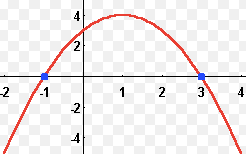
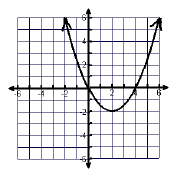
What are the zeros?
HINT: You only do the opposite when they are written in ()...(x-8), zero is x = 8

Which equation represents the graph?
HINT: Remember OPPOISITE
y = (x -1)(x+3)
y = (x + 1)(x - 3)
What is the discriminant in the Quadratic Formula?
b - 4ac
-b2 - 4ac
b2 - 4ac
If the discriminant is positive, how many solutions does the graph have?
2
1
0
If the discriminant is negative, how many solutions does the graph have?
2
1
0
If the discriminant is zero, how many solutions does the graph have?
2
1
0

