wayground logo

Free Printable Worksheets

NEW

Font size

S
M
L
XL
Worksheets

Action Potential / Synapse Review

Total questions: 21

Worksheet time: 15mins

Name
Class
Date
1.
What is the normal resting potential of a neuron cell membrane?
a)
+40mV
b)
-30mV
c)
+55mV
d)
-70mV
2.
Which ions are involved in an action potential?
a)
Na; Cl
b)
Na; K
c)
K; Cl
d)
Na; Ca
3.
At which point on the diagram does depolarisation of the axon occur? 
a)
A
b)
B
c)
C
d)
D
4.
The sodium potassium pump restores the resting potential. By which process does this work? 
a)
Osmosis
b)
Diffusion
c)
Facilitated diffusion
d)
Active transport
5.

What number(s) on the graph represents the THRESHOLD level of stimulus?

a)

1 and 5

b)

2

c)

3

d)

6

6.
When a membrane potential reaches +30mV, ________ channels open, ________ occurs, and ________ channels close.
a)
Sodium, depolarization, potassium
b)
Potassium, depoloarization, sodium
c)
sodium, repolarization, potassium
d)
postassium, repolarization, sodium
7.
Why is -55 mV a significant number?
a)
This is the largest charge achieved during an action potential
b)
This is the threshold required to complete an action potential
c)
This is the resting charge of a neuron
d)
This is the charge when all the sodium is inside the cell
8.
What number on the graph represents the Hyperpolarization phase?
a)
1
b)
2
c)
3
d)
4
9.

Action potentials run along the ______ from ______ to ________.

a)

axon, dendrites, axon terminals

b)

axon, axon terminals, dendrites

c)

dendrites, axon, axon terminals

d)

axon terminals, axon, dendrites

10.
Neurotransmitters are released from the
a)
Dendrites
b)
Post-synaptic neuron
c)
Presynaptic neuron
d)
Axon
11.

Excess neurotransmitters in the synapse that go back into the presynaptic neuron.
a)
Resting potential
b)
Reuptake
c)
Retroactivity
d)
Repolarization
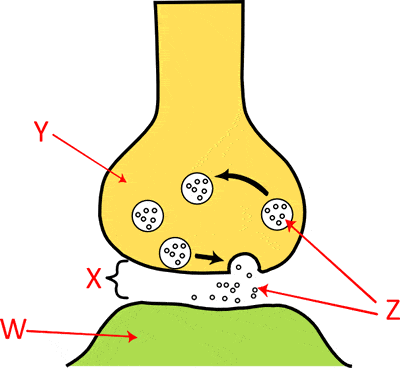
12.
W
a)
Axon Terminal Button
b)
Neurotransmitters
c)
Dendrite
d)
Synapse
13.

The area between the pre-synaptic cell and the post-synaptic cell is termed the synapse or synaptic cleft.

a)

True

b)

False

14.

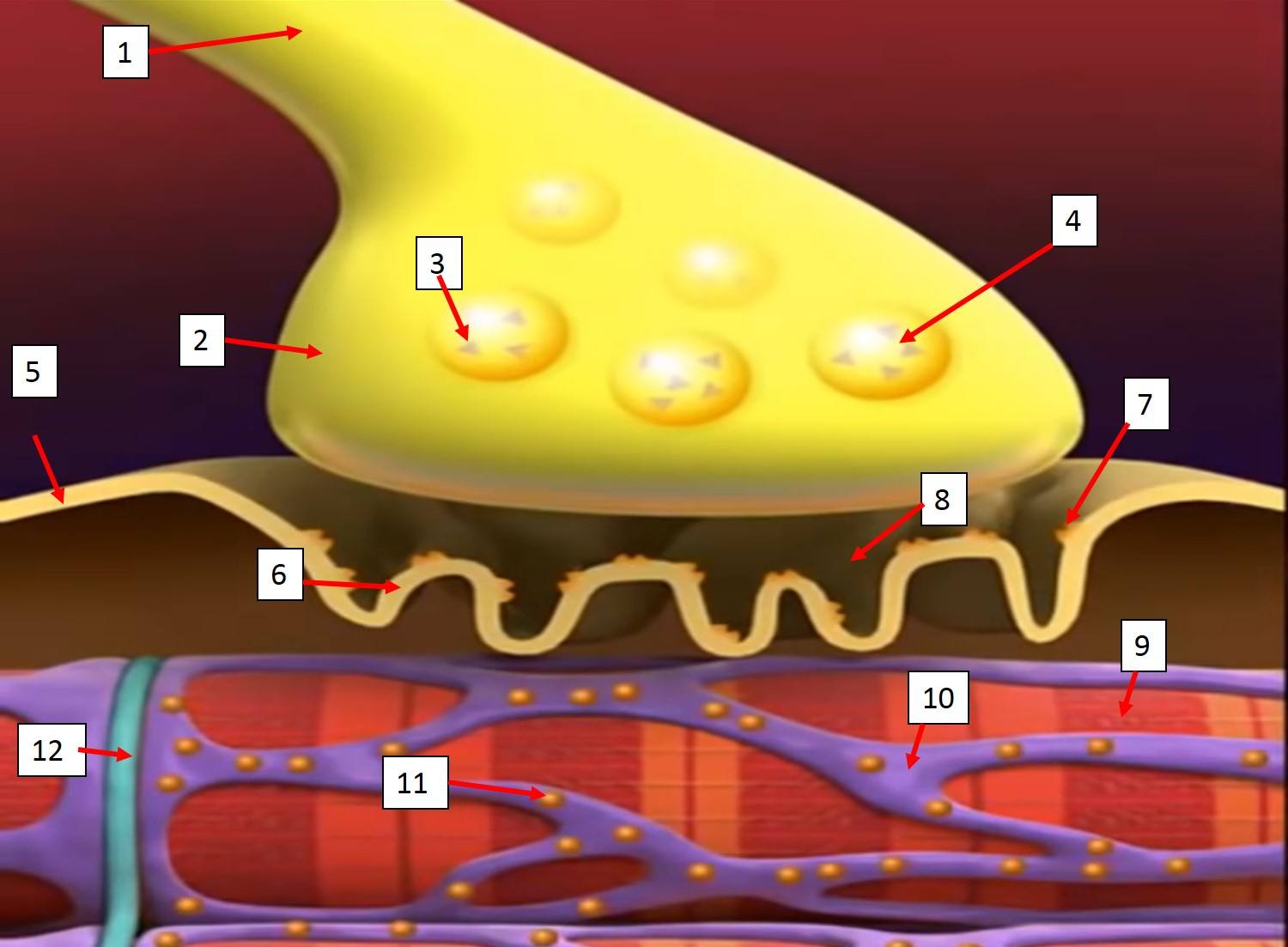
What's in the picture?

a)

synaptic vesicles

b)

neurotransmitters

c)

presynaptic neuron

d)

postsynaptic neuron

e)

synaptic cleft

15.

What's in the picture?

a)

synaptic vesicles

b)

neurotransmitters

c)

presynaptic neuron

d)

postsynaptic neuron

e)

synaptic cleft

16.
Synapses that are ____________ cause a neuron to fire whereas ____________ synapses reduce the likelihood that a neuron will fire.
a)
excitatory; inhibitory
b)
synaptic; terminal
c)
postsynaptic; presynaptic
d)
dendritic; axon
17.

What is the name of the structure that stores neurotransmitters?

a)

Synaptic cleft

b)

Acetylcholine

c)

Receptors

d)

Synaptic vesicles

18.
The neurotransmitter stored in the axon terminal identified as #3
a)
Acetylcholine
b)
Protein Channel
c)
Calcium Ion (Ca2+)
d)
Syanptic Cleft
19.
What generates a nerve impulse on the post-synaptic membrane? 
a)
Calcium binding with a receptor site
b)
Potassium leaking into the post-synaptic membrane 
c)
Neurotransmitter binding with receptor sites
d)
Neurotransmitter being removed from the synapse
20.

Neurotransmitters are released from presynaptic membrane to synaptic cleft by process of

a)

Osmosis

b)

Diffusion

c)

Active transport

d)

Exocytosis

21.

After exocytosis, the neurotransmitters are:

a)

Degraded by enzymes

b)

Degraded by enzymes or recaptured by the post-synaptic structure

c)

Degraded by enzymes or recaptured by the pre-synaptic neuron