
 Worksheets
Similarity and Transformations
Total questions: 155
Worksheet time: 5hrs 45mins

Consider the figure, segment MN is parallel to segment RP.
⅔
¾
4/3
3/2

Which can be used to show that the sum of the interior angles of the triangle is 180°.


Which sequence of transformations maps triangle 2 onto triangle 1?
a reflections across the x-axis, a reflection across the y-axis, and a translation left 1
a reflections across the x-axis, a reflection across the y-axis, and a translation right 1
a 180° clockwise rotation and a translation down 1 and left 1
a 180° clockwise rotation and a translation left 1 and up 1
Rectangle 1 is rotated 90° counterclockwise about the origin and then translated left 3 units to form rectangle 2. Which graph represents this scenario?


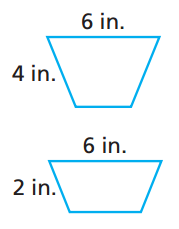
Katherine drew two similar rectangles. What is the area of the larger rectangle?
1.82 cm2
3.38 cm2
3.64 cm2
4.83 cm2

Using a proportion, find the height of the tree.
x = 0.0625 ft.
36 ft.
16 ft.


A(3,3) B(6,6) C(9,3)


Hugh drew similar triangles. What is the value of x in Hugh's drawing?
0.7
0.9
1.2
2.9

Triangle FGH is rotated and then dilated by a scale factor of n to form triangle F'G'H'. If ⊿FGH ∼ ⊿F'G'H', what is the value of n?
n = ¼
n = ⅓
n. = 3
n = 4

In the figure, triangle JKL is dilated about the origin to create triangle NPQ What is the scale factor of the dilation?
¼
½
2
4

Holly claims the two triangles on the coordinate plane are similar. Which is a valid argument to support Holly's claim?
One triangle can be mapped onto the other by a rotation of 180° about the origin.
One triangle can be mapped onto the other by translation 8 units right and 4 units down.
One triangle can be mapped onto the other by a reflection across the y-axis, followed by a rotation of 90° counterclockwise about the origin.
One triangle can be mapped onto the other by a reflection across the x-axis, followed by a translation 10 units right.

35°
55°
59°
66°


a triangle with angle measures 40° and 65°
a triangle with angle measures 45° and 65°
a triangle with angle measures 45° and 135°
a triangle with angle measures 70° and 135°

Yes. The triangles are similar by the SAS postulate
Yes. The triangles are similar by the AA postulate.
No. The triangles are not similar because they have only one equal angle.
No. The triangles are not similar because they have no similar side lengths.
Two angles in a triangle measure 25° and 67°. If a second triangle is similar to the first triangle, what is the measure of the largest angle of the second triangle.
155°
113°
92°
88°
Two angles in a triangle are 50° and 45°. If a second triangle is similar to the first triangle, what is the measure of the largest angle of the second triangle?
45°
50°
85°
180°

m + n + s = 180
m + n = q + r
n = q + s
n = 180° - q - s

a 270° counterclockwise rotation about the origin
a 270° clockwise rotation about the origin
a reflection across the x-axis followed by a 180° rotation about the origin
a reflection across the y-axis followed by a 180° rotation about the origin

True or False.
Triangle 1 is the result of translating Triangle 3 left 6 and up 2.
True
False

True or False.
Triangle 2 is the result of dilating Triangle3 by a scale factor of 2 only.
True
False

True or False.
Triangle 4 is the result of rotating Triangle 5 by 90° counterclockwise about the origin.
True
False

True or False.
Triangle 5 is the result of translating Triangle 1 right 6 and down 6.
True
False

(-4, ½)
(-4, 2)
(0, ½)
(0, 2)

a translation left 5 and down 4
a translation left 10 and down 9
a translation right 5 and up 4
a translation right 10 and up 9
A figure that undergoes a transformation where no point ever maps to itself. Which transformation must this be?
translation
rotation
reflection
dilation

For which shape will a rotation of 90° result in an image that is indistinguishable with respect to orientation.


Which transformation will carry the trapezoid onto itself?
a reflection across the y-axis
a reflection across the x-axis
a rotation of 180° about the origin
a translation of 2 units up

A reflection across the line passing through point Q and point S
a reflection across the line RQ
a rotation 90° clockwise about point Q
a rotation 180° clockwise about the point R
a rotation 360° clockwise about the point T

Which statement is true?
If line segment UV is translated 5 units right, the new line segment lies on the same line as the line segment UV.
If line segment UV is translated 4 units down, the new line segment is parallel to the line segment UV.
If line segment UV is rotated 270° clockwise about the origin, the new line segment is parallel to line segment UV.
If line segment UV is rotated 180° clockwise about the origin, the new line segment is perpendicular to line segment UV.

How many degrees does the wheel need to rotate about its axle so that the image of the wheel is indistinguishable from the original figure?
15°
30°
45°
65°
Which figure has the greatest order of rotational symmetry?









2. How many lines of symmetry does the picture have?
1
2
4
0


Translate the blue shape to the pink shape...
5 Right
2 Down
5 Left
2 Up
3 Right
1 Down
3 Left
1 Up


Work out the size of the missing angle
55
90
125
305

Work out the size of the missing angle
22
202
20
158


-----
10
-----
3
-----------
(2x+4)(4)
------
3.1

Select all the possible names for this plane.
plane CDAB
plane CDB
plane ADC
plane TCB

Which of these groups of points is noncollinear? (select all that apply)
Q, P, V
S, P, T
T, V, R
P, R, Q

Line p is parallel to line q
Lines r and s are not parallel.
What is the relationship between <3 & <10
Alternate Exterior
Alternate Interior
Consecutive Interior
Corresponding

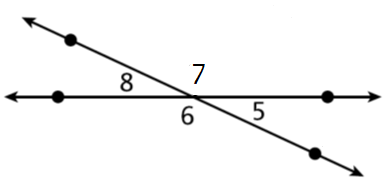
Which angles are vertical angles?
∠8 & ∠7
∠8 & ∠6
∠8 & ∠5
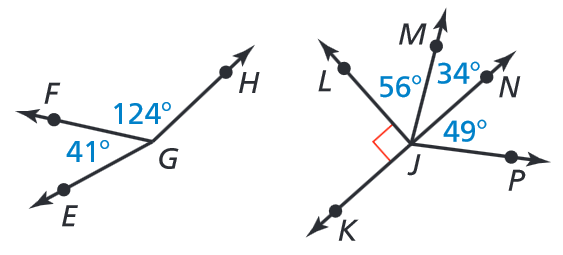
Which angle is complementary to ∠LJM
∠MJN
∠NJP
∠FGE
∠LJK

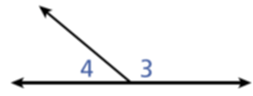
What type of angles are these? (select 2)
Adjacent Angles
Linear Pair
Complementary Angles
Supplementary Angles
Vertical Angles


If two figures are congruent, then their corresponding angles are also congruent.
True
False
Which of the following transformations will result in an image that is not congruent to the original figure?
Translation
Reflection
Rotation
Dilation
If two figures are similar, their corresponding angles are congruent.
True
False
If two figures are similar, their corresponding sides are congruent.
True
False
When a figure is dilated, we use a scale factor k. If the resulting image is larger than the original, then...
k > 1
k < 1
k = 1
k < 0
When a figure is dilated, we use a scale factor k. If the resulting image is smaller than the original, then...
k > 1
k < 1
k = 1
k < 0
What is your favorite transformation?
Translation
Reflection
Rotation
Dilation
Which transformation should you study the most tonight?
Translation
Reflection
Rotation
Dilation
What is your LEAST favorite transformation?
Translation
Reflection
Rotation
Dilation
Which of the following are similarity transformations? Choose all that apply.
Translation
Dilation
Rotation
Stretch
Reflection
What makes isometric transformations different than similarity transformations?
Isometric transformations have the same shape AND size, similarity transformations just have the same shape.
Isometric transformations are cooler
Isometric transformations have the same shape AND size, similarity transformations just have the same size.
They are the same, no differences.
Why are isometric transformations a part of the similarity transformations?
Isometric transformations maintain SIZE, and similarity transformations maintain size too.
Isometric transformations maintain SHAPE, and similarity transformations maintain shape too.
All similarity transformations are isometric transformations.
True
False
A rotation is a similarity transformation.
True
False
All transformations are isometric.
True
False
A dilation is a non-isometric transformation.
True
False
A stretch is not a similarity transformation.
True
False

Given that ΔAFG ~ ΔDRH, complete the following:
∠A
∠F
∠G
AF

Given that ΔAFG ~ ΔDRH, complete the following:
AF
AG
FG
FH

Given that ΔAFG ~ ΔDRH, complete the following:
∠A
∠F
∠G
FH

Given that ΔAFG ~ ΔDRH, complete the following:
AF
AG
FG
FH

Pentagon ABCDE is similar to Pentagon RYMNT. Which of the following is correct.
∠C ≅ ∠M
∠T ≅ ∠E
∠Y ≅ ∠B
∠A ≅ ∠M
∠C ≅ ∠R
Pentagon ABCDE is similar to Pentagon RYMNT. Which of the following is/are correct (choose all that apply).
NT/DE = RT/AE
AB/RY = NM/DC
AB/RY = ED/MT
AB/BC=RY/YM

∆ABC is similar to another triangle. The picture provides the similarity statement. ∆ABC∼ ______
ΔDRT
ΔDTR
ΔTRD
ΔTDR
ΔRTD

The two figures in each question are similar. Which of the following is true? Pentagon GYKMR ∼ ________
Pentagon EABCD
Pentagon ARMKY
Pentagon AEDCB
Pentagon BACDE

Quad OBCD is similar to Quad OHTE because:
Quad OBCD can be reflected over the x axis and then rotated 90 degrees
Quad OBCD can be reflected over the x-axis and then dilated about point O by a scale factor of 2.
Quad OBCD can be reflected over the y-axis and then dilated about point O by a scale factor of 2.
Quad OBCD can be reflected over the y-axis and then dilated about point O by a scale factor of 1/2.

ΔOBC is similar to ΔOGT because: (choose the best answer)
ΔOBC can be dilated about point O by a scale factor of 1/2, and then rotated 90 degrees about point O.
ΔOBC can be dilated about point G by a scale factor of 1/2, and then reflected over the x- axis
They aren't similar
They map to each other with similarity transformations.

The two figures in each question are similar. Which of the following is true? ΔJMT ∼ ________
ΔABC
ΔACB
ΔBCA
ΔBAC
ΔCAB

The two figures in each question are similar. Which of the following is true? ΔBAC ∼ ________
ΔJHT
ΔJTH
ΔHJT
ΔTHJ
ΔTJH
Which transformation results in a figure that is similar to the original figure but has a greater area?
A dilation of triangle QRS by a scale factor of 0.25
A dilation of triangle QRS by a scale factor of 0.5
A dilation of triangle QRS by a scale factor of 1
A dilation of triangle QRS by a scale factor of 2

In the coordinate plane, segment PQ is the result of a dilation of segment XY by a scale factor of 1/2. Which point is the center of dilation?
(-4, 0)
(0, -4)
(0, 4)
(4, 0)

The smaller triangle is transformed to create the larger triangle. Which of these is the scale factor of the dilation center at the origin?
4
2
1
1/2

Look at quadrilateral QRST. What is the image of point R after a counterclockwise rotation of 270 degrees about the origin?
(6, -3)
(-3, 6)
(-6, 3)
(3, -6)

Which figure represents the dilation of GH about the origin by a scale factor of 2?


Which transformation of HIJ does NOT result in a congruent triangle?
a reflection across the x axis, followed by a rotation of 180° about the origin
a rotation by 180° about the origin, followed by a translation of 2 units left & 3 down
a translation of 1 unit right and 2 units up, followed by a dilation by a factor of 3
a dilation by a factor of 2, followed by a dilation by a factor of ½

In the triangles shown, ∆ABC is dilated by a factor of 2/3 to form ∆XYZ. Given that m<A=50° and m<B=100°, what is m<Z?
15 degrees
25 degrees
30 degrees
50 degrees

2.0
4.5
7.5
8.0

This is a proof of the statement “If a line is parallel to one side of a triangle and intersects the other two sides at distinct points, then it separates these sides into segments of proportional lengths." Which reason justifies Step 2?
Alternate interior angles are congruent
Alternate exterior angles are congruent
Corresponding angles are congruent
Vertical angles are congruent

Parallelogram FGHJ was translated 3 units down to form parallelogram F’G’H’J’. Parallelogram F’G’H’J’ was then rotated 90° counterclockwise about point G’ to obtain F’’G’’H’’J’’. Which statement is true about parallelogram FGHJ and parallelogram F”G”H”J”?
The figures are both similar and congruent.
The figures are neither similar nor congruent.
The figures are similar but not congruent.
The figures are congruent but not similar.

Consider the triangles shown. Which can be used to prove the triangles are congruent?
SSS
ASA
SAS
AAS

In this diagram, DE is congruent to JI and angle D is congruent to angle J. Which additional information is sufficient to prove that ∆DEF is congruent to ∆JIH?


In this diagram, CD is the perpendicular bisector of AB. The two-column proof shows that AC is congruent to BC. Which theorem would justify step 6?
AAS
ASA
SAS
SSS

In this figure, LN is perpendicular to KM. What additional information would a student need to prove ∆KLN~∆MLN?


In this diagram, STU is an isosceles triangle where ST is congruent to UT. The paragraph proof shows that angle S is congruent to U. Which step is missing in the proof?
CPCTC
Reflexive Property
Definition of right angles
Angle Congruence Postulate

The following is a proof of the Pythagorean Theorem. Which reason justifies step 2?
Triangle proportionality theorem.
Corresponding sides of similar triangles are proportional.
Corresponding sides of similar triangles are congruent.
Triangle mid-segment theorem.

Alternate interior angles are congurent
Corresponding angles are congruent
Vertical angles are congruent
Alternate exterior angles are congruent
Which information is needed to show that a parallelogram is a rectangle?
The diagonals bisect each other.
The diagonals are congruent.
The diagonals are congruent and perpendicular.
The diagonals bisect each other and are perpendicular.

What prove that figure ABCD is a parallelogram?
BD bisects angle ABC.
AB is congruent to AC
BD and AC bisect each other
BD is greater than AC.
This figure shows quadrilateral JKLM. What information will NOT be used to prove that JKLM is a parallelogram?
Show that angle JLM is congruent to angle LJK
Show that JK is congruent to LM
Show that ∆JKL is congruent to ∆LMJ
Show that ∆JKL is congruent to ∆JLM


Which of the following is the algebraic representation for a dilation?
(x, y) → (-x,-y)
(x, y) → (3x,3y)
(x, y) → (x+2,y-3)
(x, y) → (y,x)


Under what composition of transformations does triangle ABC map onto triangle A''B''C''
Reflection over x-axis, then Rotation of 90 Degrees
Rotation of -90 Degrees, then Reflection over y-axis
Reflection over y-axis, then Rotation of -90 Degrees
Rotation of 90 Degrees, then Reflection over x-axis

If the red triangle is rotated 180 degrees, then reflected over y=2 what is the final image?
Green Triangle
Blue Triangle
Orange Triangle
Red Triangle

What is the transformation from Triangle ABC to Triangle A''B''C''?
Reflection x-axis, then rotation of 180 Degrees
Reflection over y-axis, then rotation of 90 Degrees
Rotation of 90 Degrees, then reflection over x-axis
Rotation of 180 Degrees, then reflection over y-axis

What is the sequence of transformations?
Reflect over the y-axis then reflect over the x-axis
Reflect over the x-axis then reflect over the y-axis
Translate 4 units then rotate 90˚
Rotate 90˚ then reflect over the x-axis
A transformation in which a second transformation is performed on an image of a first transformation is called
Composition of transformations
Congruence
Consecutive steps
Similarity


What is the ordered pair for the final location of P( 2, 3) after this series of transformations? (x,y)→(x+2, y−4) then reflected over the y−axis?
P′′(−4, 1)
P′′(−4, −1)
P′′(1, −4)
P′′(−1, −4)
What is the ordered pair for the final location of P( -7, 3) after this series of transformations? (x,y)→(x, y+3) then rotated 90° clockwise about the origin.
P′′(−7, 6)
P′′(−7, −6)
P′′(6, −7)
P′′(6, 7)
Only ________________________ is a non rigid transformation.
Rotation
Dilation
Reflection
Translation
The image of a rigid transformation will be ______________________ to its preimage.
Congruent
Similar
Corresponding
Adjacent



