
 Worksheets
Physics Tests 6 Waves
Total questions: 25
Worksheet time: 24mins
The number of cycles that are completed per second is called the ________ and is measured in _________.
frequency, Hertz
wavelength, meters
amplitude, meters
period, seconds
The period of a pendulum is 10 s. What is its frequency?
10 Hz
1 Hz
0.5 Hz
0.1 Hz

High frequency waves have _________ wavelength.
varying
long
the same
short
The distance from one point to the next identical point on a wave is called the ________________.
waveform
peak
amplitude
wavelength
The number of waves that occur in one second is...
frequency
wave speed
amplitude
wavelength
The greater the frequency, the ________ energy carried by the wave.
more
less
When does the mass move at maximum velocity in a mass-spring system?
At equilibrium
At the farthest point from the equilibrium
At its hightest point
At its lowest point
When does the mass move at 0 velocity in a mass-spring system?
At equilibrium
At the farthest point from the equilibrium
At its hightest point
At its lowest point
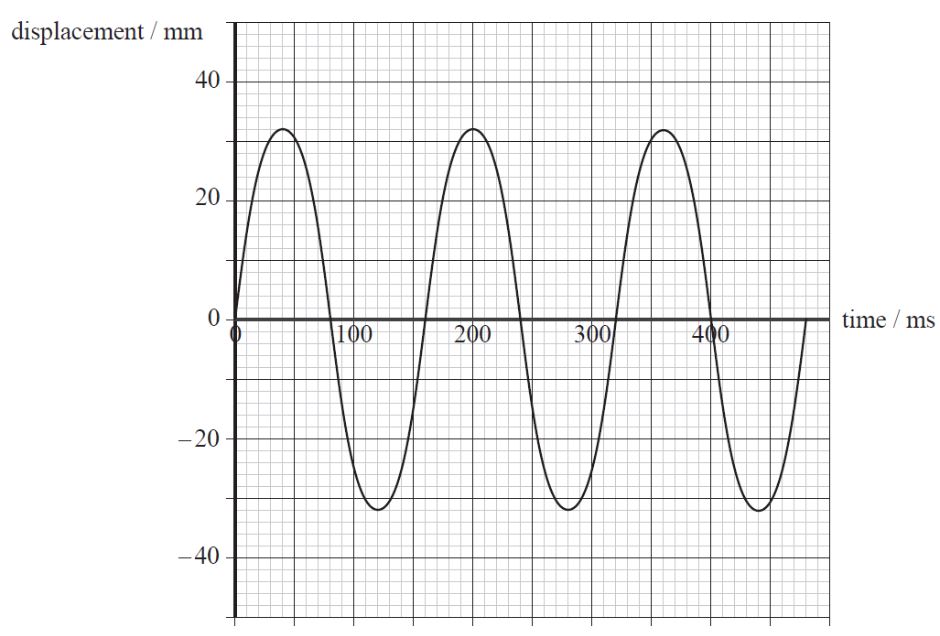
The graph shows the variation with time of the displacement of an object undergoing simple harmonic motion. At which of the following time values is kinetic energy zero?
0 ms
40 ms
80 ms
100 ms
A force of 30 N pushes a very light ideal spring -0.73 m from equilibrium. What is the force constant (spring constant) of the spring?
41 N/m
22 N/m
34 N/m
46 N/m

Which part of the wave is b?
crest
wavelength
trough
amplitude

Which part of the wave is labeled a?
crest
wavelength
trough
amplitude

What is the amplitude?
1.2 cm
3.4 cm
1.7 cm


What type of wave is pictured?
Transverse wave
Longitudinal wave
Wave, what wave?
Slinky wave
All waves carry ______________.
Sound
Light
Water
Energy
Sound travels in which kind of wave?
Longitudinal waves
Transverse waves

What causes earthquakes?
Millions of people jumping at once
The earth rotating
The movement of rock
Gravity

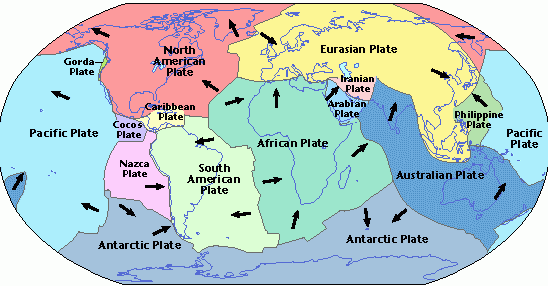

What is the fastest moving type of seismic wave?
P-wave
S-wave
Surface waves
All seismic waves travel at the same speed

Which body waves cause particles of rock material to move at right angles (perpendicular) to the direction in which the waves are traveling?
Body Waves
P Waves
S Waves
Surface Waves

Which scale measures the intensity of the ground movement?
Mercalli Scale
Richter Scale
Seismogram Scale
Bernoulli Scale

