
Font size
 Worksheets
Industrialization & Imperialism
Total questions: 70
Worksheet time: 44mins

What is the movement of people from farms to cities?
Utilitarianism
Urbanization
Proletariat
Enclosure Movement

A place where people and machines join together to mass produce goods.
Cartel
Corporation
Factory
Urbanization
This economic theory says that the government should not interfere in the economy.
Capitalism
Socialism
This economic theory states that wealth should be distributed equally among everyone. Everyone gets what they need.
Capitalism
Socialism
This economic theory states that there should be no economic classes (ex. no rich, no poor).
Capitalism
Socialism
This economic theory states that competition and supply and demand will determine the prices of goods.
Capitalism
Socialism

What natural resources gave Great Britain an advantage in the Industrial Revolution?
water and forests
wildlife and precious gems
coal and iron
good harbors

Adam Smith, who took up for laissez-faire economics, believed that:
mercantilism was the only way to insure a truly free trade.
the government should regulate the economy.
the government should not interfere with the economy.
colonies were an important source of conpetition.

How did industrialization impact women?
Many women entered the paid workplace.
Many women practiced traditional economic activities.
It had no impact on the lives of women.
Women moved from cities to rural areas.
During the Industrial Revolution, a new social and economic class that developed was the
serfs
rich, or the upper class
expanded lower class
middle class
Which of the following best defines the term capital when referencing the Industrial Revolution?
a city where industrial production increased, became an important city for a nation's economy
money, equipment, and/or resources that were used in the production of goods
a type of investment that helped a factory or business get started
none of these best define capital
Which of the following best describes industrialization?
nations began to rely on one another for trade of various goods and resources after the beginning of the Industrial Revolution
smaller nations needed assistance from their larger neighbors, so they formed trade alliances
more and more people began to move to cities, away from rural areas
advancement in technology to produce goods on a larger scale and a reliance on manufacturing of goods instead of individuals producing goods themselves
What economic theory developed in response to the British system of free enterprise that emerged during Industrial Revolution?
manorialism
mercantilism
consumerism
communism
The Industrial Revolution created a demand for raw materials. This demand led to the —
social revolutions of Europe and America
agricultural revolution in England and Scotland
famines in India and Ireland
colonization of Africa and Asia
The spread of the Industrial Revolution from Great Britain to Europe and America was important because _________________ .
it decreased the population in non-industrialized nations for years
it prevented urbanization in those nations as they searched for minerals
it allowed the East to maintain their independence for many years
it established the wealthiest economies in the West for many years
A reason some businesses hired children was:
To provide the children a bright future and opportunities
So they could save money by paying the children less money
So the children could take care of the heavy labor required for their business
To improve their public image
Economic system that believed the Proletariat (workers) should rise up to overthrow the factory owners
Capitalism
Socialism
Communism
Anarchy
Considered the Father of Communism
Otto Von Bismarck
Adam Smith
Karl Marx
Matthew Perry
Considered the Father of Capitalism
Karl Marx
Fredrich Engels
Adam Smith
Matthew Perry
Which of the following is NOT one of the Factors of Production?
Land
Labor
Taxes
Capital
This is the name of the man who led German unification:
Otto von Bismarck
Guiseppe Garibaldi
Count Cavour
Mikhail Gorbachev
This is the name of the man who led the unification of Southern Italy
Count Cavour
Otto von Bismarck
Guiseppi Garibaldi
Mikhail Gorbachev
These were the methods that Bismarck used to unite Germany --
Militarism and realpolitik
Truman doctrine and militarism
Containment policy and militarism
creoles and mestizos
This is the name of the last war that Germany engages in before their unification:
Franco-Prussian War
Austro-Prussian War
World War I
Korean Conflict
Which of the following is the best definition for realpolitik?
The use of any means to get and hold power
trying to contain the spread of Communism
Telling the European empires that they may not colonize in the Western Hemispere
the use of indigenous peoples to work on European plantations
What was Prussia known for?
running away from trouble
militarism
using speeches to make things happen
none of the above
Commodore Matthew Perry’s visits to Japan in 1853 and 1854 resulted in the
colonization of Japan by the United States
transfer of spheres of influence to China
introduction of Christianity to Japanese society
opening of trade and diplomatic relations with Japan
One effect of industrialization on Meiji Japan was that it
strengthened the power of the Shogunate
decreased the level of pollution
modernized transportation
increased the number of small farms
Japan’s increased foreign trade during the Meiji Restoration was closely related to its
need to maintain a traditional society
desire for a modern industrialized society
colonization by Western nations
encouragement of foreign investment

What happened as a result of the Berlin Conference?
European and African nations went to war with each other.
The European leaders allowed the African leaders to be apart of the governing process of the colonies.
Imperialism in Africa ended.
Europeans divided Africa into colonies without considering the cultural and ethnic differences of the African people.

Which 2 areas of Africa remained independent during this colonial period?
Madagascar
Ethiopia
Liberia
Egypt
Congo

King Leopold represented which European power?
Spain
Belgium
Austria
Romania

Why did European countries want to imperialize Africa?
They wanted more raw materials and new people to sell too
They were just mean
They needed the land for their people
Their military needed bases

What impact will imperialism have on the colonies?
Colonies may lose traditional beliefs and ideas
Colonies may be forced to learn a new religion such as Christianity
People in the colonies may be killed because of disagreement
All of the Above

How is industrialization related to imperialism?
Industrialized countries need markets and resources which can be gained through imperialism.
Imperialism pushed for industrial development in Africa due to all the resources on the continent.
Imperialism convinced industrial countries to increase the production of goods.
Industrialized countries needed more trade partners. Imperialism provided greater opportunities for global trade.
Something White keeps boring me with
Some Europeans believed that their industrial progress and wealth (being fit) allowed them to take advantage of those areas of the world not industrialized or civilized (the unfit). This concept is called
Nationalism
Racism
Assimilation
Imperialism
Social Darwinism
What did the British find so important in Egypt?
The Tomb of King Tut
The Suez Canal
The Aswan High Dam
The Nile River
What policy was enacted by the government of South Africa in 1948?
Apartheid
Segregation
Discriminatory Practice
Baasskap

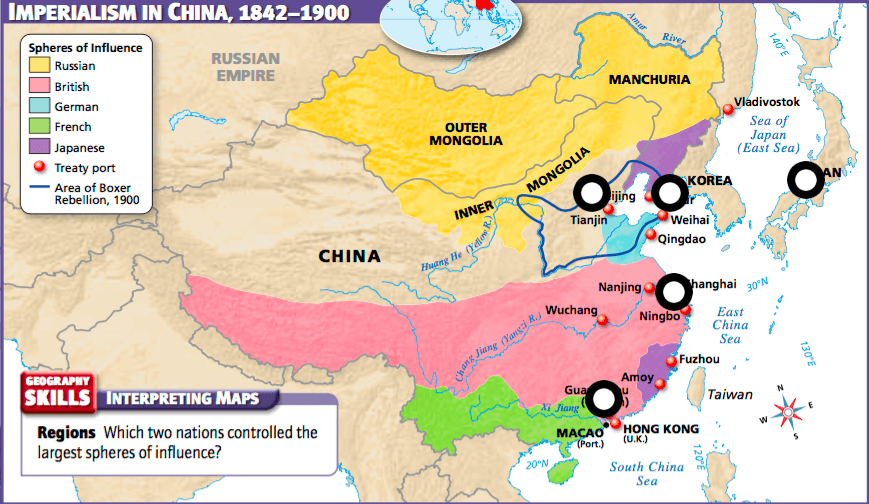


RECALL what the Treaty of Nanking did.
Brought Germany to China's defense against Britain.
Brought the US to China's defense against Britain.
Gave Britain access in 4 Chinese cities to end opium sales.
Gave the US access to all of China.
The "Open Door Policy" benefitted which of the following nations?
USA
China
Portugal
Russia

What religious divide existed in India (and still does)?
Hindus v. Christians
Muslims v. Hindus
Christians v Muslims
Hindus v. Buddhists
Why did the Sepoy Rebellion occur?
They wanted revenge for all the starvation occurring throughout India
They wanted to overthrow the British rule
Hindus and Muslims feared that ammunition was greased with fats that were against their religion
Indians thought the show of strength would frighten the British
The construction of railroad and telegraph lines between Yokohama and Tokyo and the establishment of a national bank were actions taken by Japan’s Meiji government primarily to
modernize the economy
eliminate foreign collaboration
limit urban to rural migration
increase the power of the samurai class
Emperor Meiji promoted what in Japan?
isolation and nationalism
capitalism and democracy
revolution and absolutism
reform and modernization
What was one impact of industrialization on Japan during the Meiji Restoration?
Japan became more isolated from world affairs
Demand for natural resources increased
Japan became a colonial possession of China
Traditional practices of Bushido were reintroduced
In the years following the Meiji Restoration in Japan and the unification of Germany in the 19th century, both nations experienced
an increase in military production and strengthened military forces
a reduction in tensions with neighboring nations
a restructuring of government that included popularly elected monarchs
a decrease in the reliance on industrialization and trade
The Meiji Restoration in Japan was prompted in part by
a fear that Japan would be colonized by western nations
the failure of Japanese expansion
the Shogun’s conversion to Christianity
a desire to stay isolated

