
 Worksheets
The BIG Quiz - to China
Total questions: 101
Worksheet time: 52mins
Which of the following philosophies DID NOT develop in China?
Legalism
Daoism
Buddhism
Confucianism
authority
the lower class
wealth
other countries

Finding a way to live in harmony with nature and find inner peace
Confucianism
Daoism
Legalism

Allowed
Forbidden
Encouraged
Assigned

Belief in Yin and Yang
Confucianism
Daoism
Legalism


How did Legalists believe the government rulers needed to rule to maintain order in society?
Give people freedom to make their own choices.
It is most important that leaders are an example. People will follow in their steps.
People need to be controlled with harsh punishments.

Daoism,Confucianism, and Legalism have their roots in...
China
India
Korea
Japan
Filial Piety means
respect for elders
kindness towards others
respect for women
kindness towards young people
People are evil and need lots of laws and punishments
Confucianism
Daoism
Legalism
The person who created it was named Han Fei
Confucianism
Daoism
Legalism
People should not be greedy about money or fame or other desires
Confucianism
Daoism
Legalism
Which dynasty was a period of intellectual awakening with philosophers such as Confucius and Laozi?
Xia
Shang
zhou
Qin
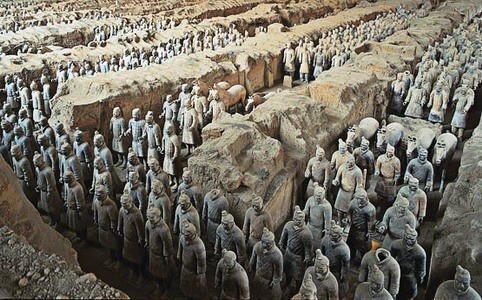
During which dynasty were the Terracotta soldiers and Great Wall made?
Xia
Shang
Zhou
Qin
Which dynasty was the longest lasting?
Xia
Shang
Zhou
Qin
Which dynasty is associated with oracle bones and taotie masks?
Xia
Shang
Zhou
Qin
Dynasty
Major river
Paved road
Series of land and sea trade routes
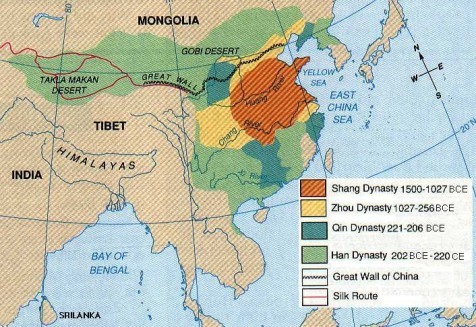
a succession of rulers from the same family
a form of government used in the UK
a democracy
a parlimentary stystem
Xia
Shang
Zhou
Han
In China, dynastic cycles were based on divine right and rulers felt justified to rule. The political right the rulers of dynasties claimed was based on
the Boulan Code of Conduct
the Mandate of Heaven
the Eightfold Path
the Confucian Principle
What is the name of the ancient trade route that connected China (Asia) to Europe?
There is not a name for this.
Silk Road
Paper Trail
Route to the West
Wedge-shaped writing on clay tablets that is one of the first writing systems used by ancient people.
Alphabet
Heiroglyphics
Cuneiform
Sanskrit
A society controlled by men, or one that favors men. In these societies women had very few rights.
equal
patriarchal
hierarchical
monarchy
Religious belief in more than one god.
Monotheism
Altruism
Atheism
Polytheism
King who developed an overarching set of written laws for all citizens of Babylon to follow.
Hammurabi
Charles I
Nemar
Shi Huangdi
Land located between the Tigris and Euphrates Rivers.
Egypt
Mesopotamia
India
China
A wanderer
Settler
Nomad
The rivers that enclosed the Fertile Crescent are called...
The White Nile and the Blue Nile Rivers
The Tigris and Euphrates Rivers
The Brahmaputra and The Indus Rivers
The Amazon and the Rio de la Plata Rivers
A group of city-states under a single authority.
Fertile Crescent
Empire
The United States
The belief in many gods
Polytheistic
Montheistic
Theocracy
Oligarchy
Sargon demanded tributes from the various city-states. What does the word tribute mean?
food
payment
government
kingdom
The surplus of crops also led to the development of new, more specialized jobs. What is a surplus?
food
technological advances
economic activity
more than what is needed.
What does “Mesopotamia” mean?
Land between the oceans
Land between the mountains
Land between the rivers
Land of the first empire
How did the people of the Fertile Crescent control the flooding of the rivers?
By using irrigation
By praying to their gods
By filling them with sand
They were not able to control the flooding rivers
What was the world’s first empire?
Mesopotamian
Babylonian
Akkadian
Sumerian
What structure stood at the center of every Sumerian city-state?
Government Building
Large Home
Monument of the Ruler
Ziggurat
Scribes were important in Sumerian society because they could read and write.
True
False
Mesopotamia is located in what is now which modern-day countries?
Primarily Syria. Also, some of Kuwait, Turkey Iran, and Syria.
Primarily Kuwait.
Also, some of Iraq, Turkey Iran, and Syria.
Primarily Iraq. Also, some of Kuwait, Turkey Iran, and Syria.
Primarily Turkey. Also, some of Kuwait, Iraq, Iran, and Syria.
Which of the following occurred first?
Mesolithic Era
Bronze Age
Paleolithic Era
Neolithic Era
Which of the following occured most recently?
Mesolithic Era
Neolithic Era
Paleolithic Era
What was the focus of people during the Paleolithic Era?
Survival
Creating New Technology
Building Relationships
Building Homes
What was the focus of people during the Mesolithic Era?
Survival by doing as they had always done.
Survival by adapting to their changing environment.
Thriving and creating new technology.
Architecture and building.
During the Mesolithic Era people,
stayed in one place.
moved around a lot.
Which of the following are features of the Neolithic Era? Select all that apply.
People began staying in one place, choosing to settle permanently.
People had a stable food supply through farming.
People relied on farming in order to feed their population.
The population grew.
People were healthier because their diet was more varied
What advancement allowed for the Neolithic Era to begin and the Neolithic Revolution to occur?
Staying in one place.
People created more tools.
Domestication of plants and animals.
People learned language.
What is the Neolithic Revolution?
The change in how people made tools.
The shift from hunting and gathering to farming to survive.
The warming of earth at the end of the Ice Ages
Settling in one place.
A map with written labels would be considered...
Prehistoric (from prehistory)
Historic (from history)
It could be either one.
True or False? People were hunter-gatherers for far longer than we have been farmers.
True
False
People improved tools during which Era(s)?
Paleolithic Era
Mesolithic Era
Neolithic Era
All of the Above
What two modern countries border the Indus River Valley?
Egypt and Ethiopia
Persia and China
Pakistan and India
Ethiopia and China
What is Mohenjo-Daro?
ancient Persian spiritual leader
ancient Aryan game
ancient Indian warrior
an Indus River Valley ancient city
What are Rig, Sama, Yajur, and Athara?
Indian empires
Persian empires
the Vedas
leaders of Hindu
How did Ashoka communicate with his people?
speeches
Indus Valley River road system
oracle bones
carved the news on columns
Who was Siddhartha Gautama?
Brahman
the Buddha
Vishnu
Ashoka the Great
What is a caste?
reincarnation
a rigid social structure
something you wear on a broken bone
the teaching of Buddha
Hinduism is based on which of these?
the Vedas
the teachings of Muhammad
Siddartha's teachings
belief in the Four Noble Truths
What are the seasonal prevailing winds that bring heavy rain to India?
tornadoes
monsoons
hurricanes
tsunamis
What mountain range lies north of India? (It provides protection!)
Andes
Rockies
Alps
Himalayas
What is moksha?
liberation from the cycle of rebirth in Hinduism
the cycle of rebirth
liberation from the cycle of rebirth in Buddhism
the individual soul
What is the house of worship in Sikhism?
Synagogue
Mosque
Gurdwara
Church
What is ahimsa?
being kind
non-violence
cycle of rebirth
karma
Harappa and Mohenjo-Daro are best known for their skill in?
Writing literature
City planning (organized layout)
Ironmaking
Pottery
Which product was the most traded in Ancient India?
Silk from China
Olive Oil from Rome
Timber from Mesopotamia
Gold from Egypt
An artifact is a...
Primary Source
Secondary Source
A textbook is an example of a...
Primary Source
Secondary Source
Which of the following can be described as a first-hand account?
Primary Source
Secondary Source
Which of the following can be described as a second-hand account?
Primary Source
Secondary Source
A photo is considered a ...
Primary Source
Secondary Source
A documentary on any historical event is considered a...
Primary Source
Secondary Source
An encyclopedia, thesaurus or any other reference material is a...
Primary Source
Secondary Source
A primary source is ALWAYS more reliable than a secondary source.
True
False
What is the definition of perspective?
Point of View
To verify
Partially true
Primary Source
What is a cataract?
triangle-shaped area of land made of soil deposited by a river
steep river rapids, almost impossible to sail by boat
a type of food eaten in Ancient Egypt
a group of traders that travel together
What is a delta?
steep river rapids, almost impossible to sail by boat
a triangle shaped area of land made of soil deposited by a river
a series of rulers from the same family
the part of an ocean that meets land
What or who was Menes?
an Egyptian leader who split Egypt in half
an Egyptian leader who made Egypt monotheistic
an Egyptian leader who was known for being very harsh
an Egyptian leader who united both upper and lower Egypt into one kingdom
What or who was a pharaoh?
ruler of unified Egypt, literally means "great house"
ruler of unified Egypt, literally means "holy"
ruler of unified Egypt, literally means "anointed one"
ruler of unified Egypt, literally means "foreseer of all things"
Who or what is a dynasty?
an ancient Egyptian ruler
people from the same family with the same name
a series of rulers from the same family
a series of rulers only in Egypt
The third Egyptian dynasty, which lasted nearly 500 years was called
Middle Kingdom
New Kingdom
Old Kingdom
Who was the most famous pharaoh of the Old Kingdom who built the Great Pyramid?
Hatshepsut
Khufu
Menes
Rameses the Great
What is the name for people from rich and powerful families?
nobles
peasants
merchants
artisans
What do we call huge stone tombs with four triangle-shaped walls that meet at a top point?
deltas
pyramids
ziggurats
buildings
What do we call the period of stability and peace in ancient Egypt between about 2050 and 1750 BC?
Old Kingdom
Middle Kingdom
New Kingdom
What do we called the height of Egypt's power and glory, between 1550 and 1050 BC?
Old Kingdom
Middle Kingdom
New Kingdom
What is a trade route?
paths used only by horses
a row of buildings with stores and tents
paths followed only by religious leaders
paths connecting two areas to facilitate the exchange of goods.
Who was the New Kingdom ruler renowned for expanding Egyptian trade?
Khufu
Menes
Ramses the Great
Queen Hatshepshat
Who was the New Kingdom pharaoh who defended Egypt from invaders and strengthened defenses?
Ramses the Great
Khufu
Queen Hatshepshat
Menes
What are hieroglyphics?
Egyptian writing system, one of the world's first, which used symbols
Egyptian version of cursive writing
items found in old burial grounds in Egypt
What is the Rosetta Stone
art found in King Tut's tomb
a stone slab inscribed with hieroglyphics and their Greek meanings
a stone that marked the location of the Great Pyramid
a tall, four-sided pillar that is pointed on top
What is a tall, four-sided pillar that is pointed on top?
sphinx
pyramid
obelisk
Rosetta Stone
What is a huge ancient Egyptian statue of an imaginary creature with the head of a human and the body of a lion?
hieroglyphic
Rosetta Stone
obelisk
sphinx
What is a long-lasting, paper-like substance made from reeds?
cotton
hieroglyphic
tissue
papyrus
The Egyptians were...
Polytheistic
Monotheistic
Athiest
Mummification was practiced by...
everyone
the poor
only pharaohs
those who could afford it
The Egyptians practiced _____________ so the Soul (ka) would recognize the body in the afterlife.
religion
mummification
dynasties
prayer
Select all that apply. Ancient Egypt was protected by...
Seas
Cataracts
Pyramids
Deserts
Select all that apply. The Pharaoh was viewed as...
God
Peasant
King
Noble

