
 Worksheets
Periodic table 2026
Total questions: 42
Worksheet time: 27mins
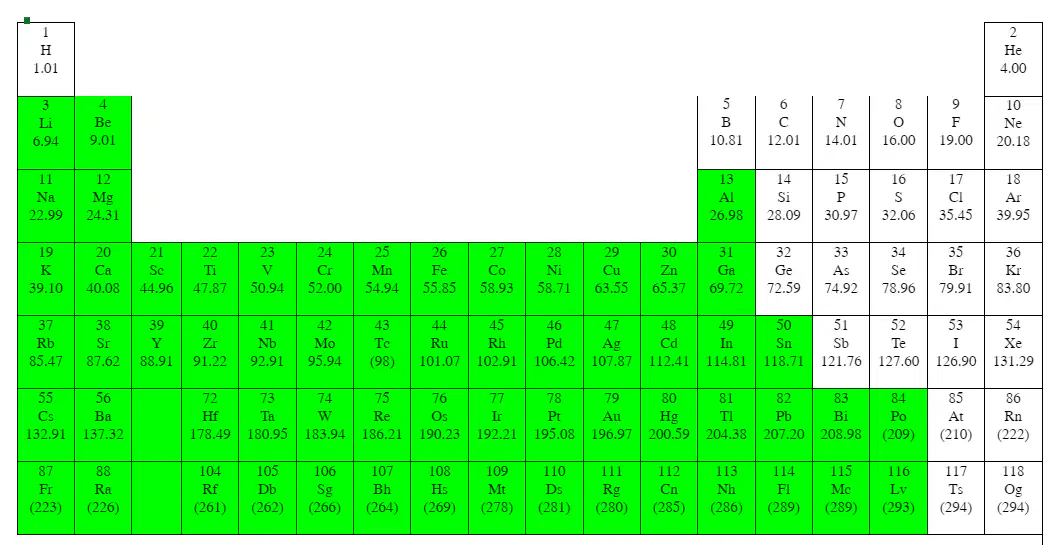
The highlighted elements are
metals
semimetals
nonmetals

The highlighted elements are
metals
semimetals
nonmetals

The highlighted elements are
metals
semimetals
nonmetals
UP and DOWN columns on the periodic table are
groups
periods
SIDE TO SIDE rows on the periodic table are
groups
periods
Which elements have properties in common?
elements in a group
elements in a period

Which two elements have properties in common?
Nitrogen and Phosphorous
Oxygen and Nitrogen
Sulfur and Nitrogen

These elements are in a:
group
period

These elements are in a:
group
period
Which elements are stable?
Group 1
Group 8
Group 18
What are the three main groups of the periodic table?
groups
metal
nonmetals
metalloids
periods

Which of element in the highlighted group is the MOST reactive?
Li
Na
K


Which of the highlighted elements is the most reactive?
F
Cl
Br
I


The two most reactive groups of elements (one metal, one nonmetal) are:


The element # 37 would be a
metals
semimetals
nonmetals
The element # 34 would be a
metals
semimetals
nonmetals
The element # 5 would be a
metals
semimetals
nonmetals
The element # 41 would be a
metals
semimetals
nonmetals
The element # 53 would be a
metals
semimetals
nonmetals
The element # 32 would be a
metals
semimetals
nonmetals

good electrical conductors

moderate electrical conductors

poor electrical conductors

alkali metals

alkaline earth metals

transition metals

halogens

noble gases
alkali metals
alkaline earth metals
transition metals
halogens
noble gases
very reactive metals. They all react with water
reactive metals; some do not react with water
reactivity of metals varies; some are quite unreactive
very reactive nonmetal
nonreactive
metals isolated by electrolysis; when they react they make soluble compounds
metals isolated by electrolysis; when they react they tend to make insoluble compounds
generally isolated by smelting with carbon
nonmetals too reactive to be found as elements
isolated by cooling to liquids
Transition metals are known for being able to (select 2)
change charge
change color
change mass
change reactivity

Which of the following would be malleable (easy to hammer)
Ni (28)
P (15)
Cl (17)
Kr (36)
Which of the following would be the most unreactive
Ni (28)
P (15)
Cl (17)
Kr (36)
Which of the following would be most likely found alone as an element in nature?
Cu (29)
P (15)
Cl (17)
Li (3)
Which of the following would be most likely able to be smelted with carbon?
Zn (30)
K (19)
Sr (38)
Br (35)
Which of the following would not have luster?
Zn (30)
K (19)
Sr (38)
P (15)
Which of the following are considered classic "salts" (high melting points, soluble in water) (check all that apply)
KBr
Li2S
CuO
FeCl3
Which of the following are NOT considered a "salts" (check all that apply)
KBr
Li2S
CuO
FeCl3

