wayground logo

Free Printable Worksheets

NEW

Font size

S
M
L
XL
Worksheets

Taxonomy and Classification Review

Total questions: 30

Worksheet time: 45mins

Name
Class
Date
1.
Which of the lists below has all of the levels of classification in the correct order?
a)
Kingdom class phylum genus order species family
b)
Class Phylum Kingdom Species Family Order Genus
c)
Kingdom Family Class Order Phylum Genus Species
d)
Kingdom Phylum Class Order Family Genus Species
2.
Scientific names are written using which two levels of classification?
a)
Kingdom phylum
b)
Kingdom class
c)
Species genus
d)
Genus species
3.
Which of the following levels of classification would have organisms that had the most in common?
a)
Phylum
b)
Family
c)
Order 
d)
Kingdom
4.
Organisms that are unicellular, plant-like or animal-like or fungus-like, live in damp or wet places like ponds, rivers, or streams.
a)
Kingdom Fungi
b)
Kingdom Plantae
c)
Kingdom Animalia
d)
Kingdom Protista
5.
Organisms that are multicellular, photosynthetic autotrophs, reproduce sexually or asexually belong to this Kingdom:
a)
Animalia
b)
Fungi
c)
Monera
d)
Plantae
6.
Organisms that are eukaryotic, unicellular OR multicellular, decomposers or parasites belong to this Kingdom:
a)
Protista
b)
Fungi
c)
Plantae
d)
Archaebacteria
7.
A group of organisms that look alike and can reproduce among themselves is known as a:
a)
Genus
b)
Phylum
c)
Species
d)
Animal Family
8.
Fungi are different from plants primarily because they
a)
are nonmotile.
b)
contain chlorophyll.
c)
are heterotrophic.
d)
have cell walls.
9.
The image shows a multicellular organism. This organism lives in water and can best be viewed using a microscope. It often reproduces asexually by budding, has no cell walls, and obtains energy by eating other organisms. Into what kingdom would you classify this organism?
a)

Animalia

b)

Fungi

c)

Plantae

d)

Protista

10.
What is taxonomy?
a)
A two-word naming system for describing organisms
b)
A classification system based on shared characteristics
c)
A method of observing living organisms in their natural environment
d)
A process for using radioactive elements to date fossils
11.
The table shows characteristics of several organisms. Based on the information given in the table, which two organisms would you think have the most recent common ancestor?
a)

Turtle and jawed fish

b)

Lamprey and jawed fish

c)

Turtle and Lamprey

d)

Lamprey and frog

12.
Tool used by a taxonomist to identify an unknown organism is a:
a)
dichotomous key
b)
binomial nmenclature
c)
scientific name
d)
binomial key
13.
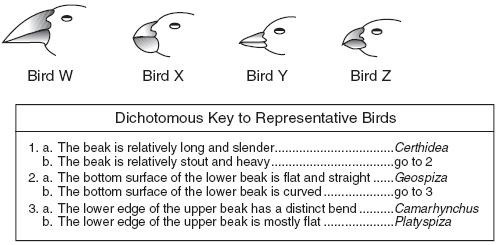
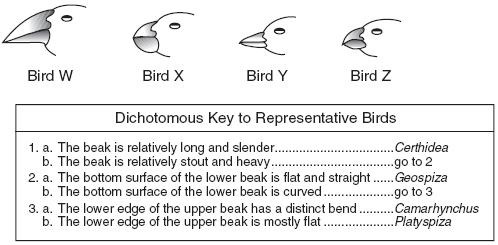
What is the name of bird W?
a)
Certhidea
b)
Geospiza
c)
Camarhynchus
d)
Platyspiza
14.
What is the name of bird Z?
a)
Certhidea
b)
Geospiza
c)
Camarhynchus
d)
Platyspiza
15.
A student discovers an arachnid with a segmented abdomen, long legs, and a tail with no stinger. The student uses the dichotomous key below to identify it. Which arachnid has the student found?
a)
Whip Scorpion
b)
Wind Scorpion
c)
Daddy long legs
d)
Scorpion
16.

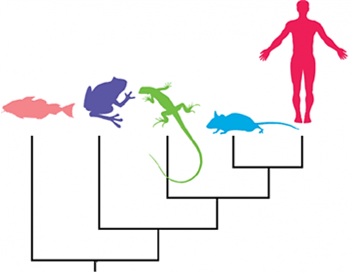
What is the human most closely related to?

a)

Fish

b)

mouse

c)

Salamander

d)

Human

17.

According to this tree, which of these animal phyla are most closely related?

a)

Arthropoda & Mollusca

b)

Arthropoda & Chordata

c)

Chordata & Mollusca

18.
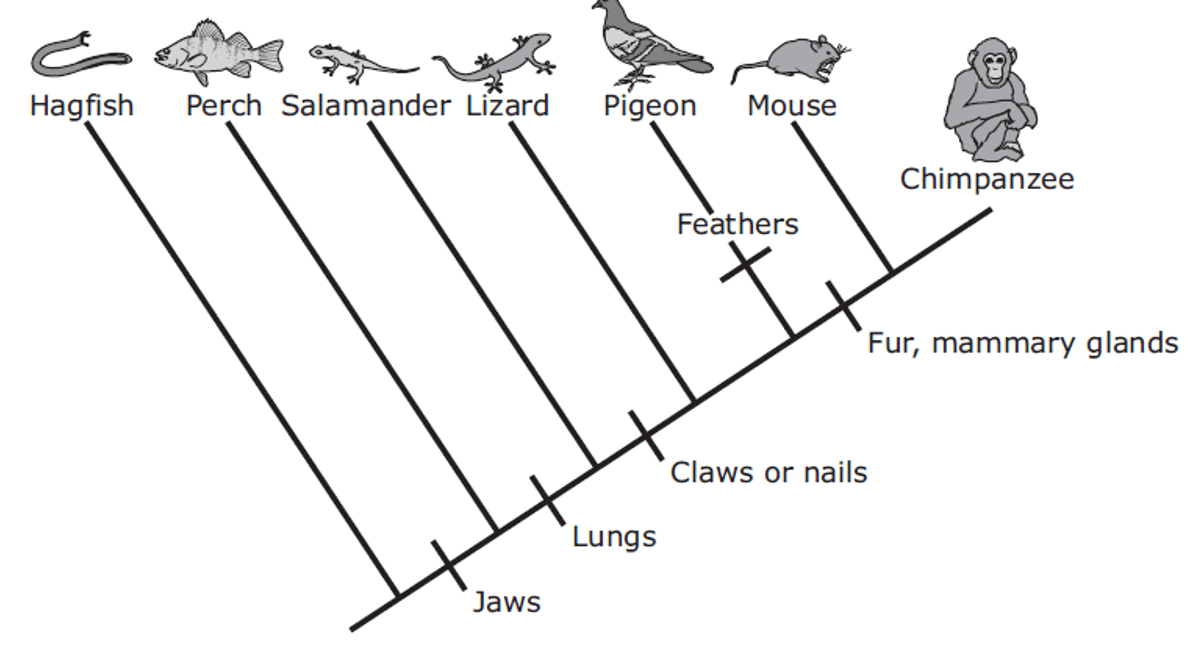
All the animals to the right of the hagfish would have the common characteristic of -
a)
Fur
b)
Claws or nails
c)
Lungs
d)
Jaws
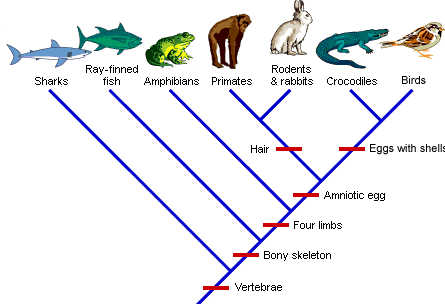
19.
According to this cladogram, primates are most closely related to -
a)
Amphibians
b)
Rodents and rabbits
c)
Crocodiles
d)
Birds
20.

what is an adaptation?

a)

a change in behavior or physical aspect of an organism in order to be better suited to survive in a particular environment.

b)

a change that an organism quickly develps to survive

c)

a unique characteristic that makes an organsism more dominant

d)

a shift in an organisms behavior

21.

Adapatations lead to...

a)

Unique organisms

b)

Evolution

c)

Mutations

d)

Stronger Organsisms

22.
An example of a behavioral adaptation is
a)
The long neck of a giraffe
b)
Penguins huddling together for warmth
c)
A camel's hump used to store water
d)
A polar bear's white fur used for camouflage
23.
An example of a physical adaptation is...
a)
a turtle hiding inside its shell
b)
The spikes on a porcupine fish
c)
a rabbit burrowing underground
d)
a viper biting when threatened
24.
A monkey has a long tail to help it swing from branch to branch.
a)
Behavioral Adaptation
b)
Structural Adaptation
25.
A squid will squirt black ink at predators when frightened.
a)
Behavioral Adaptation
b)
Structural Adaptation
26.
Why might some plants have thorns?
a)
to stay safe from animals that want to eat the plant
b)
to attract insects that spread pollen to other plants
c)
to take in nutrients from the air
d)
to provide shade for the plant
27.
Cactus have a thick waxy coating on their stem that keeps them from drying out- is this a behavioral adaptation or physical adaptation?
a)
Behavioral adaptation
b)
Physical adaptation 
28.

Why is taxonomic classification important?

a)

prove that evolution occurs

b)

discover and name every organism on earth

c)

designate Latin as the universal language of biology

d)

identify organisms and find evolutionary relationships between them

29.

An organism has the following characteristics:

  • multicellular
  • autotrophic
  • has cell walls
  • has cell nuclei
  • can reproduce sexually or asexually

Which kingdom does it belong to?

a)

Fungi

b)

Bacteria

c)

Plantae

d)

Animalia

30.
If two organisms are in the same phylum, they must also be in the same
a)
class
b)
species
c)
family
d)
kingdom