Wayground logo

Free Printable Worksheets

Font size

S
M
L
XL
Worksheets

Covalent Compounds and Acids

Total questions: 69

Worksheet time: 2hrs 37mins

Name
Class
Date
1.
Elements combine to form __________.
a)
compounds
b)
atoms
c)
positive ions
d)
negative ions
2.
What part of an atom is involved in chemical bonding?
a)
protons
b)
neutrons
c)
electrons
d)
nucleus
3.
A ________ is a model of an atom in which each dot represents a valence electron.
a)
Valence electron
b)
Electron dot diagram/Lewis dot structure
c)
Lewis bond structure
4.
How many valence electrons does nitrogen have?
a)
3
b)

2

c)
5
d)
1
5.
How many valence electrons does hydrogen have?
a)
3
b)
2
c)
5
d)
1
6.
Where are the non-metals located on the periodic table?
a)
All over
b)
On the left side of the "staircase"
c)
On the right side of the "staircase"
7.
Compounds made from only nonmetals are _________________ compounds.
a)
ionic
b)
covalent
c)
metallic
d)
chemical
8.
A covalent bond involves a __________ of electrons.
a)
sharing
b)
borrowing
c)
exchanging
d)
switching
9.
A __________ is a number written to the right of a chemical symbol and slightly below it.
a)
subscript
b)
coefficient
c)
chemical formula
d)
compound
10.
The chemical formula shows one carbon atom bonded to __________ oxygen atoms.
a)
one
b)
two
c)
three
d)
four
11.

Identify the following compound as ionic or covalent: SO2

a)

ionic

b)

covalent

12.
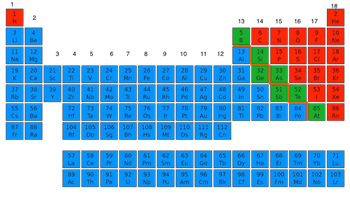
Where are the nonmetals located on the periodic table? 
a)
Blue
b)
Red
c)
Green
13.

The chemical bond between a non-metal and another non-metal will be a ________ bond.

a)

metal

b)

ionic

c)

covalent

d)

polar

14.

What type of bonding does this picture show?

a)

Ionic

b)

Covalent

15.

What type of bonding does this picture show?

a)

Ionic

b)

Covalent

16.

The chemical bond between a metal and a non-metal will be a _____ bond.

a)

metal

b)

ionic

c)

covalent

d)

polar

17.

The chemical bond between a non-metal and another non-metal will be a ________ bond.

a)

metal

b)

ionic

c)

covalent

d)

polar

18.

Sodium and Bromine will make a _____ bond.

a)

ionic

b)

covalent

c)

metallic

19.

Carbon and Oxygen will make a ___________ bond.

a)

ionic

b)

covalent

c)

metallic

20.

NaCl

a)

ionic

b)

covalent

c)

metallic

21.
What is the correct name for C4H6?
a)
Carbon Hexahydride
b)
Pentacarbon Pentahydride
c)
Hexacarbon Tetrahydride
d)
Tetracarbon Hexahydride
22.
What is the correct name for NO?
a)
Mononitrogen Monoxide
b)
Nitrogen Monoxide
c)
Mononitrogen Dioxide
d)
Nitrogen Oxide
23.
What is the formula for Tricarbon Octahydride?
a)
Ca3O
b)
C2H8
c)
C3H8
d)
Ca3H8
24.
What is Sulfur Trichloride?
a)
SCl3
b)
SiCl3
c)
SCl4
d)
Si3Cl
25.
P2O5
a)
Phosphorus Oxide
b)
Pentaphosphorus Dioxide
c)
Diphosphorous pentoxide
d)
Phosphoric Oxygen
26.
PBr5
a)
Phosphorus Bromide
b)
Phosphorus Pentabromide
c)
Pentaphosphorus bromide
d)
Phosphorus Bromine
27.
As4O10
a)
arsenic oxide
b)
quadarsenic decoxide
c)
tetraarsenic decoxide
d)
arsenic decoxide
28.
A covalent compound made of one sulfur and two oxygen atoms would be named
a)
sulfur dioxide.
b)
sulfur oxide.
c)
disulfur oxide.
d)
sulfide oxygen.
29.
The covalent compound N2O5 would be named
a)
nitrogen oxide.
b)
dinitrogen oxide.
c)
nitrogen pentoxide.
d)
dinitrogen pentoxide.
30.
Disulfur trioxide
a)
S3O2
b)
SO
c)
S2O3
d)
S2O
31.
Bromine monofluoride
a)
Br1F1
b)
BrF
c)
Br2F
d)
BrF2
32.

Choose the correct formula for this compound:


Silicon Tetrachloride

a)

SCl4

b)

SCl

c)

SiCl4

d)

SC4

33.

Choose the correct formula for this compound:


Iodine Heptafluoride

a)

I7F

b)

IF6

c)

IF7

d)

F7I

34.

What does the prefix di- mean?

a)

One

b)

Two

c)

Three

d)

Four

35.

What is the formula for Dichlorine Monoxide?

a)

Co₃O

b)

ClO₂

c)

Cl₂O

d)

(Cl₂)₂O

36.
What is the name of the following compound?
S6O3
a)
sulfurehexa trioxide
b)
hexasulfur trioxide
c)
hexasulfide trioxide
d)
trioxygen hexasulfide
37.

How many valence electrons does Oxygen (O) have?

a)

6

b)

8

c)

15

d)

16

38.

How many valence electrons does Lithium (Li) have?

a)

8

b)

1

c)

5

d)

2

39.

How many valence electrons does Bromine (Br) have?

a)

5

b)

6

c)

7

d)

8

40.
What is a valence electron?
a)
an electron that is found in the outermost shell of an atom. 
b)
an electron found in the innermost shell of an atom.
c)
an electron found in the middle shell.
41.

Which of these is incorrect?

a)
b)
42.

Which of these is correct?

a)
b)
c)
43.
This could be the dot diagram of 
a)
Ne
b)
Si
c)
Al
d)
Be
44.

This could be the dot diagram of

a)

Mg

b)

Cl

c)

C

d)

O

45.

How many valence electrons should Lithium have in its Lewis dot model?

a)

1

b)

2

c)

3

d)

4

46.

This is a correct dot diagram for nitrogen (N)

a)

true

b)

false

47.

This is a correct dot diagram for carbon (C)

a)

true

b)

false

48.

This is a correct dot diagram for neon (Ne)

a)

true

b)

false

49.
Which of these elements has 8 valence electrons?
a)
P
b)
Be
c)
O
d)
Ar
50.
Name the acid: HC2H3O2
a)
Acetic Acid
b)
Acetous Acid
c)
Hydrogen Acetate
d)
Hydrogen Dicarbon Trihydrogen Dioxygen
51.
What is the formula for Hydrosulfuric Acid?
a)
H2(SO3)
b)
H2S
c)
H2(SO2)
d)
H2(SO4)
52.
Name HF
a)
hydrofluoric acid
b)
Hypofluoric acid
c)
hydrogen fluorine acid
d)
fluoric acid
53.
Name the acid: H3PO3
a)
hydrophosphoric acid
b)
phosphorous acid
c)
phosphoric acid
d)
phosphoric hydroxide
54.
What is the formula for hydrochloric acid?
a)
HCl
b)
HClO
c)
H3ClO3
d)
HClO3
55.
What is the formula for nitric acid?
a)
HNO2
b)
HNO3
c)
HNO4
d)
H2NO3
56.
What determines the number of hydrogens in your acid?
a)
there are always just one
b)
its the same as the charge of hydrogen
c)
its the same as the charge of the anion
d)
magic
57.
What is the formula for perchloric acid?
a)
H3ClO3
b)
H3ClO4
c)
HClO3
d)
HClO4
58.
HNO2
a)
hydronitrogen
b)
hydrogen nitrogen oxygen
c)
nitrous acid
d)
nitric acid
59.
Hydroiodic acid
a)
H2I2
b)
H1I1
c)
HI
60.
HBr
a)
hydrogen bromine acid
b)
hydrobromide acid
c)
hydrobromic acid
61.
carbonic acid
a)
H2CO3
b)
H2CrO4
c)
H2C2O4
d)
HCO3
62.
chlorous acid
a)
HClO3
b)
HClO2
c)
HClO
d)
HCl
63.

The correct name for this acid H2SO3 is

a)

Hydrosulfiric acid

b)

Sulfurous acid

c)

Sulfiric acid

d)

Sulfate acid

64.

Binary acids start with "____________"

a)

acid

b)

nitric

c)

hydraulic

d)

hydro

65.

Always add the word "________" to the end when naming acids

a)

base

b)

hydro

c)

acid

d)

Baumstark

66.

When naming binary acids, the ending always changes to:

a)

-ate

b)

-ite

c)

-ic

d)

-ous

67.

When naming oxyacids, change "-ite" to:

a)

-ate

b)

-ic

c)

-ous

d)

-ite

68.

When naming oxyacids, change "-ate" to:

a)

-ate

b)

-ic

c)

-ous

d)

-ite

69.

The "Polyatomic Ion" chart is needed to name:

a)

binary acids

b)

oxyacids

c)

jack acids

d)

all acids