
 Worksheets
Specific Heat and Ohm's Law
Total questions: 38
Worksheet time: 2hrs 4mins
Name
Class
Date
1.
What size resistor would produce a 3 Amp current flow with a 12 Volt battery
a)
1 Ohm
b)
3 Ohms
c)
4 Ohms
d)
12 Ohms
2.
What is current measured in?
a)
Ω (Ohms)
b)
V (Volts)
c)
A (Amps)
d)
W (Watts)
3.
What is resistance measured in?
a)
Ω (Ohms)
b)
V (Volts)
c)
A (Amps)
d)
W (Watts)
4.
What is Resistance?
a)
The flow of electrons
b)
Electric potential difference
c)
A battery
d)
The ability to reduce the flow of electrons
5.
Electricity that flows in a closed path is called a
a)
path
b)
current
c)
circuit
d)
light
6.
What is the Voltage of a circuit that has a resistance of 5 Ω and a current of 2 A?
a)
25 V
b)
10 V
c)
2.5 V
d)
0.4 V
7.
The mathematical relationship among Voltage, Current, and Resistance
a)
Faraday's Law
b)
Tesla's Law
c)
Edison's Law
d)
Ohm's Law
8.
Current times Resistance equals
(I X R)
(I X R)
a)
Power
b)
Voltage
c)
Amperage
d)
Ohm
9.
Voltage divided by Resistance
(V / R)
a)
Current
b)
Power
c)
Ohms
d)
Watts
10.
Voltage divided by Current
(V / I)
a)
Current
b)
Power
c)
Resistance
d)
Watts
11.
If the Voltage is increased and the resistance stays the same, Current will
a)
Increase
b)
Decrease
c)
Stay the same
d)
X
12.
If the Voltage stays the same and Resistance is increased, Current will
a)
Increase
b)
Decrease
c)
Stay the same
d)
X
13.

What kind of circuit is this?
a)
series
b)
parallel
14.
This circuit has more than one loop. When one light goes out, the others stay on.
a)
closed circuit
b)
series circuit
c)
parallel circuit
d)
open circuit
15.
When all parts of the circuit are connected it is a ______ circuit.
a)
open
b)
closed
16.

The picture shows an electrical circuit. This circuit is a series circuit because:
a)
It has 3 light bulbs.
b)
The same current flows through all three light bulbs.
c)
It uses a single battery.
d)
The electrical current has more than one path to flow through
17.
As the resistance of a circuit increases, the current will...
a)
increase
b)
decrease
c)
stay the same
18.
If the battery produced 12.6 Volts and there was a 6 Ohm resistor, what would be the current?
a)
2.1 Amps
b)
2.4 Amps
c)
1.71 Amps
d)
15 Amps
19.
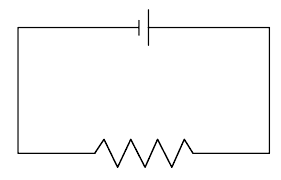
This circuit has a 24 volt battery and the resistor is 8 ohms. How many amps are running through the circuit?
a)
3 Amps
b)
192 Amps
c)
2 Amps
d)
4 Amps
20.
What happens to the current in a circuit as the resistance decreases?
a)
Current increases
b)
Current Decreases
c)
Current remains the same
21.
The specific heat of platinum is 0.133 J/g°C. How much heat(Q) is absorbed when a 10 g piece of platinum warms from 100°C to 150°C?
a)
66.5 J
b)
665 J
c)
0.0266 J
d)
0.665 J
22.
If 20 g of water undergoes a temperature change from 25° C to 30° C, how much heat energy (Q) moves from the water to the surroundings?
a)
418 J
b)
209 J
c)
83 J
d)
4.18 J
23.
The SI units J/g°C measures
a)
Specific heat
b)
mass
c)
temperature
d)
heat energy
24.
What is the temperature change(∆t) when 100 Joules of heat(Q) is added to 20 grams of copper?
a)
12.82 °C
b)
24.12°C
c)
1.95 °C
d)
5128 °C
25.
___________ is measured by the unit Joules.
a)
Heat energy
b)
Temperature
c)
Specific heat
26.
What is the formula to calculate heat energy required to raise the temperature of any substance?
a)
Q=mc∆t
b)
Q=mc
c)
Q= ½mv
d)
m=QC
27.
How many Joules of energy are required to change 10 gram of water from 20 C to 90 C?
a)
1476 J
b)
2926 J
c)
210,050 J
d)
1,404,500 J
28.
What is the symbol for Thermal Energy?
a)
Q
b)
t
c)
m
d)
C
29.
The amount of energy required to raise the temperature 1ºC for every kilogram is called____?
a)
Thermal Energy
b)
Specific Heat
c)
Temperature
d)
Kinetic Energy
30.
What unit do you use to measure Thermal Energy?
a)
J/Kg ºC
b)
Kg
c)
ºC
d)
J
31.
What is the symbol for Specific Heat
a)
Q
b)
t
c)
m
d)
C
32.
Water has a specific heat of 4184 J/KgºC. Wood has a specific heat of 1760 J/KgºC. What material needs more energy to raise the temperature 1ºC
a)
Wood
b)
Water
c)
Both are the same
33.
A material was cooled from 100ºC to 40ºC. What is the temperature change?
a)
60ºC
b)
40ºC
c)
-60ºC
d)
-40ºC
34.
What does temperature measure?
a)
Heat
b)
ºC
c)
Kinetic Energy
d)
Thermal Energy
35.
How does heat flow?
a)
Always from cold to warm
b)
Always from warm to cold
c)
Both warm to cold & cold to warm
d)
It depends on the temperature
36.
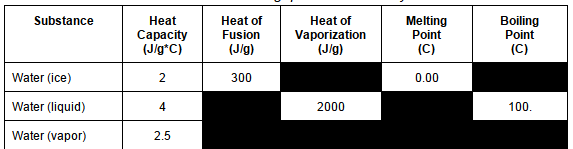
How many Joules of energy are required to change 10 gram of ice at -2 C to water at 20 C?
a)
440 J
b)
880 J
c)
10,140 J
d)
66,000 J
37.
How many Joules of energy are required to change 10 gram of water from 20 C to 90 C?
a)
1400 J
b)
2800 J
c)
210,000 J
d)
1,400,000 J
38.
How many Joules of energy are required to make 100 grams of ice at 0 C completely melt?
a)
200 J
b)
400 J
c)
30,000 J
d)
2,000,000 J
100 %

