
 Worksheets
IED Quiz 1 - Design Process and Sketching
Total questions: 43
Worksheet time: 24mins
________ is associated with an object's side-to-side dimension.
Height
Width
Depth
Length
______ is associated with with front-to-back distance.
Height
Width
Depth
Length
A ____________ shows two or more two-dimensional views of a three-dimensional object.
Isometric
Oblique
Multiview
Perspective
________ is a technique used to create multi-view drawings.
Orthographic projection
The box method
Two Point Perspective
Isometric projection
Which of the following is NOT normally included in a multi-view drawing?
Top
Left Side
Right Side
Front
A(n) ___________ line is heavy and solid, used to represent the outline of an object.
Construction line
Object line
Hidden line
Outline
When creating a multi-view drawing, you should always begin with which view?
Front
Top
Right side
Left side
In a multi-view drawing, which is the most detailed?
Front
Top
Right side
Left side
This allows designers and engineers a way to effectively communicate details of their ideas
Sketching
Constraints
Design Statement
Mechanical Dissection

The Red part of this Drawing represents
The Top View
The Right View
The Front View
The Left View

This image is called...
An Isometric Drawing
A Multi-view Drawing
a One-Point Perspective Drawing
An Ice Cream Bar
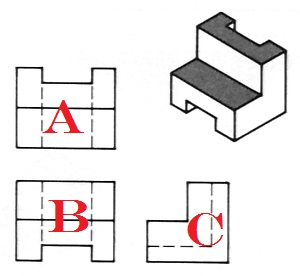
What view would go in position B of a multiview sketch?
Top
Front
Right side
What type of paper do you draw a multiview sketch on?
Graph paper
Plain paper
Isometric paper

Recognize the view for the given isometric figure.
Top view
Right side view
Left side view


B?


Which drawing below shows the Top View?


Which diagram below shows the right view of this object?


What is the purpose of sketching?
It can tell how and where the design will be used.
Sketching is appealing to people.
Sketching can provide details of an idea and lots of information all at once.
Color can be added to a sketch to show texture and appearance.

What type of drawing is the image?
multiview sketch
perspective
thumbnail sketch
isometric
What is a criteria
A cake
Goals or requirements
Limitations or boundaries
Dessert
What are constraints?
Goals
Lemons
Restrictions/boundaries
Goals/limits
What step of the design process do you meet with your group and decide on the sketch to build?
Develop a solution
Generate Concepts
Evaluate Solution
none
What is a prototype?
A type of food
Design model
Unfinished design
a sketch
When do you build a testable model?
Generate concepts
Construct and test
Define the problem
Develop a solution
What does invention mean?
To fix or edit something
To create something new
To build something
To copy another persons ideas
What is a design brief?
A list of steps to help solve the problems
Things engineers have to do
A agreement between the client and engineer
Extra boring stuff
Is the first step in the design process. Includes the problem being identified, validated, and justified. The design requirements are determined and the design brief is created.
prototype
Valid
define the problem
present solution
construct/test prototype
This step in Design process includes creating a detailed design solution and detailed technical drawings.
present solution
define the problem
Valid
Prototype
develop solution
This step in Design process includes evaluating the solution's effectiveness, reflecting on design, making recommendation for improvements of the design, and revising design documents.
develop solution
evaluate solution
define the problem
Valid
Prototype
A process that repeats a series of steps over and over until the desired outcome is obtained.
evaluate solution
iterative
develop solution
define the problem
Valid
A group technique for solving problems, generating ideas, stimulating creative thinking, etc. by unrestrained spontaneous participation in discussion
define the problem
Iterative
evaluate solution
develop solution
brainstorm

