wayground logo

Free Printable Worksheets

NEW

Font size

S
M
L
XL
Worksheets

IS4T1 Nuclear Decay and Radiation

Total questions: 31

Worksheet time: 56mins
Name
Class
Date
1.
What is emitted during Beta Radiation?
a)
A high-energy Electron.
b)
Protons.
c)
Neutrons.
d)
Nuclei
2.
What is emitted during Gamma Radiation?
a)
Particles.
b)
Protons
c)
Beta Rays.
d)
Gamma Rays.
3.
TRUE or FALSE: gamma changes the atomic number.
a)
True
b)
False
4.
What is emitted during Alpha Radiation?
a)
A helium nuclei.
b)
A helium atom
c)
Gamma Rays.
d)
Positrons
5.
Which is not true of radioactive decay?
a)
It is a result of instability in atoms
b)
It happens only in nuclear power plants
c)
Radioactivity can be useful
d)
It is hazardous to human health
6.
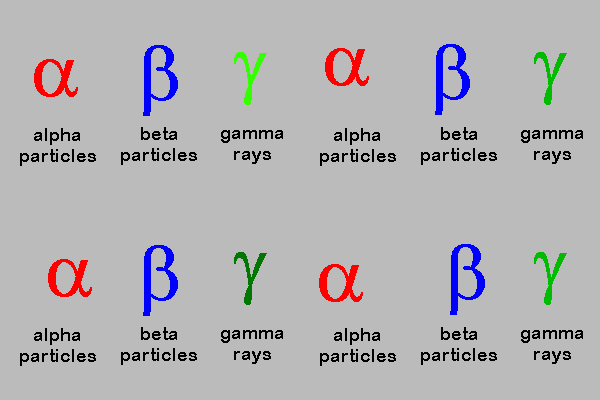
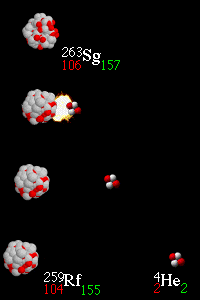
Which type of nuclear radiation is being emitted here?
a)
Alpha
b)
beta
c)
gamma 
d)
none
7.
Isotopes of the same element have different ____________. 
a)
 numbers of protons  
b)
numbers of electrons
c)
 symbols 
d)
numbers of neutrons
8.
When does radioactive decay occur?
a)
When the nucleus of an isotope is unstable
b)
When the nucleus of an isotope is stable
c)
When the electrons of an isotope are spinning
d)
When the electrons of an isotope are shared with another isotope
9.
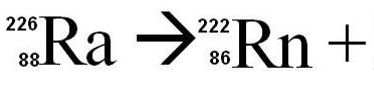
Complete the nuclear equation and determine the type of decay that is occurring in this reaction. 
a)
alpha
b)
beta
c)
gamma
d)
none
10.
In order of most to least penetrating radiation we have
a)
Alpha , Beta,  Gamma
b)
Beta , Gamma , Alpha
c)
Gamma, Beta, Alpha
d)
Gamma, Alpha, Beta
11.
After the nucleus of a radioactive element undergoes changes, the element can transform into ...
a)
  (a)  a different isotope of the same element.
b)
(b) an entirely different element.
c)
Both (a) and (b)
d)
Neither (a) nor (b)
12.
Alpha particles.....
a)
a) are positively charged.
b)
b) consist of two protons and four neutrons.
c)
c) can penetrate any thickness of matter
d)
d) All of the above 
13.
The process of nuclear change in an atom of radioactive material is called... 
a)
nuclear decay
b)
nuclear mass
c)
isotopes
d)
radon
14.
During beta decay, a nucleus .... 
a)
gives up two protons and two neutrons.
b)
  maintains the same number of protons and neutrons.
c)
  loses a proton and gains a neutron.
d)
gains a proton and loses a neutron. 
15.
When a nucleus undergoes nuclear decay by gamma rays, the atomic number of the element....
a)
remains the same
b)
  decreases by one.
c)
increases by one.
d)
increases by two.
16.
The most penetrating type of radiation is the ____.  
a)
alpha particle
b)
gamma ray
c)
beta particle
d)
uranium
17.

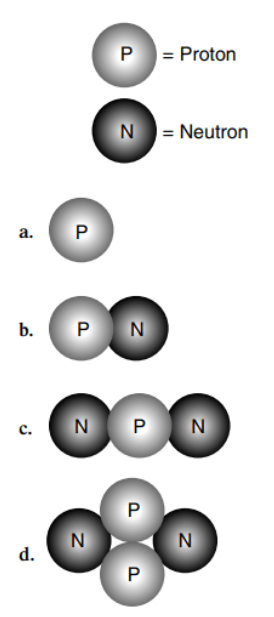
Which of these is an alpha particle?

a)

A

b)

B

c)

C

d)

D

18.

Which happens in a nucleus during gamma decay?

a)

The number of protons increases.

b)

The number of neutrons increases.

c)

The number of protons remains the same.

d)

The total number of neutrons plus neutrons decreases.

19.

When a neutron turns into a proton in a nucleus, what sort of particle is emitted?

a)

alpha

b)

beta

c)

gamma

d)

photon

20.

Gamma rays _________.

a)

have no mass and no charge

b)

have mass but no charge

c)

have no mass but have charge

d)

have mass and charge

21.

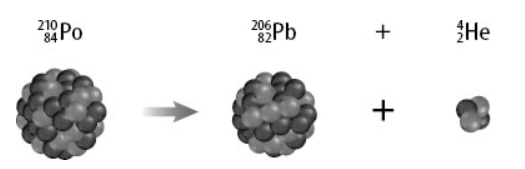
Which of these is a true statement about the products of the decay compared to polonium-210?

a)

The charges are equal but the mass numbers are not equal.

b)

The mass numbers are equal but the charges are not equal.

c)

The mass numbers and charges are equal.

d)

Neither the mass numbers nor the charges are equal.

22.

A hydrogen nucleus has only one proton. How many neutrons are in a hydrogen-3 nucleus?

a)

0

b)

1

c)

2

d)

3

23.

What percentage of rubidium-87 atoms will be left after four half lives?

a)

25.0%

b)

12.5%

c)

6.25%

d)

3.125%

24.

The solid black sections of the bars on the graph represent the percentages of

a)

carbon-14 from the original sample that has not decayed
b)

lead-206 decay product resulting from the radioactive decay

c)

nitrogen-14 decay product resulting from the radioactive decay

d)

uranium-238 from the original sample that has not decayed

25.

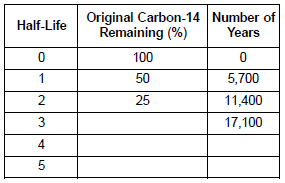
After 22,800 years, approximately what percentage of the original carbon-14 remains?

a)

15%

b)

12.5%

c)

6.25%

d)

3.125%

26.

Which diagram best represents the percentage of this radioactive isotope sample that will remain after 2 half-lives?

a)
b)
c)
d)
27.
After the third half-life, how much of the sample is left?
a)
1/2
b)
1/3
c)
1/16
d)
1/8
28.
The half-life of strontium-90 is 25 years. How much strontium-90 will remain after 100 years if the initial amount is 4.0 g?
a)
3.0g
b)
0.25mg
c)
0.3g
d)
0.25g
29.
If the half-life of uranium-232 is 70 years, how many half-lives will it take for 10 g of it to be reduced to 1.25 g?
a)
1 half-life
b)
2 half-lives
c)
3 half-lives
d)
4 half-lives
30.

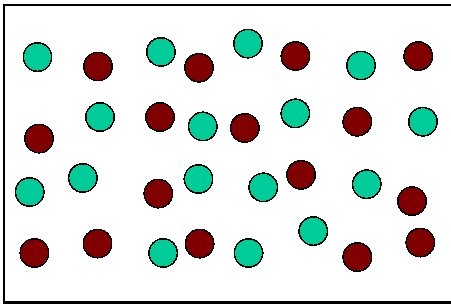
The diagram shows 32 atoms.

16 of the Red are parent isotopes

16 of the Green are daughter isotopes

How many half-lives have occurred?

a)

0

b)

1

c)

2

d)

3

31.
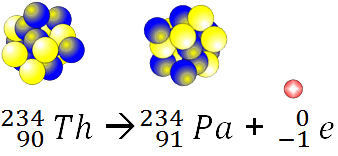
What type of decay is being illustrated in following picture? 
a)
beta decay
b)
alpha decay