Wayground logo

Free Printable Worksheets

Font size

S
M
L
XL
Worksheets

Ecology Part 1

Total questions: 25

Worksheet time: 15mins

Name
Class
Date
1.
Fish, their predators and the water, sunlight, and plants that they rely on would be considered a(n):
a)
population
b)
abiotic factor
c)
community
d)
ecosystem
2.
A food web is shown below. In this food web, the trophic level with the LEAST energy includes which of the following organisms?
a)
grasses
b)
mice
c)
snakes
d)
hawks
3.
The diagrams below show a marine food web and an incomplete terrestrial food web. The organism in the terrestrial food web that corresponds to the krill in the marine food web is located X. Which of the following organisms is most likely organism X?
a)
Option 1
b)
Option 2
c)
Option 3
d)
Option 4
4.
Which type of succession is pictured below?
a)
Primary
b)
Secondary
5.
Which type of succession is pictured below?
a)
Primary
b)
Secondary
6.
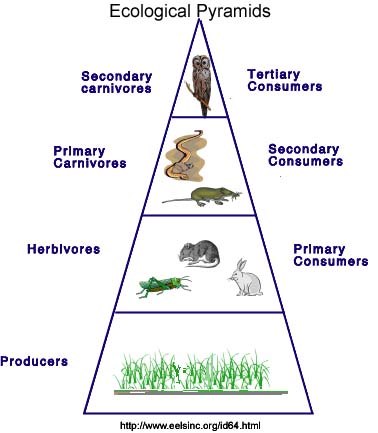
Looking at this Energy Pyramid, which trophic level stores the largest amount of energy?
a)
The first trophic level - the primary producers
b)
The second trophic level - primary consumers
c)
The third trophic level - secondary consumers
d)
the forth trophic level - third level consumers
e)
the fifth trophic level - apex predators
7.

Put the following terms in order from smallest to largest: population, biome, biosphere, community, ecosystem, organism

a)

organism -> Biome -> biosphere -> ecosystem -> population -> community

b)

Ecosystem -> community -> population -> biome -> biosphere -> organism

c)

Biosphere -> biome -> organism -> ecosystem -> community -> population

d)

organism -> Population -> community -> ecosystem -> biome -> biosphere

8.
At each trophic level of the food chain, energy is lost as heat. How much energy is PASSED to the next trophic level?
a)
100% is passed
b)
90% is passed
c)
50% is passed
d)
10% is passed
e)
0% is passed
9.
Look at the energy pyramid below. Which of the following is the correct flow of energy?
a)
The vegetation gets energy from the squirrels.
b)
The eagle gets energy from eating plants.
c)
The squirrels get energy from eating the eagle.
d)
The eagle gets energy from eating the squirrels.
10.
According to the figure below, the coyotes would be considered
a)
producers
b)
tertiary consumers
c)
secondary consumers
d)
primary consumers
11.
A group of eagles living in the same place at the same time would be considered a(n)
a)
population
b)
community
c)
ecosystem
d)
abiotic factor
12.
Organisms that are the first to move into an area, and begin forming soil for an ecosystem, are known as
a)
climax community
b)
pioneer species
13.
A climax community
a)
is the beginning of succession
b)
is the end stage of succession
c)
is found in the middle of succession
d)
is when an ecosystem is destroyed
14.
When a volcanic island is formed, lichens are often a pioneer species. What is the primary role of lichens as a pioneer species?
a)
to feed insects
b)
to provide shade for seedlings
c)
to feed microorganisms
d)
to break down volcanic rock into soil
15.
Some organisms cause decay by breaking down dead matter into raw nutrients. These organisms are best described as:
a)
consumers
b)
decomposers
c)
producers
d)
carnivores
16.
A typical diet of a rhesus monkey consists of roots, fruit, seeds and bark, though they may sometimes eat insects and small animals. Rhesus monkeys are best classified as:
a)
herbivores
b)
carnivores
c)
omnivores
d)
detrivores
17.
Use the food chain below to answer the following: Which organism would be considered the secondary consumer?
a)
beetle
b)
leaves
c)
mouse
d)
owl
18.

Which habitat has the greatest biodiversity?

a)

boreal forest

b)

savannah

c)

short-grass prairie

d)

tropical rainforest

19.

Which habitat exhibits the greatest biodiversity?

a)

A habitat with 15 different species with about 300 individuals each

b)

A habitat with 10 different species with about 75 individuals each

20.
To maintain stable internal conditions is  __________________________________.
a)
growth
b)
adaptation
c)
homeostasis
d)
development
21.

Which term refers to the non-living parts of the ecosystem?

a)

biosphere

b)

abiotic

c)

prokaryotic

d)

biotic

22.

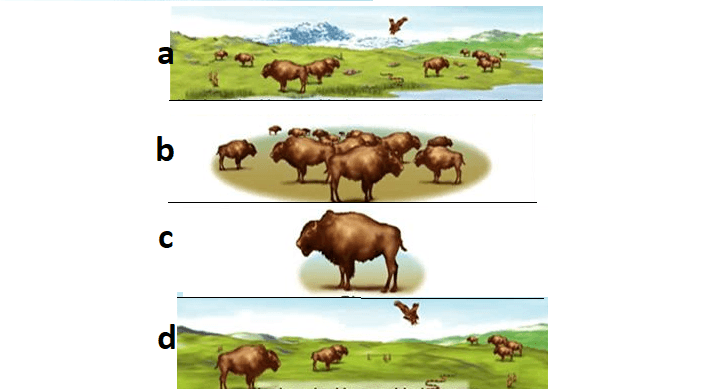
Which represents an organism?

a)

a

b)

b

c)

c

d)

d

23.
What does a food web represent?
a)
All connections of energy flow throughout all organisms in a habitat.
b)
The specific ways that mutualism is carried out.
c)
A single pathway or energy flow between organisms. 
d)
How carnivores get their food. 
24.
The largest group of organisms found in a food web would be:
a)
Primary Consumers
b)
Producers
c)
Decomposers
d)
Tertiary Consumers
25.

If only 10% of the energy in the pyramid is available as you move from one trophic level to the next, what happens to the other 90%?

a)

Passed on to decomposers

b)

Metabolized and "lost" as heat energy and waste

c)

Assembled into tissues of producers permanently

d)

False statement - 100% of the energy is available