
 Worksheets
Periodic Trends - Revision
Total questions: 21
Worksheet time: 31mins
Core charge _____? (Select all correct answers)
Is the number of protons - the number of inner shell electrons.
Increases going right on a period.
Decreases going right on a period.
Is the number of protons - the number of valence shell electrons.
Which of these groups are considered 'main-group elements'?
Groups 1,2
Groups 3-13
Groups 1,2, 13-18
Groups 4-8, 13-18
Why are they referred to as 'main-group elements'?
They are abundant in the universe.
They are scarce in the universe.
They are more important than other elements.
They all have similar energy levels.
What does the period number tell you?
The number of valence electrons.
The number of protons and electrons.
The number of electron shells occupied.
The amount of energy of the elements in the period.
What does the group number tell you?
The block that the elements are in. (s, p, d, f blocks)
The number of electron shells occupied.
The number of inner shell electrons.
The number of valence shell electrons.
Elements can be classified as either _____ or _____?
Protons or electrons.
Cations or anions.
Metals or non-metals.
Positively or negatively charged.
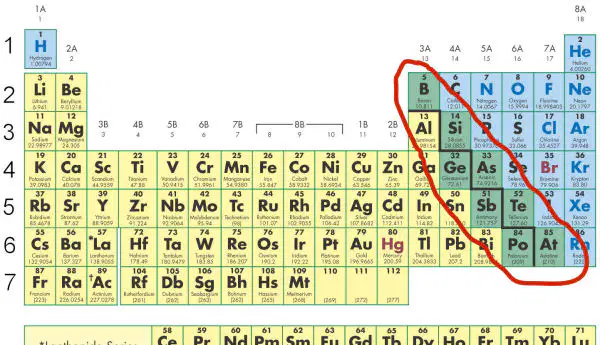
True or false: Non-metals are found to the left of the staircase. (As shown in the image)
True
False

What are elements found in group 3-12 referred to as?
Noble gases
Transition metals
Alkaline earth metals
Metalloids
Low melting point, weak, not malleable, gas at room temperature, forms an anion. These are characteristics of _____?
Metals
Non-metals
What are metalloids?

Select all correct answers.
S block contains all elements from Groups 1-2.
P block contains all elements from Groups 13-18.
D block contains all elements from Groups 3-12.
F block contains all elements that are Lanthanides or Actinides.
What is the outer electron configuration of P block elements?
s2p1 to s2p6
s1 to s2
d1s2 to d10s2
Subshells are progressively filled.
What does the highest shell number in an electron configuration tell you?
The group number.
The period number.
The number of valence electrons.
The category the element is in. (Ex: Metalloids, alkali metals, etc.)
What are the 5 patterns that are found in the Periodic Table?
How does atomic size increase and decrease going down a group and across a period?
How does electronegativity increase and decrease going down a group and across a period?
How are atomic size and electronegativity related?
What is first ionisation energy? How does it change down a group and across a period?
What is metallic character? How does it change going down a group and across a period?
What is reactivity?
Select all correct answers.
Metals' reactivity increases going down a group and decreases across a period.
Metals' reactivity decreases going down a group and increases across a period.
Non-metals' reactivity increases going down a group and decreases across a period.
Non-metals' reactivity decreases going down a group and increases across a period.

