
 Worksheets
Sectionalism and Reform
Total questions: 19
Worksheet time: 10mins
Name
Class
Date
1.
1. Sectionalism can best be defined as … ?
a)
a. The way American geography was divided up by "sections" in the 19th century, including specific areas such the Oregon, New Mexico, and Wyoming Territories.
b)
b. The act of placing the interests of your region ahead of the needs of the nation as a whole.
c)
c. The official government term for the reservation system.
d)
d. The division of the US government into 3 separate branches.
2.
2. Which of the following was a key characteristic of the West in the 19th century?
a)
a. A constant influx of new settlers.
b)
b. Mining as an important economic activity.
c)
c. Connected to the East by both rail and telegraph.
d)
d. All of the above statements are true.
3.
3. Which of the following was a characteristic of the South in the 19th century?
a)
a. An extensive railroad network connecting the rural areas to major cities like Atlanta.
b)
b. An economy based heavily on the unpaid labor of enslaved peoples.
c)
c. Sparsely populated territories with very few women.
d)
d. Many large cities with diverse populations.
4.
4. Which of the following was a characteristic of the North in the 19th century?
a)
a. Big cities with large immigrant populations.
b)
b. An economy based solely on small farming.
c)
c. Strong trade ties with Latin America, especially the Portuguese colony of Brazil.
d)
d. A government-controlled economy with little freedom for people.
5.
5. The main goal of the Missouri Compromise was to-
a)
a. establish the North as "The Union."
b)
b. form an official agreement on which new states entering the Union would be free states and which would be slave states.
c)
c. Create the borders of the new state of Missouri, which had been engaged in a territorial dispute with Arkansas.
d)
d. end the practice of slavery in America for good.
6.
6. Which of the following was NOT part of the Compromise of 1850?
a)
a. California entered the Union as a free state.
b)
b. Texas joined the Union as a free state.
c)
c. The slave trade was banned in Washington, D.C.
d)
d. A stronger Fugitive Slave Act.
7.
8. Which event showed that both pro- and anti-slavery supporters were willing to use violence for their cause?
a)
Bleeding Kansas
b)
Seneca Falls Convention
c)
Dred Scott v. Sanford
d)
The Compromise of 1850
8.

9. What event is the below excerpt describing?
a)
a. A revolt of captured and enslaved people on board the Amistad.
b)
b. A rebellion of sailors from South Carolina following nullification.
c)
c. A mutiny on a New England whaling ship.
d)
d. None of the above.
9.

10. Who is MOST likely to have said this?
a)
a. Cinqué, the leader of the African revolt on the Amistad.
b)
b. Alberto Ruiz, the Mexican military leader at the Alamo.
c)
c. Chief Crazy Horse, the Lakota Sioux leader at Little Big Horn.
d)
d. Paddy O'Neal, a leader in the Irish immigrant community in New York City.
10.
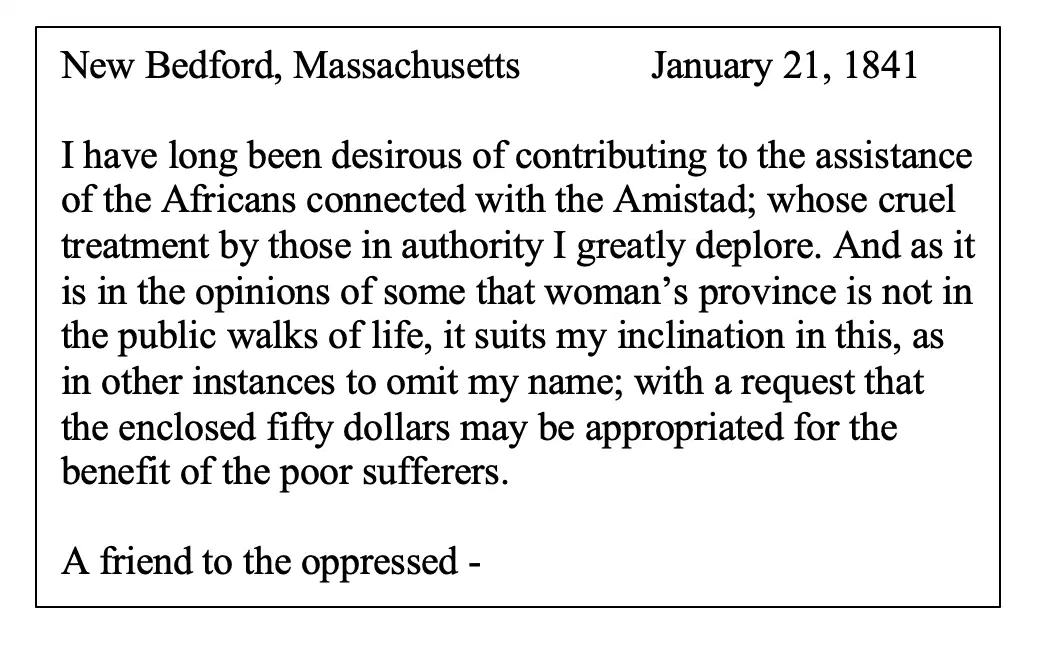
11. The woman who wrote the below anonymous letter can be described as a(n)-
a)
a. Immigrants' rights activist.
b)
b. Supporter of women's suffrage.
c)
c. Wife of a plantation owner.
d)
d. Abolitionist.
11.

12. Of the below people, who is MOST LIKELY to agree with the following statement?
a)
a. Chief Crazy Horse of the Lakota Sioux.
b)
b. Cinqué, a captured African from Sierra Leone.
c)
c. Li Wang, a Chinese immigrant forced to work on the Transcontinental Railroad for no pay.
d)
d. Kinna, a member of the Mendi indigenous group abducted from West Africa.
e)
e. All of the above.
12.
15. John Brown led a raid on the federal armory at Harper's Ferry because he … -
a)
a. Planned to steal weapons to arm plantation owners against a slave rebellion.
b)
b. Planned to steal weapons to arm slaves against plantation owners.
c)
c. Was a passionate Anti-Federalist and planned to attack Washington, D.C.
d)
d. Was the leader of the military arm of the Democratic-Republican party and planned to attack New York City.
13.
16. What did Nat Turner and John Brown have in common? -
a)
a. They are both remembered for taking drastic anti-racist actions.
b)
b. Both were escaped slaves from Virginia who reached freedom in Boston via the Underground Railroad.
c)
c. They were both students of Frederick Douglass.
d)
d. None of the above.
14.
18. Which of the following statements is NOT true of Harriet Tubman?
a)
a. She was nicknamed "Moses" for leading her people to out of slavery.
b)
b. She helped over 300 Black people gain their freedom via the Underground Railroad.
c)
c. She helped John Brown in the planning of his raid on Harper's Ferry.
d)
d. All of the above statements are true.
15.
23. "The Declaration of Sentiments" was a document that--
a)
a. Outlined the case for outlawing slavery in the United States.
b)
b. Declared women to be equal to men in every way, including in the right to vote.
c)
c. Described a method for redistributing stolen land to indigenous peoples in the Northeast.
d)
d. Supported more rights and equality for Irish immigrants.
16.
24. Who organized the Seneca Falls Convention in 1848?
a)
a. Elizabeth Cady Stanton & Lucretia Mott.
b)
b. Frederick Douglass & Harriet Tubman
c)
c. Robert Purvis & Robert E. Lee
d)
d. Harriet Tubman & Susan B. Anthony
17.
25. The purpose of the Seneca Falls Convention was to-
a)
a. Organize Northern volunteers for the Underground Railroad.
b)
b. Discuss the desire of Southern states to leave the Union.
c)
c. Establish new laws regarding the treatment of indigenous peoples and immigrants in the United States.
d)
d. Further women's rights, including the right to vote.
18.
26. Which of the following areas was NOT a part of a reform movement during this era?
a)
a. Education
b)
b. Worker's rights
c)
c. Temperance
d)
d. Prisons
e)
e. All of the above were part of a reform movement
19.
27. Which of the following is NOT true of Horace Mann?
a)
a. He worked for the rights of prisoners in Massachusetts jails.
b)
b. He fought for the same reform movement as Catherine Beecher, the sister of Harriet Beecher Stowe.
c)
c. He believed in higher pay for teachers, better curriculum, and newer school buildings.
d)
d. He was secretary of the Massachusetts Board of Education.
100 %

