Wayground logo

Free Printable Worksheets

Font size

S
M
L
XL
Worksheets

Earth Space - minireview

Total questions: 36

Worksheet time: 42mins

Name
Class
Date
1.

What type of front occurs when two air masses meet but neither advances and the boundary between them stalls?

a)

Cold front

b)

Warm front

c)

Stationary front

d)

Occluded front

2.

The process that occurs when physical forces break rock into smaller pieces without changing the rock’s chemical composition is called ____.

a)

chemical weathering

b)

erosion

c)

differential weathering

d)

mechanical/physical weathering

3.

The constant freezing and thawing of ice called ______________

a)

frost wedging

b)

unloading

c)

exfoliation

d)

constant weathering

4.

What is the area from the surface of Earth down to its center called?

a)

Biosphere

b)

Atmosphere

c)

Hydrosphere

d)

Geosphere

5.

What is a testable explanation of a situation that can be supported or disproved by careful procedures?

a)

Variable

b)

Hypothesis

c)

Scientific law

d)

Scientific theory

6.

Low-pressure systems are often associated with cloudy weather and precipitation.

a)

True

b)

False

7.

Which is an example of climate? (NOT WEATHER)

a)

average rainfall over 30 years

b)

tomorrow's highest wind speed

c)

yesterday's rainfall

d)

today's high temperature

8.

What season is cold and has short days and long nights.

a)

Spring

b)

Summer

c)

Autumn

d)

Winter

9.

What percentage of the Moon is always illuminated? (whether we see it or not)

a)

25

b)

50

c)

75

d)

100

10.
If it is summer in the northern hemisphere, which statement is true?
a)
Earth has changed the tilt of its axis by 20 degrees due to its revolution. 
b)
It is winter in the southern hemisphere due to the tilt of Earth’s axis. 
c)
It is summer in the southern hemisphere due to the tilt of Earth’s axis. 
d)
Earth has reached its closest point to the sun due to its revolution. 
11.

Which of these BEST describes the relationship between the atmosphere and hydrosphere?

a)

the atmosphere and hydrosphere have no relationship

b)

the hydrosphere grows due to the formation of volcanoes

c)

the solid layer of the hydrosphere is located in the atmosphere

d)

evaporation brings water into the atmosphere and precipitation returns it to the hydrosphere

12.

Water availability impacts plant growth and animals who depend on plants for food are interactions between the

a)

Geosphere and Hydrosphere

b)

Cryosphere and atmosphere

c)

Biosphere and geosphere

d)

Hydrosphere and biosphere

13.
Why is the Equator warmest?
a)
Because it is closest to the sun.
b)
Because it receives the most direct sunlight
c)
Because no clouds form here.
d)
Because it is far from the sun
14.
According to the law of superposition, the oldest fossils are found 
a)
At the top of the rock layers
b)
Near the bottom of the rock layers
c)
In the middle of the rock layers
d)
Somewhat near the surface
15.
Which rock layer in the diagram seems to be the oldest?
a)
F
b)
E
c)
B
d)
A
16.
Which of the following is the oldest?
a)
Layer L
b)
Intrusion D
c)
Intrusion H
d)
Layer E
17.
The thinnest layer of the Earth is the ___________.
a)
mantle
b)
crust
c)
core
18.
What is the correct order (starting from the surface) of Earth's layers?
a)
crust, outer core, inner core, mantle
b)
mantle, outer core, inner core, crust
c)
crust, mantle, outer core, inner core
d)
outer core, inner core, crust, mantle
19.
Two factors effecting the magnitude of the force of gravity between 2 objects are...
a)
mass and distance 
b)
mass and matter
c)
distance and weight 
d)
weight and mass
20.
What states that "every object in the universe attracts every other object"?
a)
Law of Universal Gravitation
b)
Newton's First Law of Motion
c)
My mother
d)
Inertia & gravity
21.

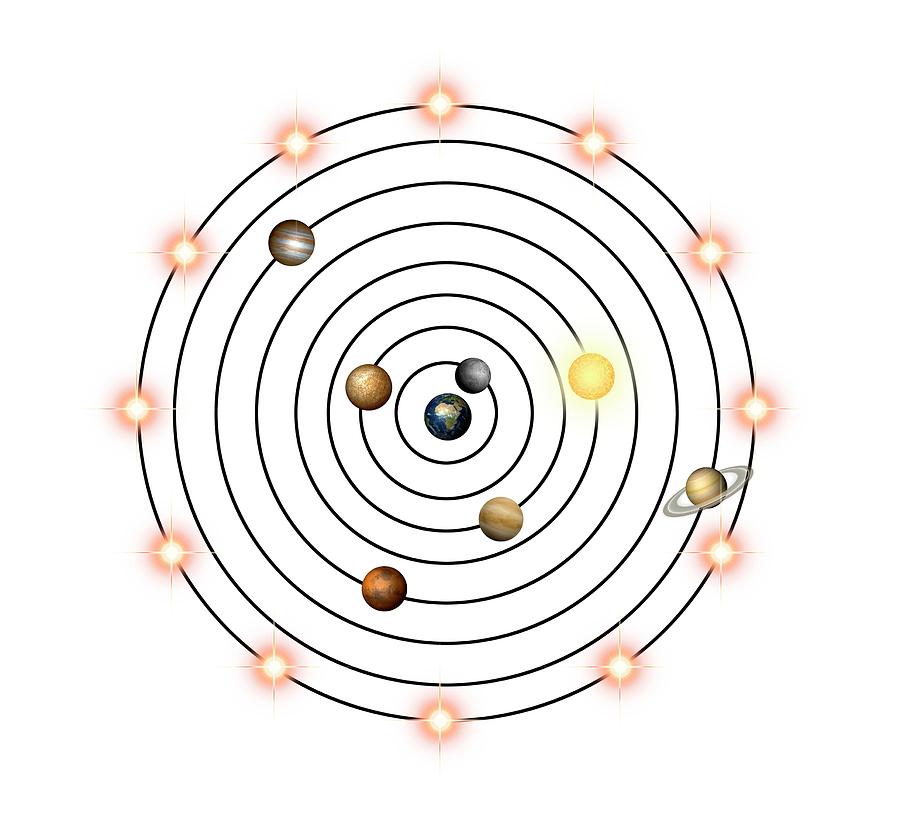
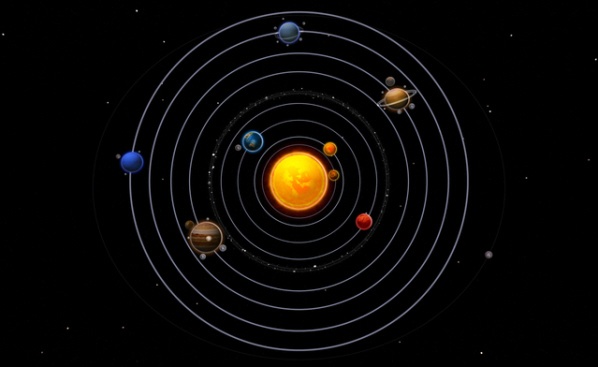
What does the GEOcentric system look like?
a)
b)
c)
d)
22.

What does the HELIOcentric system look like?

a)
b)
c)
d)
23.

Which gas most affects energy absorbed in the atmosphere? (gas associated with climate change)

a)

argon

b)

carbon dioxide

c)

helium

d)

nitrogen

24.
What forms due to water vapor in the atmosphere?
a)
wind
b)
clouds and rain
c)
carbon dioxide
d)
methane
25.
Plants but not animals can complete this part of the carbon cycle.
a)
fixation
b)
absorption
c)
respiration
d)
photosynthesis
26.
What is the term for the preserved remains of organisms?
a)
rocks
b)
fossils
c)
strata
d)
evolution
27.
The hydrosphere and atmosphere are mainly responsible for Earth's
a)
plate movement.
b)
volcanic activity.
c)
weather.
d)
habitats.
28.
Evaporation, condensation, precipitation, and accumulation are all part of which cycle?
a)
nitrogen cycle
b)
water cycle
c)
carbon cycle
d)
sulfur cycle
29.
All of Earth's water is known as the
a)
biosphere.
b)
hydrosphere.
c)
geosphere.
d)
atmosphere.
30.
Evolution is a scientific theory because
a)
it was proposed by Darwin, and never studied again. 
b)
it has been tested and supported by data from many different fields of study.
c)
it has never been studied by scientists.
d)
it describes why fossils are found in very old rocks.
31.
Finding fossils of the same animal in South America and Africa most likely means
a)
the animal swam (migrated) across a vast ocean to reach the other continent.
b)
the same creature evolved in two separate places at the same time.
c)
the continents were joined together long ago.
32.
The most accepted reason for tectonic plates moving is...
a)
wind pushing the continents around.
b)
convection currents in the mantle pushing on the plates.
c)
Earth's spin causing continents to rotate arouns.
d)
the Sun's gravity acting on mass of continents.
33.
Which plate boundary type pulls crust apart.
a)
convergent
b)
transform
c)
divergent
d)
subduction
34.
When a cold air mass moves into a warm air mass, it will get colder and we will have severe weather. What type of front is this?
a)
warm front
b)
cold front
c)
occluded front
d)
stationary front
35.

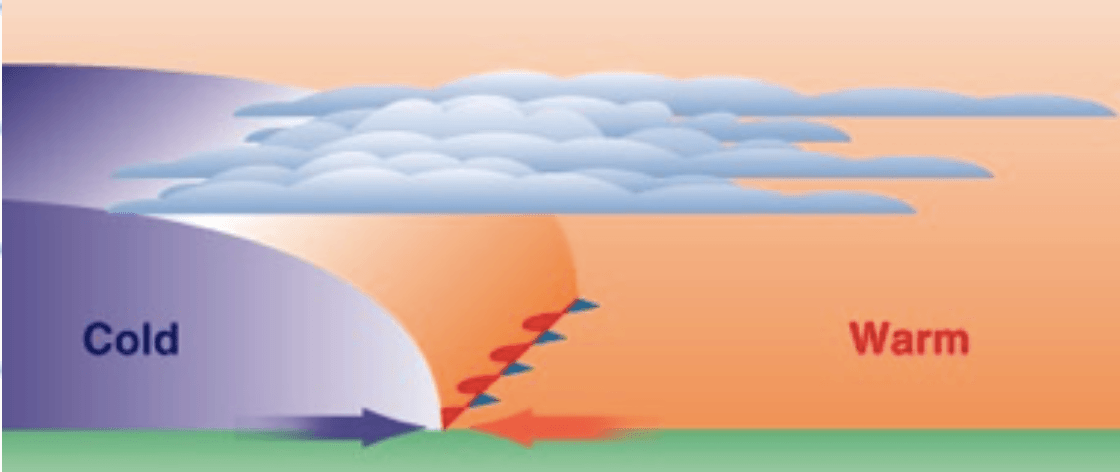
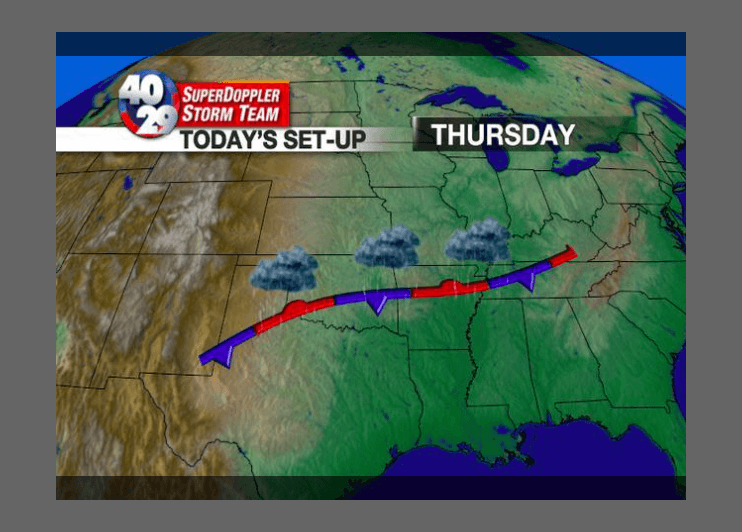
Name that front.

a)

Cold Front

b)

Warm Front

c)

Stationary Front

d)

Occluded Front

36.

Name that symbol.

a)

Cold Front

b)

Warm Front

c)

Stationary Front

d)

Occluded Front