
 Worksheets
Unit 1: Topic 1
Total questions: 20
Worksheet time: 12mins
Which of the following would NOT be included in a Statement of Profit or Loss?
Mortgage
Interest
The value of supplies used up
Service Fees
Gino, a mechanic, opened a business on 1 July 2022. The business was funded with a bank loan of $50,000, and Gino's parents also gave him $50,000 personal loan to invest in the business.
Gino also contributed $11,000 of Tools as well as $25,00 worth of Equipment.
Gino has personal shares of $5,000, a house valued at $600,000 and a personal mortgage of $400,000.
On 2 Jul, $20,000 of additional equipment was purchased for the business with cash.
According to the accounting entity assumption, the value of assets to be recorded in the books of the business would be:
$86,000
$136,000
$156,000
$56,000
The purpose of source documents is to:
Remind the accountant what happened in the business during the month
Record information in a computerized accounting system
Gather information that is generally used for end of month reporting
Provide evidence that a transaction has taken place
Which of the following transactions would have NO impact on Owner's Equity?
Furniture and Equipment contributed to the business by the Owner
Purchase of land and buildings with proceeds from a bank loan
Cash is withdrawn from the business' bank account for owner's personal expenses
Personal borrowings contributed to the business
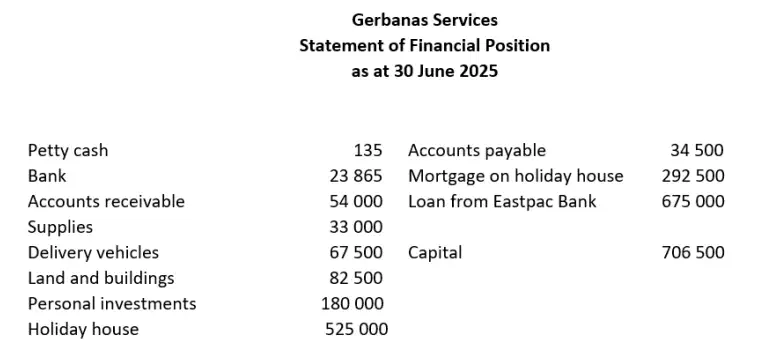
Three items which should NOT appear in the business's records are:
Petty cash, Personal investments, Family Holiday House
Family holiday house, Loan from Eastpac, Personal Investments
Personal Investments, Family holiday house, Mortgage on Holiday house
Petty cash, personal investments, mortgage on holiday house
Unlimited liability for a sole trader means:
The business is responsible for its liabilities
The owner liability for the debts of the business is restricted
The owner is fully responsible for all debts
The owner is liable for the debts up to the value of the business assets
Which of the following is considered an expense?
Payment to accounts payable
Repayment of a bank loan
Cash drawings by an owner
Payment of Interest on a bank loan
Which of the following would be revealed by a trial balance that does not balance?
The recording of an incorrect transaction amount on the debit and credit side of the correct accounts
The omission of a transaction from the general journal
The recording of a debit and credit to the correct sides of one correct account and one incorrect account
The recording of transaction amount on the credit side of two accounts affected.
Which of the following is a correct expression of the accounting equation?
Owner's Equity = Liabilities + Assets
Owner's Equity = Liabilities - Assets
Liabilities = Assets + Owner's Equity
Liabilities = Assets - Owner's Equity
The end of period financial statement based on the accounting equation is the...
Trial Balance
Statement of Cash Flows
Statement of Profit or Loss
Statement of Financial Position
The interrelationship between revenues, expenses and the accounting equation is...
because revenues increase receipts and expenses increase payments
through revenues being credit in nature and expenses being debit in nature
through net profit because net profit increases the Owner's equity an element of the accounting equation
the interrelationship of revenue and expenses is through assets and liabilites
Which of the following is true about a Chart of Accounts?
It lists only accounts which currently have balances in the ledger
It is devised when the business starts and its classifications cannot be altered
It only shows the names and balances of each account
It shows a number and a name for each account under a classification
Which of the following is true about double-entry bookkeeping?
Total value of debits should always equal total value of credits
Two entries are made in every affected account
There should be two parties involved with every transaction
For every transaction, only two accounts are effected
If total assets are equal to three time total liabilities, and owner's equity is $40,000 what is the value of total assets.
$10,000
$60,000
$80,000
$30,000
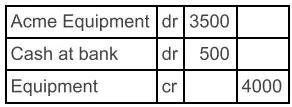
Consider the following transaction and select the correct journal entry to record it in the accounting system.
Purchased equipment on credit for $4,000 from Acme Equipment Ltd and paid a deposit of $500.
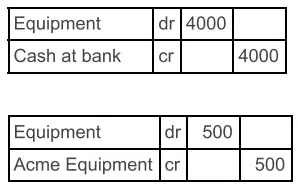
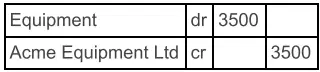
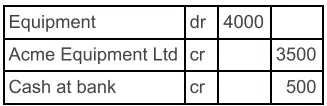
Increase to accounts are recorded on:
The debit side
the same side as the nature of the account
the credit side
the opposite side to the nature of the account
Which of the following transactions does NOT involve a revenue account?
Performed services of $10,000 on credit for P Smith
Purchased $5000 worth of furniture for cash and $3000 of supplies for cash
Received commission of $7,000 and interest of $550
Services performed $2000 for cash
The accounting process is typically
Journal, Ledger, Trial Balance
Source Document, Journal, Trial Balance
Source Document, Journal, Ledger
Journal, Trial Balance, Ledger
When the owner withdraws cash, the following entry is made:
Capital DR
Drawings CR
Capital DR
Cash at Bank CR
Drawings DR
Capital CR
Drawings DR
Cash at Bank CR
The following entry was recorded:
Advertising Dr $500
Preston Advertising Pty Ltd CR $500
Which of the following statements is correct about the entry?
Paid for advertising $500
Bought advertising on credit $500
Received $500 for advertising
Preston Advertising Pty Ltd owes the Business $500

