Wayground logo

Free Printable Worksheets

Font size

S
M
L
XL
Worksheets

Ch 6 Alg 1 Study Guide

Total questions: 61

Worksheet time: 2hrs 18mins

Name
Class
Date
1.
Anything raised to a power of zero is always: 
a)
0
b)
1
c)
itself
d)
negative
2.
According to exponent rules, when we multiply two power with the same base we _______ the exponents.
Example: c6 ⋅ c4
a)
add
b)
subtract
c)
multiply
d)
divide
3.
Simplify:    (6x2)(-3x5)
a)
18x7
b)
-18x7
c)
18x7
d)
3x7
4.
Evaluate this expression using the quotient rule.
a)
95
b)
99
c)
15
d)
9-5
5.
40
a)
0
b)
1
c)
4
d)
-4
6.
Evaluate the expression using the quotient rule.
a)
214 z13
b)
22/z7
c)
214/ z7
d)
22 z7
7.
Using the PRODUCT RULE 
complete the following:
(Write it out on paper if you need to!)
b4 ⋅ b8 = 
a)
b32
b)
4b8
c)
b12
d)
8b4
8.

Write using a single exponent: 103 x 105

a)

1015

b)

108

c)

102

d)

106

9.

Write using a single exponent: (104)5

a)

1020

b)

101

c)

109

d)

106

10.

Write using a single exponent: 3733\frac{3^7}{3^3}  

a)

3103^{10}  

b)

3213^{21}  

c)

343^4  

d)

363^6  

11.
Simplify:  x10⋅x4
a)
x40
b)
x14
c)
x6
d)
2x14
12.

4−24^{-2}  

a)

16

b)

-16

c)

8

d)

116\frac{1}{16}  

13.

135\frac{1}{3^5}  is the same as

a)

3−53^{-5}  

b)

353^5  

c)

15

d)

35\frac{3}{5}  

14.

5−27−2\frac{5^{-2}}{7^{-2}}  

a)

1049\frac{10}{49}  

b)

2549\frac{25}{49}  

c)

4925\frac{49}{25}  

d)

1014\frac{10}{14}  

15.

(45)−2\left(\frac{4}{5}\right)^{-2}  

a)

45\frac{4}{5}  

b)

(54)2\left(\frac{5}{4}\right)^2  

c)

1(45)\frac{1}{\left(\frac{4}{5}\right)}  

d)

1625\frac{16}{25}  

16.
Rewrite using a positive exponent.
7-10
a)

1/710

b)

710

c)

1/7-10

d)

-70

17.
What is the value of (-2)3?
a)
-8
b)
-6
c)
6
d)
8
18.
5-2
a)
1/25
b)
1/52
19.

Select all that represent exponential growth.

a)

y = 8xy\ =\ 8^x  

b)

y = 400(.25)xy\ =\ 400\left(.25\right)^x  

c)

y = (4)xy\ =\ \left(4\right)^x  

d)

y = 200(1+.05)xy\ =\ 200\left(1+.05\right)^x  

20.

Does the following equation represent growth or decay?

y = 3(5)x

a)

Growth

b)

Decay

21.

Does the following equation represent growth or decay?

A = 400(1+.08)5A\ =\ 400\left(1+.08\right)^5  

a)

Growth

b)

Decay

22.

Does the following equation represent growth or decay?

A = 200(1−.25)5A\ =\ 200\left(1-.25\right)^5  

a)

Growth

b)

Decay

23.

Does the following equation represent growth or decay?

A = 2(12)xA\ =\ 2\left(\frac{1}{2}\right)^x  

a)

Growth

b)

Decay

24.

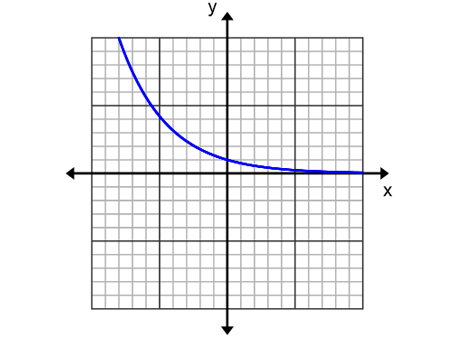
How do we know that is an example of an exponential decay?

a)

Its a line going up

b)

Its a line going down

c)

Its a smooth curve going down

d)

Its a smooth curve going up

25.

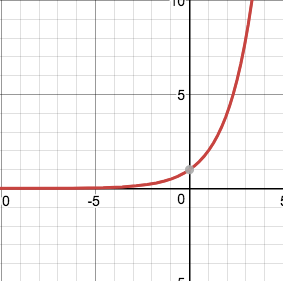
How do we know that is an example of an exponential growth?

a)

Its a line going up

b)

Its a line going down

c)

Its a smooth curve going down

d)

Its a smooth curve going up

26.
Is this exponential growth or decay?
a)
Growth
b)
Decay
27.

Which the following graphs represents an exponential growth function?

a)
b)
c)
d)
28.

What is the asymptote of y = 2x ?

a)

y = 0

b)

x = 0

29.

What is the asymptote of y = 2x - 3

a)

y = 0

b)

y = -3

c)

x = 0

d)

x = -3

30.

Identify the domain of this exponential function?

a)

All real numbers

b)

x≥0x\ge0

c)

x > 0

d)

x≤0x\le0

31.

Identify the domain and range of the function shown here.

a)

Domain: All Real Numbers
Range: y≤3y\le3

b)

Domain: x < 3


Range: All Real Numbers

c)

Domain: All Real Numbers


Range: y < 3

d)

Domain: All Real Numbers


Range: y > 3

32.

Would this be exponential growth or decay? How do you know? f(x)= 25 ( 0.20)xf\left(x\right)=\ 25\ \left(\ 0.20\right)^x  

a)

Exponential Growth because the 0.20 was less than one

b)

Exponential Decay because the 25 was bigger than 1

c)

Exponential Growth because the 25 was bigger than 1

d)

Exponential Decay because the 0.20 was less than one

33.
Solve: 7-x = 49
a)
x = 1
b)
x = -1
c)
x = 2
d)
x = -2
34.
Solve: 2x = 4x+1
a)
x = -2
b)
x = 2
c)
x = -3
d)
x = 3
35.
Solve 33 = 34x + 2
a)
x = ¼
b)
x = -¼
c)
x = ½
d)
x = -½
36.
To solve 36 = 6x, re-write 36 as what base and exponent?
a)
36
b)
63
c)
62
d)
312
37.
To solve 8 = 25x+7, you would need to re-write 8 as what base?
a)
8
b)
4
c)
2
d)
Cannot be determined
38.
2-m = 23m-3
a)
4/3
b)
3/4
c)
2
d)
1
39.
Is the sequence 2, 4, 12, 48,... geometric?
a)
yes
b)
no
40.
What is the common ratio for the sequence:
28, 14, 7, 3.5...
a)
2
b)
1/2
c)
-14
d)
-7
41.
Find the common ratio: 4, -16, 64, -256, ...
a)
r = -4
b)
r = 2
c)
r = -2
d)
r = 4
42.
Find the common ratio: 64, -16, 4, -1, ...
a)
r = -8
b)
r = -1/4
c)
r = -4
d)
r = 4
43.
Find the next three terms: 4, 12, 36, 108, ...
a)
324, 972, 2916
b)
972, 2916, 8748
c)
405, 1215, 3645
44.
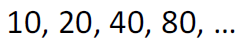
Find the common ratio for the geometric sequence.
a)
10
b)
1/2
c)
2
d)
4
45.

What are the next 3 terms in the following geometric sequence:

512, 256, 128, ___, ___, ___, ...

a)

1024, 2048, 4096

b)

32, 8, 2

c)

64, 32, 16

d)

92, 66, 38

46.
Find the common ratio for the geometric sequence.
a)
1
b)
-1
c)
7
d)
-7
47.
Is the pictured graph growth, decay, or linear or none?  
a)
Exponential Growth
b)
Exponential Decay
c)
Linear
d)
None
48.
The value of a car is $15,000 and depreciates at a rate of 8% per year. What is the decay factor?
a)
.08
b)
1.08
c)
.92
d)
8
49.
Which of the following functions shows an initial amount of $15 and an increase of 35% each year?
a)
y = 15(35)x
b)
y = 15(1.35)x
c)
y = 15(0.35)x
d)
y = 35(1.15)x
50.
Suppose a culture of bacteria begins with 5000 cells and dies by 30% each year. Write an equation that represents this situation.
a)
y=5000(0.7)x
b)
y=30(5000)x
c)
y=5000(1.3)x
d)
y=5000xx
51.
A population of 1500 deer decreases by 1.5% per year. At the end of 10 years, there will be approximately 1290 deer in the population. Which function can be used to determine the number of deer, y, in this population at the end of t years?
a)
y = 1500(1 - 0.015)t
b)
y = 1500(0.015)t
c)
y = 1500(1 + 0.015)t
d)
y = 1500(1.5)t
52.
Solve for x:
52x = 5-x
a)
0
b)
-6
c)
8
d)
1
53.
83x+3 = 86
a)
x=28
b)
x=3
c)
x=1
d)
x=12
54.
Solve: 2x = 4x+1
a)
x = -2
b)
x = 2
c)
x = -3
d)
x = 3
55.
Solve for p:
4p+2 = 64
a)
p = -16/9
b)
p = 1
c)
p = 8
d)
p = 7/6
56.
23n = 4
a)
2
b)
3
c)
2/3
d)
4
57.
2x+6=32
a)
x=-1
b)
x=11
c)
x=1
d)
x=-11
58.

What is the equation of the horizontal asymptote for following exponential function?

a)

y = -4

b)

y > -4

c)

y < -4

d)

(0, -3)

59.

What is the equation of the horizontal asymptote for following exponential function?

a)

y = 6

b)

y = 5

c)

y < 5

d)

(0, 5)

60.

The line shown on the graph is an asymptote for the exponential curve shown on the graph.

a)

TRUE

b)

FALSE

61.

The line shown on the graph is an asymptote for the exponential curve shown on the graph.

a)

TRUE

b)

FALSE