
 Worksheets
DCP 3
Total questions: 37
Worksheet time: 31mins
How many valence electrons are in an atom of each element in Group 15 in the periodic table? (Valence Electrons = Top of Periodic Table)
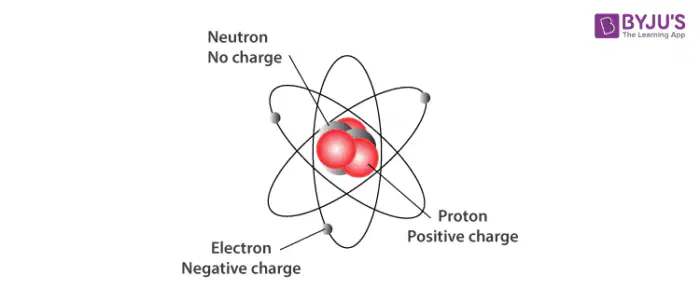
Which of these statements about the mass of subatomic particles is true?
The mass of a proton is the same as the mass of an electron.
The mass of a proton is much greater than the mass of an electron.
The mass of a neutron is much greater than the mass of a proton,
Which two elements on the periodic table are in the same period? (Period = Horizontal)
A student is studying calcium, a highly reactive element that humans need for strong bones. Which characteristic of calcium is most closely related to its chemical reactivity? (Reactivity = Valence Electrons)
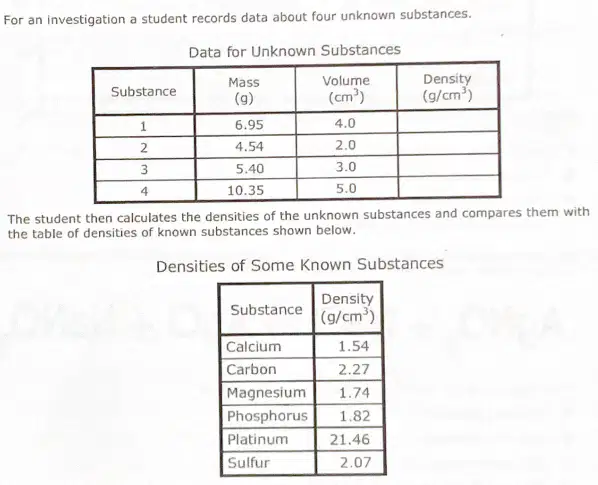
Which unknown substance is most likely sulfur?
(Density = Mass/Volume)
Which unknown substance is most likely sulfur?
(Density = Mass/Volume)
How many neutrons are in the nucleus of a potassium (K) atom with a mass number of 39? (Protons + Neutrons = Mass)
(a)
If an Arsenic (As) atom has a mass number of 75, how many neutrons are in the atom? (Protons + Neutrons = Mass)
(a)
If an Arsenic (As) atom has a mass number of 75, how many neutrons are in the atom? (Protons + Neutrons = Mass)
(a)
Which statement describes an action that most likely resulted in a chemical reaction?
A pan of water was heated on a stove, and steam formed.
A liquid was mixed with another liquid, and a precipitate formed.
A liquid was sprayed into the air, and a sweet odor was smelled.
A child blew through a wand filled with soap, and bubbles were produced.

Which group does Hydrogen belong to?
Group 1
Group 2
Group 3
Group 4
Which period is Oxygen found in?
Period 1
Period 2
Period 3
Group 16
How many atoms of oxygen are in a molecule of glucose (C6H12O6 )?
6
12
24
What is the total number of atoms in a molecule of glucose (C6H12O6 )?
6
12
24
An empty beaker has a mass of 60 grams. When mercury is added to the beaker, it has a mass of 200 grams. What is the mass of the mercury?
(Density = Mass/Volume)
A student finds a rock on the way to school. In the laboratory, he determines that the volume of the rock is 22.7 mL, and the mass is 39.943g. What is the density of the rock?
(Density = Mass/Volume)

What do elements 1 and 2 have in common?
They are both located in period 5
They are both located in group 5
They are both the same element

What do elements 1 and 3 have in common?
They are both in group 2
They are both in period 2
They are the same element

What do all of these elements have in common?
They all have similar chemical properties.
They all have 3 protons
They all have 3 energy levels
They all have 3 neutrons
An atom with 20 protons, 13 neutrons and 20 electrons would have a mass number of---
(Protons + Neutrons = Mass)
33
7
40
Sodium and lithium have similar chemical properties. What characteristic of these elements explains why they are chemically similar?
Their atoms both have one valence electron.
Their atoms both have more neutrons than protons.
Their atoms have the same number of energy levels.
Their atoms contain equal numbers of protons and electrons.
Which action represents a conversion of chemical energy into mechanical energy?
Soup beginning to boil on a stove
Pancakes reheated in a microwave oven
Sunlight melting an icicle
A grasshopper jumping from a predator
Metals tend to be (a) and nonmetals tend to be (b) .
Aluminum, sulfur, and chlorine are elements found on the periodic table. Tests involving these three elements would show that at normal room temperature (a) .
Which two organisms receive energy directly from the frog?

Which change would most likely cause a decrease in the frog population?
An increase in the bird population
An increase in the owl population
An increase in the grasshopper population
An increase in the rabbit population
Which change would most likely cause a decrease in the frog population?
An increase in the bird population
An increase in the snake population
An increase in the grasshopper population
An increase in the rabbit population
Which two organisms in the food web receive energy directly from the Titmouse?
A student used a video camera to record another student dropping a marble through water in a graduated cylinder. The students watched the video in slow motion and made the observations shown.
During which part or parts of the marble's fall did the marble experience unbalanced forces? Select TWO correct answers.

The provided table shows the properties of four different sample materials. A student has a substance with a density of 1.28 g/cm3. Which sample does the student have?
Sample 1
Sample 2
Sample 3
Sample 4

(a)

(a)

(a)

